The Korea Times : Korea at Forefront of New Mobile EraKorea at Forefront of New Mobile Era
By Kim Tae-gyu
Staff Reporter
Information-Communication Minister Chin Dae-je, right, and Samsung Electronics president Lee Ki-tae try out WiBro services, Korea’s locally developed portable Internet, in a moving car.
South Korean telecom companies look to continue their pioneer's role in applying up-to-date mobile technologies into practical use as they did with code division multiple access (CDMA). Korea has been faster than any other nations in the globe in jump-starting every commercial versions of CDMA, the offspring of U.S.-based Qualcomm.
Thanks to the nimbleness led by Korea's foremost wireless carrier SK Telecom, the world's 10th-biggest economy has found a growth phase in the mobile telephony services and cell phone productions.
With CDMA success under its belt, the country is once again at the forefront of deploying such next-generation techniques that evolved from CDMA as wideband CDMA (W-CDMA) and orthogonal frequency division multiplexing (OFDM).
The former state monopoly KT currently maintains roughly 14,000 hot spots, or WLANavailable areas, up to 40 percent of the world's total tally of 35,000.
Also SK Telecom and KT plan to start made-in-Korea Interneton- the-go services called WiBro next year, also using OFDM, for the first time in history.
Multiplexing Technologies
There are a flurry of multiplexing technologies, the minimal must in order to enable millions of wireless phone calls with relatively narrow radio spectrum bandwidth.
Because the spectrum is very limited resource, it is impossible for the government to allocate a wide range of it for wireless telephony services.
To address challenges of processing numerous calls with a narrow frequency band came multiplexing techniques of combining a number of signals.
Up until now, three major multiplexing methods have been developed . frequency division multiple access (FDMA), time division multiple access (TDMA) and CDMA.
FDMA is the oldest and still most important way of enhancing the efficiency of radio frequencies by dividing them into pieces so that many concurrent users can share them.
"It is like making lanes in expressway. By segregating traffic into a specific lane, the efficiency of frequency usage could rocket. FDMA is the most basic format used for all wireless technologies today," Dongwon Securities analyst Greg Roh said.
Based on FDMA came two more advanced versions of TDMA and CDMA. After dividing given frequency into several lanes, TDMA split it again by dividing it into different time slots.
By comparison, CDMA does not divide up the channel by time but instead encodes with data with a certain code that can be received by only a compatible receiver, or cell phone.
"Let me take an example. There are four teams who want to use a meeting room. With TDMA, each of the four teams must share the room by turns while CDMA enables them to use the room without the constraint of time by speaking different languages,"
Samsung Electronics vice president Lee Kyung-ju said. FDMA is the most fundamental technology and all of latest formats like TDMA and CDMA also hinge on it. TDMA had emerged as a mainstream in the 1990s but CDMA stole the show in the 2000s.
Next-generation solutions like W-CDMA and OFDM is evolution of CDMA of which viability was on serious suspicion just a decade ago but Korea weeded off the concerns by successfully commercializing the formula.
Deep Impact
The world tilted into global standards for communications (GSM), which is based on TDMA in the mid 1990s but Korea selected CDMA as a single national standard in 1995.
"It was a risk-ridden decision, which might have collapsed Korea's economy as a whole. But the perilous selection catapulted Korea to the world's telecom powerhouse in the end," Mertiz Securities economist Jeon Sangyong said.
Spearheaded by SK Telecom, Korea kick-started every versions of CDMA for the first time in the world even faster than the U.S., the hometown of the then-underdog technology.
SK Telecom stunned the world by commercially kicking off CDMA services in 1996 and it continued to set the trend by embarking on advanced versions of CDMA2000 1x in 2000 and EV-DO (evolution data optimized) two years later.
"SK Telecom proved CDMA is a competitive format against TDMA. In fact, the company is outright responsible for the current migration to W-CDMA and OFDM in the globe," Dongwon Securities' Roh said.
"Without the vehement investment and resolution of SK Telecom, the world might tilt toward TDMA. SK Telecom and Korea changed the main development path of mobile technologies. SK Telecom really made a dent in the global wireless scene."
Plus, SK Telecom jump-started W-CDMA service late 2003, the third-generation (3G) form of CDMA families, along with the nation's runner-up player KTF.
W-CDMA promises hithertoimpossible features including fast vide conferencing and vide call offerings at an affordable price. SK Telecom also looks to sustain its tradition as an icebreaker by upgrading W-CDMA into high-speed data packet access (HSDPA) next year.
Before commercializing HSDPA in a full-fledged manner, the outfit will give a glimpse of the services by test-running it during the Asia-Pacific Economic Cooperation Summit (APEC) slated for this November in Seoul.
In adopting OFDM, which are regarded as the mainstream format of the future, Korea is also playing a major role.
The country applied OFDM into two sectors of WLAN and WiBro, which provides folks outdoor connection to the high-speed, always-on Internet.
KT launched OFDM-based WLAN early this month, which boasts of maximum speed of 54 megabits per second (Mbps), or about 20 times faster than current fixed-line hook-up.
The services are available at universities, hotel lobbies and airport lounges, where are called as hot spots.
According to the Wireless Broadband Alliance, the organization for the 28 countries that embrace WLAN, roughly 14,000 hot spots are existing in Korea among the world's total of 35,000.
KT eyes to increase the number to 16,000 this year by introducing the Internet services at convenience stores, coffee shops and even pizza pubs.
Another OFDM-capable services on the line is WiBro, the locally developed portable Internet that will be available next year by two licensees of SK Telecom and KT.
Monday, October 03, 2005


Saturday, October 01, 2005
BBC NEWS | Science/Nature | Wild gorillas seen to use tools
BBC NEWS | Science/Nature | Wild gorillas seen to use tools Wild gorillas seen to use tools
What's fascinating is the similarity between what these creatures have done and what we do
Thomas Breuer
Gorillas have been seen for the first time using simple tools to perform tasks in the wild, researchers say.
Scientists observed gorillas in a remote Congolese forest using sticks to test the depth of muddy water and to cross swampy areas.
Wild chimps and orangutans also use tools, suggesting that the origins of tool use may predate the evolutionary split between apes and humans.
Gorillas are endangered, with some populations numbered in the hundreds.
'Valuable insights'
"We've been observing gorillas for 10 years here, and we have two cases of them using detached objects as tools," said Thomas Breuer, from the Wildlife Conservation Society (WCS), who heads the study team in Nouabalé-Ndoki National Park in the Democratic Republic of Congo.
"In the first case, we had a female crossing a pool; and this female has crossed this pool by using a detached stick and testing the water depth, and trying to use it as a walking stick," he told the BBC.
The second case saw another female gorilla pick up the trunk of a dead shrub and use it to lean on while dredging for food in a swamp.
She then placed the trunk down on the swampy ground and used it as a bridge.
"What's fascinating about these observations is the similarity between what these creatures have done, and what we do in the context of crossing a pond," observed Dr Breuer.
"The most astonishing thing is that we have observed them using tools not for obtaining food, but for postural support."
In the family
This discovery makes the gorilla the last of the great apes to be documented using tools in the wild.
Chimpanzees use stone tools to process food, and their close relatives bonobos will use the mashed ends of sticks to soak up liquids.
Orangutans - the only Asian great ape - use branches to forage for food, and leaves to modify their calls.
Though some monkeys and birds also use tools, Thomas Breuer believes that the great apes are special.
"We have now seen tool use in all the great apes in the wild," he said.
"That now makes us think that it might be the case that tool use has been an ancient trait of all great apes before the human lineage split away."
Current scientific orthodoxy holds that the separation between the chimpanzee and human lines came about six million years ago.
Research has shown that in captivity, apes can learn a range of skills including number and character recognition.
They can also learn tool use and transmit their acquired skills to other members of their social group.
The Congo team, drawn from the WCS and the Max-Planck Institute for Evolutionary Anthropology in Leipzig, Germany, believes that the tool traits they have observed in the wild may also be shared and learned across gorilla social groups.
They publish their findings in the online journal Public Library of Science Biology.
Story from BBC NEWS:
What's fascinating is the similarity between what these creatures have done and what we do
Thomas Breuer
Gorillas have been seen for the first time using simple tools to perform tasks in the wild, researchers say.
Scientists observed gorillas in a remote Congolese forest using sticks to test the depth of muddy water and to cross swampy areas.
Wild chimps and orangutans also use tools, suggesting that the origins of tool use may predate the evolutionary split between apes and humans.
Gorillas are endangered, with some populations numbered in the hundreds.
'Valuable insights'
"We've been observing gorillas for 10 years here, and we have two cases of them using detached objects as tools," said Thomas Breuer, from the Wildlife Conservation Society (WCS), who heads the study team in Nouabalé-Ndoki National Park in the Democratic Republic of Congo.
"In the first case, we had a female crossing a pool; and this female has crossed this pool by using a detached stick and testing the water depth, and trying to use it as a walking stick," he told the BBC.
The second case saw another female gorilla pick up the trunk of a dead shrub and use it to lean on while dredging for food in a swamp.
She then placed the trunk down on the swampy ground and used it as a bridge.
"What's fascinating about these observations is the similarity between what these creatures have done, and what we do in the context of crossing a pond," observed Dr Breuer.
"The most astonishing thing is that we have observed them using tools not for obtaining food, but for postural support."
In the family
This discovery makes the gorilla the last of the great apes to be documented using tools in the wild.
Chimpanzees use stone tools to process food, and their close relatives bonobos will use the mashed ends of sticks to soak up liquids.
Orangutans - the only Asian great ape - use branches to forage for food, and leaves to modify their calls.
Though some monkeys and birds also use tools, Thomas Breuer believes that the great apes are special.
"We have now seen tool use in all the great apes in the wild," he said.
"That now makes us think that it might be the case that tool use has been an ancient trait of all great apes before the human lineage split away."
Current scientific orthodoxy holds that the separation between the chimpanzee and human lines came about six million years ago.
Research has shown that in captivity, apes can learn a range of skills including number and character recognition.
They can also learn tool use and transmit their acquired skills to other members of their social group.
The Congo team, drawn from the WCS and the Max-Planck Institute for Evolutionary Anthropology in Leipzig, Germany, believes that the tool traits they have observed in the wild may also be shared and learned across gorilla social groups.
They publish their findings in the online journal Public Library of Science Biology.
Story from BBC NEWS:
Apple iBook G4 12-inch (1.33 GHz) review by PC Magazine
Apple iBook G4 12-inch (1.33 GHz) review by PC Magazine Apple iBook G4 12-inch (1.33 GHz)
REVIEW DATE: 09.29.05
BOTTOM LINE:
Plenty of upgrades, all internal—yet price is still under $1,000.
PROS:
Reduced battery life. Aging design.
CONS:
Budget price. More hard drive and memory options. Hard drive protection.
COMPANY:
Apple Computer Inc.
SPEC DATA
Price: $999.00 Direct
Type: General Purpose, Media, Value
Operating System: Mac OS X
Processor Speed: 1.33 GHz
RAM: 512 MB
Hard Drive Capacity: 40 GB
Primary Optical Drive: DVD+/-RW (Plus Minus)
Wireless: 802.11g
Screen Size: 12 inches
System Weight: 4.9 lbs
EDITOR RATING:
By Cisco Cheng
The latest Apple iBook (12-inch) may look the same on the outside, but some significant changes inside make it all the more impressive. Upgrades like a processor bump, added hard drive space, and more memory, along with several features passed down from the PowerBook—like a scroll touchpad and hard drive protection—greatly boost the Apple iBook's value, especially considering that the price remains the same low $999.
Though widescreen displays and special transflective screens are becoming the norm in consumer notebooks, Apple sticks to its guns by retaining a 1,024-by-768 antiglare display. A DVD of Titanic that we viewed looked a bit lackluster, even with the brightness turned all the way up, but working on documents in iWork '05 felt fine. We tried out the iWork '05 suite (30-day trial), using Pages and Keynote 2, which were intuitive but not as robust as Office 12. The newly added scroll touchpad is handy for scrolling through long documents and Web pages, especially since your screen real estate is only 12 inches.
* Laptops for a Bargain
The increase in processor speed—from 1.2 GHz to 1.33 GHz—is slight, as is the graphics upgrade from the ATI Radeon 9200 to the Mobility Radeon 9550, effecting imperceptible real-world improvements in everyday performance. The 512MB memory is standard (finally!) and should improve speed. We'd like to see an extended battery option in addition to the included 50-Wh battery. The battery ran down while we were watching Titanic; it lasted just 2 hours 49 minutes—somewhat less than that of the previous iBook, which lasted 3:14. Most likely, the decrease in battery life is due to newer components that consume more power.
Built-in Bluetooth 2.0 with EDR raised the iBook's mobility rating, which was also bolstered by the 4.9-pound frame and the small adapter. And thanks to OS X, which is built on a strong BSD kernel (a variant of Unix), the iBook did extremely well on our Security ratings. Music and photo ratings were also very good because of applications like iPhoto, iTunes, iMovie, and GarageBand.
A 40GB hard drive comes standard with the iBook 12-inch, but you can now upgrade to a 80GB or 100GB for $100 and $200, respectively. The iBook has a built-in SuperDrive (DVD±RW) and Airport Extreme wireless (802.11g). Also, for added hard drive security, it has a built-in motion sensor, which parks the heads of the hard drive during a sudden fall or jolt.
Though it looks the same on the outside, the Apple iBook G4 12-inch is much improved inside. The hand-me-down features from the PowerBook, such as Bluetooth EDR, advanced hard drive security, and scroll touchpad, are welcome additions. Throw in the component upgrades for the same low price of $999 and the new iBook is anything but "same old."
REVIEW DATE: 09.29.05
BOTTOM LINE:
Plenty of upgrades, all internal—yet price is still under $1,000.
PROS:
Reduced battery life. Aging design.
CONS:
Budget price. More hard drive and memory options. Hard drive protection.
COMPANY:
Apple Computer Inc.
SPEC DATA
Price: $999.00 Direct
Type: General Purpose, Media, Value
Operating System: Mac OS X
Processor Speed: 1.33 GHz
RAM: 512 MB
Hard Drive Capacity: 40 GB
Primary Optical Drive: DVD+/-RW (Plus Minus)
Wireless: 802.11g
Screen Size: 12 inches
System Weight: 4.9 lbs
EDITOR RATING:
By Cisco Cheng
The latest Apple iBook (12-inch) may look the same on the outside, but some significant changes inside make it all the more impressive. Upgrades like a processor bump, added hard drive space, and more memory, along with several features passed down from the PowerBook—like a scroll touchpad and hard drive protection—greatly boost the Apple iBook's value, especially considering that the price remains the same low $999.
Though widescreen displays and special transflective screens are becoming the norm in consumer notebooks, Apple sticks to its guns by retaining a 1,024-by-768 antiglare display. A DVD of Titanic that we viewed looked a bit lackluster, even with the brightness turned all the way up, but working on documents in iWork '05 felt fine. We tried out the iWork '05 suite (30-day trial), using Pages and Keynote 2, which were intuitive but not as robust as Office 12. The newly added scroll touchpad is handy for scrolling through long documents and Web pages, especially since your screen real estate is only 12 inches.
* Laptops for a Bargain
The increase in processor speed—from 1.2 GHz to 1.33 GHz—is slight, as is the graphics upgrade from the ATI Radeon 9200 to the Mobility Radeon 9550, effecting imperceptible real-world improvements in everyday performance. The 512MB memory is standard (finally!) and should improve speed. We'd like to see an extended battery option in addition to the included 50-Wh battery. The battery ran down while we were watching Titanic; it lasted just 2 hours 49 minutes—somewhat less than that of the previous iBook, which lasted 3:14. Most likely, the decrease in battery life is due to newer components that consume more power.
Built-in Bluetooth 2.0 with EDR raised the iBook's mobility rating, which was also bolstered by the 4.9-pound frame and the small adapter. And thanks to OS X, which is built on a strong BSD kernel (a variant of Unix), the iBook did extremely well on our Security ratings. Music and photo ratings were also very good because of applications like iPhoto, iTunes, iMovie, and GarageBand.
A 40GB hard drive comes standard with the iBook 12-inch, but you can now upgrade to a 80GB or 100GB for $100 and $200, respectively. The iBook has a built-in SuperDrive (DVD±RW) and Airport Extreme wireless (802.11g). Also, for added hard drive security, it has a built-in motion sensor, which parks the heads of the hard drive during a sudden fall or jolt.
Though it looks the same on the outside, the Apple iBook G4 12-inch is much improved inside. The hand-me-down features from the PowerBook, such as Bluetooth EDR, advanced hard drive security, and scroll touchpad, are welcome additions. Throw in the component upgrades for the same low price of $999 and the new iBook is anything but "same old."
Thursday, September 22, 2005
Engadget > The Palm Treo 700w (aka Treo 670) - Exclusive first look!

The Palm Treo 700w (aka Treo 670) - Exclusive first look!
Posted Sep 22, 2005, 1:00 PM ET by Peter RojasRelated entries: Cellphones, Features
Check it out: we got our hands on the new Windows Mobile-powered Treo, but it ain’t called the Treo 670 anymore (if it even ever was called that), it’s the Treo 700w (which implies—but doesn’t guarantee—the existence of a Palm-powered Treo 700p). We haven’t spent enough time with the 700w for a proper review — we’ve literally had it in our hands for only a few hours — but we couldn’t resist posting up this first look:
Horizontal screen orientation.Treo 700w vs. Treo 650. The 700w is actually a bit narrower than the 650.“Welcome to the Palm 700w smartphone…”Plug-and-play. Getting online with an SD WiFi card could not have been any easier.With the battery removed.A few confirmed specs: Windows Mobile 5.0, one megapixel camera, EV-DO, Bluetooth, 64MB of memory, still trying to conclusively determine the resolution of the display, but it looks to our eyes like it’s 240 x 240 pixels, not 320 x 320. But we’re not 100% on that, ok?
Tuesday, September 20, 2005
Lenovo Unveils Industry's Thinnest and Lightest 14-inch Widescreen
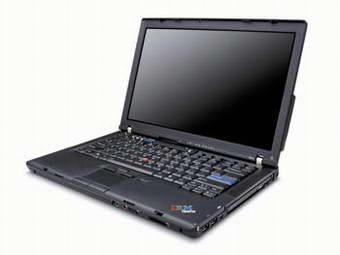
Lenovo Unveils Industry's Thinnest and Lightest 14-inch Widescreen
Lenovo today announced the ThinkPad Z-Series, the first widescreen multimedia ThinkPad notebooks with integrated Verizon Wireless Broadband Access (WWAN). ThinkPad Z Series is designed for mobile and small business users who rely on one notebook computer for both work and life demands.
In addition to the classic black ThinkPad design, the new Z Series is available in a special-edition, brushed titanium cover. Titanium offers a sleek new look, durability, and scratch resistance for one of the world’s most well-known notebook brands.
The ThinkPad Z60m’s 15.4-inch display offers 30 percent more data space than a 15-inch XGA and better viewing angles for notebook use on an airline flight. At 1.1-inches thick and just 4.2 pounds, the 14-inch ThinkPad Z60t is the thinnest and lightest widescreen notebook in its class. The Z60t boasts 25 percent more data space than a standard 14-inch XGA screen — the equivalent of four additional spreadsheet columns — offering a productive solution to business users who often work with multiple applications simultaneously.
The 14-inch ThinkPad Z will be available in October. Prices for the ThinkPad Z60t start at $1099. Prices for the ThinkPad Z60m start at $799.
The Z60m and Z60t are the first standard notebooks ever to integrate a high-speed, Evolution Data Optimized (EV-DO) wireless wide area network (WWAN) antenna for Verizon Wireless Broadband Access. The built-in WWAN antenna helps avoid many of the pitfalls associated with PC cards, including hardware incompatibility and fragile, easily damaged antennas protruding from the computer. Verizon Wireless’ network features one of the fastest connection rates in the U.S. with average speeds between 400-700 kilobytes per second. It also provides another layer of data security and protection, as it isn't susceptible to the same vulnerabilities as a shared hot spot connection, such as data theft.
Several innovative multimedia features — including hot keys to control application functions and ports to easily upload digital images and video — make the Z Series optimal for business or home use, including presentations, multimedia and DVD movies.
"One of the trends we're seeing in small businesses is that the line between work and home is blurring," said Chuck Sharp, vice president, Information Technology Solution Providers Alliance (ITSPA). "It's not efficient to spend money on separate pieces of technology for all aspects of your life. Time is at such a premium, that small businesses are looking for technology that not only improves their productivity at work, but also allows them to maximize their personal time — at home and when traveling."
For business travelers, the Z Series features a new inner armor chassis — a ThinkPad "Roll Cage" — that reduces the amount of stress on internal components when the notebook is dropped by up to 30 percent. The internal components, including the hard disk drive, are mounted in a one-piece magnesium cage that forms a more protective shell than traditional casings without affecting usability. Combined with Lenovo’s Active Protection System, a ThinkVantage Technology, the ThinkPad "Roll Cage" provides a strong solution to defend against costly hard disk damage. The Roll Cage will be deployed in the Z-Series and future ThinkPad models.
The widescreen TFT display is encased in an optional special edition titanium cover that is both durable and scratch-resistant. New Windows, multimedia and application keys enhance the legendary full-size ThinkPad keyboard. Lenovo strategically placed the large stereo speakers on either side of the keyboard for superior sound quality and volume. Adding to the multimedia capabilities are an array of ports for nearly every peripheral, including three USB 2.0 ports, as well as connections for S-Video, VGA and IEEE1394. The Z60m also boasts a 3-1 media card reader.
New ThinkVantage Technologies by Lenovo provide more powerful features in a centralized dashboard, making PC security quick and simple. The new ThinkVantage Productivity Center helps improve worker productivity by guiding them toward self-help and appropriate ThinkVantage Technologies. For example, one new feature is "Away Manager," which helps people run system-maintenance tasks when they know they will be away from their computer. These could include pre-loaded and pre-tested tasks such as Symantec Client Security, Windows Defrag, Windows Disk Cleanup, and Lenovo's own Rescue and Recovery backup utility. Productivity Center and Away Manager also help company IT departments customize the tools, enabling them to add their own regularly scheduled tasks, such as other anti-virus or anti-spyware utilities, as well as custom Web links, applications, and help files. In addition, Away Manager's "whisper-mode" enables anti-virus and disk cleanup tools to run more easily in the background, occupying a smaller percentage of system resources, with less impact to the user's valuable work time.
The Z Series come equipped with the latest version of the ThinkVantage Client Security Solution, which enables users to recover logon passwords themselves. For added security, the Z-Series also is available with Lenovo’s integrated fingerprint reader, a convenient and secure biometric solution for password management. It also features easy and powerful disk encryption, updated password manager software, and a System Security Audit to ensure users are properly securing their system.
Mobile users will appreciate the newest version of Access Connections. Capitalizing on the new WWAN capability, the newest version of Access Connections allows for users to change environments while the ThinkPad automatically adjusts by turning on and off the right connections.
Sunday, September 18, 2005
Cable broadband prices go up; DSL goes down - Tech News & Reviews - MSNBC.com
Cable broadband prices go up; DSL goes down - Tech News & Reviews - MSNBC.comCable broadband prices go up; DSL goes down
Price gap widens, with cable-modem service now 76 percent higher
The Associated Press
Updated: 6:22 p.m. ET Sept. 16, 2005
NEW YORK - The price gap between cable broadband service and phone carriers' digital subscriber lines widened to an all-time high in August, according to a survey by SG Cowen.
Cable-modem service was, on average, 75.8 percent more expensive than DSL during the month, up from a 53.3 percent gap in July. While phone carriers cut prices — the average DSL price decreased by 9.2 percent — cable companies raised them.
Leading the price decline was Verizon Communications which rolled out a slower service that cost just $14.95 a month, with a free month of service with a one-year commitment.
By contrast, cable broadband service got 4.1 percent more expensive, on average. Comcast Corp. raised prices an average of 7.9 percent, while Time Warner Cable raised by 5.8 percent, according to the survey.
Aggressive price cuts have helped phone carriers make headway in the broadband market and challenge cable companies, analyst Lowell Singer said in a note.
During the first and second quarters of 2005, cable companies captured 47.8 percent and 46.3 percent of net new broadband subscribers, respectively, down from 50.3 percent in 2004 and 60.8 percent in 2003. SG Cowen estimates that cable companies will capture about 47.3 percent of net new broadband subscribers in 2005.
Cable companies "must continually reassess whether to accept share losses or to fight back by reducing high speed data pricing and accepting lower margins," Singer wrote.
Singer or one of the other authors of the report own shares of Cablevision; SG Cowen or one of its affiliates has managed or co-managed a public offering of Cablevision and Comcast securities in the last three years.
Price gap widens, with cable-modem service now 76 percent higher
The Associated Press
Updated: 6:22 p.m. ET Sept. 16, 2005
NEW YORK - The price gap between cable broadband service and phone carriers' digital subscriber lines widened to an all-time high in August, according to a survey by SG Cowen.
Cable-modem service was, on average, 75.8 percent more expensive than DSL during the month, up from a 53.3 percent gap in July. While phone carriers cut prices — the average DSL price decreased by 9.2 percent — cable companies raised them.
Leading the price decline was Verizon Communications which rolled out a slower service that cost just $14.95 a month, with a free month of service with a one-year commitment.
By contrast, cable broadband service got 4.1 percent more expensive, on average. Comcast Corp. raised prices an average of 7.9 percent, while Time Warner Cable raised by 5.8 percent, according to the survey.
Aggressive price cuts have helped phone carriers make headway in the broadband market and challenge cable companies, analyst Lowell Singer said in a note.
During the first and second quarters of 2005, cable companies captured 47.8 percent and 46.3 percent of net new broadband subscribers, respectively, down from 50.3 percent in 2004 and 60.8 percent in 2003. SG Cowen estimates that cable companies will capture about 47.3 percent of net new broadband subscribers in 2005.
Cable companies "must continually reassess whether to accept share losses or to fight back by reducing high speed data pricing and accepting lower margins," Singer wrote.
Singer or one of the other authors of the report own shares of Cablevision; SG Cowen or one of its affiliates has managed or co-managed a public offering of Cablevision and Comcast securities in the last three years.
Saturday, September 17, 2005
Pocket PC Dubai - i-Mate JASJAR First Impressions

Pocket PC Dubai - i-Mate JASJAR First Impressions
i-Mate JASJAR First Impressions
By: Docc
September 12, 2005
Since its first appearance a few months, the JASJAR (HTC Universal) has been on the top of the list for every single gadget-geek (like me) on the face of the planet. Our daily prayers suddenly included something new, a wish for a JASJAR. Even God must be pretty uneasy ever since this device was announced Big Grin
A lot of expectations have been placed on the JASJAR, and they should be as it is a device capable of doing almost anything except giving you a backrub Wink I will be posting a full review later on in the coming weeks, but would like to give you guys a rough idea about what this BEAST is all about and what it is capable of. So lets begin…
1) Specifications: Top of the line specifications. HTC has taken great care to give the device the very best but at the same time leave’s some facets to be desired. It has most of the high-end specifications such as a VGA screen and a 520MHz processor but still leaves out practical requirements such as Quad-Band and EDGE. This will hit the users in the USA the most as both these requirements are pretty much on the top of the list for them. Barring these 2 requirements, this device is top-notch.
2) Ergonomics: A largely shared opinion is the fact that the device is too big and heavy. For those users who have been using the HTC Blue Angel (PDA2k), this will not be a shocker. The JASJAR is relatively heavier (by 70g) but not that much bigger. It is broader than the BA, but by a very small margin. It fits well in the hand, but best useable with both hands. Those who prefer single-handed functionality; this device is not for you. But I would like to advice these users also to try this device out as it really gets you hooked onto it.
3) Feel: The feel of the device is absolutely great. It is really sturdy and doesn’t creak anywhere. The only part of the device that could have been better was the back cover which is a little thin, but it has a minute tiled pattern on it to provide a good grip on the device. Feels very strong overall.
4) Functionality: I am very comfortable using the device. Most of the time I use it in notebook style rather than PDA style. If a call comes in, I just flip it open, see who’s calling, close the flip and press the green button on the side to answer the call. All this takes less than 5 seconds. The extra hardware buttons including the power button are well placed but they could have had a better tactile feel to it.
5) Bluetooth: It got along with my GPS and my Notebook like they were childhood buddies. I can Active sync without a problem and can keep the flip closed while doing so to prevent battery from being used up. In fact, most of the time, my device is closed but connected to Active sync through BT. Range is also very good on the device. I will write in a little more detail about BT and its compatibility with headsets and Caller ID later on when I do a full review.
6) Voice Speed Dial: Just plain superb. All you have to do is record voice tags for your contacts and you are good to go. Just press on the VSD button and it is in listening mode. You can also use VSD to start any application after recording a voice tag for it. It is surprisingly accurate. HTC has done a good job with this.
7) Keyboard: This is without doubt my favourite part of the device. Very responsive, good tactile feel, well spaced. Unless you have hands the size of a Yeti, you are going to enjoy using the keyboard. Once you get used to it, you can type surprisingly fast. I hardly use the stylus anymore, in fact I depend entirely on the keyboard for 99% of the functions. Where, I need to use the stylus, I just use my index finger (does the job).
8) Screen: I for one was stunned when I saw the screen. I have never used a VGA screen before, but I now realise what I have been missing out on. I just don’t know why this hasn’t become an industry standard (it will soon). The colours, the fonts, the display are just stunning. Backlight can be switched on and off using a dedicated backlight button on the front of the device.
9) Speakers: Although they are announced as proudly as the coronation of the Pope, the stereo speakers don’t give you the 5.1 surround feel because they are spaced by just 7-8cms. However, when in speakerphone mode, it is uncomfortably loud if you are in a quiet surrounding. If you are in a noisy surrounding, its still audible, although I am sure the person at the other end of the call would probably be swearing at you Big Grin
10) Camera: Finally a camera to make you throw away your 6MP camera. Oh get serious, that’s not going to happen anytime soon!!! On a more serious note, the camera is very good in comparison to its predecessors. Its takes good quality images at 1MP and 2MP (interpolated). There are various settings that can be used such as Auto, Night, Sepia etc. I must mention here about the Night mode which really improves the picture quality. Since this device supports Flash (which is very powerful), taking close-up pictures in the night is rather easy.
Things I don’t like about the device right now:
1) Boot time: Takes longer than its predecessors, roughly about 40 seconds
2) Too bulky when placed in case, have to carry in hand. You can place it in the jacket pocket on the side but it might make you look like a man with one bre*** Big Grin
3) IR port creaks even if a little pressure is used on it. Most of the time, when you open the flip from the front, you end up pressing on the IR port. I suppose it might cause a little trouble in the long run, will have to wait and see.
4) Cannot use Fn + Numerical keys for shortcut function like with notebooks.
5) Battery cover is a tad on the flimsy side, but it’s not a big issue.
These are just petty things, which absolutely should not make any difference when deciding to purchase this device.
DT decides it wants to hold onto T-Mobile USA. Again. - Engadget - www.engadget.com
DT decides it wants to hold onto T-Mobile USA. Again. - Engadget - www.engadget.comDT decides it wants to hold onto T-Mobile USA. Again.
Posted Sep 16, 2005, 11:42 PM ET by Peter Rojas
Related entries: Cellphones
T-Mobile MDA IV
Deutsche Telecom says no deal, and apparently this time they mean it: despite the recent resurgence of rumors about a possible sale, they’ve decided to hold on to T-Mobile USA, at least for the time being. We already went through all this once before — back in July the company went to great lengths to squash any and all speculation that they might be putting the 4th largest wireless carrier on the block — but then DT CEO Kai-Uwe Ricke blew it when he went out of his way to state that as far as T-Mobile USA was concerned he was “keeping all options open.” Well, it looks like DT is taking at least one option off the table now, with Ricke saying the other day that there is “no reason for a sale” and that going forward they’re going to focus on building out T-Mob USA’s 3G network.
Posted Sep 16, 2005, 11:42 PM ET by Peter Rojas
Related entries: Cellphones
T-Mobile MDA IV
Deutsche Telecom says no deal, and apparently this time they mean it: despite the recent resurgence of rumors about a possible sale, they’ve decided to hold on to T-Mobile USA, at least for the time being. We already went through all this once before — back in July the company went to great lengths to squash any and all speculation that they might be putting the 4th largest wireless carrier on the block — but then DT CEO Kai-Uwe Ricke blew it when he went out of his way to state that as far as T-Mobile USA was concerned he was “keeping all options open.” Well, it looks like DT is taking at least one option off the table now, with Ricke saying the other day that there is “no reason for a sale” and that going forward they’re going to focus on building out T-Mob USA’s 3G network.
msmobiles.com - More information about Sprint PCS Vision Smart Device (PPC-6700) available
msmobiles.com - More information about Sprint PCS Vision Smart Device (PPC-6700) availableMore information about Sprint PCS Vision Smart Device (PPC-6700) available
September 17, 2005 [Pocket PC phone]
While in EU (and globally) the first Windows Mobile 5.0 phone was T-Mobile MDA Pro - in Germany, the first Windows Mobile 5.0 in USA is PPC-6700 Pocket PC phone:
303
Information from Sprint follows.
* * * * *
Sprint Launches First Pocket PC Phone in the Country to Feature Windows Mobile 5.0 Platform
Sprint PCS Vision Smart Device (PPC-6700) Features a Sleek, New Design and Represents the First Smart Device from Sprint with EV-DO and Wi-Fi Data Capabilities
Sprint announced the launch of the Sprint PCS Vision Smart Device (PPC-6700), the first PDA/phone-combination handset in the country to offer the new Microsoft Windows Mobile 5.0 software, featuring updated Microsoft Office applications including Outlook Mobile and the new PowerPoint Mobile. Marketed by UT Starcom Personal Communications and operating on the Nationwide Sprint PCS Network, this CDMA device is a light and manageable productivity powerhouse combining a wireless phone, Evolution Data Optimized (EV-DO) and Wi-Fi data functionality, Bluetooth Wireless Technology, email, Web access, a full QWERTY keyboard, and a 1.3-megapixel camera with video capabilities. The PPC-6700 will be available through Sprint business sales channels next week for a suggested retail price of $629.99 before discounts and promotions. The device will be offered nationwide in Sprint Stores and online at www.sprint.com later this year.
"Sprint continues to provide mobile professionals a portfolio of wireless devices and broadband choices unsurpassed in the industry," said Vicki Warker, vice president of marketing and product for Sprint. "With Wi-Fi, 3G and EV-DO high-speed wireless data, our customers now have more choices for staying productive while on the go. The PPC-6700 allows customers to capture the power of any of those services without taking up too much space in a briefcase or pocket."
The PPC-6700 reproduces the Windows-based PC experience and utilizes a new suite of Microsoft Office software, including the addition of PowerPoint Mobile for viewing presentations on the go and Excel Mobile with enhanced attachment-viewing capabilities. Managing documents, email, appointments, contacts and tasks is easier than ever with a 416 MHz Intel PXA270 processor and a sliding QWERTY keyboard that opens from the side and automatically changes orientation from portrait to landscape viewing mode.
"We believe the PPC-6700 really is the next-generation mobile device," said Philip Christopher, president of UT Starcom Personal Communications. "Built with business applications in mind, the sliding keyboard and advanced data capabilities are just two of the many features, which when paired with Sprint's advanced wireless service, are designed to enable professionals to virtually carry office capabilities in their pocket." Multiple data capabilities give customers more choices for quick and convenient methods to send or receive email, attachments and text messages; view documents; browse the Web; listen to news, music and other audio clips; and access corporate applications while on the go. The handset supports broadband-like speeds where Sprint's wireless high-speed data (EV-DO) is available and is backwards compatible to provide 1XRTT throughput speeds in areas where EV-DO service is not yet available. Sprint currently provides wireless high-speed data service in more than 75 markets nationwide, covering more than 100 airports in the country. Embedded Wi-Fi for data will also allow users to connect in thousands of Sprint-compatible domestic and international Wi-Fi ZONES and other public, enterprise and residential Wi-Fi locations. Various billing methods apply in non-Sprint venues.
With embedded Bluetooth Wireless Technology, the PPC-6700 automatically connects with Bluetooth headsets and car kits (sold separately). Dial-up networking capabilities for use with Bluetooth-enabled laptops and desktop computers will be enabled with a future software release. Capturing, sharing and viewing pictures and video is easy with the embedded 1.3-megapixel camera with built-in flash and digital zoom. The device also includes a built-in mini USB port and mini SD expansion card to add memory; transfer music, photos and video from the desktop; or load additional games and applications.
"With the power and flexibility of the new Windows Mobile 5.0 software platform and the speed of the Nationwide Sprint PCS Network, mobile information workers will have the freedom to stay connected when and where they want," said Suzan DelBene, corporate vice president of marketing for the Mobile and Embedded Devices Division at Microsoft Corp. "The PPC-6700 is the result of Microsoft's strong relationship with Sprint, molding flexible software with innovative hardware and a dependable network to help business customers more easily access their most essential information."
The PPC-6700 also supports Microsoft Exchange ActiveSync for over-the-air synchronization of email and calendar information with Microsoft Exchange Server 2003.
Packaged applications include Action Info and AudibleListener. Users will enjoy a 30-day free trial of access to content from their favorite brands, including eBay, Amazon.com, FOX Sports, AP News, AP Stocks, Microsoft MapPoint, AccuWeather, Restaurant Row, and Zap 2 it Movies; details at www.actionengine.com/actioninfo/sprint. Also, Sprint customers can receive $100 cash back with a 12-month subscription to audio books, audio magazines, newspapers, radio programs and more with audible.com at www.audible.com/sprint6700.
Additional content is available via the Sprint PCS Software Store provided by Handango, an intelligent on-device catalog of applications and digital media, allowing users to find, download and buy software, games, ringtones, graphics and other applications simply and securely. The store can also be visited online at http://sprint.handango.com.
For complete details on the PPC-6700, visit http://www.sprint.com/business/products/phones/ppc6700_allPcsPhones.jsp.
September 17, 2005 [Pocket PC phone]
While in EU (and globally) the first Windows Mobile 5.0 phone was T-Mobile MDA Pro - in Germany, the first Windows Mobile 5.0 in USA is PPC-6700 Pocket PC phone:
303
Information from Sprint follows.
* * * * *
Sprint Launches First Pocket PC Phone in the Country to Feature Windows Mobile 5.0 Platform
Sprint PCS Vision Smart Device (PPC-6700) Features a Sleek, New Design and Represents the First Smart Device from Sprint with EV-DO and Wi-Fi Data Capabilities
Sprint announced the launch of the Sprint PCS Vision Smart Device (PPC-6700), the first PDA/phone-combination handset in the country to offer the new Microsoft Windows Mobile 5.0 software, featuring updated Microsoft Office applications including Outlook Mobile and the new PowerPoint Mobile. Marketed by UT Starcom Personal Communications and operating on the Nationwide Sprint PCS Network, this CDMA device is a light and manageable productivity powerhouse combining a wireless phone, Evolution Data Optimized (EV-DO) and Wi-Fi data functionality, Bluetooth Wireless Technology, email, Web access, a full QWERTY keyboard, and a 1.3-megapixel camera with video capabilities. The PPC-6700 will be available through Sprint business sales channels next week for a suggested retail price of $629.99 before discounts and promotions. The device will be offered nationwide in Sprint Stores and online at www.sprint.com later this year.
"Sprint continues to provide mobile professionals a portfolio of wireless devices and broadband choices unsurpassed in the industry," said Vicki Warker, vice president of marketing and product for Sprint. "With Wi-Fi, 3G and EV-DO high-speed wireless data, our customers now have more choices for staying productive while on the go. The PPC-6700 allows customers to capture the power of any of those services without taking up too much space in a briefcase or pocket."
The PPC-6700 reproduces the Windows-based PC experience and utilizes a new suite of Microsoft Office software, including the addition of PowerPoint Mobile for viewing presentations on the go and Excel Mobile with enhanced attachment-viewing capabilities. Managing documents, email, appointments, contacts and tasks is easier than ever with a 416 MHz Intel PXA270 processor and a sliding QWERTY keyboard that opens from the side and automatically changes orientation from portrait to landscape viewing mode.
"We believe the PPC-6700 really is the next-generation mobile device," said Philip Christopher, president of UT Starcom Personal Communications. "Built with business applications in mind, the sliding keyboard and advanced data capabilities are just two of the many features, which when paired with Sprint's advanced wireless service, are designed to enable professionals to virtually carry office capabilities in their pocket." Multiple data capabilities give customers more choices for quick and convenient methods to send or receive email, attachments and text messages; view documents; browse the Web; listen to news, music and other audio clips; and access corporate applications while on the go. The handset supports broadband-like speeds where Sprint's wireless high-speed data (EV-DO) is available and is backwards compatible to provide 1XRTT throughput speeds in areas where EV-DO service is not yet available. Sprint currently provides wireless high-speed data service in more than 75 markets nationwide, covering more than 100 airports in the country. Embedded Wi-Fi for data will also allow users to connect in thousands of Sprint-compatible domestic and international Wi-Fi ZONES and other public, enterprise and residential Wi-Fi locations. Various billing methods apply in non-Sprint venues.
With embedded Bluetooth Wireless Technology, the PPC-6700 automatically connects with Bluetooth headsets and car kits (sold separately). Dial-up networking capabilities for use with Bluetooth-enabled laptops and desktop computers will be enabled with a future software release. Capturing, sharing and viewing pictures and video is easy with the embedded 1.3-megapixel camera with built-in flash and digital zoom. The device also includes a built-in mini USB port and mini SD expansion card to add memory; transfer music, photos and video from the desktop; or load additional games and applications.
"With the power and flexibility of the new Windows Mobile 5.0 software platform and the speed of the Nationwide Sprint PCS Network, mobile information workers will have the freedom to stay connected when and where they want," said Suzan DelBene, corporate vice president of marketing for the Mobile and Embedded Devices Division at Microsoft Corp. "The PPC-6700 is the result of Microsoft's strong relationship with Sprint, molding flexible software with innovative hardware and a dependable network to help business customers more easily access their most essential information."
The PPC-6700 also supports Microsoft Exchange ActiveSync for over-the-air synchronization of email and calendar information with Microsoft Exchange Server 2003.
Packaged applications include Action Info and AudibleListener. Users will enjoy a 30-day free trial of access to content from their favorite brands, including eBay, Amazon.com, FOX Sports, AP News, AP Stocks, Microsoft MapPoint, AccuWeather, Restaurant Row, and Zap 2 it Movies; details at www.actionengine.com/actioninfo/sprint. Also, Sprint customers can receive $100 cash back with a 12-month subscription to audio books, audio magazines, newspapers, radio programs and more with audible.com at www.audible.com/sprint6700.
Additional content is available via the Sprint PCS Software Store provided by Handango, an intelligent on-device catalog of applications and digital media, allowing users to find, download and buy software, games, ringtones, graphics and other applications simply and securely. The store can also be visited online at http://sprint.handango.com.
For complete details on the PPC-6700, visit http://www.sprint.com/business/products/phones/ppc6700_allPcsPhones.jsp.
Tuesday, September 13, 2005
I4U News - JVC to Release New High Quality Music File Compression
I4U News - JVC to Release New High Quality Music File CompressionJVC to Release New High Quality Music File Compression
Topic: Other Stuff
JVC to Release New High Quality Music File Compression Technology News, Electronics Buy Guide and Gadget Review Japanese Nihon Keizai Shimbun reports that JVC is about to introduce a new high quality music file compression technology.
JVC's new music compression is supposed to allow downloaded music files to have CD quality. JVC Victor will offer CD tracks for download with the new compression starting October. JVC developed a player software for portable music players to use the new format.
In the article there is no word about how well the technology compresses. Strangely enough the JVC technology is supposed to be compatible with Apple's AAC and Sony's ATRAC format.
Topic: Other Stuff
JVC to Release New High Quality Music File Compression Technology News, Electronics Buy Guide and Gadget Review Japanese Nihon Keizai Shimbun reports that JVC is about to introduce a new high quality music file compression technology.
JVC's new music compression is supposed to allow downloaded music files to have CD quality. JVC Victor will offer CD tracks for download with the new compression starting October. JVC developed a player software for portable music players to use the new format.
In the article there is no word about how well the technology compresses. Strangely enough the JVC technology is supposed to be compatible with Apple's AAC and Sony's ATRAC format.
eBay to Acquire Skype @ Dave's iPAQ
eBay to Acquire Skype @ Dave's iPAQ
eBay to Acquire Skype
By David Ciccone, posted 17 hours ago
Reader Comments: 2
Ebay has agreed to acquire Luxembourg-based Skype Technologies SA, the global Internet communications company, for approximately $2.6 billion in up-front cash and eBay stock, plus potential performance-based consideration. The acquisition will strengthen eBay's global marketplace and payments platform, while opening several new lines of business and creating significant new monetization opportunities for the company. The deal also represents a major opportunity for Skype to advance its leadership in Internet voice communications and offer people worldwide new ways to communicate in a global online era. Skype, eBay and PayPal will create an unparalleled ecommerce and communications engine for buyers and sellers around the world.
"Communications is at the heart of ecommerce and community," said Meg Whitman, President and Chief Executive Officer of eBay. "By combining the two leading ecommerce franchises, eBay and PayPal, with the leader in Internet voice communications, we will create an extraordinarily powerful environment for business on the Net."
Founded in 2002 by Niklas Zennstrom and Janus Friis, Skype offers high-quality voice communications to anyone with an Internet connection anywhere in the world. The Skype software is easy to download and install, and enables free calls between Skype users online. Skype's premium services provide low-cost connectivity to traditional fixed and mobile telephones. Skype's software also offers a robust set of features, including voicemail, instant messaging, call forwarding and conference calling. Upcoming product innovations include Skype video, expressive content such as avatars, and customized toolbars for Outlook and Internet Explorer.
One of the fastest growing companies on the Internet, Skype already has 54 million members in 225 countries and territories. Skype is currently adding approximately 150,000 users a day and has created a thriving ecosystem of products, services, developers, and affiliates. Skype is considered the market leader in virtually all countries in which it does business. In North America alone, Skype has more users and serves more voice minutes than any other Internet voice communications provider.
"Our vision for Skype has always been to build the world's largest communications business and revolutionize the ease with which people can communicate through the Internet," said Niklas Zennstrom, Skype CEO and co-founder. "We can't think of any better platform to fulfill this vision to become the voice of the Internet than with eBay and PayPal."
"We're great admirers of how eBay and PayPal have simplified global ecommerce and payments," said Janus Friis, Skype co-founder and senior vice president, strategy. "Together we feel we can really change the way that people communicate, shop and do business online."
Zennstrom and Friis will remain in their current positions. Zennstrom will report to eBay CEO Whitman and join eBay's senior executive team.
eBay to Acquire Skype
By David Ciccone, posted 17 hours ago
Reader Comments: 2
Ebay has agreed to acquire Luxembourg-based Skype Technologies SA, the global Internet communications company, for approximately $2.6 billion in up-front cash and eBay stock, plus potential performance-based consideration. The acquisition will strengthen eBay's global marketplace and payments platform, while opening several new lines of business and creating significant new monetization opportunities for the company. The deal also represents a major opportunity for Skype to advance its leadership in Internet voice communications and offer people worldwide new ways to communicate in a global online era. Skype, eBay and PayPal will create an unparalleled ecommerce and communications engine for buyers and sellers around the world.
"Communications is at the heart of ecommerce and community," said Meg Whitman, President and Chief Executive Officer of eBay. "By combining the two leading ecommerce franchises, eBay and PayPal, with the leader in Internet voice communications, we will create an extraordinarily powerful environment for business on the Net."
Founded in 2002 by Niklas Zennstrom and Janus Friis, Skype offers high-quality voice communications to anyone with an Internet connection anywhere in the world. The Skype software is easy to download and install, and enables free calls between Skype users online. Skype's premium services provide low-cost connectivity to traditional fixed and mobile telephones. Skype's software also offers a robust set of features, including voicemail, instant messaging, call forwarding and conference calling. Upcoming product innovations include Skype video, expressive content such as avatars, and customized toolbars for Outlook and Internet Explorer.
One of the fastest growing companies on the Internet, Skype already has 54 million members in 225 countries and territories. Skype is currently adding approximately 150,000 users a day and has created a thriving ecosystem of products, services, developers, and affiliates. Skype is considered the market leader in virtually all countries in which it does business. In North America alone, Skype has more users and serves more voice minutes than any other Internet voice communications provider.
"Our vision for Skype has always been to build the world's largest communications business and revolutionize the ease with which people can communicate through the Internet," said Niklas Zennstrom, Skype CEO and co-founder. "We can't think of any better platform to fulfill this vision to become the voice of the Internet than with eBay and PayPal."
"We're great admirers of how eBay and PayPal have simplified global ecommerce and payments," said Janus Friis, Skype co-founder and senior vice president, strategy. "Together we feel we can really change the way that people communicate, shop and do business online."
Zennstrom and Friis will remain in their current positions. Zennstrom will report to eBay CEO Whitman and join eBay's senior executive team.
msmobiles.com - Why choose a Microsoft platform? (for mobile phones and PDAs)
msmobiles.com - Why choose a Microsoft platform? (for mobile phones and PDAs)Why choose a Microsoft platform? (for mobile phones and PDAs)
September 12, 2005 [General]
Symbian is inferior to Windows Mobile, so obviously one should select Windows Mobile phones, rather than Symbian based - that's our answer... but let's take a look what is Microsoft's answer, that is also much less controversial:
A quote from writings of Marcus Perryman follows.
* * * * *
Why choose a Microsoft platform?
Microsoft is not new to mobile computing. Windows CE has been in production since 1996 and is a custom built operating system aimed at resource constrained devices. The Windows Mobile platform is built using Windows CE components and enhancements to provide consistent user and developer experience across a wide range of hardware. Microsoft considers mobile computing strategic to the future of the IT industry and an ideal delivery platform for .NET applications and is in the game for the long term.
The latest version, Windows Mobile 5.0 brings improved usability, tighter security, updated Office integration and a vast improvement in the developers experience in conjunction with Visual Studio 2005.
Developers moving from .NET desktop development to the device can use their existing skills to build .NET code on the device using the same Visual Studio 2005 tools with new device specific form designers and hi-fidelity device emulators of both Pocket PC and Smartphone devices.
One style of device is not enough to solve every need and suite every taste. Microsoft works with over 40 Original Equipment Manufacturers (OEM’s) to provide the Windows Mobile software on different shape, style and capability devices while still maintaining the common user and developer experience. Modern mobile hardware is very capable with bright, colour VGA screens, 600Mhz + processors and up to 12GB of storage. Coupled with the full relational SQL Mobile database and tools even the most demanding enterprise application can be brought to Pocket PC and Smartphone devices through SQL 2000 or SQL 2005 merge replication or remote data access.
September 12, 2005 [General]
Symbian is inferior to Windows Mobile, so obviously one should select Windows Mobile phones, rather than Symbian based - that's our answer... but let's take a look what is Microsoft's answer, that is also much less controversial:
A quote from writings of Marcus Perryman follows.
* * * * *
Why choose a Microsoft platform?
Microsoft is not new to mobile computing. Windows CE has been in production since 1996 and is a custom built operating system aimed at resource constrained devices. The Windows Mobile platform is built using Windows CE components and enhancements to provide consistent user and developer experience across a wide range of hardware. Microsoft considers mobile computing strategic to the future of the IT industry and an ideal delivery platform for .NET applications and is in the game for the long term.
The latest version, Windows Mobile 5.0 brings improved usability, tighter security, updated Office integration and a vast improvement in the developers experience in conjunction with Visual Studio 2005.
Developers moving from .NET desktop development to the device can use their existing skills to build .NET code on the device using the same Visual Studio 2005 tools with new device specific form designers and hi-fidelity device emulators of both Pocket PC and Smartphone devices.
One style of device is not enough to solve every need and suite every taste. Microsoft works with over 40 Original Equipment Manufacturers (OEM’s) to provide the Windows Mobile software on different shape, style and capability devices while still maintaining the common user and developer experience. Modern mobile hardware is very capable with bright, colour VGA screens, 600Mhz + processors and up to 12GB of storage. Coupled with the full relational SQL Mobile database and tools even the most demanding enterprise application can be brought to Pocket PC and Smartphone devices through SQL 2000 or SQL 2005 merge replication or remote data access.
:: LAPTOP Magazine • Jabra SP500 ::

LAPTOP Magazine • Jabra SP500 ::
Jabra SP500
Price: $99.99
by William Van Winkle
09/13/05
Buy this Product
If you don't like wearing a headset while you drive, give the Jabra SP500 a home in your vehicle. This ovoid speakerphone clips onto a triple suction cup windshield mount and features a noise-canceling microphone at the end of a curved, rubber arm that swings out from above the speaker. A Multifunction button nestles against the speaker, and a Mute button and Volume knob rest on the bottom of the device. Jabra includes both AC and DC charging cables, and the unit weighs six ounces. Connecting the SP500 with your Bluetooth cell is easy: simply power up and hold down the Pairing button.
Functionally, the SP500 is very similar to the Bluetooth headsets we tested. The DSP-based sound enhancement technology used to match speaker volume against background noise easily overcame a full-blast air conditioner and moderate volume background music. User voices emerged clearly over driving noise, and the directional microphone demonstrated good clarity, albeit with somewhat tinny fidelity. Only highway driving with the windows down thwarted the speakerphone. Baking on a hot dashboard for several hours had no ill effects. Talk time lasted a mammoth 20 hours.
The bottom line is that this is the best sub-$300 add-on car speakerphone we've ever heard. Buy it, use it, and love it.
www.jabra.com
Monday, September 12, 2005
Pocket PC Thoughts - Daily News, Views, Rants and Raves
Pocket PC Thoughts - Daily News, Views, Rants and Raves
OFF-TOPIC eBay Acquires Skype
Posted by Darius Wey @ 08:45 AM
"eBay Inc. (Nasdaq: EBAY; www.ebay.com) has agreed to acquire Luxembourg-based Skype Technologies SA, the global Internet communications company, for approximately $2.6 billion in up-front cash and eBay stock, plus potential performance-based consideration. The acquisition will strengthen eBay’s global marketplace and payments platform, while opening several new lines of business and creating significant new monetization opportunities for the company. The deal also represents a major opportunity for Skype to advance its leadership in Internet voice communications and offer people worldwide new ways to communicate in a global online era. Skype, eBay and PayPal will create an unparalleled ecommerce and communications engine for buyers and sellers around the world."
2005 has proven to be a hotbed for mammoth acquisitions, and this one is no exception. Just announced today is eBay's acquisition of Skype Technologies, the company behind Skype for Pocket PC (and Windows, Mac OS X, and Linux). The press release outlines some of eBay's plans with Skype, but plans aside, history has shown that acquisitions can go either way (i.e. success or failure). Your thoughts on this one?
OFF-TOPIC eBay Acquires Skype
Posted by Darius Wey @ 08:45 AM
"eBay Inc. (Nasdaq: EBAY; www.ebay.com) has agreed to acquire Luxembourg-based Skype Technologies SA, the global Internet communications company, for approximately $2.6 billion in up-front cash and eBay stock, plus potential performance-based consideration. The acquisition will strengthen eBay’s global marketplace and payments platform, while opening several new lines of business and creating significant new monetization opportunities for the company. The deal also represents a major opportunity for Skype to advance its leadership in Internet voice communications and offer people worldwide new ways to communicate in a global online era. Skype, eBay and PayPal will create an unparalleled ecommerce and communications engine for buyers and sellers around the world."
2005 has proven to be a hotbed for mammoth acquisitions, and this one is no exception. Just announced today is eBay's acquisition of Skype Technologies, the company behind Skype for Pocket PC (and Windows, Mac OS X, and Linux). The press release outlines some of eBay's plans with Skype, but plans aside, history has shown that acquisitions can go either way (i.e. success or failure). Your thoughts on this one?
Wednesday, September 07, 2005
msmobiles.com - Expansys just started shipping the i-mate JASJAR
msmobiles.com - Expansys just started shipping the i-mate JASJARExpansys just started shipping the i-mate JASJAR
September 07, 2005 [Pocket PC phone]
The I-mate JASJAR is now shipping from Expansys - they have over 800 phones in stock. Interestingly this phone is not SIM locked, so no need to buy SIM unlock:
This phone is available handset only (SIM free) and unlocked, you can use your existing SIM from any of the UK or European GSM networks (Vodafone, T-Mobile, O2 etc.). If you require a connection with this phone, add the phone and one of the connection plans below to the shopping basket.
To learn more click here (UK version of this online shop, to get German, French or other version of this shop, just click on the proper link in top right corner).
Please note that this phone is shipping with operating system in international English, with Qwerty keyboard, and without SIM lock. So contrary to T-Mobile MDA Pro that is sold in Germany with operating system in German, Qwertz (not Qwerty) keyboard, and with SIM lock (additional SIM unlock costs 100 Euro).
Credit: Kim Nyberg.
September 07, 2005 [Pocket PC phone]
The I-mate JASJAR is now shipping from Expansys - they have over 800 phones in stock. Interestingly this phone is not SIM locked, so no need to buy SIM unlock:
This phone is available handset only (SIM free) and unlocked, you can use your existing SIM from any of the UK or European GSM networks (Vodafone, T-Mobile, O2 etc.). If you require a connection with this phone, add the phone and one of the connection plans below to the shopping basket.
To learn more click here (UK version of this online shop, to get German, French or other version of this shop, just click on the proper link in top right corner).
Please note that this phone is shipping with operating system in international English, with Qwerty keyboard, and without SIM lock. So contrary to T-Mobile MDA Pro that is sold in Germany with operating system in German, Qwertz (not Qwerty) keyboard, and with SIM lock (additional SIM unlock costs 100 Euro).
Credit: Kim Nyberg.
Monday, September 05, 2005
BBC NEWS | Business | Microsoft-Google battle heats up
BBC NEWS | Business | Microsoft-Google battle heats up Microsoft-Google battle heats up
Microsoft's chief executive vowed to "kill Google" in an expletive-laden tirade against the firm, according to US court documents filed by Google.
The claim was made in a sworn statement by Mark Lucovsky, a former Microsoft employee who quit for Google in 2004.
Microsoft chief Steve Ballmer has denied the claims, saying they are a "gross exaggeration of what actually took place".
The statement is the latest salvo in a bitter legal battle between the firms.
In his sworn statement, Mr Lucovsky - a key Windows architect - alleged that Mr Ballmer hurled a chair across the room when he informed him he was moving to Google, before launching into an abusive tirade against Google's chief executive Eric Schmidt.
However, Mr Ballmer has dismissed the claims.
"Mark's decision to leave was disappointing and I urged him strongly to change his mind. But his characterisation of that meeting is not accurate," he said in a statement.
Bitter row
The row between the two firms was triggered when one of Microsoft's vice presidents, Dr Kai-Fu Lee, was hired by Google to set up a research centre in China.
Microsoft claimed the move was a violation of a one-year non-compete clause in his contract and began legal action against the search engine giant.
However, Google has retaliated by claiming that Microsoft's action is a form of intimidation designed to eliminate the threat of a fast-growing rival.
The group has been moving further into the software arena - most recently with the launch of Talk, a service which lets e-mail account holders talk to each other via a PC, microphone and speakers.
The system is a direct threat to online voice and instant messaging service providers such as Skype, Microsoft and Yahoo.
Microsoft won the first round of the increasingly bitter battle between the two firms in July, when a King County Superior Court judge issued a temporary order barring Mr Lee from carrying out the duties he had been hired to do for Google.
The two sides will face each other in court again on Tuesday when Microsoft will ask a court to extend that order until the matter comes to trial in January.
Story from BBC NEWS
Microsoft's chief executive vowed to "kill Google" in an expletive-laden tirade against the firm, according to US court documents filed by Google.
The claim was made in a sworn statement by Mark Lucovsky, a former Microsoft employee who quit for Google in 2004.
Microsoft chief Steve Ballmer has denied the claims, saying they are a "gross exaggeration of what actually took place".
The statement is the latest salvo in a bitter legal battle between the firms.
In his sworn statement, Mr Lucovsky - a key Windows architect - alleged that Mr Ballmer hurled a chair across the room when he informed him he was moving to Google, before launching into an abusive tirade against Google's chief executive Eric Schmidt.
However, Mr Ballmer has dismissed the claims.
"Mark's decision to leave was disappointing and I urged him strongly to change his mind. But his characterisation of that meeting is not accurate," he said in a statement.
Bitter row
The row between the two firms was triggered when one of Microsoft's vice presidents, Dr Kai-Fu Lee, was hired by Google to set up a research centre in China.
Microsoft claimed the move was a violation of a one-year non-compete clause in his contract and began legal action against the search engine giant.
However, Google has retaliated by claiming that Microsoft's action is a form of intimidation designed to eliminate the threat of a fast-growing rival.
The group has been moving further into the software arena - most recently with the launch of Talk, a service which lets e-mail account holders talk to each other via a PC, microphone and speakers.
The system is a direct threat to online voice and instant messaging service providers such as Skype, Microsoft and Yahoo.
Microsoft won the first round of the increasingly bitter battle between the two firms in July, when a King County Superior Court judge issued a temporary order barring Mr Lee from carrying out the duties he had been hired to do for Google.
The two sides will face each other in court again on Tuesday when Microsoft will ask a court to extend that order until the matter comes to trial in January.
Story from BBC NEWS
Sunday, September 04, 2005
T-Mobile USA offers EDGE across 90% of GRPS network @ Dave's iPAQ
T-Mobile USA offers EDGE across 90% of GRPS network @ Dave's iPAQ
T-Mobile USA offers EDGE across 90% of GRPS network
By David Ciccone, posted Thursday, Sep. 1st, 2005
Reader Comments: 16
T-Mobile USA Inc. said it has launched EDGE services across 90 percent of its GPRS-enabled network and that the higher-speed wireless data service now is commercially available to customers with EDGE-enabled devices. The carrier was expected to launch EDGE earlier this year, but delayed the service due to a lack of compelling devices.
T-Mobile USA currently offers a pair of EDGE-enabled handsets from Motorola Inc. and Nokia Corp. A company spokesman said customers can continue to access the EDGE services for the same price as their current GRPS rate plans, but that the carrier would begin looking at possible EDGE-specific pricing plans sometime in the future.
Cingular Wireless L.L.C. currently offers EDGE services across most of its network and plans to offer higher-speed UMTS/HSDPA services in at least 15 markets by the end of the year. T-Mobile USA's parent company Deutsche Telekom AG said it was waiting on additional spectrum before announcing additional network upgrades.
DT also announced that its T-Mobile International operations signed Wi-Fi roaming agreements with Swisscom Mobile and Telecom Italia covering 1,000 hot-spot locations in Switzerland and 800 locations in Italy. The agreement is available to T-Mobile wireless customers in Austria, The Czech Republic, Germany, the Netherlands and the United Kingdom.
DT noted it was the leading transatlantic Wi-Fi provider with more than 13,000 locations in Europe and the United States, and it offers Wi-Fi at more than 35,000 locations around the world through roaming agreements.
T-Mobile USA offers EDGE across 90% of GRPS network
By David Ciccone, posted Thursday, Sep. 1st, 2005
Reader Comments: 16
T-Mobile USA Inc. said it has launched EDGE services across 90 percent of its GPRS-enabled network and that the higher-speed wireless data service now is commercially available to customers with EDGE-enabled devices. The carrier was expected to launch EDGE earlier this year, but delayed the service due to a lack of compelling devices.
T-Mobile USA currently offers a pair of EDGE-enabled handsets from Motorola Inc. and Nokia Corp. A company spokesman said customers can continue to access the EDGE services for the same price as their current GRPS rate plans, but that the carrier would begin looking at possible EDGE-specific pricing plans sometime in the future.
Cingular Wireless L.L.C. currently offers EDGE services across most of its network and plans to offer higher-speed UMTS/HSDPA services in at least 15 markets by the end of the year. T-Mobile USA's parent company Deutsche Telekom AG said it was waiting on additional spectrum before announcing additional network upgrades.
DT also announced that its T-Mobile International operations signed Wi-Fi roaming agreements with Swisscom Mobile and Telecom Italia covering 1,000 hot-spot locations in Switzerland and 800 locations in Italy. The agreement is available to T-Mobile wireless customers in Austria, The Czech Republic, Germany, the Netherlands and the United Kingdom.
DT noted it was the leading transatlantic Wi-Fi provider with more than 13,000 locations in Europe and the United States, and it offers Wi-Fi at more than 35,000 locations around the world through roaming agreements.
Mobile Services Restored in Areas Affected by Hurricane Katrina
Mobile Services Restored in Areas Affected by Hurricane KatrinaMobile Services Restored in Areas Affected by Hurricane Katrina
News : Mobile, posted 4-SEP-2005 21:24
T-Mobile USA, Inc. has restored its wireless service to a significant level Saturday in the hardest-hit areas of New Orleans. The company says its engineers successfully repaired, and are operating, several sites in the area including a high-capacity cell site now running on generator power on top of the Crowne Plaza Hotel Astor on Canal Street.
The wireless service is now accessible from many areas across downtown New Orleans, including the French Quarter, Convention Center and the Superdome, as well as Louis Armstrong New Orleans International Airport. T-Mobile is also enabling virtually all users of GSM/GPRS phones, whether or not they are T-Mobile subscribers, roaming access to the network in the area.
T-Mobile expects heavy call volumes and some call congestion in the area due to the anticipated high demand for service; and many parts of Louisiana still remain without wireless coverage. As conditions on the ground continue to be uncertain, T-Mobile engineers are working to maintain the highest level of service possible, and further enhance service levels in the area and the north Gulf Coast.
Sprint Nextel has also restored parts of its wireless services along the Gulf Coast. Sprint has assembled a command center and restoration team near Baton Rouge to effect repairs where it is safe to do so.
Sprint Nextel's Emergency Response Team has made available more than 3,000 phones to local, state and federal emergency personnel in the affected areas. Those phones have added communications capabilities that allow users to use their walkie-talkie service to keep in touch even when beyond wireless coverage or when regular phone lines are unavailable. Sprint Nextel will continue to provide communications support to assist in restoration efforts.
Sprint Nextel has approximately 350 employees in the four-state region directly impacted by Hurricane Katrina. Since the hurricane made landfall on Monday morning, the company has made contact with all employees via phone, email or text message to assess their physical safety and immediate needs.
Sprint Nextel customers also can use either their Sprint PCS or Nextel phones to text message (SMS) the word "give" to short code 24357 to make a $5 donation to the American Red Cross. The donation will be billed on the customer's wireless phone bill. Standard text-messaging rates will apply.
Boost Mobile is also adding a tool to its Pay-As-You-Go wireless service aimed at helping provide aid to the Hurricane Katrina disaster relief effort. Boost customers may donate up to $25 from their prepaid account to the American Red Cross to help provide immediate relief and emergency supplies to the estimated 400,000 people in New Orleans who have lost their homes and are in critical need of basic care and support. Boost Mobile will match its customers' contributions up to $50,000.
Meanwhile, Compusa is giving free access to e-mail, and local and long-distance phone service for Hurricane Katrina evacuees at all CompUSA stores in Little Rock (AR), Baton Rouge (LA), Oklahoma City (OK), Tulsa (OK), Dallas/Ft. Worth (TX), Austin (TX), Lubbock (TX), Houston (TX), San Antonio (TX), Corpus Christi (TX) and McAllen (TX).
Additionally, cash donations are being accepted for the American Red Cross relief effort in CompUSA stores across the USA.
Alltel wireless customers can support Hurricane Katrina relief efforts by text messaging donations to the American Red Cross. Customers can make a $5 donation by sending the text message (SMS) "give" to the number "24357" (2HELP). Text donations can be made through 31 October 2005. All donations are tax deductible and will appear on customers' monthly bills.
Verizon Wireless continues the urgent work of maintaining and restoring wireless service in the New Orleans and Gulf Coast regions in the aftermath of Hurricane Katrina.
The company has dispatched teams of network technicians who are making progress in strengthening communications in many of the affected areas.
Service in Baton Rouge, Louisiana; Pensacola, Florida; and Jackson, Mississippi has returned to normal, while service improvements continue in Mobile, Alabama, along the Mississippi Gulf Coast, including Biloxi, and in New Orleans and surrounding areas, including Mandeville, Lacombe, Hammond and Covington, where technicians have been able to move in and begin restoring the network. Service has also been restored at the Louis Armstrong New Orleans International airport where helicopters are transporting those that have been rescued from roof tops.
News : Mobile, posted 4-SEP-2005 21:24
T-Mobile USA, Inc. has restored its wireless service to a significant level Saturday in the hardest-hit areas of New Orleans. The company says its engineers successfully repaired, and are operating, several sites in the area including a high-capacity cell site now running on generator power on top of the Crowne Plaza Hotel Astor on Canal Street.
The wireless service is now accessible from many areas across downtown New Orleans, including the French Quarter, Convention Center and the Superdome, as well as Louis Armstrong New Orleans International Airport. T-Mobile is also enabling virtually all users of GSM/GPRS phones, whether or not they are T-Mobile subscribers, roaming access to the network in the area.
T-Mobile expects heavy call volumes and some call congestion in the area due to the anticipated high demand for service; and many parts of Louisiana still remain without wireless coverage. As conditions on the ground continue to be uncertain, T-Mobile engineers are working to maintain the highest level of service possible, and further enhance service levels in the area and the north Gulf Coast.
Sprint Nextel has also restored parts of its wireless services along the Gulf Coast. Sprint has assembled a command center and restoration team near Baton Rouge to effect repairs where it is safe to do so.
Sprint Nextel's Emergency Response Team has made available more than 3,000 phones to local, state and federal emergency personnel in the affected areas. Those phones have added communications capabilities that allow users to use their walkie-talkie service to keep in touch even when beyond wireless coverage or when regular phone lines are unavailable. Sprint Nextel will continue to provide communications support to assist in restoration efforts.
Sprint Nextel has approximately 350 employees in the four-state region directly impacted by Hurricane Katrina. Since the hurricane made landfall on Monday morning, the company has made contact with all employees via phone, email or text message to assess their physical safety and immediate needs.
Sprint Nextel customers also can use either their Sprint PCS or Nextel phones to text message (SMS) the word "give" to short code 24357 to make a $5 donation to the American Red Cross. The donation will be billed on the customer's wireless phone bill. Standard text-messaging rates will apply.
Boost Mobile is also adding a tool to its Pay-As-You-Go wireless service aimed at helping provide aid to the Hurricane Katrina disaster relief effort. Boost customers may donate up to $25 from their prepaid account to the American Red Cross to help provide immediate relief and emergency supplies to the estimated 400,000 people in New Orleans who have lost their homes and are in critical need of basic care and support. Boost Mobile will match its customers' contributions up to $50,000.
Meanwhile, Compusa is giving free access to e-mail, and local and long-distance phone service for Hurricane Katrina evacuees at all CompUSA stores in Little Rock (AR), Baton Rouge (LA), Oklahoma City (OK), Tulsa (OK), Dallas/Ft. Worth (TX), Austin (TX), Lubbock (TX), Houston (TX), San Antonio (TX), Corpus Christi (TX) and McAllen (TX).
Additionally, cash donations are being accepted for the American Red Cross relief effort in CompUSA stores across the USA.
Alltel wireless customers can support Hurricane Katrina relief efforts by text messaging donations to the American Red Cross. Customers can make a $5 donation by sending the text message (SMS) "give" to the number "24357" (2HELP). Text donations can be made through 31 October 2005. All donations are tax deductible and will appear on customers' monthly bills.
Verizon Wireless continues the urgent work of maintaining and restoring wireless service in the New Orleans and Gulf Coast regions in the aftermath of Hurricane Katrina.
The company has dispatched teams of network technicians who are making progress in strengthening communications in many of the affected areas.
Service in Baton Rouge, Louisiana; Pensacola, Florida; and Jackson, Mississippi has returned to normal, while service improvements continue in Mobile, Alabama, along the Mississippi Gulf Coast, including Biloxi, and in New Orleans and surrounding areas, including Mandeville, Lacombe, Hammond and Covington, where technicians have been able to move in and begin restoring the network. Service has also been restored at the Louis Armstrong New Orleans International airport where helicopters are transporting those that have been rescued from roof tops.
Subscribe to:
Posts (Atom)