Contact Me By Email

Saturday, September 03, 2022

Twitter had a new plan to fight extremism — then Elon arrived


Twitter had a new plan to fight extremism — then Elon arrived

By Casey Newton Zoe Schiffer 
The Verge

    It had been a long pandemic for Twitter’s research team. Tasked with solving some of the platform’s toughest problems around harassment, extremism, and disinformation, staffers absconded to Napa Valley in November 2021 for a company retreat. Despite a tumultuous change in leadership — Jack Dorsey had recently stepped down, appointing former chief technology officer Parag Agrawal to take his place — the group felt unified, even hopeful. After months of fighting bad actors online, employees took a moment to unwind. “We finally felt like we had a cohesive team,” one researcher says.

    But at the goodbye brunch on the last day, people’s phones started pinging with alarming news: their boss, Dantley Davis, Twitter’s vice president of design, had been fired. Nobody knew it was coming. “It was like a movie,” says one attendee, who asked to remain anonymous because they are not authorized to speak publicly about the company. “People started crying. I was just sitting there eating a croissant being like, ‘What’s up with the mood?’”

    The news foreshadowed a downward spiral for the research organization. Although the group was used to reorganizations, a shakeup in the middle of an outing meant to bond the team together felt deeply symbolic.

    The turmoil came to a head in April, when Elon Musk signed a deal to buy Twitter. Interviews with current and former employees, along with 70 pages of internal documents, suggest the chaos surrounding Musk’s acquisition pushed some teams to the breaking point, prompting numerous health researchers to quit, with some saying their colleagues were told to deprioritize projects to fight extremism in favor of focusing on bots and spam. The Musk deal might not even go through, but the effects on Twitter’s health efforts are already clear.

    The health team, once tasked with fostering civil conversations on the famously uncivil platform, went from 15 full-time staffers down to two.


    In 2019, Jack Dorsey asked a fundamental question about the platform he had helped create: “Can we actually measure the health of the conversation?”

    Onstage at a TED conference in Vancouver, the beanie-clad CEO talked earnestly about investing in automated systems to proactively detect bad behavior and “take the burden off the victim completely.”

    That summer, the company began staffing up a team of health researchers to carry out Dorsey’s mission. His talk convinced people who’d been working in academia, or for larger tech companies like Meta, to join Twitter, inspired by the prospect of working toward positive social change. 

    When the process worked as intended, health researchers helped Twitter think through potential abuses of new products. In 2020, Twitter was working on a tool called “unmention” that allows users to limit who can reply to their tweets. Researchers conducted a “red team” exercise, bringing together employees across the company to explore how the tool could be misused. Unmention could allow “powerful people [to] suppress dissent, discussion, and correction” and enable “harassers seeking contact with their targets [to] coerce targets to respond in person,” the red team wrote in an internal report. 

    But the process wasn’t always so smooth. In 2021, former Twitter product chief Kayvon Beykpour announced the company’s number one priority was launching Spaces. (“It was a full on assault to kill Clubhouse,” one employee says.) The team assigned to the project worked overtime trying to get the feature out the door and didn’t schedule a red team exercise until August 10th — three months after launch. In July, the exercise was canceled. Spaces went live without a comprehensive assessment of the key risks, and white nationalists and terrorists flooded the platform, as TheWashington Post reported. 

    When Twitter eventually held a red team exercise for Spaces in January 2022, the report concluded: “We did not prioritize identifying and mitigating against health and safety risks before launching Spaces. This Red Team occurred too late. Despite critical investments in the first year and a half of building Spaces, we have been largely reactive to the real-world harms inflicted by malicious actors in Spaces. We have over relied on the general public to identify problems. We have launched products and features without adequate exploration of potential health implications.”

    Earlier this year, Twitter walked back plans to monetize adult content after a red team found that the platform had failed to adequately address child sexual exploitation material. It was a problem researchers had been warning about for years. Employees said that Twitter executives have been aware of the problem but noted the company has not allocated the resources necessary to fix it. 


    By late 2021, Twitter’s health researchers had spent years playing whack-a-mole with bad actors on the platform and decided to deploy a more sophisticated approach to dealing with harmful content. Externally, the company was regularly criticized for allowing dangerous groups to run amok. But internally, it sometimes felt like certain groups, like conspiracy theorists, were kicked off the platform too soon— before researchers could study their dynamics.

    “The old approach was almost comically ineffective, and very reactive — a manual process of playing catch,” says a former employee, who asked to remain anonymous because they are not authorized to speak publicly about the company. “Simply defining and catching ‘bad guys’ is a losing game.”

    Instead, researchers hoped to identify people who were about to engage with harmful tweets, and nudge them toward healthier content using pop-up messages and interstitials. “The pilot will allow Twitter to identify and leverage behavioral — rather than content — signals and reach users at risk from harm with redirection to supportive content and services,” read an internal project brief, viewed by The Verge.

    Twitter researchers partnered with Moonshot, a company that specializes in studying violent extremists, and kicked off a project called Redirect, modeled after work that Google and Facebook had done to curb the spread of harmful communities. At Google, this work had resulted in a sophisticated campaign to target people searching for extremist content with ads and YouTube videos aimed at debunking extremist messaging. Twitter planned to do the same. 

    The goal was to move the company from simply reacting to bad accounts and posts to proactively guiding users toward better behavior.

    “Twitter’s efforts to stem harmful groups tends to focus on defining these groups, designating them within a policy framework, detecting their reach (though group affiliation and behaviors), and suspending or deplatforming those within the cohort,” an internal project brief reads. “This project seeks, instead, to understand and address user behaviors upstream. Instead of focusing on designating bad accounts or content, we seek to understand how users find harmful group content in accounts and then to redirect those efforts.”

    In phase one of the project, which began last year, researchers focused on three communities: racially or ethnically motivated violent extremism, anti-government or anti-authority violent extremism, and incels. In a case study about the boogaloo movement, a far-right group focused on inciting a second American Civil War, Moonshot identified 17 influencers who had high engagement within the community, using Twitter to share and spread their ideology. 

    The report outlined possible points of intervention: one when someone tried to search for a boogaloo term, and another when they were about to engage with a piece of boogaloo content. “Moonshot’s approach to core community identification could highlight users moving towards this sphere of influence, prompting an interstitial message from Twitter,” the report says. 

    The team also suggested adding a pop-up message before users could retweet extremist content. The interventions were meant to add friction to the process of finding and engaging with harmful tweets. Done right, it would blunt the impact of extremist content on Twitter, making it harder for the groups to recruit new followers. 

    Before that work could be fully implemented, however, Musk reached an agreement with Twitter’s board to buy the company. Shortly afterward, employees who’d been leading the Moonshot partnership left. And in the months since Musk signed the deal, the health research team has all but evaporated, going from 15 staffers to just two. 

    “Selling the company to Elon Musk was icing on the cake of a much longer track record of decisions by higher ups in the company showing safety wasn’t prioritized,” one employee says.

    Multiple former researchers said the turmoil associated with Musk’s bid to purchase the company was a breaking point and led them to decide to pursue other work.

    “The chaos of the deal made me realize that I didn’t want to work for a private, Musk-owned Twitter, but also that I didn’t want to work for a public, not-Musk-owned Twitter,” a former employee says. “I just no longer wanted to work for Twitter.”

    Phase two of the Redirect project — which would have helped Twitter understand which interventions worked and how users were actually interacting with them — received funding. But by the time the money came through, there were no researchers available to oversee it. Some employees who remained were allegedly told to deprioritize Redirect in favor of projects related to bots and spam, which Musk has focused on in his attempt to back out of the deal. 

    Twitter spokesperson Lauren Alexander declined to comment on the record.

    One employee captured the team’s frustration in a tweet: “Completely uninterested in what jack or any other c-suiter has to say about this takeover,” the employee wrote, screenshotting an article about how much Twitter CEO Parag Agrawal and former CEO Jack Dorsey stood to gain from the deal with Musk. “May you all fall down a very long flight of stairs.” (The employee declined to comment.) 

    According to current workers, the tweet was reported as being a threat to a coworker, and the employee was fired."


    Twitter had a new plan to fight extremism — then Elon arrived

    Why it Matters that I just saw a Google Nest Hub control an Apple HomeKit smart plug


    Why it Matters that I just saw a Google Nest Hub control an Apple HomeKit smart plug

    "The Matter standard is a lightbulb moment for the smart home

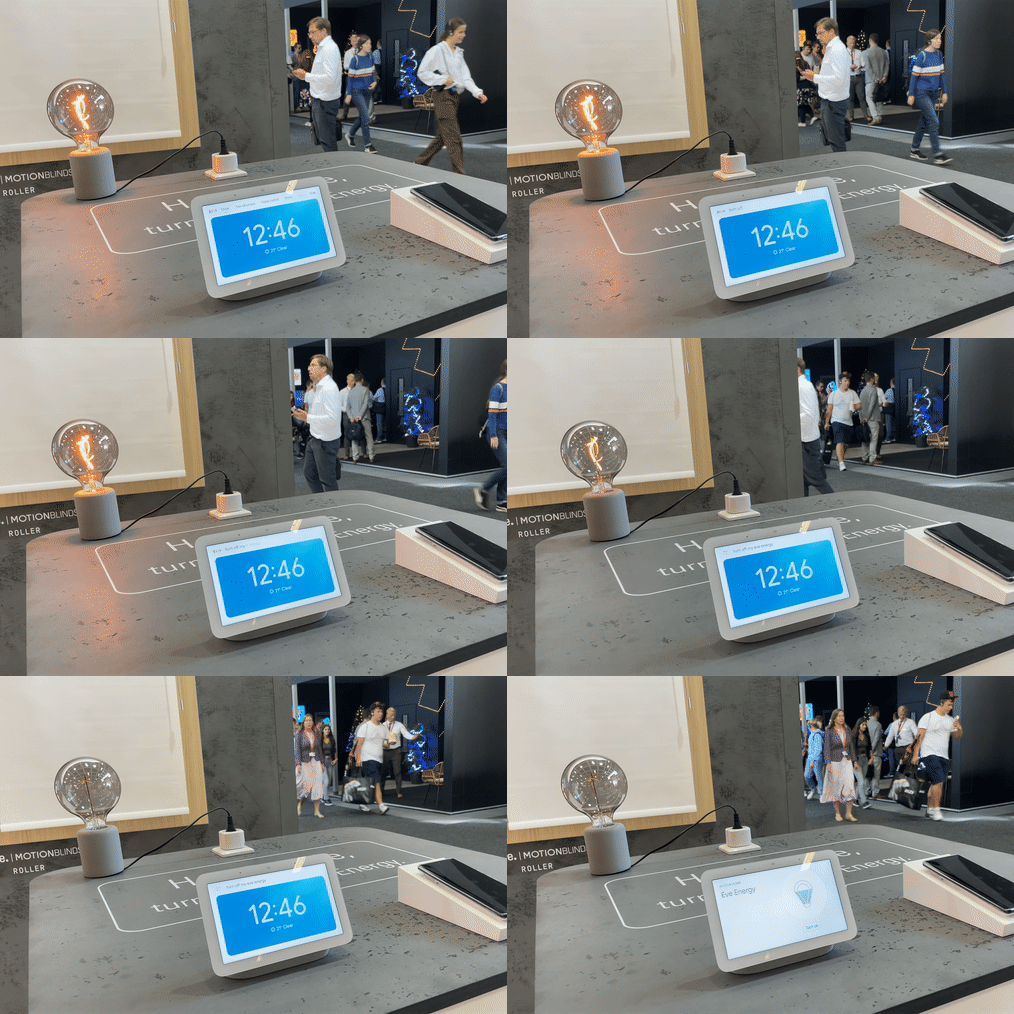
    A Google Nest Hub (2nd-gen) controlling an Eve Energy smart plug.

    Matter, the upcoming standard that’s attempting to give the smart home a single unifying language, is almost here — and I was just treated to an early demonstration of the kinds of cross-platform compatibility that it should enable in the future. The demonstration was given by Eve, which produces a range of smart plugs, radiator valves, lighting, and security devices. 

    Historically, Eve has only ever worked with Apple’s HomeKit smart home platform. This is because it didn’t want to use cloud-to-cloud platforms, preferring to keep its devices on locally-controlled platforms for privacy and security. Eve has had an iOS app but no Android app, and it didn’t support Samsung’s SmartThings, Amazon’s Alexa, or Google Home. So it was notable to see all four platforms represented as I approached Eve’s booth at the IFA trade show in Berlin. 

    The reason for the shift is Matter. It’s perhaps the most significant thing to happen to the smart home since its inception, and in theory, we’re just months away from it becoming publicly available. Eve also announced it’s launching an Android app as a counterpart to its existing iOS app, but the big deal with Matter is that you don’t technically need a device manufacturer’s app at all. You can just set up and control your Matter-enabled devices with existing apps, whether it’s Apple HomeKit, Google Home, Amazon Alexa, or Samsung SmartThings apps.

    That’s exactly what Eve was demonstrating at IFA. The Matter specification hasn’t been finalized yet, so none of the devices were running their final Matter-enabled firmware, but it was enough to see the kinds of functionality we might be able to expect when Eve’s devices get updated to support it.

    A fourth-gen Amazon Echo controlling an Eve Energy.

    The Amazon table contained a fourth-generation Echo speaker, along with a typical non-smart bulb plugged into an Eve Energy smart plug. Right now, Echo speakers can’t control Eve products, because the latter aren’t Alexa-enabled. But both products are compatible with Thread, one of the wireless protocols Matter works over and which can run locally. Eve was showing off how Matter will enable these two previously incompatible devices to speak to one another.

    Eve’s booth reps were pretty insistent that no one other than them uses voice commands to control each of their smart plugs, so I was reliant on them to issue the commands that would control Eve’s devices. “Alexa, turn off my Eve Energy,” one rep asked a fourth-generation Amazon Echo. After an (admittedly quite long) beat, a bulb plugged into an Eve Energy smart plug clicked off. 

    Matter’s design makes it simple and seamless for users across different platforms to control the same smart home products natively. The result is a more cohesive experience, where whichever voice assistant you choose to use can control all your Matter-enabled devices and where configuration changes made to a device via one ecosystem will automatically be reflected everywhere else. Each of the four demo stations was using the same model of Eve Energy smart plug, without the need for separate models for different ecosystems. Because the accessory already supports Thread, updating it to support Matter was a relatively seamless process, Eve’s PR Director Lars Felber tells me.

    A Nest Hub (2nd gen) turning off an Eve Energy via voice command.

    On the Google table, there was both a Thread-enabled second-generation Nest Huband a Google Pixel 6 Pro running the Google Home app. First, Felber told the Nest Hub, “Ok Google, turn on my lights.” The instant the Google smart display recognized the command, the Eve Energy smart plug behind it clicked on the attached light bulb. The smart display had sent a signal to the smart plug over Thread to turn it on, thanks to Matter.

    Using the Android phone running the Google Home app was less seamless in my demonstration. “Phones don’t do Thread,” Felber explained to me. As a result, the handset needed to communicate with the Nest Hub over a local Wi-Fi network for the smart display to send the command to the smart plug via Thread. Unfortunately, attempting to control the smart plug from the phone straight up didn’t work. The icon on the phone responded to my taps, but the light remained unchanged.

    It was a shame to not see Matter working flawlessly, but trade show floors are admittedly one of the worst possible places to demonstrate technology like this. Felber told me that there were around 50 overlapping Wi-Fi networks in the trade show hall we were in, and even the least congested Wi-Fi channel still had nine devices on it. The Thread protocol also uses the same 2.4Ghz frequency as Wi-Fi, resulting in more interference. The amount of noise also made issuing voice commands difficult without yelling inches away from the stand’s various smart speakers. Plus, the Matter standard currently isn’t final — so some bugginess is perhaps to be expected.

    A SmartThings Hub was hidden underneath the table.

    A third table showed off Matter’s integration with SmartThings. Confusingly, there was only a single Samsung phone (a Galaxy S22) on this table, with no Thread border router in sight. But Felber confirmed to me that the company was using an Aeotec-manufactured SmartThings Hub — that for some reason was hidden inside the table — to transmit the signal to the Eve Energy. While totally misleading, the demo worked well. Using the SmartThings app to control the smart plug felt instantaneous. 

    Finally, there was the Apple table, the least surprising of the four because it demonstrated a hardware setup that the HomeKit-exclusive Eve lineup already supports just fine — albeit now updated to use Matter rather than just Apple’s HomeKit. Alongside the smart plug and bulb on that table was an iPhone 13 and a HomePod Mini smart speaker acting as a Thread border router. Controlling the smart plug via either was very responsive. 

    The Eve Energy controlled by a HomePod Mini and and iPhone.
    Photo by Jon Porter / The Vergenone

    Although the launch of the Matter standard means Eve’s devices are about to get a lot more functional, existing owners shouldn’t need to buy new hardware to reap the benefits. Felber says Eve plans to push an OTA update to all its Thread-enabled products (which account for 14 of its 18-strong product lineup) to use Matter. The Eve Energy will be first, hopefully by the end of the year, with other devices like the Eve Door & Window, the Eve Weather, the Eve Motion, and the Eve Thermo following afterward. 

    Turning light bulbs on and off is a simple smart home party trick, and there are plenty of other examples of smart devices that work across different ecosystems. But seeing a currently Apple-exclusive accessory work (relatively) seamlessly across all these different ecosystems, with both voice and app control, has me pretty excited for what Matter might be able to achieve when it launches this fall.

    Photography by Jon Porter / The Verge"

    Why it Matters that I just saw a Google Nest Hub control an Apple HomeKit smart plug

    M2 MacBook AIR Review | The Best Laptop EXCEPT... (1 month later)

    How Big Brands Buy Reviews Without Money

    Monday, August 29, 2022

    The Latest Webb Observations Don't Disprove The Big Bang, But They Are Interesting - Universe Today

    The Latest Webb Observations Don’t Disprove The Big Bang, But They Are Interesting

    Okay, so let’s start with the obvious. ThThe big bang is not dead. Recent observations by the James Webb Space Telescope have not disproven the big bang, despite certain popular articles claiming otherwise. If that’s all you needed to hear, then have a great day. That said, the latest Webb observations do reveal some strange and unexpected things about the universe, and if you’d like to know more, keep reading.

    Let’s start with the rumors. What about the new Webb data would suggest the big bang is wrong? The same type of data Hubble gave us years ago. We generally think of evidence for the big bang being centered around two facts: first, that more distant galaxies have a higher redshift than closer ones, and second, that the universe is filled with a cosmic background of microwave radiation. The first suggests that the universe is expanding in all directions, while the second suggests that it was once in a very hot and dense state. These are two of the Three Pillars of data supporting the big bang, the third being the relative abundance of elements in the early universe. 

    But these observations are just the foundation of the big bang model. We have long since expanded on these to create the standard model of cosmology, also known as the LCDM model. That is a universe that began with the big bang and is filled with matter, dark matter, and dark energy. Everything from the acceleration of cosmic expansion to the clustering of galaxies supports this standard model. And the standard model makes predictions about other observational tests, so we can further prove its validity. That’s where the latest claims of the “big bust” come into play.

    JWST can see much deeper than Hubble. Credit: NASA, ESA, Leah Hustak (STScI)

    One of these secondary tests is known as the Tolman surface brightness test. It was first proposed in the 1930s by Richard C. Tolman and compares the apparent brightness of a galaxy with its apparent size. The ratio of brightness to size is known as surface brightness. Generally, the bigger a galaxy, the brighter it should be, so the surface brightness of every galaxy should be roughly the same. More distant galaxies would appear dimmer, but they’d also have a smaller apparent size, so the surface brightness would still be the same. The Tolman test predicts that in a static, non-expanding universe the surface brightness of all galaxies should be about the same, regardless of distance.

    This isn’t what we see. What we observe is that more distant galaxies have a dimmer surface brightness than closer ones. The amount of dimming is proportional to the amount of redshift the galaxy has. You might think this proves that all those distant galaxies are speeding away from us, but it actually doesn’t. If those distant galaxies were speeding away, you’d have two dimming effects. The red shift and the ever-increasing distance. The Tolman test predicts that in a simple expanding universe the surface brightness of galaxies should diminish proportional to both redshift and distance. We only see the effects of redshift.

    This fact has led some to propose a static universe where light spontaneously loses energy over time. It’s the so-called tired light hypothesis, and it’s very popular among big bang opponents. If the universe is static and light is tired, then the Tolman test predicts exactly what we observe. Hence no big bang.

    The CMB disproves tired light. Credit: Ned Wright 

    Back in 2014, Eric Lerner et al published a paper making exactly this point. It caused a flurry of “Big Bang Dead!” articles in the popular media. The latest claims about Webb killing the big bang began with a popular article by the same Eric Lerner. So here we are. In fairness, back in 2014, the Hubble observations supported Lerner’s claim, and so do the latest Webb observations. But what Lerner conveniently omitted from his paper is that the Hubble and Webb observations also support the LCDM model.

    It’s a common misconception that redshift proves that galaxies are speeding away from us. They aren’t. Distant galaxies aren’t speeding through space. Space itself is expanding, putting greater distance between us. It’s a subtle difference, but it means that galactic redshift is caused by cosmic expansion, not relative motion. It also means that distant galaxies appear a bit larger than they would in a static universe. They are distant and tiny, but the expansion of space gives the illusion of them being larger. As a result, the surface brightness of distant galaxies dims only proportional to redshift.

    Cosmic redshift is not caused by the Doppler effect. Credit: NASA, ESA, Leah Hustak (STScI)

    Of course, we know tired light is wrong because of the cosmic microwave background. A static, tired-light universe wouldn’t have any remnant heat from a primordial fireball. Not to mention the fact that distant galaxies would appear blurred (they don’t), and distant supernovae wouldn’t be time-dilated by cosmic expansion (they are). The only model that supports all the evidence is the big bang. Lerner’s argument is an old one that has long been disproven.

    All that said, the James Webb Space Telescope has found some unusual things. Most significantly, it has found more galaxies and more distant galaxies than there should be, and that could lead to some revolutionary changes in our standard model. Our current understanding is that after the big bang the universe went through a period known as the dark ages. During this period the first light of the cosmos had faded, and the first stars and galaxies hadn’t yet formed. Webb is so sensitive it can see some of the youngest galaxies that formed just after the dark ages. We would expect those young galaxies to be less numerous and less developed than later galaxies. But the Webb observations have found very redshifted, very young galaxies that are both common and surprisingly mature.

    It’s the kind of puzzling and unexpected data astronomers were hoping for. It’s why we wanted to build the Webb telescope in the first place. And it tells us that while the big bang model isn’t wrong, some of our assumptions about it might be.

    Reference: Lerner, Eric J., Renato Falomo, and Riccardo Scarpa. “UV Surface Brightness of Galaxies from the Local Universe to z~ 5.” International Journal of Modern Physics D 23.06 (2014): 1450058.

    Reference: Ferreira, Leonardo, et al. “Panic! At the Disks: First Rest-frame Optical Observations of Galaxy Structure at z > 3 with JWST in the SMACS 0723 Field.” arXiv preprint arXiv:2207.09428 (2022)."


    The Latest Webb Observations Don't Disprove The Big Bang, But They Are Interesting - Universe Today

    Tuesday, August 23, 2022

    No, James Webb Space Telescope Images Do Not Debunk the Big Bang

    No, James Webb Space Telescope Images Do Not Debunk the Big Bang

    “The JWST provides an intriguing look at the early universe, but it's not yet rewriting fundamental theories of the cosmos.

    James Webb Space Telescope in space (artist's rendering)

    How did the universe come to be? The prevailing theory is everything that is began with the Big Bang. In a nutshell, the theory suggests everything, everywhere, all at once suddenly burst to life. The caveat being everything and everywhere prior to the Big Bang is fairly hard to conceptualize. 

    The Big Bang theory is currently the best model we have for the birth of our universe. Astrophysicists have shown the theory explains, fairly comprehensively, phenomena we've observed in space over decades, like lingering background radiation and elemental abundances. It's a robust framework that gives us a pretty good idea of how the cosmos came into being some 13.8 billion years ago. 

    But with the flurry of preprint papers and popular science articles about the James Webb Space Telescope's first images, old, erroneous claims that the Big Bang never happened at all have been circulating on social media and in the press in recent weeks. One scientist has claimed that the JWST images are inspiring "panic among cosmologists" -- that is, the scientists who study the origins of the universe.

    This is simply not true. The JWST has not provided evidence disproving the Big Bang theory, and cosmologists aren't panicking. Why, then, are we seeing viral social media posts and funky headlines that suggest the Big Bang didn't happen at all?

    To answer that question, and show why we should be skeptical of claims like this, we need to understand where the idea came from.

    Where did "the Big Bang didn't happen" come from?

    It all started with an article at The Institute of Art and Ideas, a British philosophical organization, on Aug. 11. The piece was written by Eric Lerner, who has long argued against the Big Big theory. He even wrote a book titled The Big Bang Never Happened in 1991. 

    This provocatively headlined article at IAI is also related to an upcoming debate Lerner is participating in, run by the IAI, dubbed "Cosmology and the Big Bust." 

    Lerner's article gathered steam across social media, being shared widely on Twitter and across Facebook, over the last week. It makes sense why it's caught fire: It's a controversial idea that upends what we think we know about the cosmos. In addition, it's tied to a new piece of technology in the James Webb telescope, which is seeing parts of the universe we've never been able to see before. Including Webb as the news hook here suggests there's new data which overturns a long-standing theory.

    Don't get me wrong -- there is new and intriguing data emerging from the JWST. Just not the kind that would undo the Big Bang theory. Most of this new data trickles down to the public in the form of scientific preprints, articles that are yet to undergo peer review and land on repositories like arXiv, or popular press articles.

    Lerner's piece uses some of the early JWST studies to attempt to dismiss the Big Bang theory. What's concerning is how it misconstrues early JWST data to suggest that astronomers and cosmologists are worried the well-established theory is incorrect. There are two points early in Lerner's article which show this:

    • He points to a preprint with the word "Panic!" in its title, calling it a "candid exclamation."
    • He misuses a quote from Allison Kirkpatrick, an astronomer at the University of Kansas. 

    The first point is just a case of Lerner missing the pun. The full title of the paperis "Panic! At the Disks: First Rest-frame Optical Observations of Galaxy Structure at z>3 with JWST in the SMACS 0723 Field." The first author of that preprint, astronomer Leonardo Ferreira, is clearly riffing on popular 2000s emo band Panic! at the Disco with his title. It's a tongue-in-cheek reference, not a cosmological crisis. 

    As for the second point, Lerner takes this quote from Allison Kirkpatrick, which comes from a Nature news article published on July 27:

    "Right now I find myself lying awake at three in the morning and wondering if everything I've done is wrong."

    This cherrypicked quote isn't in direct reference to the Big Bang theory. Rather, Kirkpatrick is reckoning with the first data coming back from the JWST about the early evolution of the universe. It's true there are some puzzles for astronomers to solve here, but, so far, they aren't rewriting the beginning of the universe to do so. Kirkpatrick has stated her quotes were misused and even changed her Twitter name to "Allison the Big Bang happened Kirkpatrick."   

    "We as scientists have a responsibility to educate the public, and I take that responsibility very seriously," Kirkpatrick told CNET. "Deliberately misleading the public makes it difficult for them to trust real scientists and to know fact from fiction."

    In addition, Lerner's article claims that his ideas are being censored by the scientific establishment, and later he also points to his theory being important to develop fusion energy on Earth. It's no coincidence the same paragraph links to LPPFusion, a company run by Lerner aimed at developing clean energy technologies.

    Why does this matter?

    One of the chief reasons the Big Bang theory stands up is because of the cosmic microwave background. This was discovered in 1964. In short, the CMB is the radiation leftover from the Big Bang, right when the universe began and scientists have been able to "see" it with satellites that can detect that lingering radiation. 

    So to bolster evidence the Big Bang theory is incorrect, you'd need to explain the CMB another way. Lerner's dismissive of the CMB, and his proposal for the observation has been disproven in the past. If you're interested in further arguments against Lerner's hypotheses and why the claims don't add up, I recommend checking out Brian Keating's recent YouTube video. Keating is a cosmologist at the University of California, San Diego, and dives into a bit more detail about the limits of Lerner's arguments.

    It's also important to note Webb is not built to see and undertake new analyses of the CMB itself. The telescope can't "see" that far back in time. However, it will look at an epoch a few hundred million years after the Big Bang. What it finds there will almost certainly reshape our views on the early universe, galaxies and the evolution of the cosmos. But it's disingenuous to claim the early images and study results have contradicted the Big Bang theory.

    Kirkpatrick notes JWST's images actually do the opposite. She said they "support the Big Bang model because they show us that early galaxies were different than the galaxies we see today -- they were much smaller!"

    Science is about making incremental progress in our understanding, coming to increasingly stronger conclusions based on observations. The observations astrophysicists and cosmologists have made over decades line up with the Big Bang theory. They don't line up anywhere near as neatly if we use Lerner's alternative theory. That's doesn't mean scientists won't find evidence overturning the Big Bang theory. They just might! But, for now, it remains our best theory for explaining what we see. 

    Scientific theories can -- and should -- be challenged by well-reasoned scientists presenting highly detailed and thoughtful arguments. This is not one of those times. And that means, despite the headlines, the Big Bang did happen. 

    Updated Aug 22: Added Kirkpatrick's quotes.“