Contact Me By Email

Friday, January 06, 2006

:: LAPTOP Magazine • Sprint PCS Vision Smart Device PPC-6700 ::


:: LAPTOP Magazine • Sprint PCS Vision Smart Device PPC-6700 ::Sprint PCS Vision Smart Device PPC-6700
The EV-DO and Wi-Fi-enabled PPC-6700 is powerful and versatile enough to be the only device you take on the road.
Price: $599 ($449 with instant rebate)

by Mark Spoonauer
Date Posted: 01/05/2006

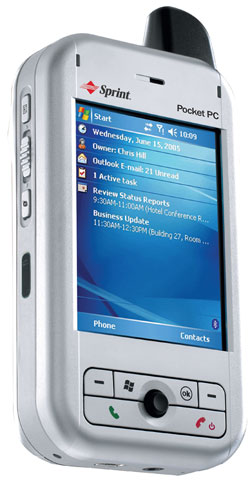
As the first truly formidable competitor to the Treo, the Sprint PCS Vision Smart Device PPC-6700 beats Palm’s device to the punch when it comes to speed, wireless connectivity, and keyboard input. This 416-MHz Pocket PC slider leverages the advantages of Microsoft’s new Windows 5.0 operating system, including soft keys for easier one-handed navigation and PowerPoint Mobile for viewing presentations. It grabs e-mail and downloads Web pages in a hurry thanks to the inclusion of both EV-DO and Wi-Fi connectivity. It’s not the lightest PDA/phone combo, but the PPC-6700 certainly makes the most of its size.

Unlike traditional smart phones, the 6.1-ounce, one-inch thick PPC-6700 takes a bold step forward by incorporating a keyboard that slides out from the left side of the device. This action automatically switches the orientation of the 240 x 320-pixel screen from portrait to landscape, but in most instances there was at least a one to two second delay. Because the keyboard layout is larger than what you’ll find on a Treo or BlackBerry, you’ll be entering everything from e-mail to changes to Word documents quickly and with few errors; no lengthy practice sessions required.

Up front, a useful joystick controls scrolling through documents and selecting items or links. The common dedicated Talk and End buttons make an appearance as well. The most welcome design touch is the pair of soft buttons that you’ll find both on the front of the device and to the left and right of the keyboard. These buttons’ functions change depending on the application and enable you to do more without having to take the stylus out of its holster within the antenna. For example, pressing the Menu button within Outlook Mobile pulls up several options, including Reply, Forward, and Save to Contacts.

The rest of the design is fairly straightforward, with a MiniSD memory card slot on top, a sliding volume control flanked by Launch keys for the voice recorder and Internet Explorer Mobile on the left, and a Launch key/Shutter button for the 1.3-megapixel camera on the right side. That camera isn’t just for show. You can easily attach pictures to outgoing e-mails or to contact entries so you can immediately identify incoming callers.

As a Web surfing and e-mail device, the PPC-6700 shines because of its compatibility with Sprint’s EV-DO network. With speeds in the 400 to 700 Kbps range, we loaded most Web pages within 10 to 15 seconds, and you’ll have no problems downloading attachments to your device using either Pocket Outlook or Sprint’s Business Connection service. Sprint has initiated its EV-DO rollout in more than 75 markets with about 30 business districts fully covered, which will increase to 56 by December. Meanwhile, Verizon Wireless has 171 markets fully covered.

Sprint beats Verizon with its monthly data plan: it’s only $15 per month for unlimited data on this device, compared to $49 per month for Verizon’s smart phones. Alas, you can’t use the PPC-6700 as a wireless modem for your notebook using its Bluetooth connection, but Sprint and Microsoft promise a software upgrade to enable dial-up networking capability in the coming weeks. If you decide to use this device as a modem, Sprint will recommend that you step up to a more expensive data plan.

If you find yourself in an area without EV-DO, you can either rely on Sprint’s slower, but tolerable 1xRTT network (50 to 70 Kbps) or turn on the PPC-6700’s Wi-Fi radio using the handy Wireless Manager utility. The connection proved even faster than EV-DO in our tests, loading most Web sites in about six seconds. However, at times we couldn’t connect at all over Wi-Fi, even though the device could see the network.

With 64MB of RAM and 128MB of what Microsoft calls persistent system memory at your disposal, PPC-6700 owners won’t have to worry about their data disappearing should their battery die. With about 4.7 hours of usage time, you can use this for a good chunk of your day before reaching for the USB charger. Adding a MiniSD card will give you more room for your MP3s, pictures, and other files, but keep in mind that at the moment you’re limited to 1GB of capacity, compared to 2GB for fuller size SD card slots.

As a phone, the PPC-6700 performed decently in our tests in Manhattan, San Francisco, and New Jersey, delivering mostly clear audio quality. If you’re in an office or conference room, we definitely recommend engaging the speakerphone, as it was at times difficult to hear the other caller unless we had the handset positioned the right way on our ear.

In addition to Microsoft’s own programs, the PPC-6700 comes with a free trial of Action Info, an application that gives you instant access to news, weather, and other info form such brands as AP News, AccuWeather, Restaurant Row, eBay, and Amazon. If you’re into listening to audio books, check out the pre-loaded AudiblePlayer. You can get $100 cash back when you sign up for a 12-month subscription (www.audible.com).

Our biggest gripe with this PDA/phone combo is its display. Yes, it looks great indoors, but we could barely make out the numbers on the Phone screen outside on a sunny day. You’ll either have to hold the PPC-6700 at the right angle to see the onscreen dialpad or slide open the keyboard and use the numeric keys.

The Treo 650 remains number one when it comes to ease of use and sheer value, but the PPC-6700 will reward you for the $50 premium with faster Web connections and the most comfortable smart phone keyboard yet. It’s easily the best Windows Mobile Pocket PC phone on the market.

View QuickSpecs for Sprint PCS Vision Smart Device PPC-6700 >>

Palm Treo 700w Gallery (MobileBurn)


Palm Treo 700w Gallery (MobileBurn)Quick Hands-On Impression of the Treo 700w

Earlier this evening I had the chance to play around with Palm's new Treo 700w, the company's first device to run the Windows Mobile OS. This new Microsoft OS running Treo had much the same physical characteristics of the Treo 650, and even the Windows Mobile OS itself had more than a few Palm-like customizations made to it. Enough so that existing Treo 650 users should feel reasonably at home with the new device.

There is no Windows "home" key on the 700w, as there is on all other Windows Mobile devices I have used. Instead, the green call button handles that function - except when a contact or phone number happens to be highlighted on the display. Another change from the standard WinMobile 5.0 is that when you hold down the OK button you are brought to the running programs list, which is a nice touch.

The keypad layout and such were good, as expected, but the material that the buttons were made out of felt quite hard. Even when compared to earlier Treo devices. None of this will be a real problem in using the device, though, and I expect that the Treo 700w is going to be one of the best selling Windows Mobile devices on the market when all is said and done.

Worlds first mobile Skype Solution - VoSKY™ Call Center @ Mobility Today

Worlds first mobile Skype Solution - VoSKY™ Call Center @ Mobility Today
Worlds first mobile Skype Solution - VoSKY™ Call Center

By agent680, posted 8 hours ago
Reader Comments: 0

Make or Receive Skype Calls from Any Phone, Wherever You Are

LAS VEGAS (2006 International CES, January 6, 2006)- Until now, making a Skype call required being near your computer. Now you can make or receive Skype calls from any mobile phone as well as any handset in the house or office with the VoSKY' Call Center from Actiontec. This small hardware accessory makes it possible to use the Skype service to call across the country or across the world for free or at online rates, wherever you are.

As the world’s first mobile Skype solution, the VoSKY Call Center enables Skype subscribers to use their cell phones to talk to their Skype buddies for free, or to non-Skype users anywhere in the world for the cost of a local call. By plugging the device into an Internet-connected PC and any stationary phone with which it is being used, users have the ability to:

• Place Skype and SkypeOut calls from any mobile or stationary phone, simply by calling the phone number to which the Call Center is connected and following the voice prompts to initiate the call.

• Receive incoming Skype or SkypeIn calls on any mobile or stationary phone, using an incoming call forwarding feature that allows the Call Center to direct Internet calls to any phone number of the user’s choice.

• Get notified on any phone when Skype contacts come online, using a call return feature that enables the Call Center to call any phone number when a previously unavailable buddy signs on. Users can then call that person by pressing the “1” button on their telephone keypad.

These features extend Skype’s reach not only to cell phones but also to consumers who have no broadband connection at home. In that case, the VoSKY Call Center can be installed at the office, and users can call their office number to make Skype or SkypeOut calls.

The product can also be used by Internet cafés in countries with limited home broadband connectivity to provide an inexpensive but revenue-generating long-distance service. Customers can place Skype or SkypeOut calls from home by making a local call to the café and then routing calls through the VoSKY Call Center for a fee.

Skype is now a central part of voice communications for millions worldwide, but until now consumers have been limited to using Skype while being near their computers,” said Gunjan Bhow, Actiontec’s Vice President of Marketing. “Our VoSKY Call Center frees Skype subscribers to use the service from any mobile, home or office phone in the world for the first time.

The VoSKY Call Center plugs into the USB port of the user’s PC as well as any stationary phone with which it is being used. It allows the same phone to be used for both regular and Internet calls, avoiding the complications of needing separate handsets for each. It supports call waiting as well as Skype speed dialing; incorporates state-of-the-art echo-cancellation technology for signal clarity; and requires no network configuration, change in firewall or router settings, or external power supply. Power is provided by the USB port of the PC.

The VoSKY Call Center is available immediately for $69.95 at www.vosky.com

Wednesday, January 04, 2006

Akihabara News - SCH-i830, the PocketPC phone for Verizon


Akihabara News - SCH-i830, the PocketPC phone for VerizonSCH-i830, the PocketPC phone for Verizon
Samsung presents their SCH-i830, a phone for the US market and more specifically for the Verizon operator. It's similar to the SCH-i730 but this SCH-i830 packs everything into a smaller package! Unfortunately the device runs on 2003SE Phone Edition (and not WM5). It has a QWERTY keyboard and is CDMA EV-DO compatible. The good news is that it's also GSM/GPRS compatible, so it can be used anywhere on this planet!

Tuesday, January 03, 2006

Provider of TV Movie Channels Looks to Expand to PC's and Video Players - New York Times

Provider of TV Movie Channels Looks to Expand to PC's and Video Players - New York TimesJanuary 3, 2006
Provider of TV Movie Channels Looks to Expand to PC's and Video Players
By SAUL HANSELL

Starz Entertainment Group is introducing a $9.99-a-month subscription service that will allow people to download movies from the Internet and watch them on their computers, portable video players and television sets.

The new offering, called Vongo, comes at a time when movie studios and television networks are rapidly expanding their efforts to distribute their content over the Internet, experimenting with both paid and advertiser-supported models.

"We see a market out there of people who are saying, 'I want to choose what I want to watch, control how I watch it and watch it wherever I am,' " said Robert Greene, a senior vice president at Starz, which operates pay movie channels under the Starz or Encore name and is owned by Liberty Media, the company controlled by John C. Malone, the cable entrepreneur.

Since 2004, Starz has offered a movie download subscription service, called Starz Ticket, using technology from RealNetworks. But the RealNetworks software does not allow movies to be downloaded to hand-held devices. With Vongo, Starz will shift to technology from Microsoft that will allow movies to be downloaded and watched on portable video players using Microsoft's software.

Until now, portable players have been costly and have found few buyers. But that is starting to change. Lower-priced players are expected to be introduced later this week at the International Consumer Electronics Show in Las Vegas. And of course, interest in portable video has soared with the Apple Computer video iPod, and the popularity of $1.99 episodes of TV shows sold at the iTunes online store.

Microsoft will promote the Vongo service in a coming release of its Media Player software. Separately, Starz will also offer Vongo through Sony's Connect download service. Until now, Connect has mainly sold music, but executives involved with Sony's plans say that this week the company will announce an expansion to video downloads as well.

Starz, which is offering a test version of the service at Vongo.com, has so far not been able to work out an arrangement for Vongo to run on iPods.

This is a significant problem, said Josh Bernoff, an analyst with Forrester Research.

The Microsoft Portable Media Center devices "have not done particularly well so far," he said. "They don't have the momentum that the iPod does."

He said there would be a modest market for Vongo, mainly among people who want to watch movies on their computers, or more likely on laptops while traveling.

Apple is expected to offer some sort of expanded video offering at the MacWorld conference in San Francisco next week. While Apple is closed-mouthed about its plans, there is considerable speculation among industry analysts that Apple will introduce a device that will let people watch video from the Internet on their TV sets.

So far, however, Apple has not offered any subscription services for digital content (subscription services use technology that disables the music or video files on users' PC's and devices if they stop paying their monthly subscription bill). Indeed, Apple's chief executive, Steven P. Jobs, has been outspoken in his belief that consumers want to own rather than rent what they listen to and watch.

As a subscription service, Vongo will allow users to download as many movies as they want for $9.99 a month. They will be able to choose from an ever-changing roster of about 800 movies, including about 300 films in rotation on the Starz cable channel (mainly movies released in theaters one to three years earlier) and 500 older titles.

Several years ago, when Starz renewed its long-term contracts with studios, including those owned by Sony and the Walt Disney Company, to put movies on its cable channels, it bought the rights to use them on the Internet as well. This means that other digital services cannot offer these movies in rental or subscription services during the period covered by the Starz contract.

Most of the other studios sell their subscription rights to HBO or Showtime, which have been less active in digital distribution than Starz.

How much interest consumers have in downloading movies remains to be seen. The legal online offerings so far - Starz's subscription service and pay-per-view downloads from MovieLink and CinemaNow - have attracted relatively few customers. (The pay services have to compete with illegal free trading in movie and television files over the Internet.)

Some argue that most Internet users are interested only in short video clips, like news reports and the humorous video oddities that ricochet across the Web.

Yet Apple's early success in selling downloads of hourlong television programs, a service that began by offering the hit series "Lost" and "Desperate Housewives" for the video iPod, is changing that perception.

Mr. Greene argued that Starz had learned from its earlier experience and thought that it now had the formula to attract more customers to download movies.

Vongo will be cheaper than Starz Ticket, which costs $12.95 a month and offers only about 300 movies. Vongo will also be adding some shorter original content, like music concerts and sports coverage.

Starz will continue to offer the Starz Ticket service through RealNetworks, but will put all its promotional effort into Vongo.

Mr. Greene said that the new Microsoft-based service was easier for consumers to use and that the company's deal with Microsoft was more economically advantageous than its deal with RealNetworks, although he declined to be specific about the terms.

Slingbox takes the shows on the road | CNET News.com

Slingbox takes the shows on the road | CNET News.comSlingbox takes the shows on the road

By The Hollywood Reporter

Story last modified Tue Jan 03 05:17:00 PST 2006

Sling Media plans to announce Thursday that consumers can use a wide range of mobile devices to watch their home television from anywhere in the world.

The company is set to unveil new software that adds this capability to its Slingbox hardware this week at the Consumer Electronics Show in Las Vegas.

Jason Krikorian, Sling Media's co-founder and head of business development, said support for mobile devices has been part of the company's vision but that the initial focus was on the PC because of the broadband connection.

"There are solutions for live and recorded TV on mobile phones, but now for the first time you can have full access to every single channel you've got at your house," he said. "It's not just a TV experience on your phone--it's your TV experience, like you have at home when you're on your couch."

The new mobile software works with any device that uses Microsoft's Windows Mobile Platform versions 4.0 or 5.0. A visual version of a remote control pops up on the screen, making it a fairly straightforward process to choose whether to watch television live from one's home cable set-top box or satellite receiver or something on a digital video recorder.

"You can watch your home TiVo from the backseat of a car driving on the 101," Krikorian said.

"You can watch 'Lost' the day after it airs without paying two bucks," added Sling Media's public relations director Brian Jaquet, in a reference to the television programs sold on Apple Computer's iTunes store for viewing on an iPod.

Sling Media does not collect any fees beyond the initial $250 purchase price of the Slingbox hardware. The only additional cost is for the mobile data service at whatever rate the person's carrier charges.

Krikorian said the new software also improves picture quality, besides including more customization options and other enhancements for accessing home entertainment from a remote computer.

Monday, January 02, 2006

Data, Music, Video: Raising a Curtain on Future Gadgetry - New York Times

Data, Music, Video: Raising a Curtain on Future Gadgetry - New York TimesJanuary 2, 2006
Data, Music, Video: Raising a Curtain on Future Gadgetry
By DAMON DARLIN

The flat-panel televisions will be getting bigger, the MP3 players and cellphones will be getting smaller. And almost everything will be getting cheaper.

But the biggest trend expected at the International Consumer Electronics Show, which begins this week in Las Vegas, is that these machines will be communicating with one another. The theme of this year's show might best be described as Convergence: This Time We Mean It.

For more than a decade, manufacturers of consumer electronics like televisions and audio gear have talked about blending their products with personal computers, so that consumers can enjoy a seamless stream of data, video and music anywhere. It has not happened, because the two industries do not have compatible technology standards and the requisite high-speed Internet connections have not been widespread enough.

This year all that changes, say executives who will be introducing new products at the show. They say that consumers will finally be able to sling images and sound wirelessly around a room or an entire house. The major electronics makers will be showing TV's with computer capabilities and phones that will play video and music, as well as the next generation of digital recording and storage devices.

While technological convergence may now be possible, some fear the industries have not yet made connecting all those devices simple enough for the average user.

"There is still a lot of confusion around the connected home," said Van L. Baker, a market analyst with Gartner, a technology research and consulting firm. "Reducing it will be the challenge to keeping the momentum going."

Getting consumers past the confusion of how to link, say, a PC to a TV will be the next big hurdle.

The show comes after a very good year for consumer electronics. Plasma and liquid-crystal display televisions, MP3 players and digital cameras with five or more megapixels of resolution have been big sellers.

"We don't see any reason that this will slow down anytime soon," Mr. Baker said. "The transition of entertainment from analog to digital, of time-shifting and place-shifting, is just getting under way."

Attendees of the electronics show, the biggest trade show in the country, will be scrambling to get a first glimpse at some of the products that will fuel the growth of the industry, which represents $126 billion in annual sales. The annual exhibition is off limits to the general public, but it is expected to attract 130,000 executives, dealers, journalists and investors.

More than 2,500 exhibitors, a record, spread across 1.6 million square feet, another record, will try to grab their attention. This year, 6 percent of the exhibitors will be from China, illustrating that nation's significance as a major player in the industry. Among foreign attendees, China will rank third, behind Canada and Taiwan.

The show is more than just a display of new technological toys. It is also a forum for industry executives to forge alliances and present new business strategies.

Bill Gates, the chairman of Microsoft, will give his vision of the future in a speech Wednesday evening. Sir Howard Stringer, the chairman and chief executive of Sony, will take his turn Thursday morning. On Friday morning Terry Semel, the chairman and chief executive of Yahoo, will speak, followed later that day by Larry Page, a co-founder of Google.

Intel plans a major announcement about its new Viiv (rhymes with drive) multimedia platform, which will power PC's built to deliver digital entertainment. Intel hopes that Viiv will transform the home computer in the same way that its Centrino platform transformed the laptop into a mobile communications device. Paul S. Otellini, the chief executive of Intel, will give a speech Thursday evening outlining Intel's road map.

Manufacturers are expecting another record year in 2006, but with continuing declines in prices. Across a broad swath of categories like cameras and audio and DVD players, consumers will pay less and get more features. Even in the flat-panel TV industry, prices dropped as much as 40 percent in 2005. This trend will translate into slower revenue growth in 2006.

As for new areas of growth, analysts are predicting big sales of game consoles in 2006 as Sony introduces its PlayStation 3 and Nintendo brings out its Revolution console. Both devices, like the new Microsoft Xbox 360, can be used as the central node for a wirelessly networked home.

Electronics companies will also be introducing new home media servers and TV's that can receive digital content wirelessly from a PC or via an HDMI cable (for high-definition multimedia interface). Another hot topic at the show will be IPTV, or Internet protocol television, which sends programming over the Internet through a broadband connection.

Then there are the companies, like Elan Home Systems, that want to get right in the middle and sell devices to control all the networked appliances. Elan will be at the show introducing a control pad for everything in your house, from electronic devices to the drapes.

While major players in the electronics industry continue to squabble over the format of the next generation of DVD's - Blu-ray vs. HD-DVD - both factions will be showing products that consumers can buy this year. The new players will be expensive, some costing more than $1,000. Still, the industry expects to sell about a half-million of the new players in 2006, mostly as components in PC's rather than as stand-alone devices.

In the audio sector, companies are seeking ways to take advantage of the popularity and dominance of the Apple iPod. Several manufacturers are planning to announce products that will work with the iPod to move music to devices around the house.

Another big trend, said Steve Tirado, chief executive of Silicon Image, a semiconductor maker, is bigger storage devices. "People want a place to consolidate their digital media."

Ross Rubin, the director for industry analysis at NPD, a market research firm, said that apart from home networking systems, some new technologies would make their way to consumer markets this year.

Canon and Toshiba will both present televisions with surface-conduction electron-emitter displays. The technology produces crisper pictures than can be offered by existing flat-panel televisions, the manufacturers say. The sets will go on sale later this year.

Other Asian TV manufacturers will also demonstrate sets built with new organic light-emitting diodes that use less energy and could one day be cheaper to produce than liquid-crystal display panels.

Another notable product development to be seen at the show is the miniaturization of cathode-ray tube technology to fit into flat-panel televisions, allowing what could be the best-quality picture yet. "They will be very high end, very expensive," said Mr. Rubin. But like that of so many products at the show, the price will eventually go down.

Those Born to Shop Can Now Use Cellphones - New York Times

Those Born to Shop Can Now Use Cellphones - New York TimesJanuary 2, 2006
E-Commerce Report
Those Born to Shop Can Now Use Cellphones
By BOB TEDESCHI

Calling all retailers: 2006 may finally be the year that consumers start buying goods with their cellphones.

With people already spending billions on ring tones, wallpaper and games for their phones, analysts and retail executives say they believe it will not be much of a leap to get them to use their phones to buy shoes, books and laptops.

"This will start to show up on the radar screen in 2006," said Roger Entner, an analyst with Ovum, a technology consulting firm in London. "The more different pieces we add to these Swiss Army phones, the easier it is to get user acceptance for the next application. And especially around next Christmas, the convenience of shopping on a computer or a cellphone will beat the mall hands down."

Back in 1999, electronic retailers like Amazon.com created miniature Web sites that could be browsed on cellphone handsets, but these companies overlooked something critical: few consumers owned phones that could render images similar to those displayed on a personal computer. Now, Mr. Entner said, 190 million people in the United States have a cellphone, and at least 150 million of those have a color screen.

Back then, consumers cared little about using their cellphones for anything other than chatting. Now they are quickly accepting phones as multipurpose devices. This year, consumers will spend more than $3 billion on ring tones, video clips, games and other services - to say nothing of the money they are paying phone companies for the extra air time required to use those services.

EBay, which like Amazon.com offered users years ago a way to shop its site on cellphones, plans to introduce to Verizon users this month a new version of mobile phone technology that will allow subscribers, for $4 a month, to browse the site, bid on items and receive alerts whenever they have been outbid. The service, which is already available to users of Cingular and Sprint, is a premium version of a stripped-down program that is available free on any phone with a Web browser. EBay introduced the free version in June.

"These kinds of services are still pretty new in the U.S.," said Chris Donlay, an eBay spokesman, "so I think it'll take a while to get some critical mass, but people are using our service, and they seem to like it."

The initiative costs eBay little. The company commissioned Bonfire Media, a technology company based in Los Altos, Calif., to build the free site, and Bonfire built the premium application on its own. EBay, Bonfire and the cellphone companies share the revenue for the premium version, which has attracted tens of thousands of users, according to Bonfire. The company said hundreds of thousands of people had used the free version.

One of eBay's challengers, Overstock.com, which sells travel services and products for fixed prices and at auction, also recently forayed deeper into the wireless realm. In November it started Mobile O, where cellphone users can use their phones to browse and buy anything on Overstock's Web site.

The service was initially intended for customers of Verizon Wireless, who pay $5 to activate it. Jeanne De Sanctis, chief executive of mRocket, which developed the Mobile O application for Overstock and markets similar services to other companies, said Mobile O would be available on Sprint this week .

Patrick M. Byrne, Overstock's chief executive, has personally helped develop the company's mobile efforts, investing more than $200,000 of his own money in mRocket, and lending Overstock engineers to the project. Should mRocket's service gain widespread commercial success, Mr. Byrne's stake in the company would transfer to Overstock. "We do see the number of orders on Mobile O gradually picking up, but it's still a tiny percentage of our business," Mr. Byrne said. "My hunch is that this is going to start really happening more in '07."

Overstock has begun mentioning the service in its advertising campaigns and featuring it more prominently on its Web site. "I view this as a lottery ticket we're paying maybe $300,000 a year to buy," including staff costs, Mr. Byrne said. "Maybe that's all lost money, but if American consumers ever adopt this, we're first in the game."

Security has been a concern for both retailers and cellphone companies; neither wants to be held responsible by consumers if their credit card information is pilfered as it is entered into their handsets.

EBay avoids that problem by not giving users the option of paying by phone. They can win auctions or even secure most "Buy It Now" purchases using their cellphones, but they must pay for the purchases through their PC's. Overstock allows users to tap in credit card or login information securely, using data encryption methods.

Mr. Byrne said he expected many early Mobile O subscribers to use it to compare prices while they were shopping. Alex Poon, chief executive of Bonfire Media, said he had witnessed such behavior from many users of eBay's mobile service.

Consumer Reports magazine added to the cellphone shopping trend with last month's introduction of ShopSmart. For $4 a month, Verizon Wireless and Sprint customers can use their phones to check prices and read product reviews, among other things, on thousands of items.

Of course, the biggest beneficiaries of these services could be cellphone companies. Chris Matherly, associate director of entertainment products and services for Verizon Wireless, said the company had "seen this migration coming for quite some time."

"Data products and services are growing, and as that happens these early adopters from three years ago want to do more than just download videos and games," Mr. Matherly said.

But even though big names like Consumer Reports, eBay and Overstock have recently given the mobile commerce trend some momentum, Mr. Matherly said Verizon was not ready to put its full marketing muscle behind the idea.

"We're not to the point where you'll see a national campaign for Overstock.com that's Verizon-sponsored," Mr. Matherly said. "We're not quite there yet."

Thursday, December 29, 2005

10 Greatest Gadget Ideas of the Year - New York Times

10 Greatest Gadget Ideas of the Year - New York TimesDecember 29, 2005
David Pogue
10 Greatest Gadget Ideas of the Year

ON New Year's Eve, don't be surprised to witness more heartfelt celebrating than usual; 2005 was not a year noted for its tidings of good cheer, and plenty of people will be happy to see it go.

Still, there were inspiring and gratifying success stories if you knew where to look - and the high-tech industry was one of them. Google Earth redefined how we think of our planet, the Razr phone proved that people do care about beauty, and the iPod - well, you know all about the iPod.

But some of the year's greatest joys weren't new products, but aspects of new products. Here and there, you could find tiny touches of brilliance: clever steps forward and new spins on old features that somehow made it through committee, past the bean counters and under the radar of marketing departments.

Here they are, the 10 best gadget ideas of 2005:

THE FOLDING MEMORY CARD After taking a few digital photos, the next step, for most people, is getting them onto the computer. That usually involves a U.S.B. cable, which is one more thing to carry and avoid misplacing.

SanDisk's better idea is to take the memory card out of the camera and stick it directly into your computer's U.S.B. port.

That's possible with the SanDisk Ultra II SD Plus card. It looks just like any other SD memory card, except that it folds on tiny hinges. When you fold it back on itself, you reveal a set of metal contacts that slide directly into the U.S.B. jack of your Mac or PC. The computer sees the card as an external drive, and you can download the photos as you always do - except that you've eliminated the need to carry around a cable.

THE VOICE MAIL VCR Voice mail is a delightful invention. But trying to remember which keys to press - for replay, skip, delete and so on - is not so delightful, especially if you have more than one voice mail system to learn. Thanks to Palm, then, for adding VCR-style buttons on the touch screen of its coming Treo 700W cellphone. You just tap Skip, Play, Delete, or whatever. The phone remembers which touch tones to play so you don't have to.

THE FRONT-SIDE TV CONNECTOR The home-theater explosion is all well and good, but one less exciting aspect never appears in the photos: the rat's nest of cables. Depending on how permanently your TV has been built into your cabinetry, getting behind it to plug or unplug something is either a royal pain or a full-blown construction project.

Hewlett-Packard's latest microdisplay (rear projection) TV sets solve the problem sweetly and simply: everything plugs into the front. A broad tunnel lets you hand each cable to yourself from the back, an illuminated connection panel makes it easy to see what you're doing at the front, and an attractive door hides the whole ingenious system.

THE BIGGER-THAN-TV MOVIE Most digital still cameras today can also capture video big enough to fill a standard TV screen (640 by 480 pixels) and smooth enough to simulate standard TV motion (30 frames a second). But Canon's PowerShot S80 model goes one step further: it can capture videos at even higher resolution (1024 x 768 pixels).

Why on earth would you need a video picture of higher resolution than the TV itself? Three reasons. First, your videos will look better on high-definition sets. Second, the videos fill much more of your computer screen when played there. And finally, that's so much resolution, you can isolate a single frame and grab it as a still photograph.

TV à LA CARTE It's always seemed crazy that TV companies would spend $1 million an episode writing and producing a program that is shown only once. Yet the obvious solution - making past shows available for purchase on the Internet - gave TV executives nightmares of teenage download pirates run amok.

It took Apple to persuade them to dip a little toe into the Internet waters. ABC took the first plunge, offering iPod owners five shows' worth of archives for a perfectly pitched price of $2 each - and no commercials. NBC came next with a broader menu of shows. The concept was a hit, the floodgates have opened, and the era of downloadable, reasonably priced, lightly copy-protected TV episodes is finally upon us.

THE OUTER-BUTTON FLIP PHONE First came the cellphone with a hinge (the flip phone). Then came the flip phone with an external screen, so you could see who was calling. Problem was, this arrangement deprived you of the option to dismiss the call or send it to voice mail. If you opened the flip phone to get to the Ignore button, you'd answer the call - unless you'd turned off the "opening phone answers the call" feature, in which case you lost one great convenience of having a flip phone to begin with.

The solution? Add buttons on the outside of the phone. When a call comes in to the LG VX8100, for example, its external screen identifies the caller - and the small buttons just below it are labeled Ignore (let it ring until voice mail picks up) or Dismiss (send it directly and immediately to voice mail). You get the best of all cellular worlds, without ever having to open the phone.

THE FREE DOMAIN NAME A domain name is what comes before the ".com" in a Web address - like NYTimes.com, verizonwireless.com or MarryMeBritney.com. Getting your own personal dot-com name has its privileges - for example, your e-mail address can be You@YourNameHere.com - but it costs money and requires some expertise.

It took Microsoft, of all companies, to make getting your own dot-com name free. Its new Office Live online software suite for small businesses, now in testing, will offer a domain name, Web site and e-mail accounts free. Yes, you'll see ads on the screen (unless you pay for the adless version) - but plenty of people won't mind viewing them in exchange for a free, professional-looking Web presence.

THE MODULAR DVD SCREEN If you tallied up the amount of money you've spent on L.C.D. screens, you'd probably go white-haired in horror. One on your laptop, one on your digital camera, plus screens on your Game Boy, camcorder, portable DVD player, car dashboard and so on.

Audiovox has taken a small step toward reducing that redundancy with its Shuttle DVD player. It's a portable, battery-powered DVD player (available in three screen sizes) that hangs from the driver's-side headrest, for the benefit of the young audience in the back seat of the car. But the beauty of the Shuttle is that you can also buy docking stations for it: a car-ceiling mount, for a more permanent and central position; an under-cabinet mount, complete with AM-FM radio, for the kitchen; a cable-ready tabletop stand, with stereo speakers, for the home; and so on. The player and screen move with you from place to place, so your investment isn't sitting wasted every time you leave the minivan.

THE FAMILY-PORTRAIT BURST MODE If you've ever tried to take a family portrait, you know about Ansel's Law: the odds of somebody's eyes being closed increases geometrically with the number of people in the group.

That's why Casio digital cameras, in self-timer mode, automatically shoot three consecutive snaps, a fraction of a second apart. You've just tripled your odds of getting one decent shot.

THE HYBRID HIGH-DEFINITION TAPE JVC and Sony developed the first camcorders capable of recording in spectacular wide-screen high definition. This would have been a perfect opportunity for them to introduce yet another type of videocassette - some expensive, proprietary new format that wouldn't fit any other camcorder (and would generate millions in sales).

But they didn't. Instead, these HDTV camcorders record on everyday $4 drugstore MiniDV tapes, the same kind used in regular camcorders. In fact, you can mix and match high-def and standard video on the same tape. It took a lot of engineering to cram so much more video data onto the same amount of tape, but for home-movie buffs, it was a surprising, generous, kind-hearted move.

And there you have it: 10 of the year's best small, sweet improvements in our electronic lives. Come New Year's Eve, raise one tiny toast to the anonymous engineers whose eccentricities or idealism brought these sparkling developments to life.

E-mail: Pogue@nytimes.com

Wednesday, December 28, 2005

Brighthand — Price for Treo 700w Leaked


Brighthand — Price for Treo 700w LeakedPrice for Treo 700w Leaked
RumorMill™
By Ed Hardy | Editor-in-Chief

Dec 27, 2005

At this point, a great deal is known about Palm's first Windows Mobile smartphone, the Treo 700w. Still, a few critical details remain a mystery

The device was announced months ago, and rumors have filled in many of the details Palm didn't want to reveal, including the fact that this model will almost certainly be introduced at the Consumer Electronics Show early next month.

But there are a few vital facts that are known... until now. Someone has leaked one of these -- the price.

For many months, this Pocket PC will be available only from Verizon Wireless. And, according to a post on HowardForums, it will cost $500 with a two-year contract.

This is the lowest possible price. With a one-year contract it will go up to $550, and it will be $620 for those who aren't signing a new contract at all.

When this smartphone was formally unveiled, Palm warned that it would cost more than its sister model, the Treo 650, did at its launch. This is because the 700w will be the first model from this company to offer EV-DO.

This means it will it will be able to supply typical data transfer speeds of 400 to 700 kilobits per second (kbps). That's well above any other Treo.
Still Not Known

Neither rumors nor Palm have yet revealed every detail on this smartphone.

The speed of its Intel processor is not known, nor the capacity of its swappable battery.

Still, the post on HowardForums did say that the Treo 700w will offer 4.6 hours of use time, or 360 hours in standby mode.
More About the Windows Mobile Treo

This Pocket will have 64 MB of storage. Because it runs the latest version of Windows Mobile, this will behave similarly to the NVFS storage in the Treo 650, and won't be erased if the device's battery runs down completely.

Windows Mobile TreoThis model will have Bluetooth short-range wireless networking, but not built-in WiFi. Still, users will have option of using a WiFi SD card.

It will be a CDMA-based smartphone that, as previously mentioned, supports EV-DO.

This Pocket PC will have a 240-by-240-pixel display, like HP's most recent Windows Mobile smartphones.

Those considering buying this device should be aware that Palm has said that a similar model Treo with support for GSM/GPRS networks will not be available earlier than the second half of 2006.

Tuesday, December 27, 2005

PCWorld.com - Winners and Losers 2005

PCWorld.com - Winners and Losers 2005Winners and Losers 2005

What were the best and worst tech stories of the year? Our expert separates the good from the bad. In some cases, they're the same.

Dan Tynan
Tuesday, December 27, 2005

It was the best of years, it was the worst of years. In fact, 2005 was a lot like any other year, only for some reason it seemed longer than most. It was a year where blogs and podcasting threatened to overtake mainstream media, where a Web search giant tried to be everything for everybody but instead became a magnet for critics, and where the recording industry won a major battle against peer-to-peer file sharing only to shoot itself in the foot (and every other appendage) over a disastrous copy-protection scheme. And that's just for starters.


Advertisement


Here, then, are one observer's completely unscientific and highly opinionated picks for the biggest winners and losers of the year in technology.

WINNER: Google

Meet your new best friends, Sergey and Larry. Want a free e-mail account? No problem. A blog? Satellite maps? How about a searchable library of every book ever written? Here, have some free Wi-Fi. Oh, and don't forget to enter the stuff you want to sell into Google's new classified ad/online garage sale/whatever-you-want database. No charge, and no need to say thanks. Remember that silly dot-com-era notion that you could make money by giving things away? Guess what? It actually works!

LOSER: Google

What does a company with staggering amounts of computing power, the world's best brains, and a share price north of $400 do? Anything it darn well pleases. But the next thing you know it's getting sued for copyright violations by the Association of American Publishers and becoming part of the hacker's tool kit. Google's seemingly unquenchable ambition and near-monopoly on everything it touches--otherwise known as "Microsoft Syndrome"--is making more and more people nervous.

WINNER: Sony PlayStation Portable (PSP)

Think of it as a Game Boy for arrested adolescents. Sony managed to squeeze one of the world's most powerful gaming systems into a unit slightly larger than a paperback novel. The PSP also holds photos, plays MP3s, and displays major Hollywood releases on its 4-inch LCD (though with some price tags approaching $30, the PSP's Universal Media Discs can cost more than a comparable DVD). It comes with a Wi-Fi-enabled Web browser, and rumors of a cell phone add-on abound. On the downside, it does not make daiquiris--yet.

LOSER: Motorola Rokr E1

The Rokr was supposed to be the new "It" gadget, a marriage between the world's most stylish cell phone and the planet's best digital music player, the IPod. But it was roundly panned for its skimpy 100-song capacity, painfully slow data transfer, and sluggish interface. This marriage is destined to be shorter than one of J. Lo's.

WINNER: The Survival Blog of New Orleans

Operating from the offices of Web host DirectNIC in downtown New Orleans, the Interdictor blog kept posting during the worst of Hurricane Katrina, powered by a 750-kilowatt diesel generator and a fiber-optic hookup. Blogger Michael Barnett and his colleagues slept in the air-conditioned room where they kept the servers, and blogged throughout the crisis. The Interdictor's live Webcam offered some of the first images of the city following the disaster, and the blog has continued to cover the region's recovery and rebuilding.

LOSER: The FEMA Web site

Though it hardly counts as the worst of the Federal Emergency Management Agency's transgressions during Katrina, the FEMA site where displaced people could apply for federal aid worked only with Internet Explorer and JavaScript. Relief workers using donated computers were forced to use the notoriously insecure browser to enter hurricane victims' personal information. Seems like everybody at FEMA was doing one heckava job.

WINNER: Apple Computer

Apple started the year with the Mac Mini, a pint-size $499 Macintosh sans monitor, and ended it with the long-awaited video-enabled IPod. In between, Apple announced it would start using Intel chips in its new line of Macs. The first Intel-based Macs should debut at around the same time as Windows Vista, which could lead to the first serious OS competition since, oh, 1989. All in all, a very good year in Apple-achia.

LOSER: Apple Computer

For a company that turned rumor wrangling into an art form, Apple proved mighty touchy when rumor sites revealed information about the Mac Mini and other products weeks before the company's official announcements. Touchy enough, in fact, to sic their legal beagles upon them. In one case, a California judge ruled the sites could not protect the anonymity of their sources (that ruling is currently under appeal). Apparently, the sites broke St. Steven of Jobs' 10th Commandment: Thou shalt not release information without prior approval. The result? Apple still doesn't have the information it sought, but did get a ton of bad PR.

LOSER: Cisco Systems

When Cisco Systems learned a third-party consultant planned to discuss security flaws in its software at last July's Black Hat conference, the company demanded he change his presentation and instructed conference employees to tear the relevant pages out of the Black Hat program. No matter; Mike Lynn gave his presentation anyway, and the resulting uproar over Cisco's response blew back in the company's face. Cisco says it has fixed the flaws Lynn identified. However, Lynn has recently claimed that Cisco's Internetwork Operating System--software used by thousands of Internet routers--is riddled with other bugs, some more serious than the one he revealed last July.

WINNER: Juniper Networks

In November, Cisco's primary competitor in the router market, Juniper Networks, hired a new networking security expert. His name? Mike Lynn.

LOSER: Sony BMG Entertainment

Adding copy protection to CDs is onerous enough, but Sony BMG Entertainment and its tech partner First 4 Internet went completely beyond the pale. Insert certain Sony BMG CDs into your PC's disc drive and they would secretly install First 4 Internet's XCP software, which not only limited the number of copies you could make, but also made your system vulnerable to hack attacks. Sony BMG then posted a "fix" that made matters worse, before issuing a recall of the music CDs, offering refunds, and promising to discontinue using XCP. It turns out the record company knew about the vulnerability for at least two weeks before blogger Mark Russinovich made the news public last Halloween. Thanks for sharing, Sony.

EXTREME LOSER: Sony BMG Entertainment

Researchers at Information Security Partners recently identified a security flaw with SunnComm's MediaMax, an alternative copy-protection scheme found on other Sony BMG CDs. The flaw could allow a remote attacker to hijack a user's PC. This time, Sony responded with a patch almost immediately--which was quickly found to have the exact same flaw. Can you say "consumer boycott?"

WINNER: ITunes

Kudos go to Apple and ITunes for holding fast to a $1-per-song pricing scheme (for now at least) in the face of extreme pressure from the record labels, as well as for convincing Hollywood to allow its video content to be downloaded (for $2 per show). Since the announcement in October, more than 3 million videos had been sold at press time, proving that people will pay for media online if it's fairly priced and easy to get. Let's just hope downloaders aren't watching them while driving.

LOSER: The Grokster Decision

Last June, the U.S. Supreme Court announced its decision in Grokster v. MGM, holding that providers of P2P networks could be held liable for inducing copyright infringement. The impact on illegal file swappers--who have plenty of other options for doing what they shouldn't be doing--was negligible. But the decision dealt a blow to the rights of ordinary consumers by narrowing the reach of another famous copyright case. The 1984 Betamax decision kept the VCR from being sued out of existence and led to the creation of a $20 billion video-rental industry, as well as the DVD and other innovations. The Grokster decision may make technology companies more reluctant to bring new ideas to market.

WINNER: Wikipedia

You can't do a Web search on any major topic without this wiki popping up near the top of the results page. Heavily linked, authoritative, and constantly updated, the world's largest interactive encyclopedia came into its own this year. According to Hitwise, Wikipedia became the second-most-visited reference site on the Web this year, trailing only Dictionary.com.

LOSER: Wikipedia

Popular, yes. Accurate? Not necessarily. Because its entries can be edited by anyone, the Wikipedia can be the source of dubious or biased information. Like the entry on "Swiftboating" that was recently Swiftboated itself by an anti-John Kerry partisan, or the article that falsely implicated an innocent man in the assassination of Robert F. Kennedy. To the wiki's credit, both items were quickly pulled and corrected; contributors are now required to register for the site, which should, theoretically, limit the number of spurious entries. But with more than 800,000 articles in English and well over 1 million in 15 other languages, foolproof policing is well nigh impossible. Then again, the Journal Nature compared Wikipedia to the venerable Encyclopaedia Brittanica and found hundreds of errors in both--though the wiki had slightly more.

LOSER: TiVo

TiVo fans everywhere were crushed last September when the digital-video-recording service began responding to Macrovision's copy-protection signals, which can automatically block recording of pay-per-view and video-on-demand programming or delete them from your TiVo box after a week. Before you know it, TiVo won't let you fast-forward through commercials or replay those wardrobe malfunctions.

WINNER BY LOSING: Web TV

No, not that browser-on-your-TV gadget that Microsoft bought in 1997 and effectively killed. I'm talking about original programming broadcast on the Web using podcasts, video blogs, and the like. It really got started in 2005, and most of the content is, well, god-awful. But the potential for a smarter, weirder, funnier form of TV is enormous. Memo to Hollywood: Watch your back.

Dan Tynan writes the Gadget Freak column for PC World magazine. He is author of Computer Privacy Annoyances (O'Reilly Media, 2005) and writes The WitList satirical blog.

Monday, December 26, 2005

KeralaNext.com:Print

KeralaNext.com:PrintTaiwan & Korea Lead in the Adoption of Consumer Technologies

Dallas, TX December 23, 2005 -- Taiwan and South Korea lead the world in the adoption of consumer technologies, according to Global Digital Living™ (GDL), a new international study from Parks Associates.

GDL surveyed over 10,000 households in 13 countries and ranked nations according to their proclivity to adopt and use MP3 players, video-on-demand (VOD), home networks, computers, online services, and similar advanced technologies. The United States proved the most receptive to TV-related technologies (such as DVRs and digital cable) but fell behind Taiwan and Korea in the adoption of computer-related technologies. Europe countries generally placed behind North America and developed Asian countries like Japan in the adoption of all categories surveyed.

“Each nation has particular strengths and weaknesses in terms of technology adoption,” said John Barrett, director of research at Parks Associates. “Canada, for instance, is a very impressive market for home networking while Japan is the undisputed champion for mobile phones, with over one-half of all Japanese households using mobile phone features like e-mail or photo messaging every month. Of course long commute times in Japan encourage the use of mobile phone entertainment features.”

The results of the Global Digital Living™ survey were released to coincide with the upcoming Consumer Electronics Show (CES) in Las Vegas where Parks Associates will be on-hand to discuss the results (South Hall, booth 25539). For additional information on Global Digital Living™, visit www.parksassociates.com or contact 972-490-1113.


About Parks Associates: Parks Associates is a market research and consulting firm focused on all product and service segments that are “digital” or provide connectivity within the home. The company’s expertise includes home networks, digital entertainment, consumer electronics, broadband and Internet services, and home systems.

Founded in 1986, Parks Associates creates research capital for companies ranging from Fortune 500 to small start-ups through market reports, multiclient studies, consumer research, workshops, and custom-tailored client solutions. Parks Associates also hosts Fall Focus and co-hosts CONNECTIONS™ (in partnership with the Consumer Electronics Association) each year. www.parksassociates.com.

Contact: Jenny Barrett or Chelsey Tyson

Parks Associates
972-490-1113

Wednesday, December 21, 2005

Engadget > Chi Mei's UCP-100 may or may not be Moto's next Smartphone, but we do know it has 802.11g


EngadgetChi Mei's UCP-100 may or may not be Moto's next Smartphone, but we do know it has 802.11g

Posted Feb 17th 2005 9:01AM by Peter Rojas
Filed under: Cellphones
Chi Mei UCP-110 UMA Windows Mobile Smartphone

Are you ready to rock? Because PhoneScoop got the scoop on the Chi Mei UCP-100, a promising new Windows Mobile-powered smartphone which could possibly end up being the successor to Motorola's MPx220 (Chi Mei made that phone, too). This clamshell-style handset has quad-band GSM, EDGE, 1.3 megapixel digitial camera, Bluetooth, and a miniSD card slot, but the best part is that it sports built-in 802.11g WiFi. Oh, and it also has Kineto's new UMA software we wrote about the other day, which'll let you seamlessly hop between WiFi and cellular networks, automatically switching you from one to the other depending on how close you are to a hotspot. No word on when this might arrive over here or what it might be called when it gets here.

Treonauts | Dedicated to your Treo 700 & 650. The Perfect All-In-One Communications, Information & Entertainment Tool.: Treo 700w Review: Part 1


Treonauts | Dedicated to your Treo 700 & 650. The Perfect All-In-One Communications, Information & Entertainment Tool.: Treo 700w Review: Part 1Treo 700w Review: Part 1

I’ve now had the opportunity to play around with my Treo 700w for a little over a week and I’m slowly getting a sense of what it can do and how well and easy (or bad and complicated) it is to use on a daily basis.

First I must state that I have no previous experience whatsoever with Windows Mobile or Pocket PC devices and so I will be unable to compare the performance of the Treo 700w to competing devices powered by this OS. Instead I will be using my beloved Treo 650 running PalmOS as the benchmark for evaluating the forthcoming Treo 700w.

My intention is not to write about “the battle of the OS’” pitching PalmSource against Microsoft but to evaluate both pragmatically and neutrally. It is evident that some Treonauts will categorically prefer either PalmOS or Windows Mobile without much consideration for performance and usability while others will carefully weigh the pros and cons of each to decide which Treo to purchase. There is no doubt that both the Treo 650 and Treo 700w have unique pros and cons that will each be more or less appealing to different Treonauts and as you’ll discover in my review the ‘perfect’ solution combining the best of both worlds is still not in sight.

Below are the main areas of performance and usability of the Treo 700w that I will be taking a closer look at and review in the coming days:

1. Synchronization (Microsoft ActiveSync 4.1)
2. Today (Home screen)
3. Phone (Calls, Speed Dial)
4. Contacts
5. Calendar
6. Tasks
7. Notes
8. Email (part of Messaging)
9. Browser (Internet Explorer)
10. SMS and MMS (part of Messaging)
11. Pictures & Videos
12. Windows Media Mobile (Movies, Music, TV, Streaming Audio & Video)
13. Word, Excel and PowerPoint Mobile
14. Pocket MSN (Messenger, Hotmail)
15. Verizon Wireless Sync
16. Programs
17. Settings
18. Bluetooth
19. WiFi

In this first part of my review I will be taking you through my experiences with the Synchronization and Today functions. Additionally, in parentheses I have added my opinion of how each function compares to our Treo 650.

1. Synchronization with Microsoft ActiveSync 4.1 (Better)

Installing ActiveSync on my PC was done in a few minutes and after following the simple instructions and setting my preferences (I chose to sync my Outlook Contacts, Calendar, Tasks and Notes leaving out the email, IE Favorites, Files and Media options) I was ready to sync my Treo for the first time using either my existing Seidio Retractable Sync & Charge cable or the standard Treo 650 cradle.

There are a number of things that I particularly liked about ActiveSync such as the fact that it syncs in the background without the annoying, distracting and even stressful Hotsync progress windows that appear on screen under PalmOS – I could easily keep working without noticing that a sync was in progress.

Additionally, the Explore button in ActiveSync easily allows me to view, add or delete files on my Treo 700w. Similarly, you can also access the files on any SD card inserted in the Treo 700w so that it becomes a useful USB card reader – I really love this and wish that it was available out of the box in our Treo 650 instead of having to use a third party program such as Softick Card Export II.

Under Tools there is also an option to quickly Add/Remove Programs and perhaps more importantly was the very cool finding that once your Treo 700w is connected to your PC it can automatically share its Internet connection saving you from having to use data minutes if you don’t happen to have an unlimited wireless data plan (it’s kind of the same setup that I use with reverse BT DUN on my Treo 650 but much, much easier).

2. Today (Better)

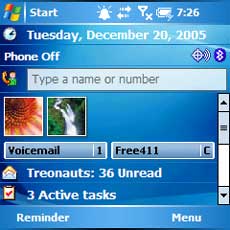
There is much to like about the Treo 700w’s Today screen even if it could be considered to be somewhat cluttered with too much information if you decide to add all of the options that you can have which include: Lookup Field (Type name or number), Date, Speed Dial (Text + Picture), Owner Info, Messaging, Tasks, Web Search, Pocket MSN, Calendar and Picture. I personally chose to add everything except Owner Info and Picture (which was making my Today screen run extremely slow…).

As on the Treo 650, typing any character will automatically start a Contacts search. However, the Treo 700w has a few minor but neat additions such as the fact that the contacts begin to appear in a pop up (see below) within the Lookup Field and that it also has a smart feature which allows it to determine whether you are trying to dial a number (below right) or search a contact.

Next is the Speed Dial section which offers you the option of dialing via either Picture or Text as well as a Quick Key for any existing or new contact that you want.

Below this I have added the Email and Tasks which I can access via either the 5Way button or simply with my thumb on the screen to open each respective application.

One function of the Today screen which I particularly like and which immediately makes the most of its high speed data connection is the Web Search box in which you type anything then hit the return key to see a couple of seconds later your query results from Google… very neat.

I haven’t yet properly setup my MSN account and so I will have to slightly skim this part but I can quickly tell you that the icons for the MSN butterfly, house, messenger and mail respectively open 1) an MSN jump page; 2) the MSN Mobile web page in IE Mobile; 3) MSN Messenger and 4) your Hotmail account. Any existing MSN user will undoubtedly be absolutely delighted to see such a tight integration on the Treo 700w.

I can also tell you as a bit of a preview that I was able to follow a link here from WindowsMedia.com which allowed me to perfectly stream both TV and video on the Treo 700w…

Lastly I have my Calendar function at the very bottom of the Today screen which like the Email and Task will take me to the application with either the 5Way or my thumb on the screen.


I hope that this will have given you a good overview of how ActiveSync and Today work with the Treo 700w and how it compares to the Treo 650. Also, even though I write that I consider both these functions to be ‘Better’ overall than the similar ones under PalmOS in our Treo 650 there are nonetheless other ones which I will review in the coming days that are definitely not so.

Tuesday, December 20, 2005

T-Mobile Hints At 3G Plans (MobileBurn)

T-Mobile Hints At 3G Plans (MobileBurn)T-Mobile Hints At 3G Plans

Newsbrief by Brad Kellett on Tuesday December 20, 2005.

Note: Sponsored advertising links, if any, are in green.

In an interview with BetaNews, T-Mobile's senior vice president of Engineering Operations, Neville Ray, hinted at T-Mobile's plans for 3G services. Ray also revealed that the company is currently undertaking 3G testing in some markets, though he would not reveal specific locations.

"We are very hopeful that by the end of 2006, and definitely in 2007, we'd be able to bring 3G services to the market. Some of this is auction dependent," Ray stated, referring to a cellular spectrum auction to take place next summer. The article notes that while Ray does not talk about which 3G technology T-Mobile will be utilizing, it is likely that they will head to UMTS - the same technology used by T-Mobile's sister companies in Europe.

Monday, December 19, 2005

Verizon’s Treo 700w to launch at CES in January? - Engadget - www.engadget.com


Verizon’s Treo 700w to launch at CES in January? - Engadget - www.engadget.comVerizon’s Treo 700w to launch at CES in January?

Posted Dec 19, 2005, 4:30 AM ET by Paul Miller
Related entries: Cellphones, Handhelds

Treo 700 small

It seems Handango, the mobile software provider, might of let the word slip in a letter to developers requesting applications a certain forthcoming phone on VZW, stating that “in early January, Verizon will be exclusively launching the new Windows Mobile 5.0 Treo 700, and we need YOUR applications to feature on our Verizon sites.” Early January would lead us to believe that they’re targeting this for the one expo to rule them all: CES.

[Thanks, Kerunt]

Resco Explorer: Another Program With Registration Code Problems


Resco Explorer: Another Program With Registration Code Problems
A few months ago I posted a rant about Travelmate and its subscription services not being user friendly.

It is now time for another software to join the list: Resco Explorer 2005.

I have installed the software on my Windows Mobile 5.0 device, and entered the registration code. This was one week ago. Today I tried using it to be greeted with an announcement that I was running a demo version. I then tried the registration code I have here and it showed a dialog:

"ERRORL The code does not match with this Owner name. Legal owners can obtain a valid code at: www.resco.net/regcode.asp".

What? What a pain... Ok, so I entered my email address on that page and got the registration code. The same one again. And again the same stupid error message.

When are companies stop using this registration procedures that are so non user friendly?

This is not free software, Resco did not send it for a review, and like many others I paid for it and I am being tortured by this stupid thing.

I don't want my worst enemy using this kind of mind torturing software.

What type of software authentication would you like to see in use, knowing that most of these devices must be connected to a network (via Activesync at least) when installing new software?

Would something like a centralised repository where all the software keys are stored and your software is authorised based on your emal address, owner name and password be a good solution?

Sunday, December 18, 2005

BBC NEWS | Programmes | Click Online | Microsoft's vision of the future


BBC NEWS | Programmes | Click Online | Microsoft's vision of the future Microsoft's vision of the future

By Dan Simmons
Reporter, BBC Click Online

Everyone has a different idea of what fun gadgets they would like to see in the future, and some of Microsoft's researchers have been demonstrating in Brussels what they hope might take off.


WHEREABOUTS CLOCK
Those familiar with the Harry Potter books and films might recognise the first idea - called the Whereabouts Clock.

It shows you where people are, and its inventor Abigail Sellen thinks its best use is in the home.

She said: "We noticed in our studies of family life that it was important to know - when you come home from work for example - are my kids still at school, have they left school yet, has my husband left work yet, shall I get the dinner on? This kind of thing. Actually knowing where your family is very important to family life."

This is more a new concept than a new technology, and the real version may still be a year or two away.

It would track the mobile phone signals of loved ones, then cross-reference which mobile cell they were in with pre-programmed locations, like the home, school, or workplace.


HAVE YOUR SAY
Let us know which of these tech toys you think will take off

Ms Sellen added: "This is not very specific at all about where people are, and that's deliberate. We don't want to invade people's privacy too much, so we deliberately keep things very coarse grained.

"If I'm at home I might want to know if my kids have left school, but I don't necessarily want to know exactly where they are."

Though targeted at home users, this technology could be very tempting to some bosses wanting track the whereabouts of their staff.

Home front

Getting the future of domestic technology right is notoriously difficult: whatever happened to the idea of putting the internet on the front of microwave ovens?


HOMENOTE
Homenote is a 21st Century version of the Post-It note, whereby you can text or e-mail your messages to a place rather than a person. Some might wonder, though, whether we really want e-mail in the kitchen.

Andy Reinhardt, a technology correspondent for Business Week magazine, says: "Everything takes longer than you expect, and people hold onto their old ways of doing things. There are sometimes good reasons for that.

"The danger, in a sense, is that we fall in love with the technology and we don't ask enough questions about its usefulness, or whether or not it actually improves life; it often does but sometimes it just makes things more complicated."

The next idea that really bowled us over at Click Online was a kind of interactive video and image bowl that reacts to touch. However the final product, if there is one, is still few years away.


INTERACTIVE BOWL
Microsoft researcher Alex Taylor explained: "What we hope to be able to do is take still images and video and be able to see them in the bowl and possibly also listen to music.

"We also hope to be able to drag the images around the bowl, making use of the physical properties of the bowl to be able to display things in certain places, and possibly let them sit at the bottom of the bowl for storage."

Microsoft's Cambridge research labs reckon that such objects could be covered in touch-sensitive "skins" next year.

The processors and projectors would be housed in the base of the bowl, and Bluetooth is already capable of transferring data from mobile devices wirelessly.

It could make an inspired, if expensive, addition to any coffee table, but dirty fingers or items scratching the touch-sensitive surfaces could mean the novelty factor might not be the only thing that wears off.

Picture this

The Digital Tapestry, an application created by Carsten Rother, automatically creates a tapestry from your favourite snaps.


DIGITAL TAPESTRY
Mr Rother told Click Online: "This software takes, fully automatically, a large collection of images, then takes the important bit from each image by doing optic recognition.

"For instance we do space detection, we detect other objects, like cats and dogs in home photographs. Then we stitch these objects together and collage them automatically into one image.

"This process will typically take a user about one hour with image editing software, or even longer to get great results. And this software does it fully automatically for you."

You can remove unwanted objects at a stroke, or even change the way they look simply by drawing in a few lines.

And although you can already achieve these results manually with existing software, this tends to be a time-consuming process.

The trick here is to find algorithms that do all the difficult work for you, even to the extent that you can view images in 3D.

Both these utilities are expected to be available in late 2006/2007.


PERSONALISED FACIAL SKETCH TECHNOLOGY
Already released in Japan and due for wider release next year, Personalised Facial Sketch Technology creates a caricature of any portrait snap.

It identifies key parts of the face, like the edge of the lips or eyes, automatically to create a cartoon version.

You can then use the results as emoticons for personalising instant messaging or e-mail.

Getting social

A final application, Snarf, may not be much to look at, but it attracted a lot of attention at the show.

It helps manage your Outlook inbox, and rather than sort by date, with the most recent e-mail appearing at the top, Snarf prioritises your messages based on your relationship with the sender.

So mail from the people you deal with often is automatically flagged up for your attention.

Marc Smith, the researcher working on it, says: "It's a lot like the experience I have when people come to my door at home.

"When strangers come to my door, my dog is likely to bark at them, but if you visit frequently my dog knows that you're a friend of the family and it'll stop barking and wag its tail.

"E-mail tools should know the difference between strangers and people you interact with frequently, and help you sort and prioritise your mail accordingly."

The automatic sorting can be overridden by various manual controls.

And you can also can check out this free application for yourself. As of December a beta version is available at the Microsoft Research website (although you should be aware that beta versions are not finished, and can cause problems on your computer).

Only a handful of projects were on display for just a few hours in Brussels to give Euro MPs and other VIPs a sense that Microsoft is not just churning out operating systems.

Whether the company is seen as a major innovator will depend in part on the whereabouts of these ideas in the years to come.

Click Online is broadcast on BBC News 24: Saturday at 2030, Sunday at 0430 and 1630, and on Monday at 0030. It can be watched on the website from late Friday afternoon. A short version is also shown on BBC Two and BBC News 24 as part of BBC Breakfast: Saturday at 0645. Also BBC World .

Story from BBC NEWS: