Saturday, July 06, 2024


Wednesday, July 03, 2024
Monday, July 01, 2024
Apple releases security updates for all AirPods and several Beats: how can we install them?
Apple releases security updates for all AirPods and several Beats: how can we install them?
“The best thing is to update as soon as possible.
News
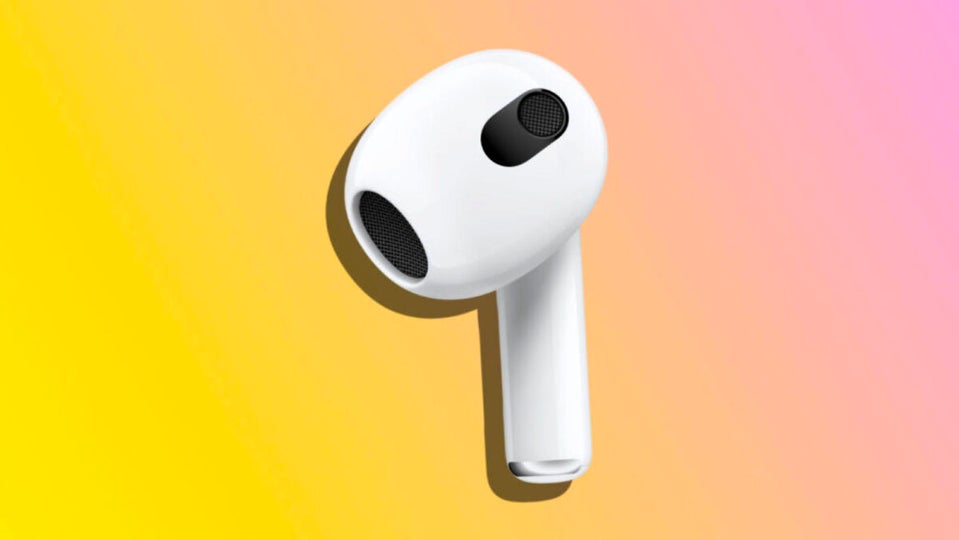
Apple has released new firmware updates for several of its headphones, including AirPods, AirPods Pro, AirPods Max, Powerbeats Pro, and Beats Fit Pro. These updates address a security vulnerability that could have allowed an attacker within Bluetooth range to impersonate the details of a previously connected device to our headphones, granting unauthorized access to them.
New Firmware for AirPods and Beats
The update applies to the latest models of AirPods and Beats, specifically the second generation of AirPods Pro, PowerBeats Pro, and Beats Fit Pro, which now have firmware version 6F8. It also applies to first and second generation AirPods, along with AirPods Max, which have received version 6A326.
Although Apple has not indicated whether this security vulnerability has been exploited, it is recommended to update the firmware of our headphones as soon as possible to avoid possible attempts to replicate the exploit now that it has been made public.
How to install these updates?
There is no direct mechanism to initiate a firmware update on AirPods and Beats. Updates are installed automatically while the headphones are connected and within Bluetooth range of an iPhone, iPad, or Mac. However, to encourage the update, we can follow these steps:
- Connect the headphones to a device and play some music.
- Place them in the charging case and plug it into the power outlet.
- Keep them near the device in question.
Later on, we can verify if the update has been installed. We will do it as follows:
- Open the Settings app.
- Tap on General.
- Select About.
- Tap on AirPods.
- Look for the number next to “Firmware Version”.
Keeping your devices up to date is vital for their security and optimal performance. With updates like today’s, while we wait for the AirPods 4 and the AirPods Lite, it is best to update our headphones as soon as possible.“
Thursday, June 27, 2024
Two Killer Asteroids Are Flying by Earth, and You May Be Able to See One - The New York Times
Two Killer Asteroids Are Flying by Earth, and You May Be Able to See One
"The smaller of the pair was spotted only this month and could be visible with binoculars as it passes by our planet within the distance to the moon.

This week, two asteroids — one big enough to destroy a city, and the other so large it could end civilization — are set to fly near our planet.
Don’t panic.
Both have a zero percent chance of impacting Earth. And, depending on where you are in the world, you may even be able to see one of them.
The bigger of the pair, (415029) 2011 UL21, will travel at a distance more than 17 times farther away than the moon on Thursday at 4:14 p.m. Eastern time. It is a whopping 7,600 feet long, but it will be too far to spot easily without a strong telescope.
However, two days later, the smaller space rock, named 2024 MK will get considerably nearer to humanity. On Saturday, at 9:46 a.m. Eastern time, it will zip by Earth at 75 percent of the distance to the moon. If you have a decent backyard telescope or perhaps even with some good binoculars, and your skies are cloud-free, you could see the 400- to 850-foot rock as a speck of light zipping across the starry night.
“The object will be moving fast, so you have to have some skills to spot it,” said Juan Luis Cano, a member of the Planetary Defense Office at the European Space Agency.

Stargazers in the United States, particularly those farther to the southwest, may catch the asteroid flitting past the planet. Those atop Hawaii’s Mauna Kea volcano will be well positioned to see it as the asteroid zooms by before sunrise. However, people in South America may have the easiest viewing experience, said Andrew Rivkin, a planetary astronomer at the Johns Hopkins University Applied Physics Laboratory.
Small asteroids and cometary fragments occasionally pierce Earth’s atmosphere, creating a harmless light show. Many more rocky and icy shards just miss the planet, and often squeeze between Earth and the moon.
An asteroid the size of 2024 MK threading this celestial needle is less common. “Passes this close by things this big are rare but happen on decadal timescales — this will be the third (that we know of) this century,” Dr. Rivkin said in an email.
Anyone that fails to spot 2024 MK need not feel left out for too long. On April 13, 2029, Apophis, a 1,100-foot-long asteroid, will fly less than 20,000 miles above Earth’s surface, closer than the orbits of geosynchronous satellites — meaning it will be visible to the naked eye.

Such close approaches are useful for planetary defense researchers. This week’s asteroids will be pinged by radar arrays on Earth, making it possible to pinpoint precisely their dimensions and onward journeys.
“These measurements will reduce the uncertainties in their motion considerably and enable us to compute their trajectories further into the future,” said Lance Benner, the principal investigator of the asteroid radar research program at NASA’s Jet Propulsion Laboratory.
The double flyby also serves as a serendipitous preview of Asteroid Day on June 30 — an occasion endorsed by the United Nations that is designed to raise awareness about asteroid impacts.
On that day in 1908, a space rock roughly 160 feet across exploded above a remote swath of Siberia, instantly leveling 800 square miles of forest — about the area of the Washington D.C. metro area. It is known as the Tunguska event after a river flowing through the region it destroyed.
Although more are discovered every year, most near-Earth asteroids capable of destroying a city are yet to be found. Fortunately, many more may be spotted by a pair of telescopes that are under construction — the multipurpose Vera C. Rubin Observatory in Chile, and NASA’s Near-Earth Object Surveyor spacecraft.
The 2024 MK asteroid is at least twice the length of the Tunguska impactor. It is certainly welcome that the asteroid was found before its encounter with Earth, and that it will miss us. But astronomers just discovered the space rock on June 16.
“The case of 2024 MK is yet another reminder about the fact that there are a lot of large objects still to be found,” Dr. Cano said. Space agencies have the plans, and technology, to defend the planet from killer asteroids — but only if they find them before the asteroids find us."
Tuesday, June 25, 2024
Faster Than the Speed of Light: Information Transfer Through “Spooky Action at a Distance” at the Large Hadron Collider
Faster Than the Speed of Light: Information Transfer Through “Spooky Action at a Distance” at the Large Hadron Collider
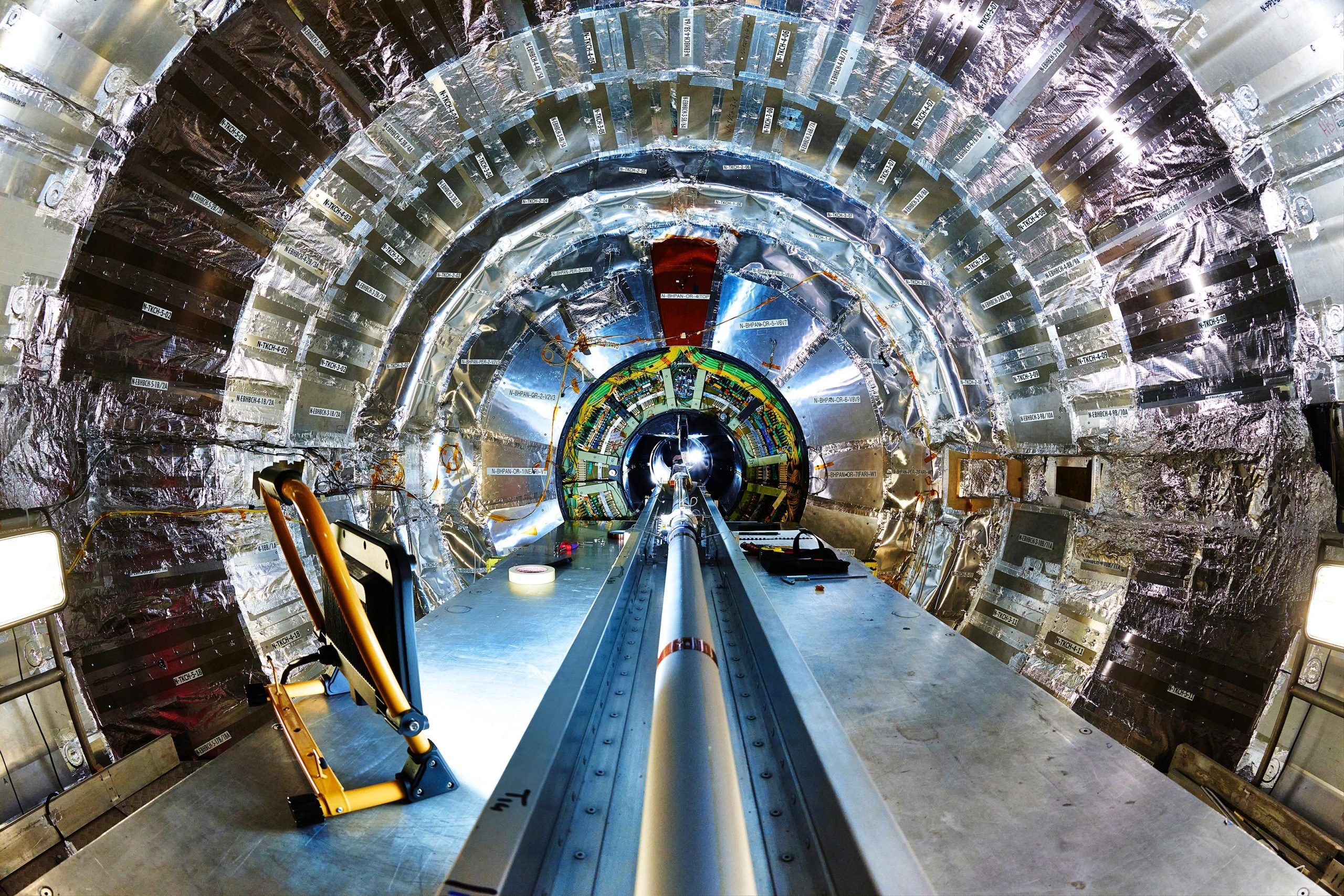
The inside of the Compact Muon Solenoid (CMS) experiment at the Large Hadron Collider. Rochester physicists working at the detector have observed spin entanglement between top quarks and top antiquarks persisting at long distances and high speeds. Credit: CERN
Researchers have confirmed that quantum entanglement persists between top quarks, the heaviest known fundamental particles.
“Physicists have demonstrated quantum entanglement in top quarks and their antimatter partners, a discovery made at CERN. This finding extends the behavior of entangled particles to distances beyond the reach of light-speed communication and opens new avenues for exploring quantum mechanics at high energies.
An experiment by a group of physicists led by University of Rochester physics professor Regina Demina has produced a significant result related to quantum entanglement—an effect that Albert Einstein called “spooky action at a distance.”
Entanglement concerns the coordinated behavior of minuscule particles that have interacted but then moved apart. Measuring properties—like position or momentum or spin—of one of the separated pair of particles instantaneously changes the results of the other particle, no matter how far the second particle has drifted from its twin. In effect, the state of one entangled particle, or qubit, is inseparable from the other.
Breakthrough in Particle Physics
Quantum entanglement has been observed between stable particles, such as photons or electrons.
But Demina and her group broke new ground in that they found, for the first time, entanglement to persist between unstable top quarks and their antimatter partners at distances farther than what can be covered by information transferred at the speed of light. Specifically, the researchers observed spin correlation between the particles.
Hence, the particles demonstrated what Einstein described as “spooky action at a distance.”
A ‘New Avenue’ for Quantum Exploration
The finding was reported by the Compact Muon Solenoid (CMS) Collaboration at the European Center for Nuclear Research, or CERN, where the experiment was conducted.
“Confirming the quantum entanglement between the heaviest fundamental particles, the top quarks, has opened up a new avenue to explore the quantum nature of our world at energies far beyond what is accessible,” the report read.
CERN, located near Geneva, Switzerland, is the world’s largest particle physics laboratory. Production of top quarks requires very high energies accessible at the Large Hadron Collider (LHC), which enables scientists to send high-energy particles spinning around a 17-mile underground track at close to the speed of light.
Quantum Information Science and Future Applications
The phenomenon of entanglement has become the foundation of a burgeoning field of quantum information science that has broad implications in areas like cryptography and quantum computing.
Top quarks, each as heavy as an atom of gold, can only be produced at colliders, such as LHC, and thus are unlikely to be used to build a quantum computer. But studies like those conducted by Demina and her group can shed light on how long entanglement persists, whether it is passed on to the particles’ “daughters” or decay products, and what, if anything, ultimately breaks the entanglement.
Theorists believe that the universe was in an entangled state after its initial fast expansion stage. The new result observed by Demina and her researchers could help scientists understand what led to the loss of the quantum connection in our world.
Top Quarks in Quantum Long-Distance Relationships
Demina recorded a video for CMS social media channels to explain her group’s result. She used the analogy of an indecisive king of a distant land, whom she called “King Top.”
King Top gets word that his country is being invaded, so he sends messengers to tell all the people of his land to prepare to defend. But then, Demina explains in the video, he changes his mind and sends messengers to order the people to stand down.
“He keeps flip flopping like this, and nobody knows what his decision will be at the next moment,” Demina says.
Nobody, Demina goes on to explain, except the leader of one village in this kingdom who is known as “Anti-Top.”
“They know each other’s state of mind at any moment in time,” Demina says.
Demina’s research group consists of herself, graduate student Alan Herrera, and postdoctoral fellow Otto Hindrichs.
As a graduate student, Demina was on the team that discovered the top quark in 1995. Later, as a faculty member at Rochester, Demina co-led a team of scientists from across the US that built a tracking device that played a key role in the 2012 discovery of the Higgs boson—an elementary particle that helps explain the origin of mass in the universe.
Rochester researchers have a long history at CERN as part of the CMS Collaboration, which brings together physicists from around the globe. Recently, another Rochester team achieved a significant milestone in measuring the electroweak mixing angle, a crucial component of the Standard Model of Particle Physics, which explains how the building blocks of matter interact.“
Monday, June 24, 2024
Sunday, June 23, 2024
Thursday, June 13, 2024
Tuesday, June 11, 2024
Monday, June 10, 2024
Apple Just Schooled Google in How to Talk About AI - CNET
Apple Just Schooled Google in How to Talk About AI
"Commentary: Google's AI discussion at I/O was an indecipherable mess. Apple's message couldn't have been clearer.

Apple's WWDC 2024 keynote has just wrapped up and its new AI tools on the iPhone, iPad and Macs played a big part of the conversation. Google's I/O event last month was all about AI, but Google's approach to the topic was a hot casserole of nonsense that left me, a tech journalist of 13 years, scratching my head. Apple took a different approach.
Presenters at Google I/O threw around a wild amount of info, including a whole host of new brand names to figure out. Gem, Gemma, Gemini, Veo, Astra, Learn LM -- I sat through Google's event struggling to even understand which thing does what, let alone why I should care about any of it. I ended my working day feeling out of my depth and like the tech world had left me behind.
More from WWDC
And while Apple has just talked a lot today about how its host of new AI features will work across all its platforms, it did so in a way that actually makes sense. It took a definite "show, don't tell" approach by giving real examples of what its new features will actually do and, crucially, how you'll benefit from using them.
We were given demos on how to ask the new AI-powered Siri to "make my photo pop" before seeing an image receive auto-edits. Or how the on-screen awareness allows you to just say "add this address to Mike's contact card" when Mike texts you a new address. All of Apple's examples were clear, understandable and showed how Apple continues to succeed in taking a customer-focused approach.

Apple showed real, practical examples of its AI tools in use.
Apple/Screenshot by James MartinBoth Google's I/O and Apple's WWDC are fundamentally developer-focused events, designed to tell industry professionals about these updates so they can then roll them out to users. Google's event was so pro-heavy, however, so full of jargon and assumed knowledge, that it alienated consumer tech fans like myself. As a result, I'm not excited about Google's AI promises -- simply because I don't really know what they are. And that means I may be less inclined to use Chrome or Gmail or to buy an Android phone that makes use of its AI tools -- which of course is Google's whole mission.
Apple's keynote instead spoke to me, directly, not via indecipherable developer-talk. Tim Cook called AI on Apple devices "Personal Intelligence" and it felt just that, while the impactful slogan "AI for the rest of us" appeared on screen behind Craig Federighi, almost as a callout to Google's impenetrable event.
But more than that, Apple focused on issues that matter to me as a consumer. There was a lot of talk around privacy in AI, how my data will be protected and even things like the emphasis on cartoon-style generative images of your friends and family, rather than attempting photorealistic images, which would be both creepy as hell and potentially extremely problematic.

Google even kept its own count of how many times it said "AI" although by our count the number was even higher.
Screenshot/James Martin/CNETApple still talked directly to its developers, explaining for example that the SDK for its ChatGPT integration will be available to be used in different apps, but it still did so in a way that left me feeling exactly why this would be beneficial when I use my iPhone.
At the end of Apple's event I felt like I knew what had happened. I understood the upcoming products, and more than that, I'm excited to try them. I may well be excited to try Google's products once I get to know them, but Google was so busy tripping over itself in the 140 times it said the words "AI" in its keynote that I feel like it forgot to tell me what those products even are.
By sticking to its customer-first approach, Apple has been able to break through the jargon and actually tell me why I should care, and in the constantly developing, endlessly confusing world of AI, that's a huge win for Apple. "