Contact Me By Email

Friday, December 16, 2005

msmobiles.com - Cingular 2125 Windows Mobile 5.0 Smartphone Review


msmobiles.com - Cingular 2125 Windows Mobile 5.0 Smartphone ReviewCingular 2125 Windows Mobile 5.0 Smartphone Review

December 17, 2005 [MS Smartphone]
Its not really a surprise that Cingular stores don't have the Cingular 2125 in stock yet, most managers don't even know what it is, makes sense since the device was officially released just this week. Of all the managers we talked to, for the most part they simply couldn't get past the fact that the 2125 is Cingular branded, they believe all phones have to be a Nokia or Motorola. Here is a phone that makes Symbian Series 60 devices look like technology from the 80's. We got our hands on a Cingular 2125, and we are reviewing the hell out of it!

Cingular 2125 - Windows Mobile 5.0 Smartphone

Ordering is painful - When it comes to ordering a Cingular 2125, until they are in stock at your local store you are much better off ordering online or by calling Cingular. If you are willing to accept a 2 year contract, it can be ordered online for $299, if you want a 1 year contract, it will cost you $369, and you will have to call to order, or buy it from your local Cingular store. If you already have a contract and wish to simply buy the phone, it will cost $399, and it will be SIM locked, which means you cannot use the phone with other wireless carriers like T-Mobile, or European carriers like Orange, O2 or Vodafone. With a one or two year contract, for release there is a $100 rebate if you purchase an unlimited data service with your plan. The pain of ordering is due to the fact that not a single Cingular employee knew what the device was, I even had a store manager tell me there is no such device, and there wont be any Cingular only devices. Its a good thing we didn't listen to that jerk.

Smartphone Thoughts - Daily news, views, rants and raves


Smartphone Thoughts - Daily news, views, rants and raves

Small, Sleek, and WiFi Enabled: The iMate SP5m Smartphone Reviewed
By Mike Temporale on Tuesday, November 22, 2005

Product Category: Hardware
Manufacturer: i-mate
Where to Buy: Expansys
Price: $494.95 USD
Specifications: Windows Mobile 5.0, Quad-Band Smartphone Featuring QVGA, Bluetooth, and WiFi.

Pros:

* Beautiful QVGA Screen;
* Fast Data Access Over GPRS & WiFi;
* Dedicated music buttons.

Cons:

* EU power cable requires North American adapter;
* Poorly designed belt case.

Summary: The i-mate SP5m is the first of its kind to hit the street; a Windows Mobile Smartphone with WiFi built-in! Don't be fooled by its innocent looks, the SP5m is more than just a Typhoon with a new shell and WiFi slapped on it. It also sports a beautiful QVGA screen and runs the latest version of Microsoft's Windows Mobile for Smartphone devices, 5.0. The wildly successful Typhoon set the record as the smallest Smartphone on the market. It was a breakthrough device, providing users with the power of Windows Mobile, and a battery that wouldn't quit after a couple hours of use, all in an ultra slim package. Can the SP5m successfully build on the Typhoon foundation? You will have to read on for the full review and find out!

Brighthand — Motorola Q Coming to Verizon


Brighthand — Motorola Q Coming to VerizonMotorola Q Coming to Verizon
By Ed Hardy | Editor-in-Chief
Dec 16, 2005

The FCC has given its approval to the Motorola Q.

Typically, this would mean that all the details on this upcoming smartphone would be posted on this U.S. government's web site. However, because of a confidentiality request, this hasn't happened.

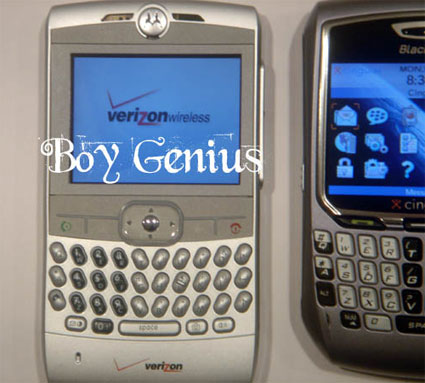
Still, there is an image in one of the test reports that clearly shows a Motorola Q with the Verizon logo on it.

Motorola had previously announced that the Q will be available first from a carrier that uses CDMA, but this is the first time that there has been any hard evidence that it would be Verizon.

What little information the FCC is revealing on this device can be found on its web site.
More About the Motorola Q

Its maker claims that the Motorola Q will be "the world's thinnest, lightest QWERTY phone".

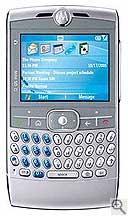
Motorola Q It will have a tablet design, with a 320-by-240-pixel screen above a backlit keyboard.

This will be one of the first devices to run Windows Mobile 5.0 for Smartphone, and therefore will support the push email system Microsoft is developing.

The Motorola Q won't just be about email, though. It will be able to play music in a variety of formats and it will sport dual speakers.

In a slightly unusual move, it will have a 320-by-240-pixel (QVGA) that is in landscape mode by default.

A miniSD slot will offer additional storage for music, as well as other types of files.

It will include a 1.3 megapixel camera and Bluetooth short-range wireless networking.

Motorola hasn't given all the specifications on this device, but, according to a leaked description of this model, it will have 64 MB of RAM and 128 MB of Flash ROM.

msmobiles.com - Handango leaks information that Palm Treo 700 will be released at CES

msmobiles.com - Handango leaks information that Palm Treo 700 will be released at CESHandango leaks information that Palm Treo 700 will be released at CES
December 16, 2005 [Pocket PC phone]
In this story we mention Motorola Q, Palm Treo 700w and sales of pirated software at Handango...

Handango writes:

In early January, Verizon will be exclusively launching the new Windows Mobile 5.0 Treo 700, and we need YOUR applications to feature on our Verizon sites, as well as in our new 5.0 PPC InHand catalog. Additionally, your WM 5.0 applications will be sold through several other channels, including Microsoft, Dell, HP, Alltel, and Sprint. If you have not already done so, please email windowsmobile@handango.com with the following information on your 5.0 applications:
1. Application Name
2. Product ID
3. If the app is square-screen aware
4. If OTA files are uploaded and ready for InHand

For additional information on making your application 5.0 aware, please visit: Windows Mobile 5.0 Migration Guide.

In other words: "early January" means "at CES 2006" - the biggest in USA trade show about consumer electronics.

There are also rumors that Motorola Q smartphone will also be released at CES...

Speaking of Handango: it still keeps selling pirated software, another fresh example is here - but it's not a shocker - we were reporting about it before: obviously Handango has enough money to go 3GSM conference to Barcelona, Spain, but not enough money to ensure legality of their operation.

World's Most Expensive Stereo Components - Forbes.com


World's Most Expensive Stereo Components - Forbes.com

Lifestyle Feature
World's Most Expensive Stereo Components
Dan Lyons

See our list of the World's Most Expensive Stereo Components.

In the age of the iPod, does anyone need a fancy home audio system? The answer, if one is serious about music, is an emphatic "yes."

These days, music is portable and modular, served a la carte in a million ways a million times per day to millions of listeners around the globe. Whether through MP3 players, satellite radio or ripped from a CD on a PC, to many people the notion of having to sit at home to enjoy their favorite music is as archaic as using a mimeograph machine to make copies.

And if one is going to be listening at home, why spend too much money? After all, there are now enough peripherals for an MP3 player, such as Bose's Sound Dock--which costs around $300--that lets users plug in their iPods and deliver quality acoustics anywhere in their home. Not only that, but for less than $200 it is possible to walk out of a Wal-Mart (nyse: WMT - news - people ) or Best Buy (nyse: BBY - news - people ) carrying a mini audio unit from a reputable brand, such as Sony (nyse: SNE - news - people ) or JVC, which is capable of cranking out 400 watts or more of sound.

But for music connoisseurs, comparing a glorified boombox with state-of-the-art audio equipment is like saying that it's just as much fun to drive a $22,000 Pontiac Grand Am as it is a $200,000 Ferrari F430. The two cars fulfill the same basic function, but the Ferrari does it on such an infinitely higher level of performance and craftsmanship as to render all comparisons absurd.

Take for example the Ongaku amplifier from Audio Note Japan. This 27-watt power amplifier uses a single-ended triode circuit and is hand crafted in a Tokyo workshop by Hiroyasu Kondo, a world-renowned engineer who uses 20 pounds of silver throughout the amp, including silver wire in the windings of the hand-made transformers. This audio work of art delivers a level of sound quality unmatched by any other amplifier on the market--and for $80,000 it had better.

Think that's an expensive piece of stereo equipment? Try $135,000 for a pair of Alexandria X-2 loudspeakers from Provo, Utah-based Wilson Audio Specialties, or the $145,000 Evolution Music System from Krell Industries in Orange, Conn., which generate the kind of butt-kicking bass that doesn't just blow out windows but also knocks down walls.

Of course, many people may not need Rockport Technologies' 535-pound, $73,750 System III Sirius turntable to enjoy their old collection of LPs. There are enough more-than-adequate turntables--not to mention amps, preamps, speakers, etc.--that cost thousands less and still deliver excellent sound.

But no one "needs" a Ferrari F430, nor does anyone "need" to go from zero to 60 in 3.9 seconds. Still, if you afford it, why the heck shouldn't you? Not only do you get major bragging rights, it's also a freaking blast.

Lenovo ThinkPad Z60m laptop review by PC Magazine


Lenovo ThinkPad Z60m laptop review by PC Magazine Lenovo ThinkPad Z60m
REVIEW DATE: 11.14.05
BOTTOM LINE:
Though the widescreen display and titanium cover of the Lenovo ThinkPad Z60m aren't typical of a ThinkPad design, the quality, features—and keyboard—remain pure ThinkPad.

PROS:
Great performance. Terrific battery life. Titanium cover.

CONS:
Heavy.

COMPANY:
Lenovo

SPEC DATA
Price: $2,299.00 Direct
Type: Business, General Purpose
Operating System: MS Windows XP Professional
Processor Name: Intel Pentium M 760
Processor Speed: 2 GHz
RAM: 1024 MB
Hard Drive Capacity: 100 GB
Graphics: ATI Mobility Radeon X600
Primary Optical Drive: DVD+/-RW (Plus Minus)
Wireless: 802.11a/g
Screen Size: 15.4 inches
Screen Size Type: widescreen
System Weight: 7.1 lbs
EDITOR RATING:

By Cisco Cheng

The latest laptop from Lenovo, the Lenovo ThinkPad Z60m ($2,299 direct) is a far cry from the portable matte-black boxes business users are accustomed to. It's a hefty desktop replacement covered in titanium, with a 15.4-inch widescreen and a bulky weight of 7.1 pounds. The Z60m is a sturdy, impressive system—though not exactly road material.

Our test system was configured with a 2.0-GHz Pentium M 760 and 1GB of RAM, which boosted its scores on our performance tests. And a nine-cell battery gave it an impressive score on MobileMark 2005, coming in at 6 hours 3 minutes of battery life. For those who work with 3D applications, the Z60m has ATI Mobility Radeon X600 discrete graphics. Its gaming scores were above average for a notebook, so believe it or not, gaming is possible on this ThinkPad. (For more testing results check out the Lenovo's ThinkPad Z60m's benchmark chart.)

If the titanium cover is too shocking, you can opt for the traditional matte-black finish. The 15.4-inch widescreen has plenty of room for writing and viewing Web pages. Even though the "m" in Z60m stands for multimedia, the antiglare screen is more suitable for work than for watching DVDs. The transreflective screen found on the HP Pavilion dv4000 is better suited for contrasting images, such as high-resolution photos and DVD-quality videos. Not forgetting the security needs of business users, Lenovo builds in a fingerprint reader and includes TPM (Trusted Platform Module).

* Desktops and Notebooks for Every Budget

You can configure the Z60m with an integrated EV-DO antenna, but our review unit didn't come with one. The antenna is better suited for a smaller system that is likely to be carried out of the office more often, like the Lenovo ThinkPad Z60t. We tested the EV-DO on that system, and the throughput rates were very acceptable.

The keyboard continues to live up to the ThinkPad moniker, and a newly added Microsoft Windows key gives users access to all the shortcuts available in Windows applications. Like the smaller Z60t, the Z60m comes with three USB ports, a FireWire port, and a rarely seen S-Video port. The 3-in-1 card reader is a first for a ThinkPad; it accepts SD, MS, and MS Pro formats.

The ThinkVantage suite, included on all ThinkPads, has gone through a major makeover recently. With just a press of the Blue ThinkVantage button, the ThinkVantage Productivity Center pops up. You can launch maintenance tasks, manage your connections, back up your system, and more. A utility called Rejuvenation lets you restore your system while preserving vital settings like printer drivers, connectivity settings, My Favorites, and even files in your "My Documents" folder. The Away Manager gives the user more control over antivirus software and Windows utilities. Away Manager operates in conjunction with Whisper mode, which lets you maximize performance on selected tasks without affecting other applications.

Though we don't recommend commuting daily with the Lenovo ThinkPad Z60m, it's a very formidable desktop replacement notebook for your every business need—and for having a bit of fun.

Thursday, December 15, 2005

Forbes.com - Magazine Article

Forbes.com - Magazine ArticleWhere Not To Put Your Money In Tech For 2006
David Ng, 12.15.05, 6:00 AM ET

As shares of Google and Apple Computer reach for infinity and beyond, it's high time to take a look at some technology stocks whose futures appear somewhat less stellar.

By many accounts, 2006 will be rotten for Solectron (nyse: SLR - news - people ), an electronics-manufacturing-services company, as well as a host of chip-related companies, including Lattice Semiconductor (nasdaq: LSCC - news - people ), Novellus Systems (nasdaq: NVLS - news - people ), Varian Semiconductor Equipment Associates (nasdaq: VSEA - news - people ) and Applied Materials (nasdaq: AMAT - news - people ).

Analysts are telling investors to avoid digital-video recording company TiVo (nasdaq: TIVO - news - people ) and the Chinese Internet portal Baidu (nasdaq: BIDU - news - people ). Also set to underperform are business applications providers Agile Software (nasdaq: AGIL - news - people ) and Mercury Interactive (nasdaq: MERGE - news - people ).

Of course, there's no guarantee that these stocks will perform as predicted. Just don't say we didn't warn you.

Wednesday, December 14, 2005

South Korea Standardizes Cell Phone Connectors (MobileBurn)

South Korea Standardizes Cell Phone Connectors (MobileBurn)South Korea Standardizes Cell Phone Connectors

News by Brad Kellett on Wednesday December 14, 2005.

Note: Sponsored advertising links, if any, are in green.
Click Here

The three mobile service providers in South Korea - SK Telecom, KTF, and LG Telecom - have agreed on a new standardized data/charge port that will be required on all new handsets released in the country.

While the traditional argument is that having different ports across different brand cell phones will promote sales of accessories, the three carriers rationalize their decision by saying that standardized connectors will allow development of more value-added services and actually increase sales of accessories. Regardless of the marketing impacts, this is definitely a boon for consumers, as they will no longer have to buy all new accessories when upgrading handsets.

The three carriers have signed an MOU (Memorandum of Understanding), though a deadline for standardization has not been announced.

Tuesday, December 13, 2005

First Look: New Windows Mobile 5.0 Pocket PCs and Smartphones! :: Buyers Guide 2006


First Look: New Windows Mobile 5.0 Pocket PCs and Smartphones! :: Buyers Guide 2006T-Mobile SDA II Smartphone

T-Mobile's new SDA II is a Smartphone with a a 195 MHz processor and with 64 MBs of RAM and 64 MBs of flash ROM memory. This device has four notable features: A QVGA screen, an integrated 1.3 megapixel camera, built-in Wi-Fi, and 4 large buttons to control music playback.

The SDA II's 320x240 pixel, 65K color display measures 2.4 inches diagonally, just slightly larger than the screens on earlier models. I was quite impressed with the screen's sharp and crisp display of text and graphics; excellent for watching movies and album cover artwork while listening to music.

The SDA II has exciting features, including a very readable QVGA screen and build-in Wi-Fi: features not normally found in a Smartphone.

The addition of a high resolution camera is another welcomed advancement over other current Smartphones, which have lower-resolution VGA cameras. At 1.3 megapixels, it has 4 times more resolution and takes much better pictures. The file size of the image is larger and e-mailing them to friends will take more resources, but they provide a more satisfying end result. I took some impressive pictures with this camera in low-light conditions-by far the best images I've taken with any embedded camera I've tested.

The camera is also capable of capable of recording movies with sound that can be sent via MMS (Multimedia Messaging Service) or Outlook e-mail. There are three file formats that the video can be encoded in: Motion-JPEG AVI (playable using Windows Media Player), MPEG-4, and H2.63 (playable using Quicktime players). You can use AVI video format and Outlook to e-mail a video to a friend with a Windows Desktop computer. However the AVI file is much larger than files saved in the MPEG-4 or H2.63 formats. If you are sending videos from phone to phone via MMS it's best to use MPEG-4 or H2.63 because these formats are supported by most video phones on the market today.

The mini-SD card is stored underneath the 1,150 mAh battery. next to the SIM card slot. I was disappointed in the layout because with a music device it's nice to have easy access to change the memory cards. That said, it's still a "Plays for Sure" device and you can always re-sync with your desktop to change music frequently.

One of the things that are immediately noticeable on the MDA II is the four large round buttons on the front panel, below the display. Three are used for music playback (play/pause, skip/next, and skip/previous) and one button that looks like the letter "T" in the form of an "@" sign that launches Pocket Internet Explorer and connects the device to the T-Mobile site on the Internet. The three music buttons are not very readable and I had difficulty making out the symbols. I hope they paint the raised symbols black on the final version of the device, to make them readable.

Above the round buttons and immediately below the display are four small rectangular buttons used for menu navigation. The far left and right buttons activate the soft keys; middle left is the Home button, and middle right is the Back These buttons are very tiny and are difficult to use. I found myself using mini joystick for most of my navigation when I could. However, the left and right soft buttons still had to be used to activate menus. Since I use the mini-joystick to control music anyway, I think it would be better if the rectangular buttons were larger and the music buttons smaller. I also found the dialing keypad a bit difficult to use because the buttons are so small. I had to use my finger nail to press the keys and my fingers sometimes covered two keys at the same time. This slowed down entering text via predictive T9 text input. It would actually be better if the rectangular buttons were switched with the round buttons. This way it would be much easier to navigate and since the music buttons are used that much anyways. Even so, I also used the mini joystick to control music playback was easier to use than the buttons.

I was impressed with the MDA II's built-in connectivity options. With Wi-Fi, Bluetooth, and EDGE/GSM/GPRS, all the bases are covered. Windows Mobile 5.0 provides integrated support for Wi-Fi, and this is the first Smartphone I've see with Wi-Fi built in. It's a much-welcomed feature, especially for those who have wireless networks at work or home.

The MDA II's good features far outweighed some of the minor issues I had with the buttons. The screen, connectivity, camera, and strong audio output make this a very desirable phone!

Bottom line:

The MDA II Music has exciting features, including a very readable QVGA screen and built-in Wi-Fi-features not normally found in a Smartphone. The quality of the images the camera took impressive me. If you don't mind the smaller menu navigation buttons, this is an excellent choice device.

These are the first Windows Mobile 5.0 devices we've gotten to test. If the features they included and the quality they display are any indication, we can look forward to a bright Windows Mobile future as more innovative devices become available.

HTC: Premier designer and developer of Windows Mobile devices

HTC is the Taiwanese company that works with HP, Dell, Audiovox, and other vendors to design and manufacturer most of the Windows Mobile devices available today. HTC doesn't sell devices directly to the consumer.

We list the HTC Universal in this review because we tested a device we got from HTC through Microsoft, before any vendor announcements had been made. As we went to press with this issue, branded versions of the Universal were available through T-Mobile (MDA Pro) and I-mate (JASJAR). We expect that the device will be offered by other vendors as well.

The PPC-6700 is Sprint's version of a different HTC device, the "Apache." Sprint is the first U.S. wireless carrier to introduce the device, but we expect it to be offered by other vendors.

HTC also had a hand in the design and manufacture of the other two devices in this review: the Axim X51v and the iPAQ rx1950. However, Dell and HP have exclusives on these devices: you won't see them with another vendor's brand name on them.

A Cautionary Note Concerning Windows Mobile 5.0

We are an enthusiast magazine and as such like to share the excitement and vision of Windows Mobile computing. However, please take note. As we complete this Buyers Guide, Windows Mobile 5.0 devices are just beginning to ship.

Windows Mobile 5.0 is a major upgrade, several years in the making. Based on the nature of software in general, and Microsoft's track record in particular, you should proceed with caution before purchasing a Windows Mobile 5.0 device. With most new and complex high-tech products, bugs, unanticipated problems, and "gotchas" are discovered. Third-party software that worked on your current Pocket PCs and Smartphones should work on Windows Mobile 5.0 devices, but there is always the possibility that it won't until the vendor updates it.If you are a cautious sort, wait. Check out online forums and read about what Windows Mobile 5.0 users are saying. Wait for our next issues' reviews of new devices and reports of existing problems and workarounds. On the other hand, if you like being in the mobile computing forefront and enjoy having the latest and greatest, then go ahead, upgrade your iPAQ or Dell, or purchase a new Windows Mobile 5.0 device. As fixes and minor updates to the software become available, you should be able to get them for free, from your device manufacturer. (Hal Goldstein)

Monday, December 12, 2005

BBC NEWS | Business | China's rich fuel mobile revolution

BBC NEWS | Business | China's rich fuel mobile revolution China's rich fuel mobile revolution
By Charlotte Windle
BBC Shanghai business reporter

University student, Ma Dingming, has just purchased his second mobile phone this year.

The phone, made by Taiwanese company Dopod, cost him $848. The phone he bought earlier in the year cost him $867.

"I've bought the new phone because it's the latest model," he says.

"It is really more of a PDA so it has a high CPU frequency and larger RAM than your average phone and a Microsoft operating system that enables me to take notes, surf the internet and log onto MSN chat rooms."

Ma financed the purchase of the two phones with his monthly allowance, as well as with money received from relatives last Chinese New Year, when it is common to give children and young people "hong bao" - envelopes filled with cash - as part of the festivities.

Flexible sales methods

China's increasingly wealthy middle classes and tech savvy youngsters are the main reasons why companies, including Nokia and Motorola, have invested billions of dollars in establishing manufacturing and distribution networks across the Chinese mainland.

In 2004, the Chinese purchased 92 million mobile phones, an increase of 15.8% over 2003, making China the largest mobile phone market in the world.

The International Data Corporation forecasts that the market for mobile handsets will continue to grow, with more than 400 million handsets sold between now and 2009.

In the first half of 2005, the top five brands on the mainland were Nokia, Motorola and Samsung, followed by local companies Ningbo Bird, TCL, Konka, and Lenovo.

But, perhaps surprisingly, the market share held by China's domestic producers is falling, down from 34% at the beginning of the year to 30% at the end of the third quarter.

Furthermore, Lenovo's mobile phone division is the only domestic handset maker is profitable so far this year.

"The main reason for the success of foreign companies is their success in developing more flexible ways of selling their handsets," according to Alan Hsieh, managing director of International Data Corporation China.

Third generation mobiles

Domestic brands insist on selling through their own distribution channels.

They have their own branches in every province in China, where they employ thousands of salespeople who then sell to retailers.

Nokia and Motorola, on the other hand, use individual agents who then sell to retailers.

This agent system cuts costs and enables them to reach more effectively into smaller cities in more remote areas.

The government has not interfered with this shift in favour of foreign handset makers.

It is, however, keen to push China's home-grown intellectual property in the field of mobile communications, in particular its home-grown 3G, or third generation mobile standard known as TD-SCDMA.

The standard is still being tested, which is why China has been slow to divide up its 3G licenses.

New standards

The Chinese government must decide whether to push ahead with TD-SCDMA which is not commercially proven but whose developers claim will use only a fifth of the bandwidth of the next best alternative, the European standard WCDMA.

It seems unlikely that China will opt for the American standard, known as CDMA 2000, given that its developer, Qualcomm, levies a hefty charge for its use.

Whatever China decides, it will have to make the decision soon.

"The government will act no later than the second quarter of 2006," says Steven Qin, business planning director for Shanghai-based Panasonic partner Cosmobic Technology.

"After all, the network needs to be fully operational in time for the 2008 Olympic Games."

The most likely outcome is that the European standard, W-CDMA, will be adopted by the state-owned China mobile, which operates 70% of China's mobile phones.

However, it seems likely that at least one of China Mobile's 4 competitors will be forced to adopt China's home-grown standard TD-SCDMA.

If the standard proves successful, China hopes to export TD-SCDMA to other developing markets.
Story from BBC NEWS:

Sunday, December 11, 2005

Selecting a new Windows Mobile device


Jasjar / k-jam / SP5 / Apache
Selecting a new Windows Mobile device
Articles : Windows Mobile, posted 10-DEC-2005 00:03, by Darryl Burling

I’ve been a fan of HTCs devices for a while now – I’ve used a couple of their previous generation of phones and they’ve performed well and have been very hardy. I’ve been watching the new generation to see what it offers and have been thinking of upgrading to a new Windows Mobile 5 device. So when I had the opportunity recently to have a trial run with four new devices now available in New Zealand and running Windows Mobile 5 I thought I might write a buyers guide of sorts highlighting the points that I found were key to making the decision for me.

The four devices I’ve used in the last few weeks are the i-mate branded Jasjar, K-Jam, and Smartphone SP5 and the Telecom branded Apache. Here is an overview of each one (links go to our Geekzone Smart Devices Database where you will find more information and other names for these devices):

i-mate Jasjar
Device Type: Pocket PC Phone Edition
Form factor: Clamshell
Keyboard: QWERTY with Number row
Processor: 520MHz Bulverde
Screen Resolution: VGA – 640x480
Wireless: GPRS/GSM/UMTS (3G), 802.11b WiFi, Bluetooth

i-mate k-jam
Device Type: Pocket PC Phone Edition
Form factor: Pocket PC with sliding keyboard
Keyboard: QWERTY (no number row)
Processor: 200MHz OMAP
Screen Resolution: QVGA – 320x240
Wireless: GPRS/EDGE/GSM, 802.11b WiFi, Bluetooth

i-mate Smartphone SP5
Device Type: Smartphone
Form factor: Candybar
Keyboard: Numeric/T9
Processor: 200MHz OMAP
Screen Resolution: QVGA – 320x240
Wireless: GPRS/GSM, 802.11b WiFi, Bluetooth

Telecom Apache
Device Type: Pocket PC Phone Edition
Form factor: Pocket PC with sliding keyboard
Keyboard: QWERTY (no number row)
Processor: 416MHz Bulverde
Screen Resolutionv: QVGA – 320x240
Wireless: CDMA/EVDO (3G), 802.11b WiFi, Bluetooth

It’s probably worth noting here that these devices run different versions of Windows Mobile 5 (a point I came across fairly early in the process). The Jasjar and the Apache both run build 14354 while the K-Jam and SP5 run build 14402. Other than some minor functional differences in the start menu, what the differences are between the two versions I don’t know. From my experience the Jasjar was the least stable of the devices - not that they were unstable devices, but that I experienced a couple of issues on the Jasjar I didn’t experience on the others. FWIW the Apache was more stable than the Jasjar which leads me to think that the Jasjar’s instability issues (few that they were) were not related to the OS as much as the device itself.

To try and make this as even as possible I’m going to have three types of notes on each device. The notes are based on a decision making process rather than just raw stats, so they’ll be a little more subjective than you might find them.

You may have a different opinion on many of these things depending on your usage. I’m after a device primarily for data, but also for a phone – and I only want to carry a single device.

So here goes!

i-mate Jasjar
There were a few things that I really liked about the Jasjar. I loved the keyboard – not that it was better or worse than the other keyboards, but it was certainly better than the PDA2K. The screen is really nice. It displays text clearly and has lots of room for text, and it displays pictures well. It also has UMTS (3G) support which means high speed WAN connectivity (where available). It has an SD Card slot – and is the only device out of all the ones I evaluated here that did – which means it has higher storage capacities. The Jasjar also has a 3.5mm headphone jack for listening to music, etc using whatever headphones you like. The stylus was really good too.

There were also a couple of things I didn’t like about the Jasjar. It was big - really big. If you have to hold the thing up to your head for a phone call you will probably get tired of holding after a while. But seriously – you’ll need a Bluetooth headset if you plan on using it as a phone. I found that the keyboard was quite large compared to the other devices too. When using it I found that I needed to put the screen flat and then hold the device at a specific angle to be able to reach the keys in the middle of the keyboard with my thumbs – if you have smaller hands you’ll need to put the device down or do wrist gymnastics to reach the center of the keyboard. Finally the Jasjar was really hard to do anything with if you only want to use one hand. Even the simplest task such as checking the time is impossible one handed and the absence of buttons when the device is in a tablet form factor also reduces your ability to work with it one handed.

i-mate k-jam
This device seems to have most of the good features of the Jasjar, but in a fraction of the size. The k-jam is small. It’s the same size as the Jam, with just a little more depth (actually about 5mm more – which is arguably not just a little). The extra depth is to account for the slide out keyboard, which is my second like. The size of the keyboard was also a big plus – its smaller than the Jasjar, but bigger than the PDA2K. In fact as a thumbboard – I’d say its probably about the perfect size – big enough for big thumbs, but small enough for people with smaller hands to manage.

Things I don’t like about the K-Jam: I loathe the stylus. I wasn’t a fan of the stylus on the Jam, but this is worse – a short telescopic stylus would be OK if it always extended when you pulled it out, but it doesn’t and you need to use a second hand to extend it or use the 2cm long closed down version which is frustrating. Fortunately – with a keyboard you almost never need the stylus. The second thing I would like to see more of on the k-jam would be more buttons. It would be nice to have an OK button - although I mapped the IE button to OK and the mail button to start which helped. I also preferred the numbers to be separate keys (ala Jasjar) rather than shared. As with most phones, the k-jam sports a tiny 2.5mm headphone jack – meaning restricted headphone selections. Finally, if you’ve got an investment in SD cards, you will need to drop that for miniSD cards for this device – which for the moment means you are limited to 1Gb miniSD cards (bigger cards are on the horizon though).

i-mate SP5
The SP5 is the successor to the SP3/SP3i phones that were running Windows Mobile 2003 Second Edition. The SP5 is a candybar phone first, but with the smart capabilities of the Windows Mobile range. Thus you can install applications on it, surf the internet, synchronise PIM with an Exchange Server and enter data on it. The SP5 includes two key new features in addition to Windows Mobile 5 that were not in previous Smartphones – WiFi support and a very nice QVGA screen. The screen on this device is gorgeous – brilliant colour, high resolution and very crisp edges.

One of the reasons I’ve not owned a candy bar phone since converged Pocket PC Phones came out is that data entry on these devices is really hard without a decent keyboard or touch screen. This hasn’t changed (although it might with the Motorola Q). The other issue with the smartphone platform is the lack of mobile office applications and their viability. This is really a killer for me.

As something to consider, I found that Wi-Fi was not really a big benefit – the device is really too small to seriously use for browsing the internet – and the T9 keyboard is just too slow and cumbersome to work with for more than simple data/URL address entry. This situation is exacerbated by issues such as having to enter WEP keys and similar niggly issues.

Having said all of this – this is by far the nicest smartphone I’ve ever used.

Telecom Apache
The apache shares many of the nice features of the k-jam. It’s the same size, same keyboard size (keys are the same as the Jasjar though), similar camera, screen and form factor, however, it has some unique things about it too. It has better buttons than the k-jam – including an OK button. In addition the keyboard has slightly larger keys, which many people will like. It also has CDMA EVDO support meaning stupidly fast WAN speeds (easily eclipsing the UMTS support of the Jasjar), in addition to Wi-Fi – in fact it almost negates the need for WiFi. The camera on the Apache also has a macro mode which some may like.

There are two things that I find negative about the Apache. It has an aerial – and it’s big and ugly and not aesthetically pleasing. The second problem with the apache (for me anyway) is that it functions on another network – meaning a change of phone numbers for me (again). Neither of these are insurmountable issues and when you consider the CDMA EVDO support as well as the improved button layout support, it weighs in at much the same place (YMMV).

Conclusion
So having been through all these – the issues for me came down to size and keyboard support. In short this translates to practicality.

In the end after using each one of these devices as my only device for a short amount of time (between a couple of days and a week) I decided to get an i-mate k-jam.

The Apache was knocked out as work pays the bill and they weren’t keen on switching networks (yet).

The 3G support and the screen of the Jasjar was tempting, but the trade off of size is a big price to pay for the luxury of a nice screen.

3G support is a nice to have, but I don’t need video calling and much of my data is consumed in email or RSS for which GPRS support is fine. For the times when I want to do more, there are plenty of Wi-Fi networks around, and GPRS is an easy fallback. If you happen to be in an area where there is EDGE support – the i-k-jam radio stack supports this – talk to your local provider about access to these networks.

The SP5 was a really nice phone, but just too hard to work with for more than reading email on a consistent basis.

If you are happy to use two devices, you might consider a SP5 and the Jasjar as a great combination. I used these devices together for a couple of days and the small size of the SP5 is a great compliment to the Jasjars capabilities. However, if you want to use two devices and want to use these two together you probably have too much money or work for a telco. Between the two of them you’d be paying NZ$2500 – or as much as a really good laptop.

My conclusion from my time with these devices is that they are all really good devices and serve a variety of needs really well. Take your time to select one though - they are not cheap.

Saturday, December 10, 2005

HP to rebadge the HTC Feeler / SP3i as iPAQ SmartPhone rw4500? - Engadget - www.engadget.com


HP to rebadge the HTC Feeler / SP3i as iPAQ SmartPhone rw4500? - Engadget - www.engadget.com

Posted Dec 10, 2005, 7:30 PM ET by Ryan Block
Related entries: Cellphones

HP iPAQ rw4500

The HTC Feeler has been out overseas on Euro T-Mo for a while now as the T-Mobile SDA (not to be confused with the European SDA Music / American T-Mo SDA / HTC Hurricane — yes, we know this is unnecessarily complicated), but it looks like HP’s rebadging it as the iPAQ SmartPhone rw4500. If this is in fact destined for US release it seems kind of silly, considering the US SDA / Hurricane is essentially the same device as the Feeler, but with a QVGA display (compared to 220 x 176), 1.3 megapixel camera (compared to VGA), and music buttons. Then again, we are all for more Smartphones, smartphones, and, um, good phones on T-Mobile, so let’s have ‘em!

[Thanks, rock99rock]

China CRIENGLISH

China CRIENGLISH Anti-Spam Group Established In China
2005-12-10 12:11:06 CRIENGLISH.com

China's first anti-Spam organization for informtion technology administrators, the Anti-Spam of the Internet Society of China (ASISC) has launched.

The ASISC includes computer networking administrative professionals who are cooperating together to build a highly efficient and safe anti-spam management system.

The group also seeks to establish a good Internet society image and team up with international anti-spam initiatives.

More than 100 million Chinese use e-mail services frequently. At the same time, it becomes the top receiver of junk mails. According to a survey, Chinese netizens receive over 10 junk messages every week on average.

Friday, December 09, 2005

EV-DO Motorola Q gets official - Engadget - www.engadget.com


EV-DO Motorola Q gets official - Engadget - www.engadget.comEV-DO Motorola Q gets official

Posted Dec 8, 2005, 3:51 PM ET by Peter Rojas
Related entries: Cellphones

CDMA Motorola Q on Verizon

Ok, one bit of solid product news out of Mobius today: we pretty much already knew this, but Motorola just officially confirmed that they’re going to be launching the EV-DO version of their Q Smartphone in the first quarter of next year. They wouldn’t go so far as to confirm which carrier is getting it, but it’d be very, very surprising if it wasn’t Verizon. So what happens to the EDGE version of the Q they were showing off a few months ago?

msmobiles.com - Microsoft pushes Taiwanese hardware manufacturers to reduce price for Pocket PC phones to sub-$300 region

msmobiles.com - Microsoft pushes Taiwanese hardware manufacturers to reduce price for Pocket PC phones to sub-$300 regionMicrosoft pushes Taiwanese hardware manufacturers to reduce price for Pocket PC phones to sub-$300 region
December 09, 2005 [Pocket PC phone]
Nokia is advertising their Symbian smartphones together with their regular non-smartphone phones - thus creating synergy effect. Nokia spends hundreds of millions of $ for advertising of mobile phones too. Nokia also reuses components from regular phones in smartphones, what results in economy of scale effect.

Maybe instead of forcing poor manufacturers to reduce costs (and compromise quality?), Microsoft should use above mentioned effects, particularly synergy effect: Microsoft should embed advertising of Windows Mobile into existing marketing campaigns of other Microsoft products (like operating systems, office software, database software, etc).... Read on!

Digitimes - Chinese publication in English language - has direct access to press in Chinese language (that is used also in Taiwan) so they know well the situation among hardware manufacturers there. Apparently Microsoft wants to force poor hardware manufacturers from Taiwan to produce cheap Pocket PC phones:

Microsoft plans to team up with Taiwan ODM handset makers and own-brand handset vendors to manufacture sub-US$300 PDA phones in a bid to help the company expand its share of the global OS (operating system) market for mobile devices, according to sources at Taiwan makers and vendors.

Smartphone Thoughts - Daily news, views, rants and raves

Smartphone Thoughts - Daily news, views, rants and raves:Friday, December 9, 2005
OFF-TOPIC
Gartner's Advice: Stop Deploying BlackBerry
Posted by Jerry Raia @ 12:00 PM
"Enterprises should not deploy or invest in Research In Motion's BlackBerry "until RIM's legal position is clarified," market research firm Gartner said this week. In addition, Gartner urged enterprises to demand that Research In Motion (RIM), which has been struggling in a patent action brought against it by NTP, should publicly detail its plans for a workaround should it loose its suit. Besides getting details on the workaround, enterprises should also "carefully review their legal and operational impact," Gartner said in a research advisory."

Gartner has been know to go over the top sometimes. This is a bit different though. The situation with RIM is serious with regard to the number of users affected. I have to admit the thought all those Blackberry things suddenly becoming paper weights make me happy.
Very Happy"

Wednesday, December 07, 2005

BBC NEWS | Business | Microsoft invests $1.7bn in India

BBC NEWS | Business | Microsoft invests $1.7bn in India Microsoft invests $1.7bn in India
The US software giant Microsoft has unveiled plans to invest $1.7bn (£981m) in India over the next four years.

The company said it would create 3,000 new jobs in the country and pump more money into research and development.

Microsoft is keen expand its operations in India, a country where well-trained workers are available at a fraction of what they cost in the West.

On Monday, the world's largest chipmaker Intel announced plans to invest $1bn in India.

Intel said it planned to substantially boost research and development in the country over the next five years.

'Strategic vision'

Microsoft chairman Bill Gates said the company wanted to increase its workforce in India to "7,000 over the next three to four years".

He said the $1.7bn investment "would be deployed across select focus areas over the next four years in line with Microsoft's strategic vision for India".

India's Information Technology minister Dayanidhi Maran said news of the investment was "an indicator of the value that Microsoft attaches to its development and R&D activities in the country".

Microsoft currently outsources a number of services to India

Earlier this year, the company opened a research centre in India's southern city of Hyderabad.

Microsoft plans to open a innovation centre in India's technology hub Bangalore next month.
Story from BBC NEWS:

Sunday, December 04, 2005

msmobiles.com - Review of Cingular 2125 - new MS Smartphone that is coming soon to USA


msmobiles.com - Review of Cingular 2125 - new MS Smartphone that is coming soon to USAReview of Cingular 2125 - new MS Smartphone that is coming soon to USA
December 04, 2005 [MS Smartphone]
Cingular 2125 is not an American incarnation of HTC Tornado but it is a bid different construction - HTC Faraday. This is the first real review of this phone. It lacks Wi-Fi and UMTS but it has EDGE and in combination with availability of flat rate mobile Internet access in USA - it can therefore still be a perfect mobile phone for some people! Read on!


Well the device doesn’t have WiFi. As I stated earlier, I don’t really care. With EDGE I have been seeing speeds between 150-210kb/s. I ran 6 tests on the Mobile Speed Test at dslreports.com. For the tests I selected either the 200kb or the 600kb file size. I think they best represent actual speed of the device. On average I would say I was seeing about 175kb/s for either file size. Sure it would be nice to have the 1mb/s+ speeds of WiFi, but with the relatively low cost ($19.99) for unlimited data on Cingular, I’m ok with not having it. With a device like the wizard which has a larger screen, it would be a different story, but the small screen really doesn’t need it (IMHO). If you HAVE to have WiFi, you’ll be paying the $499 for the SP5(m) or waiting who knows how long for the TMobile device.