Contact Me By Email

Sunday, December 11, 2005

Selecting a new Windows Mobile device


Jasjar / k-jam / SP5 / Apache
Selecting a new Windows Mobile device
Articles : Windows Mobile, posted 10-DEC-2005 00:03, by Darryl Burling

I’ve been a fan of HTCs devices for a while now – I’ve used a couple of their previous generation of phones and they’ve performed well and have been very hardy. I’ve been watching the new generation to see what it offers and have been thinking of upgrading to a new Windows Mobile 5 device. So when I had the opportunity recently to have a trial run with four new devices now available in New Zealand and running Windows Mobile 5 I thought I might write a buyers guide of sorts highlighting the points that I found were key to making the decision for me.

The four devices I’ve used in the last few weeks are the i-mate branded Jasjar, K-Jam, and Smartphone SP5 and the Telecom branded Apache. Here is an overview of each one (links go to our Geekzone Smart Devices Database where you will find more information and other names for these devices):

i-mate Jasjar
Device Type: Pocket PC Phone Edition
Form factor: Clamshell
Keyboard: QWERTY with Number row
Processor: 520MHz Bulverde
Screen Resolution: VGA – 640x480
Wireless: GPRS/GSM/UMTS (3G), 802.11b WiFi, Bluetooth

i-mate k-jam
Device Type: Pocket PC Phone Edition
Form factor: Pocket PC with sliding keyboard
Keyboard: QWERTY (no number row)
Processor: 200MHz OMAP
Screen Resolution: QVGA – 320x240
Wireless: GPRS/EDGE/GSM, 802.11b WiFi, Bluetooth

i-mate Smartphone SP5
Device Type: Smartphone
Form factor: Candybar
Keyboard: Numeric/T9
Processor: 200MHz OMAP
Screen Resolution: QVGA – 320x240
Wireless: GPRS/GSM, 802.11b WiFi, Bluetooth

Telecom Apache
Device Type: Pocket PC Phone Edition
Form factor: Pocket PC with sliding keyboard
Keyboard: QWERTY (no number row)
Processor: 416MHz Bulverde
Screen Resolutionv: QVGA – 320x240
Wireless: CDMA/EVDO (3G), 802.11b WiFi, Bluetooth

It’s probably worth noting here that these devices run different versions of Windows Mobile 5 (a point I came across fairly early in the process). The Jasjar and the Apache both run build 14354 while the K-Jam and SP5 run build 14402. Other than some minor functional differences in the start menu, what the differences are between the two versions I don’t know. From my experience the Jasjar was the least stable of the devices - not that they were unstable devices, but that I experienced a couple of issues on the Jasjar I didn’t experience on the others. FWIW the Apache was more stable than the Jasjar which leads me to think that the Jasjar’s instability issues (few that they were) were not related to the OS as much as the device itself.

To try and make this as even as possible I’m going to have three types of notes on each device. The notes are based on a decision making process rather than just raw stats, so they’ll be a little more subjective than you might find them.

You may have a different opinion on many of these things depending on your usage. I’m after a device primarily for data, but also for a phone – and I only want to carry a single device.

So here goes!

i-mate Jasjar
There were a few things that I really liked about the Jasjar. I loved the keyboard – not that it was better or worse than the other keyboards, but it was certainly better than the PDA2K. The screen is really nice. It displays text clearly and has lots of room for text, and it displays pictures well. It also has UMTS (3G) support which means high speed WAN connectivity (where available). It has an SD Card slot – and is the only device out of all the ones I evaluated here that did – which means it has higher storage capacities. The Jasjar also has a 3.5mm headphone jack for listening to music, etc using whatever headphones you like. The stylus was really good too.

There were also a couple of things I didn’t like about the Jasjar. It was big - really big. If you have to hold the thing up to your head for a phone call you will probably get tired of holding after a while. But seriously – you’ll need a Bluetooth headset if you plan on using it as a phone. I found that the keyboard was quite large compared to the other devices too. When using it I found that I needed to put the screen flat and then hold the device at a specific angle to be able to reach the keys in the middle of the keyboard with my thumbs – if you have smaller hands you’ll need to put the device down or do wrist gymnastics to reach the center of the keyboard. Finally the Jasjar was really hard to do anything with if you only want to use one hand. Even the simplest task such as checking the time is impossible one handed and the absence of buttons when the device is in a tablet form factor also reduces your ability to work with it one handed.

i-mate k-jam
This device seems to have most of the good features of the Jasjar, but in a fraction of the size. The k-jam is small. It’s the same size as the Jam, with just a little more depth (actually about 5mm more – which is arguably not just a little). The extra depth is to account for the slide out keyboard, which is my second like. The size of the keyboard was also a big plus – its smaller than the Jasjar, but bigger than the PDA2K. In fact as a thumbboard – I’d say its probably about the perfect size – big enough for big thumbs, but small enough for people with smaller hands to manage.

Things I don’t like about the K-Jam: I loathe the stylus. I wasn’t a fan of the stylus on the Jam, but this is worse – a short telescopic stylus would be OK if it always extended when you pulled it out, but it doesn’t and you need to use a second hand to extend it or use the 2cm long closed down version which is frustrating. Fortunately – with a keyboard you almost never need the stylus. The second thing I would like to see more of on the k-jam would be more buttons. It would be nice to have an OK button - although I mapped the IE button to OK and the mail button to start which helped. I also preferred the numbers to be separate keys (ala Jasjar) rather than shared. As with most phones, the k-jam sports a tiny 2.5mm headphone jack – meaning restricted headphone selections. Finally, if you’ve got an investment in SD cards, you will need to drop that for miniSD cards for this device – which for the moment means you are limited to 1Gb miniSD cards (bigger cards are on the horizon though).

i-mate SP5
The SP5 is the successor to the SP3/SP3i phones that were running Windows Mobile 2003 Second Edition. The SP5 is a candybar phone first, but with the smart capabilities of the Windows Mobile range. Thus you can install applications on it, surf the internet, synchronise PIM with an Exchange Server and enter data on it. The SP5 includes two key new features in addition to Windows Mobile 5 that were not in previous Smartphones – WiFi support and a very nice QVGA screen. The screen on this device is gorgeous – brilliant colour, high resolution and very crisp edges.

One of the reasons I’ve not owned a candy bar phone since converged Pocket PC Phones came out is that data entry on these devices is really hard without a decent keyboard or touch screen. This hasn’t changed (although it might with the Motorola Q). The other issue with the smartphone platform is the lack of mobile office applications and their viability. This is really a killer for me.

As something to consider, I found that Wi-Fi was not really a big benefit – the device is really too small to seriously use for browsing the internet – and the T9 keyboard is just too slow and cumbersome to work with for more than simple data/URL address entry. This situation is exacerbated by issues such as having to enter WEP keys and similar niggly issues.

Having said all of this – this is by far the nicest smartphone I’ve ever used.

Telecom Apache
The apache shares many of the nice features of the k-jam. It’s the same size, same keyboard size (keys are the same as the Jasjar though), similar camera, screen and form factor, however, it has some unique things about it too. It has better buttons than the k-jam – including an OK button. In addition the keyboard has slightly larger keys, which many people will like. It also has CDMA EVDO support meaning stupidly fast WAN speeds (easily eclipsing the UMTS support of the Jasjar), in addition to Wi-Fi – in fact it almost negates the need for WiFi. The camera on the Apache also has a macro mode which some may like.

There are two things that I find negative about the Apache. It has an aerial – and it’s big and ugly and not aesthetically pleasing. The second problem with the apache (for me anyway) is that it functions on another network – meaning a change of phone numbers for me (again). Neither of these are insurmountable issues and when you consider the CDMA EVDO support as well as the improved button layout support, it weighs in at much the same place (YMMV).

Conclusion
So having been through all these – the issues for me came down to size and keyboard support. In short this translates to practicality.

In the end after using each one of these devices as my only device for a short amount of time (between a couple of days and a week) I decided to get an i-mate k-jam.

The Apache was knocked out as work pays the bill and they weren’t keen on switching networks (yet).

The 3G support and the screen of the Jasjar was tempting, but the trade off of size is a big price to pay for the luxury of a nice screen.

3G support is a nice to have, but I don’t need video calling and much of my data is consumed in email or RSS for which GPRS support is fine. For the times when I want to do more, there are plenty of Wi-Fi networks around, and GPRS is an easy fallback. If you happen to be in an area where there is EDGE support – the i-k-jam radio stack supports this – talk to your local provider about access to these networks.

The SP5 was a really nice phone, but just too hard to work with for more than reading email on a consistent basis.

If you are happy to use two devices, you might consider a SP5 and the Jasjar as a great combination. I used these devices together for a couple of days and the small size of the SP5 is a great compliment to the Jasjars capabilities. However, if you want to use two devices and want to use these two together you probably have too much money or work for a telco. Between the two of them you’d be paying NZ$2500 – or as much as a really good laptop.

My conclusion from my time with these devices is that they are all really good devices and serve a variety of needs really well. Take your time to select one though - they are not cheap.

Saturday, December 10, 2005

HP to rebadge the HTC Feeler / SP3i as iPAQ SmartPhone rw4500? - Engadget - www.engadget.com


HP to rebadge the HTC Feeler / SP3i as iPAQ SmartPhone rw4500? - Engadget - www.engadget.com

Posted Dec 10, 2005, 7:30 PM ET by Ryan Block
Related entries: Cellphones

HP iPAQ rw4500

The HTC Feeler has been out overseas on Euro T-Mo for a while now as the T-Mobile SDA (not to be confused with the European SDA Music / American T-Mo SDA / HTC Hurricane — yes, we know this is unnecessarily complicated), but it looks like HP’s rebadging it as the iPAQ SmartPhone rw4500. If this is in fact destined for US release it seems kind of silly, considering the US SDA / Hurricane is essentially the same device as the Feeler, but with a QVGA display (compared to 220 x 176), 1.3 megapixel camera (compared to VGA), and music buttons. Then again, we are all for more Smartphones, smartphones, and, um, good phones on T-Mobile, so let’s have ‘em!

[Thanks, rock99rock]

China CRIENGLISH

China CRIENGLISH Anti-Spam Group Established In China
2005-12-10 12:11:06 CRIENGLISH.com

China's first anti-Spam organization for informtion technology administrators, the Anti-Spam of the Internet Society of China (ASISC) has launched.

The ASISC includes computer networking administrative professionals who are cooperating together to build a highly efficient and safe anti-spam management system.

The group also seeks to establish a good Internet society image and team up with international anti-spam initiatives.

More than 100 million Chinese use e-mail services frequently. At the same time, it becomes the top receiver of junk mails. According to a survey, Chinese netizens receive over 10 junk messages every week on average.

Friday, December 09, 2005

EV-DO Motorola Q gets official - Engadget - www.engadget.com


EV-DO Motorola Q gets official - Engadget - www.engadget.comEV-DO Motorola Q gets official

Posted Dec 8, 2005, 3:51 PM ET by Peter Rojas
Related entries: Cellphones

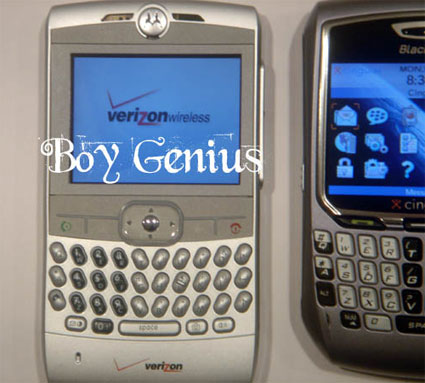
CDMA Motorola Q on Verizon

Ok, one bit of solid product news out of Mobius today: we pretty much already knew this, but Motorola just officially confirmed that they’re going to be launching the EV-DO version of their Q Smartphone in the first quarter of next year. They wouldn’t go so far as to confirm which carrier is getting it, but it’d be very, very surprising if it wasn’t Verizon. So what happens to the EDGE version of the Q they were showing off a few months ago?

msmobiles.com - Microsoft pushes Taiwanese hardware manufacturers to reduce price for Pocket PC phones to sub-$300 region

msmobiles.com - Microsoft pushes Taiwanese hardware manufacturers to reduce price for Pocket PC phones to sub-$300 regionMicrosoft pushes Taiwanese hardware manufacturers to reduce price for Pocket PC phones to sub-$300 region
December 09, 2005 [Pocket PC phone]
Nokia is advertising their Symbian smartphones together with their regular non-smartphone phones - thus creating synergy effect. Nokia spends hundreds of millions of $ for advertising of mobile phones too. Nokia also reuses components from regular phones in smartphones, what results in economy of scale effect.

Maybe instead of forcing poor manufacturers to reduce costs (and compromise quality?), Microsoft should use above mentioned effects, particularly synergy effect: Microsoft should embed advertising of Windows Mobile into existing marketing campaigns of other Microsoft products (like operating systems, office software, database software, etc).... Read on!

Digitimes - Chinese publication in English language - has direct access to press in Chinese language (that is used also in Taiwan) so they know well the situation among hardware manufacturers there. Apparently Microsoft wants to force poor hardware manufacturers from Taiwan to produce cheap Pocket PC phones:

Microsoft plans to team up with Taiwan ODM handset makers and own-brand handset vendors to manufacture sub-US$300 PDA phones in a bid to help the company expand its share of the global OS (operating system) market for mobile devices, according to sources at Taiwan makers and vendors.

Smartphone Thoughts - Daily news, views, rants and raves

Smartphone Thoughts - Daily news, views, rants and raves:Friday, December 9, 2005
OFF-TOPIC
Gartner's Advice: Stop Deploying BlackBerry
Posted by Jerry Raia @ 12:00 PM
"Enterprises should not deploy or invest in Research In Motion's BlackBerry "until RIM's legal position is clarified," market research firm Gartner said this week. In addition, Gartner urged enterprises to demand that Research In Motion (RIM), which has been struggling in a patent action brought against it by NTP, should publicly detail its plans for a workaround should it loose its suit. Besides getting details on the workaround, enterprises should also "carefully review their legal and operational impact," Gartner said in a research advisory."

Gartner has been know to go over the top sometimes. This is a bit different though. The situation with RIM is serious with regard to the number of users affected. I have to admit the thought all those Blackberry things suddenly becoming paper weights make me happy.
Very Happy"

Wednesday, December 07, 2005

BBC NEWS | Business | Microsoft invests $1.7bn in India

BBC NEWS | Business | Microsoft invests $1.7bn in India Microsoft invests $1.7bn in India
The US software giant Microsoft has unveiled plans to invest $1.7bn (£981m) in India over the next four years.

The company said it would create 3,000 new jobs in the country and pump more money into research and development.

Microsoft is keen expand its operations in India, a country where well-trained workers are available at a fraction of what they cost in the West.

On Monday, the world's largest chipmaker Intel announced plans to invest $1bn in India.

Intel said it planned to substantially boost research and development in the country over the next five years.

'Strategic vision'

Microsoft chairman Bill Gates said the company wanted to increase its workforce in India to "7,000 over the next three to four years".

He said the $1.7bn investment "would be deployed across select focus areas over the next four years in line with Microsoft's strategic vision for India".

India's Information Technology minister Dayanidhi Maran said news of the investment was "an indicator of the value that Microsoft attaches to its development and R&D activities in the country".

Microsoft currently outsources a number of services to India

Earlier this year, the company opened a research centre in India's southern city of Hyderabad.

Microsoft plans to open a innovation centre in India's technology hub Bangalore next month.
Story from BBC NEWS:

Sunday, December 04, 2005

msmobiles.com - Review of Cingular 2125 - new MS Smartphone that is coming soon to USA


msmobiles.com - Review of Cingular 2125 - new MS Smartphone that is coming soon to USAReview of Cingular 2125 - new MS Smartphone that is coming soon to USA
December 04, 2005 [MS Smartphone]
Cingular 2125 is not an American incarnation of HTC Tornado but it is a bid different construction - HTC Faraday. This is the first real review of this phone. It lacks Wi-Fi and UMTS but it has EDGE and in combination with availability of flat rate mobile Internet access in USA - it can therefore still be a perfect mobile phone for some people! Read on!


Well the device doesn’t have WiFi. As I stated earlier, I don’t really care. With EDGE I have been seeing speeds between 150-210kb/s. I ran 6 tests on the Mobile Speed Test at dslreports.com. For the tests I selected either the 200kb or the 600kb file size. I think they best represent actual speed of the device. On average I would say I was seeing about 175kb/s for either file size. Sure it would be nice to have the 1mb/s+ speeds of WiFi, but with the relatively low cost ($19.99) for unlimited data on Cingular, I’m ok with not having it. With a device like the wizard which has a larger screen, it would be a different story, but the small screen really doesn’t need it (IMHO). If you HAVE to have WiFi, you’ll be paying the $499 for the SP5(m) or waiting who knows how long for the TMobile device.

Saturday, December 03, 2005

[print version] Bye Bye BlackBerry? | CNET News.com

[print version] Bye Bye BlackBerry? | CNET News.comBye Bye BlackBerry?

By Ian Austen
http://news.com.com/Bye+Bye+BlackBerry/2100-1047_3-5981263.html

Story last modified Sat Dec 03 08:27:00 PST 2005

OTTAWA--What if your BlackBerry screen went dark?

To executives like Douglas Steenland of Northwest Airlines, the idea of doing business without a BlackBerry is about as appealing as reverting to rotary dial phones and Telex machines.

"It's the proverbial blessing and curse," Steenland said of his BlackBerry, which sends e-mail messages wirelessly. "It's a blessing because it liberates you from the office. It's a curse because there's no escape."

That is why there was so much anxiety throughout corporate America over this week's news that a long-running patent infringement battle between the maker of BlackBerry, Research in Motion, and NTP, a tiny patent holding company, might cause a service shutdown, perhaps within a month.

Indeed, the prospect of life without BlackBerries is so frightening to Northwest--a heavy user if ever there was one--that the airline immediately demanded a conference call with RIM executives and one is scheduled for Tuesday.

"Everybody here hopes that somebody else will fix the problem," said Andrea Newman, Northwest's senior vice president for government relations. "But no one really knows what the problem is or what it will take to fix it."

RIM, which is based in Waterloo, Ontario, promises it has a solution that will keep its beloved BlackBerries humming even in the face of an injunction. While most analysts view the prospects of a shutdown as unlikely, they have little faith in the proposed solution, which has potential legal pitfalls of its own. What's more, the history of the struggle between the companies means that no outcome is certain. (RIM declined to comment.)

In an interview early this year and more recently at an investors' conference in New York, James Balsillie, the chairman and co-chief executive, said that the company had developed a new software technology that did not infringe on NTP's patents and would provide a way to escape any injunction.

RIM has offered little additional information about its new system other than to say that switching over to it would not require subscribers to acquire new devices or to alter their current units.

"On this subject they seem to have an attitude that they wish that people would stop talking about it," said Kenneth Hyers, a wireless research analyst with ABI Research who is based in Raleigh, N.C. The company briefed Hyers this week, he said, and indicated only in broad terms that the software modifications would be made at a network level.

"That begs the question, 'If they've been sitting on this all this time, why haven't they implemented it?'" he said. "Their answer is that this is a major network upgrade and nobody wants to mess with the network if they don't have to."

That, Hyers added, suggests that installing the software will not be as easy as RIM suggested.

While the change, if it is made, will not require any action by subscribers, it's not clear if it will alter how the BlackBerry e-mail service operates.

Balsillie has said that the new system has been tested with focus groups but he offered no details.

Any changes to the experience of users, said Avi Greengart, the principal mobile devices analyst at Current Analysis in Sterling, Va., could undermine a chief reason for BlackBerry's success. There are 3.65 million BlackBerry users worldwide.

"You now have a very nice, seamless e-mail experience with BlackBerry," Greengart said. "If you want to do just voice and e-mail, it's hard to beat a BlackBerry."

There is one party who says he knows the details of the change but who also has a vested interest in the case. Donald Stout, the patent lawyer who is a co-founder of NTP of Arlington, Va., said RIM showed him its alternative system.

While he formally agreed not to disclose its details, Stout said that RIM's alterative is not invisible to users. "It would differentiate their e-mail in a manner that there is a risk from the end-user standpoint that it takes away some of the things I like about the BlackBerry service," Stout said on Friday.

He acknowledged that RIM might have since altered its software in a way that avoids those problems.

Stout said that he doubted very much that RIM had found a way around his company's patents. "That's balderdash," he said. "They're just trying to keep the ball up in the air."

If NTP wins an injunction to end BlackBerry service and RIM keeps BlackBerry service operating through the new software, Stout said his company would ask for an immediate judicial review of the changes.

If that hearing finds RIM is still infringing on NTP's patents, Stout said NTP would ask that RIM and every wireless carrier in the United States offering BlackBerry service be cited for contempt.

The dispute dates to the beginning of the decade when RIM was still a relatively small company. Stout said NTP believed that RIM's system infringed on broad patents given to NTP's co-founder, Thomas Campana Jr., an engineer who is deceased, for a primitive wireless e-mail system he devised as a subcontractor during the 1980's at a company called Telefind.

In the lawsuit that followed RIM's initial rebuff of NTP, a jury in Richmond, Va., found in NTP's favor. That decision, largely upheld on appeal, required RIM to pay a royalty that would have generated about $240 million to date.

In March, the two companies announced that RIM would pay NTP $450 million to license its patents. But that deal collapsed over final terms.

Although NTP is now asking a federal court in Virginia to block BlackBerry service to everyone in the United States except government and aid agency account holders, most analysts say that the Canadian company can, and should, still settle out of court. The estimated price tag for that, however, is now pegged at $700 million to $1.5 billion. While such a settlement is large for a patent case, RIM is estimated to have at least $1.8 billion in cash.

When an injunction would arrive is not clear. But Stout, in a view shared by others, expects that a ruling could come as soon as the end of this month or by mid-January at the latest. It is possible that RIM may then be given a period, perhaps of several weeks, to shut down.

RIM still has other legal options. The United States Patent and Trademark Office is reviewing eight of NTP's patents and has issued preliminary rulings against the company in several cases. But final rulings are unlikely to come for months and a two-part appeal process could extend the review for years. In any case, NTP needs only a single patent upheld to gain an injunction.

In addition, RIM is preparing an appeal to the Supreme Court, although even it acknowledges that the court rarely hears patent appeals.

Even if the court accepts RIM's appeal, which hinges on the fact that its software resides on servers based in Canada where NTP does not hold patents, any Supreme Court decision is unlikely to come swiftly.

So far there has been little apparent impact on BlackBerry sales. Greengart at Current Analysis said that most BlackBerry purchases in the United States are made by corporate information technology departments that would be reluctant to change to alternative hand-held units from Palm, Nokia and Samsung, or move to wireless e-mail software from Good Technology and SEVEN because of the cost and the bother.

As well, he added, many corporations prefer BlackBerry because its software offers a high level of security and its devices cannot be used by employees for non-work-related tasks like listening to downloaded music.

As for Stout, he has no apologies for BlackBerry owners who may be cut off by his company's request for a shutdown or RIM investors who will probably see their shares sink if the company loses a market that provides about 70 percent of its revenue.

Shares of RIM closed at $64.50, down 52 cents.

"If this goes as far as an injunction, I won't feel sorry for them," Stout said. "No BlackBerry customer can say that NTP didn't offer a license. If RIM turns that down, they have no one to blame but themselves for the consequences. BlackBerry users should tell RIM to stop fooling around with their service and take the license."

Tuesday, November 22, 2005

PCWorld.com - Popular Programs Suffer Wave of Internet Attacks

PCWorld.com - Popular Programs Suffer Wave of Internet AttacksPopular Programs Suffer Wave of Internet Attacks

A new report on the top Internet vulnerabilities of 2005 finds a trend toward attacking common user applications.

Erik Larkin, PC World
Tuesday, November 22, 2005

Internet criminals are increasingly targeting popular applications like backup software and Web browsers instead of the operating systems that run them, according to a new report from government and industry security experts.


Advertisement


Attackers are targeting backup and recovery programs, as well as "the antivirus and other security tools that most organizations think are keeping them safe," according to the SANS Top 20 report for 2005, released today. The shift toward finding and exploiting vulnerabilities in programs represents a major change from past years, when Windows and other operating systems and Internet services like Web and e-mail servers were the preferred targets.

"A new wave of attacks concentrated on application programs" in 2005, the report states.

Popular Software at Risk

In addition to holes in security and backup programs, critical vulnerabilities in instant messaging programs, Web browsers, file sharing applications, and media players are all listed among the Top 20.

And those vulnerabilities are drawing all the wrong sorts of attention. According to SANS, unwanted network traffic targeting Symantec Veritas BackupExec rocketed to 500,000 instances within days of an announced security hole in the product, up from a previous maximum of about 50,000 instances.

Symantec wasn't alone. Microsoft Office, Internet Explorer, Firefox, and AOL Instant Messenger also suffered from serious reported vulnerabilities, as did RealPlayer and iTunes. Also, according to a previous report from the Yankee Group, the number of flaws reported in antivirus and other security programs is increasing at a far faster rate than for Windows.

Opportunities for Criminals

Applications represent an increasingly attractive target because operating systems and Internet services have become more resilient after years of steady attacks. Many programs, on the other hand, lack any means for automatic program updates. The delay between an announced vulnerability and the time that an administrator or home user manually updates the software represents a window of opportunity for Internet criminals.

New awareness of critical security holes in the network devices that guide Internet traffic represents the second important shift in the Top 20, according to the report.

"Compromises of network devices can provide attackers one of the most fruitful platforms for eavesdropping and launching targeted attacks," it states.

Government organizations within the United States, the United Kingdom, and Canada all contributed to the report, as did Internet security companies TippingPoint and Qualys. The SANS Institute has been producing the Top 20 report since 2000.

PC World earlier this year explored the new waves of criminal activity in a five-part series called Web of Crime.

Tuesday, November 15, 2005

Pocket PC Thoughts - Daily News, Views, Rants and Raves

Pocket PC Thoughts - Daily News, Views, Rants and RavesSamsung i730 Wins CNET Best Smartphone Award
Posted by Ed Hansberry @ 05:00 PM
"The Samsung SCH-i730 manages a pretty impressive feat: It shrinks a Windows Mobile-based smart phone into a form factor that actually fits comfortably in your pants pocket and includes broadband wireless, Wi-Fi, Bluetooth, a built-in keyboard, and a speedy processor. Despite some irritating quirks in its wireless support, the Samsung i730 stays in the running for the "Treo killer" title."

The most interesting thing about this is it isn't the Treo 650. I've seen a few of these around town, more than any other brand of Windows Mobile Pocket PC Phone with the possible exception of the various makes based on the HTC device used for the PDA2K/Audiovox 6600. If it weren't for the fact that turning on WiFi basically turns off the phone, this would be an almost perfect device.

Monday, November 14, 2005

Sun Microsystems Will Offer New Generation of Processors - New York Times

Sun Microsystems Will Offer New Generation of Processors - New York TimesNovember 14, 2005
Sun Microsystems Will Offer New Generation of Processors
By LAURIE J. FLYNN

SAN FRANCISCO, Nov. 13 - Sun Microsystems is set to announce the first of a new generation of processors for computer servers on Monday that the company says offers faster performance with far less energy use.

Sun Microsystems, once a high flier in Silicon Valley, hopes that the new chip, called the UltraSparc T1, will help it win back the market share it lost to higher-performing yet less expensive Unix servers the last few years.

The chip, code-named Niagara while in development, is designed for a specific niche of the server market: high-volume Web service operations, like those at Google and eBay. Sun has not yet announced the specific server models that will use the new chip, but the company's executives said the servers would be available before the end of this year, several months ahead of the original schedule.

Sun, based in Santa Clara, Calif., is hoping the new chip will restore the high profile of its core Sparc server line, which still accounts for a majority of its revenues.

While the overall Unix server market has been growing - it increased 6.6 percent, to $4.2 billion, in the second quarter of 2005 from a year ago, according to the Gartner Group, a research firm - Sun's overall share has been falling, from 38 percent to 33 percent in the second quarter of this year. Hewlett-Packard's market share remained about the same, and I.B.M.'s grew slightly.

The UltraSparc T1, following a trend in the semiconductor industry, adds new features that conserve energy significantly, which could translate into huge savings for Web services companies. Sun's announcement comes just a month after Google said it would expand its use of Sun equipment, though neither company has provided any details about their plans.

The UltraSparc T1 has eight processing cores, each able to execute four instruction sequences, called threads. As a result, the chip includes the same processing power and features of an entire network server, said Greg Papadopoulos, Sun's chief technology officer.

"It's really a race to the death for the microprocessor," Mr. Papadopoulos said. "The systems are being placed on the chip."

Sun has invested heavily in developing innovative new servers and server processors in the last few years as its struggled to regain its business momentum. In September, the company announced a revamped server technology called Galaxy for the lower-end market.

"Now it's all about Sun as a big R.& D. shop trying to monetize its investments," said Brent Bracelin, an analyst who follows Sun for Pacific Crest Securities. He has an outperform rating on Sun stock. "Hopefully, at some point we'll start to see the dividend, but that hasn't happened yet."

Wednesday, November 09, 2005

eHomeUpgrade | Top NBC Universal Content On Demand through DIRECTV for $0.99


eHomeUpgrade | Top NBC Universal Content On Demand through DIRECTV for $0.99Top NBC Universal Content On Demand through DIRECTV for $0.99
Category: Content Providers - November 07, 2005
By NEWS RELEASE [196 Reads]
Digg This | Email Story | Discuss [1 Post]
directv_plus_r15_dvr.jpg

NBC Universal and DIRECTV, Inc., today announced a first of its kind agreement that will give consumers access to the top programs of NBC and its cable entertainment networks, USA, SCI FI and Bravo, within hours after they air, commercial free, for just 99 cents. The programs will be available on demand through the new DIRECTV Plus interactive DVR.

This multi-year agreement will give the primetime on demand rights to NBC Universal TV programs, such as "Law & Order: SVU," "Law & Order: CI," "The Office," "Monk," "Surface" and "Battlestar Galactica." The programs will be available until the following week's episode airs. NBC Universal's movies and TV events will also be available through DIRECTV Plus, and on pay-per-view (PPV).

"The way people are consuming content is changing," said David Zaslav, President, NBC Universal Cable. "Through this agreement with DIRECTV, consumers will be able to watch top NBC content on demand for just $0.99, when they want, without commercials. It's a huge sea change. This deal is the first of its kind and we value DIRECTV's partnership in rolling it out."

"We are thrilled to be able to make some of the best and most watched programs in all of television, both network and cable, even more readily available to viewers," said Jeff Zucker, President, NBC Universal Television Group. "We are extremely aware that viewers can't always watch these programs when they're originally scheduled, and this will give them far more control over when they're able to see these shows."

"DIRECTV and NBC are the first to offer viewers primetime programming on demand, and this agreement furthers DIRECTV's position as a technology and programming leader supporting our commitment to deliver the best television experience available anywhere," said Chase Carey, president and CEO, DIRECTV, Inc. "DVRs have fundamentally changed the way people watch television, giving viewers greater choice, control and convenience. We will take the DVR experience to new levels by offering the widest array of network primetime programming available on demand."

The DIRECTV Plus DVR will be available at retailers such as Best Buy and Circuit City this month. DIRECTV Plus will be the most advanced DVR available with features such as 100 hours of recording capacity, interactive functionality, one-touch recording and Viewmarks, which enable viewers to mark favorite places in recorded programs and jump directly to them.

The NBC TV programs that are available are some of the highest rated shows on television. "Law & Order: Special Victims Unit" opened its seventh season on NBC with its highest season-premiere numbers ever. This season, "Law & Order: Criminal Intent" is building on its "West Wing" lead-in by 52 percent in adults 18-49. "Surface" is averaging a 3.9 rating, 9 share in adults 18-49 and 8.0 million viewers this season to keep it a solid #2 in 18-49 in the competitive Monday 8-9 p.m. ET hour. "Battlestar Galactica" leads SCI FI Channel's high-powered Friday lineup, which consistently wins the night among all cable networks when the SCI FI schedule is in first-run. "Monk" was cable's #1 Friday series last summer and its July 8 season premiere was the #2 basic-cable original-series telecast of the entire third quarter. In its second season, "The Office" continues to deliver some of the most upscale audiences for any comedy on network television.

About NBC Universal
NBC Universal is one of the world's leading media and entertainment companies in the development, production, and marketing of entertainment, news, and information to a global audience. Formed in May 2004 through the combining of NBC and Vivendi Universal Entertainment, NBC Universal owns and operates a valuable portfolio of news and entertainment networks, a premier motion picture company, significant television production operations, a leading television stations group, and world-renowned theme parks. NBC Universal is 80%-owned by General Electric, with 20% controlled by Vivendi Universal.

About DIRECTV, Inc.
DIRECTV, Inc. is the nation's leading digital multichannel television service with more than 15 million customers. DIRECTV and the Cyclone Design logo are registered trademarks of DIRECTV, Inc. DIRECTV (NYSE: DTV) is a world-leading provider of digital multichannel television entertainment services. DIRECTV is approximately 34 percent owned by News Corporation.

Brighthand — HTC Preparing 4 GB Windows Mobile Phone


Brighthand — HTC Preparing 4 GB Windows Mobile PhoneHTC Preparing 4 GB Windows Mobile Phone
RumorMill
By Ed Hardy | Editor-in-Chief
Nov 8, 2005

Although many people like the idea of having gigabytes of storage capacity in their handheld or smartphone, quite a few of these people are nervous about having a miniature hard drive in a mobile device.

According to information that was leaked to msmobiles.com, HTC is developing a Windows Mobile phone that will have 4 GB of solid-state Flash storage, not a microdrive.

This device, codenamed the HTC Muse, will clearly be focused on music, as it will also include an FM tuner and built-in stereo speakers.

HTC Muse It will even have a set of buttons on the front for controlling the Windows Media Player.

While it will, of course, also be capable of storing hours of video, users will have to watch it on a 240-by-240-pixel display.

This Pocket PC will have two cameras: one VGA and another 2.1 megapixel with flash.

The HTC Muse will supposedly run Windows Mobile 5.0 on a 416 MHz processor.

It will have 64 MB of ROM and 64 MB of RAM. If 4 GB of internal storage isn't enough, it will also have a microSD memory card slot.

Reportedly, it will support GSM/GPRS/EDGE/UMTS, and possibly even HSDPA. This device will also include WiFi and Bluetooth.

The HTC Muse is expected to be out next summer for an undisclosed price.

msmobiles.com - Top Management of Microsoft in panic - visionary memos sent to Microsoft employees

msmobiles.com - Top Management of Microsoft in panic - visionary memos sent to Microsoft employeesTop Management of Microsoft in panic - visionary memos sent to Microsoft employees
November 09, 2005 [General]
While we were complaining here for several years already that Microsoft lacks innovativeness and thus is missing out on many major business opportunities, it looks like Bill Gates (de facto boss of Microsoft) and Steve Ballmer (CEO of Microsoft) have noticed it just now! Major changes at Microsoft coming! Read on!

Lately Steve and Bill have promoted Ray Ozzie to a position of CTO - Chief Technical Officer. With this catchy name and visionary statements something should be changing now at Microsoft. After all many companies with disruptive technologies and already implemented ideas, have managed to beat Microsoft: Google is offering server side e-mail and increasingly more and more functionality on the server making Windows XP and MS Office totally irrelevant, Skype has managed to dwarf any efforts of Microsot in Voice over IP (VoIP) area and RIM Blackberry overtaken push email market practically eliminating the need for MS Exchange Server.

Now once again Microsoft is playing catch-up game - i.e. trying to release the same products as competition but 2-3 years after they did that. However such primitive catch-up strategy may not be enough because adversaries this time are much more agile in the past.

To motivate troops (i.e. Microsoft employees) both Bill Gates and Ray Ozzie have sent out memos to employees (click their names in this sentence to see these memos).

While Bill Gates once again completely fails to mention (or even to understand) mobility in his memo, Ray Ozzie indeed refers to Windows Mobile issues, here are some quotes:

While we’ve led with great capabilities in Messenger & Communicator, it was Skype, not us, who made VoIP broadly popular and created a new category. We have long understood the importance of mobile messaging scenarios and have made significant investment in device software, yet only now are we surpassing the Blackberry.

[...]

Entertainment & Devices Division

a. CONNECTED ENTERTAINMENT - How can XBox Live benefit from interconnection with other services assets, such as PC-based and mobile-based IM and VoIP? How might both the PC and XBox mutually benefit from a common marketplace? Might PC users act as spectators/participants in XBox games, and vice-versa?

b. GRASSROOTS MOBILE SERVICES – How might the Windows Mobile device experience be transformed by for consumers by connection to a services infrastructure – in particular one enabled by RTC-based unified communications? How might unmediated connection to a rich services infrastructure transform mobile phones into a mass market messaging, media and commerce phenomenon?

c. DEVICE/SERVICE FUSION – What new devices might emerge if we envision hardware/software/service fusion? What new kinds of devices might be enabled by the presence of a service?

As you can see above Ozzie is pushing deeper integration of services with products. In other words: not just selling stand alone products but binding them better with server side services.

Conclusion: while it is still difficult to predict what will be influence of these major changes at Microsoft on Windows Mobile platform and products, probably integration of VoIP into Windows Mobile version of MSN Messenger will occur and Pocket MSN will be extended to cover more services.

Generally we think that these changes can only bring good results for Windows Mobile, however still Microsoft lacks any vision for clearing the situation with MVP program - still many unworthy people get this title while many worthy community contributors are blocked. One final example that Microsoft's MVP program is broken is David Ciccone, who was running Dave's iPAQ website for many years (not just news but huge forum part too) and has contributed to Windows Mobile community thousand times more than many existing MVPs. Microsoft however continued to deny him MVP title and yesterday he closed his Windows Mobile community site and moved to generic one - Mobility Today. Yes, changes are coming at Microsoft, but these changes are not deep enough yet. Microsoft must try harder!

CBS 46 Atlanta - CBS, NBC to Offer TV Shows for 99 Cents

CBS 46 Atlanta - CBS, NBC to Offer TV Shows for 99 CentsCBS, NBC to Offer TV Shows for 99 Cents
Nov 8, 2005, 09:11 AM

NEW YORK (AP) -- CBS and NBC have announced deals to offer replays of prime-time programs for 99 cents per episode, shifting television toward a sales model that gained popularity with downloaded music.

CBS is teaming up with Comcast Corp. and NBC with satellite operator DirecTV to offer the on-demand replays.

NBC Universal will offer commercial-free episodes of "Law & Order: SVU" and other shows to subscribers of DirecTV Group Inc. who use the satellite company's new digital video recorder.

Comcast's on-demand customers in some markets will be able to view "CSI: Crime Scene Investigation," "NCIS," "Survivor" and "The Amazing Race" at their convenience.

Terms of the deals, which were announced Monday, were not disclosed.

"This is an incredibly exciting evolution for CBS and network television - video on demand is the next frontier for our industry," CBS Chairman Leslie Moonves said of the deal with Philadelphia-based Comcast, the nation's largest cable systems operator. CBS, which is owned by Viacom Inc., announced last week it would stream episodes of its show "Threshold" over CBS.com.

The Walt Disney Co.'s ABC network offers downloads of several programs, including "Desperate Housewives" and "Lost," for $1.99 each via iTunes software from Apple Computer Inc.

Less than three years ago, Apple helped spur the explosion of legally downloaded music with its iTunes Music Store and iPod portable players - the latest versions of which now play video.

Comcast's service will be available starting in January to customers in markets with a CBS owned-and-operated television station, which includes the nation's seven largest media markets. The episodes will be available as early as midnight following a broadcast and will include commercials.

The DirecTV agreement includes shows that air on NBC, USA, Bravo and the Sci-Fi Channel, including "The Office" and "Monk." Episodes of the shows will remain available for one week after their broadcast. NBC Universal is a unit of General Electric Co.

DirecTV, which is based in El Segundo, Calif., and controlled by the media conglomerate News Corp., began shipping its new DVR this week. The device uses interactive software from NDS Group Ltd., another News Corp. unit, and is designed to transition the company from dependence on similar devices made by TiVo Inc.

"We are talking to the other networks and hope to reach similar agreements soon," DirecTV spokesman Robert Marsocci said Monday.

The new DirecTV DVR comes with a hard drive that holds 160 hours of programming. One hundred hours are available for subscribers to record and store programs. The remaining 60 hours will be used by DirecTV to download programs that can be viewed on demand for an extra fee.

Friday, November 04, 2005

The ThinkPad is returning to retail - Engadget - www.engadget.com

The ThinkPad is returning to retail - Engadget - www.engadget.comThe ThinkPad is returning to retail

Posted Nov 4, 2005, 12:01 AM ET by Paul Miller
Related entries: Laptops, Tablet PCs

thinkpad z60t

Just in case you’ve been holding off on those Lenovo ThinkPads until you could score one all brick and mortar style, now you can; and for a considerable discount too. Lenovo has just announced that Office Depot is picking up the ThinkPad line, with the Z60t widescreen and the T43 (with a biometric fingerprint reader) going on sale Sunday, and they’re selling the laptops with a pretty sweet discount: $699 instead of their usual $1399 pricepoint. They’ll also be busting out the X and R series along with that 12-inch Tablet, the X41, but no word on pricing for those yet. This will be the first time since 1999 that you’ll be able to buy a ThinkPad in the flesh.

From Gunpowder to the Next Big Bang - New York Times

From Gunpowder to the Next Big Bang - New York TimesNovember 4, 2005
Op-Ed Contributor
From Gunpowder to the Next Big Bang
By THOMAS L. FRIEDMAN

BEIJING

There is a techie adage that goes like this: In China or Japan the nail that stands up gets hammered, while in Silicon Valley the nail that stands up drives a Ferrari and has stock options. Underlying that adage is a certain American confidence that whatever we lack in preparing our kids with strong fundamentals in math and science, we make up for by encouraging our best students to be independent, creative thinkers.

There is a lot of truth to that. Even the Chinese will tell you that they've been good at making the next new thing, and copying the next new thing, but not imagining the next new thing. That may be about to change. Confident that its best K-12 students will usually outperform America's in math and science, China is focusing on how to transform its classrooms so students become more innovative.

"Although we are enjoying a very fast growth of our economy, we own very little intellectual property," Wu Qidi, China's vice minister of education, told me. "We are so proud of China's four great inventions [in the past]: the compass, paper-making, printing and gunpowder. But in the following centuries we did not keep up that pace of invention. Those inventions fully prove what the Chinese people are capable of doing - so why not now? We need to get back to that nature." Nurturing more "creative thinking and entrepreneurship are the exact issues we are putting attention to today." But this bumps head-on against Chinese culture and politics, which still emphasize conformity.

But for how much longer? Check out Microsoft Research Asia, the research center Bill Gates set up in Beijing to draw on Chinese brainpower. In 1998, Microsoft gave IQ tests to some 2,000 top Chinese engineers and scientists and hired 20. Today it has 200 full-time Chinese researchers. Harry Shum, a Carnegie Mellon-trained computer engineer who runs the lab, has a very clear view of what Chinese innovators can do, given the right environment. The Siggraph convention is the premier global conference for computer graphics and interactive technologies. At Siggraph 2005, 98 papers were published from research institutes all over the world.

Nine of them - almost 10 percent - came from Microsoft's Chinese research center, beating out M.I.T. and Stanford. Dr. Shum said: "In 1999 we had one paper published. In 2000, we had one. In 2001, we had two. In 2002, we had four. In 2003 we had three. In 2004, we had five, and this year we are very lucky to have nine." Do you see a pattern?

In addition, Microsoft Beijing has contributed more than 100 new technologies for current Microsoft products - from the Xbox to Windows. That's a huge leap in seven years, although, outside the hothouses like Microsoft, China still has a way to go.

Dr. Shum said: "A Chinese journalist once asked me, 'Harry, tell me honestly, what is the difference between China and the U.S.? How far is China behind?' I joked, 'Well, you know, the difference between China high-tech and American high-tech is only three months - if you don't count creativity.' When I was a student in China 20 years ago, we didn't even know what was happening in the U.S. Now, anytime an M.I.T. guy puts up something on the Internet, students in China can absorb it in three months.

"But could someone here create it? That is a whole other issue. I learned mostly about how to do research right at Carnegie Mellon. ... Before you create anything new, you need to understand what is already there. Once you have this foundation, being creative can be trainable. China is building that foundation. So very soon, in 10 or 20 years, you will see a flood of top-quality research papers from China."

Once more original ideas emerge, though, China will need more venture capital and the rule of law to get them to market. "Some aspects of Chinese culture did not encourage independent thinking," Dr. Shum said. "But with venture capital coming into this country, it will definitely inspire a new generation of Chinese entrepreneurs. I will be teaching a class at Tsinghua University next year on how to do technology-based ventures. ... You have technology in Chinese universities, but people don't know what to do with it - how to marketize it."

A few of his young Chinese inventors demonstrated their new products for me. I noticed that several of them had little granite trophies lined up on their shelves. I asked one of them, who had seven or eight blocks on her shelf, "What are those?" She said the researchers got them from Microsoft every time they invented something that got patented.

How do you say "Ferrari" in Chinese?