Deutsche Telekom not interested in selling T-Mobile USA - report - Forbes.com
E-mail | Comments | E-Mail Newsletters | RSS
AFX News Limited
Deutsche Telekom not interested in selling T-Mobile USA - report
07.05.2005, 04:25 AM
FRANKFURT (AFX) - Deutsche Telekom AG has no intention of selling its US mobile phone unit T-Mobile USA, German daily Sueddeutsche Zeitung reported, citing unnamed sources close to the management and supervisory boards.
The reports were 'purely fictitious' and were invented by financial investors in the US, the sources told the newspaper.
Deutsche Telekom's supervisory board did not recently discuss the sale of the US unit, the sources added.
The Wall Street Journal Europe reported earlier, citing unnamed sources, that the telecoms giant's management board has been discussing the divestment of T-Mobile USA and that a sale could value the mobile phone business at an estimated 25-30 bln usd.
jfb/cml
Tuesday, July 05, 2005


Samsung SCH-i730 Intro - Samsung SCH-i730 review - Smartphones - CNET Reviews
Samsung SCH-i730 Intro - Samsung SCH-i730 review - Smartphones - CNET ReviewsCNET editor's take
View video & photos
Reviewed by Denny Atkin
Edited by William O'Neal
Reviewed June 30, 2005
Editors' rating:
Excellent
8.3
out of 10
How we rate
The Samsung SCH-i730 manages a pretty impressive feat: It shrinks a Windows Mobile-based smart phone into a form factor that actually fits comfortably in your pants pocket and includes broadband wireless, Wi-Fi, Bluetooth, a built-in keyboard, and a speedy processor. Despite some irritating quirks in its wireless support, the Samsung i730 stays in the running for the "Treo killer" title.
Design
The Samsung SCH-i730 is much smaller than typical Windows Mobile-based handhelds; only the diminutive I-mate Jam is smaller, but the Jam lacks the i730's keyboard and Wi-Fi support. In fact, other than being slightly thicker, the i730 is virtually identical in size to Palm's popular Treo 650. At 2.28 by 0.97 by 4.49 inches and 6.4 ounces, the i730 is close in size to other Windows Mobile-based smart phones, but it has the touch screen and the full Windows Mobile application compatibility that many smart phones lack.
The well-designed i730 is destined to give the Treo 650 a run for its money.
With the slider closed, the i730 is relatively small.
The i730's screen resolution is lower than the Treo 650's (240x320 pixels vs. 320x320 for the Treo), but its 2.8-inch rectangular screen is better for Web browsing and video playback than the Treo's square display, particularly when using the Windows Mobile 2003 SE screen-rotation feature, which lets you easily switch the screen between Landscape and Portrait modes. Though the screen is on the smallish side, it's extremely bright and sharp.
With a cool black and silver design, the i730 sports a large display.
It's hard to avoid Treo comparisons when discussing the i730. Though it hides its full QWERTY keyboard behind the screen using an innovative slider design, this thumb keyboard is the first we've used that matches the Treo's comfort level and potential typing speed. The backlit keys are raised bubbles, rather than the small, flat keys used by the Siemens SX66, which has a similar slider design. The keyboard is very comfortable, but because of its sliding design, the Samsung i730 hasn't been as well optimized for one-handed use as the Treo. Also, gamers take note: The i730 can recognize only one button press at a time, so you won't be able to move and fire simultaneously in games such as Galaga.
The sliding form factor hides a nifty full QWERTY keyboard.
Features
Thanks to the combination of its operating system and specs, the Samsung SCH-i730 is a processing powerhouse. It sports a 520MHz Intel PXA272 processor, 64MB of internal RAM, 128MB of flash memory (more than 80MB of which is available for program storage), and an SDIO/MMC expansion slot. It runs Windows Mobile 2003 Second Edition, which offers a full set of PIM functions as well as Pocket versions of Microsoft Word and Microsoft Excel. Music and movie fans will appreciate the inclusion of Windows Media Player 10.0, which supports PlaysForSure WMA files from online music stores such as Napster and Musicmatch and easy syncing of television programs recorded by Windows Media Center PCs. The Samsung i730 also includes a few bonus applications, including Sprite Backup, an excellent program launcher, and Verizon's Wireless Sync push e-mail client. While Microsoft's Windows Mobile push functionality won't be built into devices until we see units featuring Windows Mobile 5.0, Verizon's push e-mail client does the trick. Though some preproduction i730s were shown with a built-in 1.3-megapixel camera, this feature is missing from the initial i730 released by Verizon. It's possible that the camera could appear in a second model or in a version from another carrier, but no camera version has been announced. Nevertheless, we had hoped that a high-end smart phone such as the Samsung i730 would have at least a VGA-quality camera.
With a 1GB SD card, the i730 stores enough digital music to hold you over during those commutes.
The i730 has the full laundry list of wireless features: It includes Bluetooth, Wi-Fi, and both 1xRTT and EV-DO cellular data. The Bluetooth support worked perfectly with the hardware we tested, including the Think Outside Stowaway Bluetooth keyboard, the Stowaway Travel Mouse, the Logitech Mobile Freedom Bluetooth headset, and the Pharos Bluetooth GPS. However, Verizon has chosen not to include Bluetooth dial-up networking support, so you can't use the i730 as a wireless modem in conjunction with your laptop. Given the blistering speeds we saw in our EV-DO testing--download speeds ranging from 520Kbps to 640Kbps, compared with 60Kbps to 110Kbps for 1xRTT--we can see why Verizon would be concerned that laptop users might use this feature more than the company would like. This omission means you'll have to do your work directly on the i730 if you can't find an access point for your laptop.
Another quirk: The phone feature shuts down when you're using the i730's Wi-Fi radio, so incoming calls will go directly to voicemail. (And you have to manually turn the phone radio back on after shutting down Wi-Fi.) This is less of an issue in areas where EV-DO support is available, since our speed tests showed EV-DO data speeds were comparable to that of a Wi-Fi connection or a DSL modem. EV-DO support is still rolling out in major cities; in the Seattle area, we found some suburbs have EV-DO coverage, while in others, the phone fell back to 1xRTT support.
Performance
The Samsung SCH-i730's phone features worked smoothly in our tests. Voices sounded clear on both ends of the call when speaking directly into the phone, but conversations were a bit quiet when using the Logitech Mobile Freedom Bluetooth headset. Speakerphone quality, though, is excellent. A nice bonus is the inclusion of VoiceSignal software, which lets you dial by pressing the button on your Bluetooth headset and saying "Call name." Voice and data coverage were excellent, though the lack of analog support means you may have trouble finding a signal in some rural areas. (That said, digital CDMA coverage is more widespread in the United States than GSM.)
The i730 includes a pair of batteries: a 1,100mAh standard battery and a thicker 1,700mAh extended battery. Battery life will vary dramatically depending on how you use the phone. Wi-Fi is a real power hog, and the extended battery will come in handy if you plan to use this feature much. The standard battery is rated at 150 minutes of talk time and 130 hours of standby; this seems accurate from our testing. The package also includes a stereo headset, a belt holster, and an extremely portable folding USB sync cradle.
View video & photos
Reviewed by Denny Atkin
Edited by William O'Neal
Reviewed June 30, 2005
Editors' rating:
Excellent
8.3
out of 10
How we rate
The Samsung SCH-i730 manages a pretty impressive feat: It shrinks a Windows Mobile-based smart phone into a form factor that actually fits comfortably in your pants pocket and includes broadband wireless, Wi-Fi, Bluetooth, a built-in keyboard, and a speedy processor. Despite some irritating quirks in its wireless support, the Samsung i730 stays in the running for the "Treo killer" title.
Design
The Samsung SCH-i730 is much smaller than typical Windows Mobile-based handhelds; only the diminutive I-mate Jam is smaller, but the Jam lacks the i730's keyboard and Wi-Fi support. In fact, other than being slightly thicker, the i730 is virtually identical in size to Palm's popular Treo 650. At 2.28 by 0.97 by 4.49 inches and 6.4 ounces, the i730 is close in size to other Windows Mobile-based smart phones, but it has the touch screen and the full Windows Mobile application compatibility that many smart phones lack.
The well-designed i730 is destined to give the Treo 650 a run for its money.
With the slider closed, the i730 is relatively small.
The i730's screen resolution is lower than the Treo 650's (240x320 pixels vs. 320x320 for the Treo), but its 2.8-inch rectangular screen is better for Web browsing and video playback than the Treo's square display, particularly when using the Windows Mobile 2003 SE screen-rotation feature, which lets you easily switch the screen between Landscape and Portrait modes. Though the screen is on the smallish side, it's extremely bright and sharp.
With a cool black and silver design, the i730 sports a large display.
It's hard to avoid Treo comparisons when discussing the i730. Though it hides its full QWERTY keyboard behind the screen using an innovative slider design, this thumb keyboard is the first we've used that matches the Treo's comfort level and potential typing speed. The backlit keys are raised bubbles, rather than the small, flat keys used by the Siemens SX66, which has a similar slider design. The keyboard is very comfortable, but because of its sliding design, the Samsung i730 hasn't been as well optimized for one-handed use as the Treo. Also, gamers take note: The i730 can recognize only one button press at a time, so you won't be able to move and fire simultaneously in games such as Galaga.
The sliding form factor hides a nifty full QWERTY keyboard.
Features
Thanks to the combination of its operating system and specs, the Samsung SCH-i730 is a processing powerhouse. It sports a 520MHz Intel PXA272 processor, 64MB of internal RAM, 128MB of flash memory (more than 80MB of which is available for program storage), and an SDIO/MMC expansion slot. It runs Windows Mobile 2003 Second Edition, which offers a full set of PIM functions as well as Pocket versions of Microsoft Word and Microsoft Excel. Music and movie fans will appreciate the inclusion of Windows Media Player 10.0, which supports PlaysForSure WMA files from online music stores such as Napster and Musicmatch and easy syncing of television programs recorded by Windows Media Center PCs. The Samsung i730 also includes a few bonus applications, including Sprite Backup, an excellent program launcher, and Verizon's Wireless Sync push e-mail client. While Microsoft's Windows Mobile push functionality won't be built into devices until we see units featuring Windows Mobile 5.0, Verizon's push e-mail client does the trick. Though some preproduction i730s were shown with a built-in 1.3-megapixel camera, this feature is missing from the initial i730 released by Verizon. It's possible that the camera could appear in a second model or in a version from another carrier, but no camera version has been announced. Nevertheless, we had hoped that a high-end smart phone such as the Samsung i730 would have at least a VGA-quality camera.
With a 1GB SD card, the i730 stores enough digital music to hold you over during those commutes.
The i730 has the full laundry list of wireless features: It includes Bluetooth, Wi-Fi, and both 1xRTT and EV-DO cellular data. The Bluetooth support worked perfectly with the hardware we tested, including the Think Outside Stowaway Bluetooth keyboard, the Stowaway Travel Mouse, the Logitech Mobile Freedom Bluetooth headset, and the Pharos Bluetooth GPS. However, Verizon has chosen not to include Bluetooth dial-up networking support, so you can't use the i730 as a wireless modem in conjunction with your laptop. Given the blistering speeds we saw in our EV-DO testing--download speeds ranging from 520Kbps to 640Kbps, compared with 60Kbps to 110Kbps for 1xRTT--we can see why Verizon would be concerned that laptop users might use this feature more than the company would like. This omission means you'll have to do your work directly on the i730 if you can't find an access point for your laptop.
Another quirk: The phone feature shuts down when you're using the i730's Wi-Fi radio, so incoming calls will go directly to voicemail. (And you have to manually turn the phone radio back on after shutting down Wi-Fi.) This is less of an issue in areas where EV-DO support is available, since our speed tests showed EV-DO data speeds were comparable to that of a Wi-Fi connection or a DSL modem. EV-DO support is still rolling out in major cities; in the Seattle area, we found some suburbs have EV-DO coverage, while in others, the phone fell back to 1xRTT support.
Performance
The Samsung SCH-i730's phone features worked smoothly in our tests. Voices sounded clear on both ends of the call when speaking directly into the phone, but conversations were a bit quiet when using the Logitech Mobile Freedom Bluetooth headset. Speakerphone quality, though, is excellent. A nice bonus is the inclusion of VoiceSignal software, which lets you dial by pressing the button on your Bluetooth headset and saying "Call name." Voice and data coverage were excellent, though the lack of analog support means you may have trouble finding a signal in some rural areas. (That said, digital CDMA coverage is more widespread in the United States than GSM.)
The i730 includes a pair of batteries: a 1,100mAh standard battery and a thicker 1,700mAh extended battery. Battery life will vary dramatically depending on how you use the phone. Wi-Fi is a real power hog, and the extended battery will come in handy if you plan to use this feature much. The standard battery is rated at 150 minutes of talk time and 130 hours of standby; this seems accurate from our testing. The package also includes a stereo headset, a belt holster, and an extremely portable folding USB sync cradle.
Deutsche Telekom may sell T-Mobile USA
Deutsche Telekom may sell T-Mobile USAwashingtonpost.com
Deutsche Telekom may sell T-Mobile USA
By Boris Groendahl
Reuters
Monday, July 4, 2005; 7:49 AM
FRANKFURT (Reuters) - Deutsche Telekom has been sounding out institutional investors on whether to sell off U.S. mobile operator T-Mobile USA or spend billions of dollars to expand the business, according to fund managers.
Deutsche Telekom and T-Mobile USA officials declined to comment on what they called market rumors.
In a series of one-on-ones meetings with major investment funds, Chief Financial Officer Karl-Gerhard Eick and other executives of Europe's biggest phone carrier told fund managers a decision would be made by the end of the year.
But many investors are skeptical a buyer will emerge and question whether there was a sensible way to spend the $30 billion Deutsche Telekom could raise in a sale, and hope T-Mobile USA might need less investment if it goes on its own.
"There were several meetings with Eick in which they were testing what our reaction would be," said one fund manager at a major German fund who spoke on the condition of anonymity. The meetings happened around March, he said.
A fund manager at another major German fund, who also declined to be named, confirmed that options for the U.S. mobile business were discussed earlier this year.
"They said there would be a period of uncertainty (until the end of the year), and that we would have to trust them to make the right decision," the second investor added.
One option that Eick presented to investors was to sell the fast-growing business, bought for $40 billion during the peak of the telecoms bubble, while it was still on a good run, signing up subscribers fast, and boosting sales and earnings.
The second scenario was to buy permits for third-generation (3G) mobile phone services in auctions next year and build a 3G network for such services as streaming music and video calls. Analysts reckoned costs of up to $10 billion.
Possible buyers would be Britain's Vodafone Group, the world's biggest mobile carrier, or cable operators seeking an entry into the mobile phone market, the investors said.
"Eick was saying half jokingly how he could always call (Vodafone Chief Executive) Arun Sarin if he wanted to sell," one fund manager said.
But Vodafone, whose U.S. mobile arm, Verizon Wireless, is a joint venture with Verizon Communications, has repeatedly dismissed the notion. "We would not be interested in the T-Mobile USA assets," a company spokesman said Sunday.
GROWTH ENGINE
"Potential buyers of T-Mobile USA do not seem to be forming a queue," analysts at CSFB said in a research note last week. Deutsche Telekom would have to perform a strategic about-face if it sold the business.
T-Mobile USA has been among the fastest growing U.S. providers in recent years, with a more than 30 percent rise in customers and core earnings growth of nearly 50 percent in 2004.
T-Mobile USA had $2.85 billion in revenues and more than 18 million customers at the end of the first quarter.
Moreover, it was the sole growth motor of the entire Deutsche Telekom group. With fixed-line revenues in its domestic market and mobile sales in most of Europe slipping, T-Mobile USA is Chief Executive Kai-Uwe Ricke's brightest star.
"Ricke can kiss good-bye to his goal to be the fastest-growing European integrated telecoms operator if he sells T-Mobile USA," said one fund manager. "There is nothing he could buy that would deliver growth on the same scale."
After the latest round of consolidation in the U.S. mobile industry, which had six large players this time last year, the number of national operators is expected to drop later this year to four from five.
Analysts say T-Mobile, the smallest of the four operators, will have to prop up spending if it wants to keep pace.
"(It must) either commit to this, or look to divest itself of the asset at the best price," said Rich Nespola, chief executive at U.S. consultancy Management Network Group.
Spending includes 3G technology, which mobile operators hope will raise revenues as it becomes much more than a portable device for phone calls.
"They need 3G because data services are the only path to continue growing that makes sense," said a fund manager.
After operators spent around 100 billion euros ($121 billion) on 3G licenses in Europe in 2000, investors fret about a similarly inflated series of U.S. spectrum auctions next year. But the consolidation has reduced the number of bidders and might help make the next auction less expensive.
"It's not really clear what it all will cost," said a fund manager. "In the worst case, you could look at $10 billion (for spectrum and network gear). But as things stand now, I'd rather expect $5 billion over three to five years."
"That's manageable. They can do that, even without (their credit rating) being cut. To me it looks as if that's what's going to happen." ($1=.8275 Euro) (Additional reporting by Kenneth Li and Sinead Carew in New York)
Deutsche Telekom may sell T-Mobile USA
By Boris Groendahl
Reuters
Monday, July 4, 2005; 7:49 AM
FRANKFURT (Reuters) - Deutsche Telekom
Deutsche Telekom and T-Mobile USA
In a series of one-on-ones meetings with major investment funds, Chief Financial Officer Karl-Gerhard Eick and other executives of Europe's biggest phone carrier told fund managers a decision would be made by the end of the year.
But many investors are skeptical a buyer will emerge and question whether there was a sensible way to spend the $30 billion Deutsche Telekom could raise in a sale, and hope T-Mobile USA might need less investment if it goes on its own.
"There were several meetings with Eick in which they were testing what our reaction would be," said one fund manager at a major German fund who spoke on the condition of anonymity. The meetings happened around March, he said.
A fund manager at another major German fund, who also declined to be named, confirmed that options for the U.S. mobile business were discussed earlier this year.
"They said there would be a period of uncertainty (until the end of the year), and that we would have to trust them to make the right decision," the second investor added.
One option that Eick presented to investors was to sell the fast-growing business, bought for $40 billion during the peak of the telecoms bubble, while it was still on a good run, signing up subscribers fast, and boosting sales and earnings.
The second scenario was to buy permits for third-generation (3G) mobile phone services in auctions next year and build a 3G network for such services as streaming music and video calls. Analysts reckoned costs of up to $10 billion.
Possible buyers would be Britain's Vodafone Group
"Eick was saying half jokingly how he could always call (Vodafone Chief Executive) Arun Sarin if he wanted to sell," one fund manager said.
But Vodafone, whose U.S. mobile arm, Verizon Wireless, is a joint venture with Verizon Communications
GROWTH ENGINE
"Potential buyers of T-Mobile USA do not seem to be forming a queue," analysts at CSFB said in a research note last week. Deutsche Telekom would have to perform a strategic about-face if it sold the business.
T-Mobile USA has been among the fastest growing U.S. providers in recent years, with a more than 30 percent rise in customers and core earnings growth of nearly 50 percent in 2004.
T-Mobile USA had $2.85 billion in revenues and more than 18 million customers at the end of the first quarter.
Moreover, it was the sole growth motor of the entire Deutsche Telekom group. With fixed-line revenues in its domestic market and mobile sales in most of Europe slipping, T-Mobile USA is Chief Executive Kai-Uwe Ricke's brightest star.
"Ricke can kiss good-bye to his goal to be the fastest-growing European integrated telecoms operator if he sells T-Mobile USA," said one fund manager. "There is nothing he could buy that would deliver growth on the same scale."
After the latest round of consolidation in the U.S. mobile industry, which had six large players this time last year, the number of national operators is expected to drop later this year to four from five.
Analysts say T-Mobile, the smallest of the four operators, will have to prop up spending if it wants to keep pace.
"(It must) either commit to this, or look to divest itself of the asset at the best price," said Rich Nespola, chief executive at U.S. consultancy Management Network Group.
Spending includes 3G technology, which mobile operators hope will raise revenues as it becomes much more than a portable device for phone calls.
"They need 3G because data services are the only path to continue growing that makes sense," said a fund manager.
After operators spent around 100 billion euros ($121 billion) on 3G licenses in Europe in 2000, investors fret about a similarly inflated series of U.S. spectrum auctions next year. But the consolidation has reduced the number of bidders and might help make the next auction less expensive.
"It's not really clear what it all will cost," said a fund manager. "In the worst case, you could look at $10 billion (for spectrum and network gear). But as things stand now, I'd rather expect $5 billion over three to five years."
"That's manageable. They can do that, even without (their credit rating) being cut. To me it looks as if that's what's going to happen." ($1=.8275 Euro) (Additional reporting by Kenneth Li and Sinead Carew in New York)
Friday, July 01, 2005
DigitalCamera@101reviews � Creative Introduces Zen Sleek
DigitalCamera@101reviews � Creative Introduces Zen SleekThursday, Jun 30, 2005
Creative Introduces Zen Sleek
Category: News
Creative Introduces Zen SleekCreative has launched an Apple iPod mini lookalike in its latest member of the Zen MP3 players - Zen Sleek
Award-winning Zen family gains a new member featuring a striking design with distinctive materials and textures.
Creative the worldwide leader in digital entertainment products for the personal computer and the Internet, announces the exciting new Zen Sleek MP3 player. This compact, high-end player, with large backlit display and touch-sensitive controls, combines sleek, glossy white contours with smooth aluminium, making it ultra-stylish as well as easy to use.
Everyone can enjoy using the Zen Sleek, thanks to the intuitive design of its backlit Touch Pad control which gives natural, one-handed fingertip management of all the player’s functions, even in poor light. It is complemented by the large blue backlit display, which provides all the information users need about tracks, artists, playlists and settings. The Zen Sleek can store up to 10,000 songs* in WMA or 5,000 in MP3, while quick and easy downloads from a PC at up to a song per second are assured by support for USB 2.0. It can also record direct from its built-in FM radio and microphone and offers playtimes up to 16 hours from the rechargeable battery.
“The Zen Sleek is the latest expression of Zen style,” comments Geraldine De Bonis, European Business Manager for MP3 Players with Creative. “Its combination of cutting edge design with the most advanced audio technology makes it a unique and modern statement of excellence. It’s the player for people who want an individual product with outstanding sound.”
The Zen Sleek fits comfortably into the hand for fingertip management of all its powerful features. Output can be adjusted to personal taste via the Equalisation feature, which offers nine acoustic environments. Like other Creative MP3 players, it supports the widest choice of music download services, giving owners easier access to the music they want.
Zen Sleek Features:
· Stunning design, in smooth aluminium and cool white contours.
· 20GB hard disk stores up to 10,000 songs* in WMA or 5,000 in MP3. Also supports WAV.
· Vertical touchpad with LED backlight is quick and intuitive to use, gives total control with fingertip touch.
· Large blue backlit display for access to comprehensive track information and settings.
· FM tuner with 32 presets and direct recording, to capture memorable broadcasts.
· Built-in microphone for live voice recording and personal notes.
· Equalisation feature with nine acoustic environments such as ‘rock’ or ‘jazz’, plus bass boost, enable listeners to customise music to their personal preferences.
· USB 2.0 connection, for downloads at up to a song per second.
*Based on four-minute songs at 64Kbps in WMA, 128Kbps in MP3.
Creative Introduces Zen Sleek
Category: News
Creative Introduces Zen SleekCreative has launched an Apple iPod mini lookalike in its latest member of the Zen MP3 players - Zen Sleek
Award-winning Zen family gains a new member featuring a striking design with distinctive materials and textures.
Creative the worldwide leader in digital entertainment products for the personal computer and the Internet, announces the exciting new Zen Sleek MP3 player. This compact, high-end player, with large backlit display and touch-sensitive controls, combines sleek, glossy white contours with smooth aluminium, making it ultra-stylish as well as easy to use.
Everyone can enjoy using the Zen Sleek, thanks to the intuitive design of its backlit Touch Pad control which gives natural, one-handed fingertip management of all the player’s functions, even in poor light. It is complemented by the large blue backlit display, which provides all the information users need about tracks, artists, playlists and settings. The Zen Sleek can store up to 10,000 songs* in WMA or 5,000 in MP3, while quick and easy downloads from a PC at up to a song per second are assured by support for USB 2.0. It can also record direct from its built-in FM radio and microphone and offers playtimes up to 16 hours from the rechargeable battery.
“The Zen Sleek is the latest expression of Zen style,” comments Geraldine De Bonis, European Business Manager for MP3 Players with Creative. “Its combination of cutting edge design with the most advanced audio technology makes it a unique and modern statement of excellence. It’s the player for people who want an individual product with outstanding sound.”
The Zen Sleek fits comfortably into the hand for fingertip management of all its powerful features. Output can be adjusted to personal taste via the Equalisation feature, which offers nine acoustic environments. Like other Creative MP3 players, it supports the widest choice of music download services, giving owners easier access to the music they want.
Zen Sleek Features:
· Stunning design, in smooth aluminium and cool white contours.
· 20GB hard disk stores up to 10,000 songs* in WMA or 5,000 in MP3. Also supports WAV.
· Vertical touchpad with LED backlight is quick and intuitive to use, gives total control with fingertip touch.
· Large blue backlit display for access to comprehensive track information and settings.
· FM tuner with 32 presets and direct recording, to capture memorable broadcasts.
· Built-in microphone for live voice recording and personal notes.
· Equalisation feature with nine acoustic environments such as ‘rock’ or ‘jazz’, plus bass boost, enable listeners to customise music to their personal preferences.
· USB 2.0 connection, for downloads at up to a song per second.
*Based on four-minute songs at 64Kbps in WMA, 128Kbps in MP3.
Wednesday, June 29, 2005
msmobiles.com - T-Mobile launches web-n-walk also for Windows Mobile phones new SDA smartphone coming
msmobiles.com - T-Mobile launches web-n-walk also for Windows Mobile phones new SDA smartphone comingT-Mobile launches web-n-walk also for Windows Mobile phones + new SDA smartphone coming
June 29, 2005 [General]
T-Mobile transfers Internet experience on PCs to cell phones... including MDA Compact Pocket PC phone and new SDA (!!!) Microsoft Smartphone!
More information from T-Mobile follows.
* * * * *
web’n’walk: T-Mobile launches open mobile Internet.
* T-Mobile transfers Internet experience on PCs to cell phones
* Easy spontaneous access to the World Wide Web with Sidekick II, MDA compact, Nokia 6680 and the new SDA model
* Fast, user-friendly surfing with optimized Internet browsers
* Worry-free offers: Internet-optimized devices with attractive price plans
T-Mobile is the first carrier in Europe to bring free Internet to mobile phones: web’n’walk is the name of the offer that T-Mobile is using to compile attractive packages for mobile users in the World Wide Web. The first web’n’walk offers are now available in Germany and Austria. In the course of the year, mobile Internet will also spread to Great Britain, the Netherlands and the Czech Republic.
The vital difference from mobile portals and their often restricted content is that web’n’walk gives T-Mobile customers not only far greater flexibility in Internet usage but also the advantages of free Internet, with optimized quality and low package prices. This offer from T-Mobile gives customers the opportunity to transfer Internet experience they have gained on their PCs to mobile scenarios, with the added advantage of the spontaneity and flexibility that are typical of cell phones.
“With web’n’walk we are giving vital impetus to mobile Internet usage,” says René Obermann, CEO at T-Mobile International. “We are paving the way to free Internet for our mobile customers, demonstrating once again that we are the innovation leader in the mobile communications market.”
“web’n’walk lets our customers click into their favorite sites wherever they happen to be, retrieve the information they require and subscribe to entertainment offers,” adds Ulli Gritzuhn, CMO at T Mobile International. “We expect all data-enabled cell phones from T-Mobile to be web’n’walk devices in five years’ time.”
To mark the launch, four cell phones will offer the new web’n’walk experience: Sidekick II, MDA compact, Nokia 6680 and the new SDA model. Sidekick II came to market in June and has a full-size keyboard and large color display – spelling maximum ease of use for Internet access. A special compression procedure accelerates retrieval and display of the Internet pages. E-mails are delivered automatically and promptly to their recipients via the mail push service.
MDA compact provides T-Mobile customers with a fast, easy-to-use access medium to the open Internet. To make MDA compact even speedier, the device now comes with an improved Internet browser.
The third cell-phone model in the web’n’walk launch offer is a Nokia 6680. With this compact device, users can, for example, use T-Mobile’s UMTS network (UMTS, Universal Mobile Telecommunications System) to pick up e mails plus attachments at high speeds and for fast Internet searches. Special software also optimizes page representation in 262,000 colors on the Nokia 6680 display.
Around September, T-Mobile is due to introduce a fourth web’n’walk device, the new SDA model, which will attract above all a mass market. This full-size smart phone will have an optimized Internet browser for even faster surfing on the open Internet. T-Mobile also has plans to greatly expand its web’n’walk mobile device portfolio in the coming months.
“Our target is to attract several hundreds of thousands of new web’n’walk customers by the end of 2006,” René Obermann quotes the sales forecast for the new offer. “What’s more, we expect ARPU (average revenue per user) to climb significantly for customers using the mobile Internet.”
To ensure that Sidekick II and MDA compact users on the move can access the Internet offers they need with minimum effort, the Google search engine is preconfigured as the homepage, accessible via the Internet Explorer icon. In the future, T-Mobile and Google Inc. will cooperate closely on the new web’n’walk offers. They aim to further improve the comfort, benefit and speed of Internet access with cell phones from T Mobile. In addition to the search engine, users will find a list of interesting links. Here, they can click their way rapidly to RTL news, online weather forecasts or Postbank’s online offers. And of course users can replace this homepage with their own personal favorite at any time.
To mark the launch of the web’n’walk offer, T-Mobile is introducing new volume-based data options in Germany and, at the same time, making its existing offers even more attractive. For example, the new Data 30 option offers a monthly inclusive volume of 30 MB for mobile data transmission, instead of the previous 10 MB, and at a monthly price of only EUR 10. Once the inclusive volume is used up, a price of EUR 1.90 is charged for each additional MB. There is also a special attraction for everyone who surfs the mobile net with Sidekick II: the 30 MB limit for the Sidekick Data option is being lifted until the end of the year. This means that a real flat rate option is now available in T-Mobile Deutschland’s network for a monthly price of EUR 15.
June 29, 2005 [General]
T-Mobile transfers Internet experience on PCs to cell phones... including MDA Compact Pocket PC phone and new SDA (!!!) Microsoft Smartphone!
More information from T-Mobile follows.
* * * * *
web’n’walk: T-Mobile launches open mobile Internet.
* T-Mobile transfers Internet experience on PCs to cell phones
* Easy spontaneous access to the World Wide Web with Sidekick II, MDA compact, Nokia 6680 and the new SDA model
* Fast, user-friendly surfing with optimized Internet browsers
* Worry-free offers: Internet-optimized devices with attractive price plans
T-Mobile is the first carrier in Europe to bring free Internet to mobile phones: web’n’walk is the name of the offer that T-Mobile is using to compile attractive packages for mobile users in the World Wide Web. The first web’n’walk offers are now available in Germany and Austria. In the course of the year, mobile Internet will also spread to Great Britain, the Netherlands and the Czech Republic.
The vital difference from mobile portals and their often restricted content is that web’n’walk gives T-Mobile customers not only far greater flexibility in Internet usage but also the advantages of free Internet, with optimized quality and low package prices. This offer from T-Mobile gives customers the opportunity to transfer Internet experience they have gained on their PCs to mobile scenarios, with the added advantage of the spontaneity and flexibility that are typical of cell phones.
“With web’n’walk we are giving vital impetus to mobile Internet usage,” says René Obermann, CEO at T-Mobile International. “We are paving the way to free Internet for our mobile customers, demonstrating once again that we are the innovation leader in the mobile communications market.”
“web’n’walk lets our customers click into their favorite sites wherever they happen to be, retrieve the information they require and subscribe to entertainment offers,” adds Ulli Gritzuhn, CMO at T Mobile International. “We expect all data-enabled cell phones from T-Mobile to be web’n’walk devices in five years’ time.”
To mark the launch, four cell phones will offer the new web’n’walk experience: Sidekick II, MDA compact, Nokia 6680 and the new SDA model. Sidekick II came to market in June and has a full-size keyboard and large color display – spelling maximum ease of use for Internet access. A special compression procedure accelerates retrieval and display of the Internet pages. E-mails are delivered automatically and promptly to their recipients via the mail push service.
MDA compact provides T-Mobile customers with a fast, easy-to-use access medium to the open Internet. To make MDA compact even speedier, the device now comes with an improved Internet browser.
The third cell-phone model in the web’n’walk launch offer is a Nokia 6680. With this compact device, users can, for example, use T-Mobile’s UMTS network (UMTS, Universal Mobile Telecommunications System) to pick up e mails plus attachments at high speeds and for fast Internet searches. Special software also optimizes page representation in 262,000 colors on the Nokia 6680 display.
Around September, T-Mobile is due to introduce a fourth web’n’walk device, the new SDA model, which will attract above all a mass market. This full-size smart phone will have an optimized Internet browser for even faster surfing on the open Internet. T-Mobile also has plans to greatly expand its web’n’walk mobile device portfolio in the coming months.
“Our target is to attract several hundreds of thousands of new web’n’walk customers by the end of 2006,” René Obermann quotes the sales forecast for the new offer. “What’s more, we expect ARPU (average revenue per user) to climb significantly for customers using the mobile Internet.”
To ensure that Sidekick II and MDA compact users on the move can access the Internet offers they need with minimum effort, the Google search engine is preconfigured as the homepage, accessible via the Internet Explorer icon. In the future, T-Mobile and Google Inc. will cooperate closely on the new web’n’walk offers. They aim to further improve the comfort, benefit and speed of Internet access with cell phones from T Mobile. In addition to the search engine, users will find a list of interesting links. Here, they can click their way rapidly to RTL news, online weather forecasts or Postbank’s online offers. And of course users can replace this homepage with their own personal favorite at any time.
To mark the launch of the web’n’walk offer, T-Mobile is introducing new volume-based data options in Germany and, at the same time, making its existing offers even more attractive. For example, the new Data 30 option offers a monthly inclusive volume of 30 MB for mobile data transmission, instead of the previous 10 MB, and at a monthly price of only EUR 10. Once the inclusive volume is used up, a price of EUR 1.90 is charged for each additional MB. There is also a special attraction for everyone who surfs the mobile net with Sidekick II: the 30 MB limit for the Sidekick Data option is being lifted until the end of the year. This means that a real flat rate option is now available in T-Mobile Deutschland’s network for a monthly price of EUR 15.
Tuesday, June 28, 2005
In-depth survey from Handango reveals behavior and trends for PDA and smartphone downloads
In-depth survey from Handango reveals behavior and trends for PDA and smartphone downloadsIn-depth survey from Handango reveals behavior and trends for PDA and smartphone downloads
News : Windows Mobile Pocket PC : Software, posted 29-JUN-2005 09:52
Third-party software is a powerful influencer in the decision to purchase a smartphone or handheld, according to a recent Handango survey of mobile content users and their behavior. The in-depth results from more than 14,000 buyers of mobile downloads revealed that the selection and quality of third-party software had a "strong influence" or "somewhat of an influence" on 69% of the users' decisions to purchase their mobile devices. The availability of third-party software was also ranked as the third most important influencer in a device buying decision behind only "need in my personal life" and "need in my line of work".
"The rich data from our customer survey enables Handango and our partners -- including mobile operators, handset manufacturers, portals and developers -- to optimize content discovery, purchasing and usage, which helps us grow the overall mobile downloads ecosystem," said Randy Eisenman, president and chief executive officer of Handango. "This year, we're also very excited to make a subset of the survey data available to the public in an effort to spread awareness of the desires and needs of mobile content users."
Additional findings from the survey revealed that people who actively use mobile content on their smartphones and handhelds are more satisfied with their mobile device and less likely to change brands. Ninety-four percent of respondents indicated that they are "extremely satisfied" or "very satisfied" with their mobile device experience.
In the same survey last year, customers ranked "multimedia capabilities" as a minor influence in their decision to buy a mobile device. This year, customers ranked the multimedia capabilities of the mobile device as a more important buying criterion than price and the sixth most important criterion overall behind "need in personal life", "need in line of work", "availability of third-party software", "wireless capabilities" and "brand".
Seventy-one percent of respondents reported having purchased and installed more than five applications, not including trials and freeware, indicating extremely active usage. However, despite extremely high satisfaction and usage rates, two out of five respondents reported having difficulty licensing their mobile applications. Currently, mobile content providers employ a wide variety of licensing schemes which may lead to the high rate of issues.
Customers ranked "availability of a trial" was the number one influencer in their decision to purchase mobile downloads. While there was a strong desire to try applications before buying, respondents indicated that only very short trial periods are needed. Sixty-nine percent of customers say they need less than three days to evaluate an application and 29% said they need less than one hour.
The survey also uncovered a wide array of user preferences. Customers indicated that they are primarily interested in applications in four key categories: Business & Professional, Productivity, Utilities and Games. Yet, their specific uses within these and other secondary categories were excessively broad. When customers were asked which application led them to purchase their current mobile device, their responses ran the gamut with no single response gathering more than 5% of answers. This indicates a wide variety of personalization and professional needs which can only be met by a broad selection of mobile downloads.
News : Windows Mobile Pocket PC : Software, posted 29-JUN-2005 09:52
Third-party software is a powerful influencer in the decision to purchase a smartphone or handheld, according to a recent Handango survey of mobile content users and their behavior. The in-depth results from more than 14,000 buyers of mobile downloads revealed that the selection and quality of third-party software had a "strong influence" or "somewhat of an influence" on 69% of the users' decisions to purchase their mobile devices. The availability of third-party software was also ranked as the third most important influencer in a device buying decision behind only "need in my personal life" and "need in my line of work".
"The rich data from our customer survey enables Handango and our partners -- including mobile operators, handset manufacturers, portals and developers -- to optimize content discovery, purchasing and usage, which helps us grow the overall mobile downloads ecosystem," said Randy Eisenman, president and chief executive officer of Handango. "This year, we're also very excited to make a subset of the survey data available to the public in an effort to spread awareness of the desires and needs of mobile content users."
Additional findings from the survey revealed that people who actively use mobile content on their smartphones and handhelds are more satisfied with their mobile device and less likely to change brands. Ninety-four percent of respondents indicated that they are "extremely satisfied" or "very satisfied" with their mobile device experience.
In the same survey last year, customers ranked "multimedia capabilities" as a minor influence in their decision to buy a mobile device. This year, customers ranked the multimedia capabilities of the mobile device as a more important buying criterion than price and the sixth most important criterion overall behind "need in personal life", "need in line of work", "availability of third-party software", "wireless capabilities" and "brand".
Seventy-one percent of respondents reported having purchased and installed more than five applications, not including trials and freeware, indicating extremely active usage. However, despite extremely high satisfaction and usage rates, two out of five respondents reported having difficulty licensing their mobile applications. Currently, mobile content providers employ a wide variety of licensing schemes which may lead to the high rate of issues.
Customers ranked "availability of a trial" was the number one influencer in their decision to purchase mobile downloads. While there was a strong desire to try applications before buying, respondents indicated that only very short trial periods are needed. Sixty-nine percent of customers say they need less than three days to evaluate an application and 29% said they need less than one hour.
The survey also uncovered a wide array of user preferences. Customers indicated that they are primarily interested in applications in four key categories: Business & Professional, Productivity, Utilities and Games. Yet, their specific uses within these and other secondary categories were excessively broad. When customers were asked which application led them to purchase their current mobile device, their responses ran the gamut with no single response gathering more than 5% of answers. This indicates a wide variety of personalization and professional needs which can only be met by a broad selection of mobile downloads.
Google Earth 3.0 review by PC Magazine
Google Earth 3.0 review by PC MagazineGoogle Earth 3.0
REVIEW DATE: 06.28.05
# Company: Google Inc., www.google.com
# Price: Free. Plus version: $20 per year
Total posts: 2
Buy It Here $0.00
By Richard V. Dragan
When the Keyhole satellite-imagery Web service debuted last year, we were impressed with the technology—so much so that we gave it our award for technical excellence. The folks at Google saw the potential too and used some of the company's IPO booty to snatch up Keyhole. The result is Google Earth 3.0: the same wide-ranging, detailed aerial images provided by Keyhole, combined with Google's excellent local search capabilities. And since the formerly $299 service is now free, we're even bigger fans. Whether you're traveling or just geographically curious, this new service presents map information using an intuitive, interactive virtual globe.
To get started, you download and install the 10MB Google Earth client, which provides access to the company's digital imagery servers. Type in an address and the on-screen view zooms in to it with a satellite's perspective in real time. (A 128-Kbps network connection is required.) You can use the convenient buttons to navigate in any direction, zoom in and out, and tilt the terrain for a true 3D effect.
Google Earth 3D Cities In this version, Google has beefed up its collection of satellite imagery for worldwide coverage and has added 3D views of about 40 American cities. Buildings are rendered in gray blocks only, but that's enough to give a perspective of each city's skyline.
As you scroll around and zoom in and out, the animation is seamless and simply a joy to experience. Services like TerraFly present satellite imagery, but they don't offer such smooth movement. (It remains to be seen whether Microsoft's announced MSN Virtual Earth will offer the same sort of animation when it debuts this summer.) The easy-to-use client app also features panels for displaying maps, as well as for searching and cataloging your favorite places. You can annotate any location using a placemark (akin to a bookmark), and even add a live URL link. You can save and share annotations as XML files, and also e-mail or print any image on the site. And as with the original Keyhole service, you can mark two locations on the map and the service will calculate the distance between them.
Beyond marking individual points of interest, Google Earth gives you over 100 available geographical and business overlays to choose from, ranging from restaurants and other businesses to weather, crime statistics, and geology. In a big city like New York, these annotations can quickly become overcrowded, but the service had no trouble pointing out Italian restaurants in Manhattan, for example.
For any point of interest or business, Google Earth lets you link to the Google Local search feature, as well as to Google Maps. By default, linked pages are displayed in the embedded browser showing detailed information about a restaurant or business. One nit here is that cross-referencing satellite imagery (in Google Earth) and a standard road map (in Google Maps) was a bit awkward. Putting additional detail into pop-up windows on the actual satellite map (an approach that is apparently in the works for MSN Virtual Earth) seems like a better idea to us. And for getting driving directions, we actually preferred the driving locations in Google Maps for clarity. The animated flyover option inside Google Earth give you a bird's-eye view of your route, but the animation can be disorienting, especially for city driving. Luckily, text-based directions are available in both Google Earth and Maps.
A Plus version of Google Earth ($20 per year) adds the ability to draw shapes on maps and to import data from common GPS devices. The business-oriented Pro version ($400 per year) increases resolution for printing and lets you save your fly-by tours as video files for animations. But the vast majority of users will be well served by the free version. Its ability to provide smooth virtual flyovers is the best we've seen to date, and the integration of Google's search technology makes it even more useful.
REVIEW DATE: 06.28.05
# Company: Google Inc., www.google.com
# Price: Free. Plus version: $20 per year
Total posts: 2
Buy It Here $0.00
By Richard V. Dragan
When the Keyhole satellite-imagery Web service debuted last year, we were impressed with the technology—so much so that we gave it our award for technical excellence. The folks at Google saw the potential too and used some of the company's IPO booty to snatch up Keyhole. The result is Google Earth 3.0: the same wide-ranging, detailed aerial images provided by Keyhole, combined with Google's excellent local search capabilities. And since the formerly $299 service is now free, we're even bigger fans. Whether you're traveling or just geographically curious, this new service presents map information using an intuitive, interactive virtual globe.
To get started, you download and install the 10MB Google Earth client, which provides access to the company's digital imagery servers. Type in an address and the on-screen view zooms in to it with a satellite's perspective in real time. (A 128-Kbps network connection is required.) You can use the convenient buttons to navigate in any direction, zoom in and out, and tilt the terrain for a true 3D effect.
Google Earth 3D Cities In this version, Google has beefed up its collection of satellite imagery for worldwide coverage and has added 3D views of about 40 American cities. Buildings are rendered in gray blocks only, but that's enough to give a perspective of each city's skyline.
As you scroll around and zoom in and out, the animation is seamless and simply a joy to experience. Services like TerraFly present satellite imagery, but they don't offer such smooth movement. (It remains to be seen whether Microsoft's announced MSN Virtual Earth will offer the same sort of animation when it debuts this summer.) The easy-to-use client app also features panels for displaying maps, as well as for searching and cataloging your favorite places. You can annotate any location using a placemark (akin to a bookmark), and even add a live URL link. You can save and share annotations as XML files, and also e-mail or print any image on the site. And as with the original Keyhole service, you can mark two locations on the map and the service will calculate the distance between them.
Beyond marking individual points of interest, Google Earth gives you over 100 available geographical and business overlays to choose from, ranging from restaurants and other businesses to weather, crime statistics, and geology. In a big city like New York, these annotations can quickly become overcrowded, but the service had no trouble pointing out Italian restaurants in Manhattan, for example.
For any point of interest or business, Google Earth lets you link to the Google Local search feature, as well as to Google Maps. By default, linked pages are displayed in the embedded browser showing detailed information about a restaurant or business. One nit here is that cross-referencing satellite imagery (in Google Earth) and a standard road map (in Google Maps) was a bit awkward. Putting additional detail into pop-up windows on the actual satellite map (an approach that is apparently in the works for MSN Virtual Earth) seems like a better idea to us. And for getting driving directions, we actually preferred the driving locations in Google Maps for clarity. The animated flyover option inside Google Earth give you a bird's-eye view of your route, but the animation can be disorienting, especially for city driving. Luckily, text-based directions are available in both Google Earth and Maps.
A Plus version of Google Earth ($20 per year) adds the ability to draw shapes on maps and to import data from common GPS devices. The business-oriented Pro version ($400 per year) increases resolution for printing and lets you save your fly-by tours as video files for animations. But the vast majority of users will be well served by the free version. Its ability to provide smooth virtual flyovers is the best we've seen to date, and the integration of Google's search technology makes it even more useful.
Bill Gates is no match for the Teflon president | News.blog | CNET News.com
Bill Gates is no match for the Teflon president | News.blog | CNET News.comJune 28, 2005 11:34 AM PDT
Bill Gates is no match for the Teflon president
Bill Gates may be the ultimate techie tycoon, but he's not the greatest American of all time.
That was the collective judgment of some 2.5 million people who took part in an "American Idol" style poll this month, which had its finale Sunday night. Gates had been short-listed to the top 100 Greatest Americans. The contest was hosted by America Online and the Discovery Channel.
Highest honors went to Ronald Reagan, cited for having "played many roles during his lifetime." The late Cold Warrior and Hollywood star was one of three presidents in the top five, along with Abraham Lincoln (2) and George Washington (4). (Reagan apparently edged Lincoln by just 0.5 percent of the vote.) The other two spots went to Martin Luther King Jr. (3) and Ben Franklin (5).
Microsoft's chairman and chief software architect did make it into the Greatest American top 25. That puts him in the company of the sitting president (but not his father), Henry Ford, the Wright brothers, Muhammed Ali, Oprah Winfrey, Roosevelts Franklin and Eleanor, and Armstrongs Neil and Lance.
Apple and Pixar CEO Steve Jobs finished farther back with the larger pack, somewhere between 26 and 100.
Posted by Jonathan Skillings
Bill Gates is no match for the Teflon president
Bill Gates may be the ultimate techie tycoon, but he's not the greatest American of all time.
That was the collective judgment of some 2.5 million people who took part in an "American Idol" style poll this month, which had its finale Sunday night. Gates had been short-listed to the top 100 Greatest Americans. The contest was hosted by America Online and the Discovery Channel.
Highest honors went to Ronald Reagan, cited for having "played many roles during his lifetime." The late Cold Warrior and Hollywood star was one of three presidents in the top five, along with Abraham Lincoln (2) and George Washington (4). (Reagan apparently edged Lincoln by just 0.5 percent of the vote.) The other two spots went to Martin Luther King Jr. (3) and Ben Franklin (5).
Microsoft's chairman and chief software architect did make it into the Greatest American top 25. That puts him in the company of the sitting president (but not his father), Henry Ford, the Wright brothers, Muhammed Ali, Oprah Winfrey, Roosevelts Franklin and Eleanor, and Armstrongs Neil and Lance.
Apple and Pixar CEO Steve Jobs finished farther back with the larger pack, somewhere between 26 and 100.
Posted by Jonathan Skillings
Sunday, June 26, 2005
mobilePASSION: First Look: Samsung i730 Pocket PC Phone Edition
mobilePASSION: First Look: Samsung i730 Pocket PC Phone EditionFirst Look: Samsung i730 Pocket PC Phone Edition
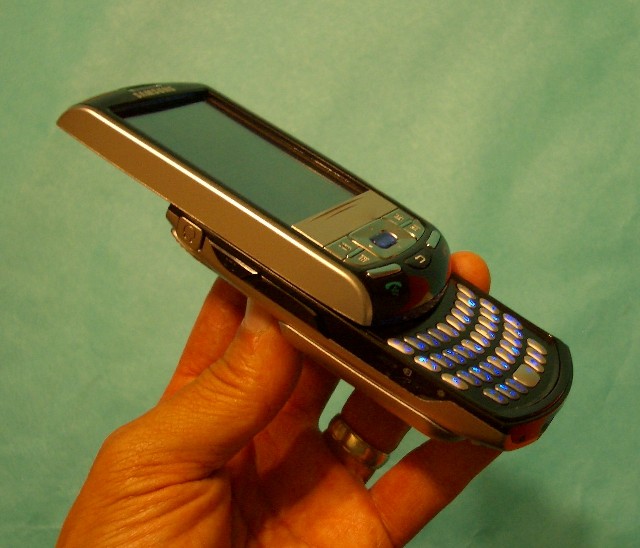
Slidkeyboardextendedbattery_1 Samsung’s new SCH-i730 is a major improvement over their previous i700. The most visible change is the slide-down QWERTY thumb keyboard, for e-mail and other text entry duties. Less visible, but perhaps more important is the enhanced wireless power built into the device. The i730 has a built-in EVDO/1xRTT capable mobile phone as well as integrated Wi-Fi and Bluetooth capability.
Samsung was very serious about getting a form factor out that will be attractive to anyone interested in an integrated tactical keyboard yet keeping the overall size small. Verizon Wireless will be carrying the Samsung i730 product and I have heard that the availability should be around July 7.
Imgp0981The i730 ships with an AC charger that plugs directly into the i730 or into the USB desk cradle that folds to easily fit in your Pocket. The cradle not only recharges your i730, it simultaneously charges a second high-capacity battery that comes with the unit. The extended battery is great to bring along with you if you use the battery-draining Wi-Fi capability.
The Samsung device ships with a carrying case in the increasingly popular belt clip style, with a plastic snap holder that allows the device to be clipped to your belt in with the screen facing in toward the body for protection. The phone clip is able to be rotated around the belt clip pivot. Samsung also included a second stylus in the package.
Imgp0971_1 Fig. 1: The PalmOS Treo 650 (left) next to the Samsung i730.
The PalmOS-based competitor to this is the new Treo 650. Figure 1 shows the Treo 650 and Samsung i730 side by side. Although the i730 is slightly thicker, it feels great in the hand. The screen resolution of the i730 (240 x 320 pixels) is less than the Treo (320 x 320), however the i730 displayed my webblog in better detail. The Treo is a great form factor but the hidden keyboard of the i730 really gives this a WOW factor. I love the fact that the i730 gives me choices for doing input by using the QWERTY thumb keyboard or directly writing on the touch screen using the powerful handwriting recognition capability, which isn’t available on the Treo.
Imgp0871You can see the i730 here stacks up very nicely to the small Smartphone and imate JAM. The imate JAM which was by far the smallest Pocket PC not to mention Pocket PC Phone Edition.
Built-in software
The device is based on Microsoft’s Windows Mobile 2003 Second Edition software for the Pocket PC Phone Edition. This suite includes the Windows Mobile 2003 Second Edition OS and “Pocket” versions of Outlook, Word, Excel, Internet Explorer, Windows Media Player, and Windows Media Player 10. In addition, it includes a Phone Dialer to interface with the phone technology, a variety of configuration utilities, and a few other apps. A user-installable version of Microsoft’s desktop PC synchronization program ActiveSync is found on the Companion CD.
Srs_wow Fig: SRS WOW XT lets you fine tune the i730’s audio.
In addition to the standard software from Microsoft, the i730 comes with SRS WOW XT, an application that noticeably improves the audio on the device using its SRS 3D Effect, Focus, and TruBass settings. You can access the SRS feature directly from an icon at the bottom of the Today Screen. Also contributing to the enriched audio experience is the amazingly loud and clear sounding audio / phone speakers on the back of the device.
I730_008I730_014 Samsung added a number of cool applications to the i730, including a TV/VCR remote controller (left), Ringtone manager, and Launcher (right). Samsung also added Launcher (great way to use the device with one hand using the 5-way directional pad) CarKit Volume, Ringtone Manager, Today Screen Wireless plug-in, OBEX FTP, Remote Control (turns the i730 into a programmable universal infrared remote), Sprite Backup (an award winning way to backup your data and programs), VoiceSignal (use your voice to call and lookup contacts or even open a few apps) and the radically cool Picsel Browser.
Picsel Browser can easily show a full Web site screen as well as zoom in very close with superb detail by tapping the screen. I saw the early version of Picsel Browser (www.picsel.com/manufacturers/browser/) demoed a while ago, but this is the first time I have seen it incorporated into a Windows Mobile device. It is hard to describe how easy this is to use—it must be experienced to be truly appreciated. Picsel Browser allows you read most common document types and browse the Web. You can “pan” the viewed page by stroking the screen in any direction as if you were pushing around a piece of paper on your desk. You can zoom in or out by simply tapping on the screen, let go and then quickly touch the screen again with an up or down stroke. You can easily control the amount of zoom by keeping you pen on the screen as you stroke. Say “bye-bye” to those horizontal and vertical windows scroll bars when viewing with Picsel.
Under the hood
The processor is the Intel PXA272 running at 520 MHz. Combined with 64 MB of RAM (57 MB available), the unit runs applications very quickly. I can’t wait to send an i730 over to my buddies at Pocket PC Techs (www.pocketpctechs.com) to see if they can upgrade it to a full 128MB of RAM. The i730 ships with a whopping 128 MB of flash ROM, 86 MB of which is available to the user. Data stored in this “SafeStore” is non-volatile—secure even if you loose battery power.
The power/sync connector located on the bottom is the same as the i600 or i700 models, which means you should be able to use i600 or i700 accessories with the device. My SPH-i700 Series Lil Sync Pro Retractable Sync-N-Charge Cable from Pocket PC Techs worked like a charm, allowing me to sync the device and power my device from my laptop’s USB port. However, Wi-Fi and Bluetooth draw too much power and I had to turn them off to recharge the battery. I also highly recommend the screen protector for the device. I am very picky about screen protectors and I feel the WriteSHIELDS from Pocket PC Techs are the best on the market.
The well-engineered spring-loaded QWERTY keyboard slides smoothly down from the bottom half of the i730. This slide is much better designed than on the HTC membrane keyboard of the MDA3 line. The feel of the keys is very nice, and it’s easy to distinguish between them because of their raised button feel. The keyboard is backlit in blue, so you can see them in poor lighting conditions. Press any key and the back lighting comes on. You can adjust how long you want the backlight to stay on.
Wireless via Integrated WiFi, EVDO/1xRTT, Bluetooth, Infrared or CDMA
The WiFi runs just as you would expect with auto-configuration of Windows Mobile. When you are outside a Wi-Fi access point you get online with the blazing fast EVDO services. I wasn’t able to test out the high speed wireless data EVDO because my hometown of Albuquerque isn’t up yet. I have read I can expect it to check in at over 600 Kbps. I ended up connecting on using 1XRTT with speeds around 100 Kbps. I will be in Atlanta and Orlando so I will give it a go there.
Bluespoonax I used the Bluespoon AX headset to answer calls and control the operation of the i730 via the built-in VoiceSignal software. The built-in Bluetooth worked fine for me also. I was able to pair up immediately with my Bluespoon AX headset and answer incoming calls by tapping the AX’s receive/call button. However the coolest thing was being able to use Bluespoon AX with the VoiceSignal software. I simply tapped the receive/call button and I could use my voice to directly dial any of my existing contacts or tell the i730 to dial any number. Although VoiceSignal isn’t as powerful as Microsoft’s VoiceCommand, the capability to use my Bluespoon AX is SWEET!
Bluetooth_stowaway__1 I had no problem getting the Think Outside Stowaway Bluetooth keyboard to work with the i730. The Bluetooth Manager even includes a HID Connection Manager. It allowed me to connect to the i730 with my Think Outside Stowaway Bluetooth keyboard without the need to install additional software drivers. The built-in thumb keyboard, but it’s easier to input data quickly with this full-size mobile keyboard.
One very amazing Pocket PC
The i730 does not come with an integrated digital camera. It appears that Samsung left room on the back of the device for a camera. I hope they decide to include one in a future version of the device. The huge SafeStore size is great for secure data storage.
The keyboard was nice, but with Second Edition’s landscape viewing capability, I would love to have seen the keyboard slide out from the side of the unit, to be used with landscape mode. This would have allowed for larger keys, or for the existing ones to be slightly farther apart and easier to hit. Although I know many people who prefer thumb keyboards, I still find it easier and faster to use the touch screen interface to enter text.
Finally, Microsoft just released the latest version of its OS and application suite, Windows Mobile 5.0. Devices with integrated phone capability face a long testing period to insure that they work with the wireless networks they are designed for. Yes, it would have been great if the i730 had Windows Mobile 5.0 built into it. But if that were the case, we’d probably be waiting for this excellent device for another six months. Still, I noticed that the user interface for the VoiceSignal software has the two Smartphone-like “soft keys” at the bottom of the screen; a feature found on all Windows Mobile 5.0 Pocket PCs. Hopefully, this bodes well for a future upgrade.
Conclusion
Putting the minor things aside, the Samsung SCH-i730 is an amazing product. Its small size and QWERTY keyboard will attract many users, as will its fast wireless capabilities. Although I’ve been very satisfied with my i-mate JAM, I can hardly wait for the i730 to be released.
Updated since original writing;
Stuff to Love;
- Bunch of dedicated extra buttons; It has the expected Send and End phone buttons not to mention the 4 dedicated buttons on the front surrounding the 5-way Nav button. PLUS...
- The "Back" function button between the phone Send and End buttons. This makes for a greatly improved one handed operation of the device and again shows the forward seeking hardware design of the product. This hopefully bodes well for the potential upgrade to Windows Mobile 5 someday.
- The VoiceSignal button on the right side below the SD slot. This makes initiating the app very easy.
- The sliding spring loaded switch on the left side that in one position keylocks the phone int he up position. This gives you visual confirmation that the phone is locked to prevent accidental operation and it also triggers a small red KEYLOCK icon the home screen... This same switch also puts the unit in suspend mode and blanks the screen when slid in the down position. I typically slide it down to turn off the screen and then immediately up to keylock the device before I put in in my pocket.
- The earphone jack is more of the universal standard instead of the unique i700/i600 version with the wierd collar.
Stuff to wish for;
- The WirelessSync app that Verizon ncludes on the device makes it a little confusing if your intent is to directly sync to a Windows Exchange 2003 Server ExchangeSync directly using the Windows Mobile ActiveSync on the device.
- The battery life on this unit seems to drain faster than I would have liked although having the two batteries has been a super blessing and prevents me from running into any problems. I am only able to run two days before a recharge is necessary. I don't have the official released product so I don't know how this translates to the final product.
Slidkeyboardextendedbattery_1 Samsung’s new SCH-i730 is a major improvement over their previous i700. The most visible change is the slide-down QWERTY thumb keyboard, for e-mail and other text entry duties. Less visible, but perhaps more important is the enhanced wireless power built into the device. The i730 has a built-in EVDO/1xRTT capable mobile phone as well as integrated Wi-Fi and Bluetooth capability.
Samsung was very serious about getting a form factor out that will be attractive to anyone interested in an integrated tactical keyboard yet keeping the overall size small. Verizon Wireless will be carrying the Samsung i730 product and I have heard that the availability should be around July 7.
Imgp0981The i730 ships with an AC charger that plugs directly into the i730 or into the USB desk cradle that folds to easily fit in your Pocket. The cradle not only recharges your i730, it simultaneously charges a second high-capacity battery that comes with the unit. The extended battery is great to bring along with you if you use the battery-draining Wi-Fi capability.
The Samsung device ships with a carrying case in the increasingly popular belt clip style, with a plastic snap holder that allows the device to be clipped to your belt in with the screen facing in toward the body for protection. The phone clip is able to be rotated around the belt clip pivot. Samsung also included a second stylus in the package.
Imgp0971_1 Fig. 1: The PalmOS Treo 650 (left) next to the Samsung i730.
The PalmOS-based competitor to this is the new Treo 650. Figure 1 shows the Treo 650 and Samsung i730 side by side. Although the i730 is slightly thicker, it feels great in the hand. The screen resolution of the i730 (240 x 320 pixels) is less than the Treo (320 x 320), however the i730 displayed my webblog in better detail. The Treo is a great form factor but the hidden keyboard of the i730 really gives this a WOW factor. I love the fact that the i730 gives me choices for doing input by using the QWERTY thumb keyboard or directly writing on the touch screen using the powerful handwriting recognition capability, which isn’t available on the Treo.
Imgp0871You can see the i730 here stacks up very nicely to the small Smartphone and imate JAM. The imate JAM which was by far the smallest Pocket PC not to mention Pocket PC Phone Edition.
Built-in software
The device is based on Microsoft’s Windows Mobile 2003 Second Edition software for the Pocket PC Phone Edition. This suite includes the Windows Mobile 2003 Second Edition OS and “Pocket” versions of Outlook, Word, Excel, Internet Explorer, Windows Media Player, and Windows Media Player 10. In addition, it includes a Phone Dialer to interface with the phone technology, a variety of configuration utilities, and a few other apps. A user-installable version of Microsoft’s desktop PC synchronization program ActiveSync is found on the Companion CD.
Srs_wow Fig: SRS WOW XT lets you fine tune the i730’s audio.
In addition to the standard software from Microsoft, the i730 comes with SRS WOW XT, an application that noticeably improves the audio on the device using its SRS 3D Effect, Focus, and TruBass settings. You can access the SRS feature directly from an icon at the bottom of the Today Screen. Also contributing to the enriched audio experience is the amazingly loud and clear sounding audio / phone speakers on the back of the device.
I730_008I730_014 Samsung added a number of cool applications to the i730, including a TV/VCR remote controller (left), Ringtone manager, and Launcher (right). Samsung also added Launcher (great way to use the device with one hand using the 5-way directional pad) CarKit Volume, Ringtone Manager, Today Screen Wireless plug-in, OBEX FTP, Remote Control (turns the i730 into a programmable universal infrared remote), Sprite Backup (an award winning way to backup your data and programs), VoiceSignal (use your voice to call and lookup contacts or even open a few apps) and the radically cool Picsel Browser.
Picsel Browser can easily show a full Web site screen as well as zoom in very close with superb detail by tapping the screen. I saw the early version of Picsel Browser (www.picsel.com/manufacturers/browser/) demoed a while ago, but this is the first time I have seen it incorporated into a Windows Mobile device. It is hard to describe how easy this is to use—it must be experienced to be truly appreciated. Picsel Browser allows you read most common document types and browse the Web. You can “pan” the viewed page by stroking the screen in any direction as if you were pushing around a piece of paper on your desk. You can zoom in or out by simply tapping on the screen, let go and then quickly touch the screen again with an up or down stroke. You can easily control the amount of zoom by keeping you pen on the screen as you stroke. Say “bye-bye” to those horizontal and vertical windows scroll bars when viewing with Picsel.
Under the hood
The processor is the Intel PXA272 running at 520 MHz. Combined with 64 MB of RAM (57 MB available), the unit runs applications very quickly. I can’t wait to send an i730 over to my buddies at Pocket PC Techs (www.pocketpctechs.com) to see if they can upgrade it to a full 128MB of RAM. The i730 ships with a whopping 128 MB of flash ROM, 86 MB of which is available to the user. Data stored in this “SafeStore” is non-volatile—secure even if you loose battery power.
The power/sync connector located on the bottom is the same as the i600 or i700 models, which means you should be able to use i600 or i700 accessories with the device. My SPH-i700 Series Lil Sync Pro Retractable Sync-N-Charge Cable from Pocket PC Techs worked like a charm, allowing me to sync the device and power my device from my laptop’s USB port. However, Wi-Fi and Bluetooth draw too much power and I had to turn them off to recharge the battery. I also highly recommend the screen protector for the device. I am very picky about screen protectors and I feel the WriteSHIELDS from Pocket PC Techs are the best on the market.
The well-engineered spring-loaded QWERTY keyboard slides smoothly down from the bottom half of the i730. This slide is much better designed than on the HTC membrane keyboard of the MDA3 line. The feel of the keys is very nice, and it’s easy to distinguish between them because of their raised button feel. The keyboard is backlit in blue, so you can see them in poor lighting conditions. Press any key and the back lighting comes on. You can adjust how long you want the backlight to stay on.
Wireless via Integrated WiFi, EVDO/1xRTT, Bluetooth, Infrared or CDMA
The WiFi runs just as you would expect with auto-configuration of Windows Mobile. When you are outside a Wi-Fi access point you get online with the blazing fast EVDO services. I wasn’t able to test out the high speed wireless data EVDO because my hometown of Albuquerque isn’t up yet. I have read I can expect it to check in at over 600 Kbps. I ended up connecting on using 1XRTT with speeds around 100 Kbps. I will be in Atlanta and Orlando so I will give it a go there.
Bluespoonax I used the Bluespoon AX headset to answer calls and control the operation of the i730 via the built-in VoiceSignal software. The built-in Bluetooth worked fine for me also. I was able to pair up immediately with my Bluespoon AX headset and answer incoming calls by tapping the AX’s receive/call button. However the coolest thing was being able to use Bluespoon AX with the VoiceSignal software. I simply tapped the receive/call button and I could use my voice to directly dial any of my existing contacts or tell the i730 to dial any number. Although VoiceSignal isn’t as powerful as Microsoft’s VoiceCommand, the capability to use my Bluespoon AX is SWEET!
Bluetooth_stowaway__1 I had no problem getting the Think Outside Stowaway Bluetooth keyboard to work with the i730. The Bluetooth Manager even includes a HID Connection Manager. It allowed me to connect to the i730 with my Think Outside Stowaway Bluetooth keyboard without the need to install additional software drivers. The built-in thumb keyboard, but it’s easier to input data quickly with this full-size mobile keyboard.
One very amazing Pocket PC
The i730 does not come with an integrated digital camera. It appears that Samsung left room on the back of the device for a camera. I hope they decide to include one in a future version of the device. The huge SafeStore size is great for secure data storage.
The keyboard was nice, but with Second Edition’s landscape viewing capability, I would love to have seen the keyboard slide out from the side of the unit, to be used with landscape mode. This would have allowed for larger keys, or for the existing ones to be slightly farther apart and easier to hit. Although I know many people who prefer thumb keyboards, I still find it easier and faster to use the touch screen interface to enter text.
Finally, Microsoft just released the latest version of its OS and application suite, Windows Mobile 5.0. Devices with integrated phone capability face a long testing period to insure that they work with the wireless networks they are designed for. Yes, it would have been great if the i730 had Windows Mobile 5.0 built into it. But if that were the case, we’d probably be waiting for this excellent device for another six months. Still, I noticed that the user interface for the VoiceSignal software has the two Smartphone-like “soft keys” at the bottom of the screen; a feature found on all Windows Mobile 5.0 Pocket PCs. Hopefully, this bodes well for a future upgrade.
Conclusion
Putting the minor things aside, the Samsung SCH-i730 is an amazing product. Its small size and QWERTY keyboard will attract many users, as will its fast wireless capabilities. Although I’ve been very satisfied with my i-mate JAM, I can hardly wait for the i730 to be released.
Updated since original writing;
Stuff to Love;
- Bunch of dedicated extra buttons; It has the expected Send and End phone buttons not to mention the 4 dedicated buttons on the front surrounding the 5-way Nav button. PLUS...
- The "Back" function button between the phone Send and End buttons. This makes for a greatly improved one handed operation of the device and again shows the forward seeking hardware design of the product. This hopefully bodes well for the potential upgrade to Windows Mobile 5 someday.
- The VoiceSignal button on the right side below the SD slot. This makes initiating the app very easy.
- The sliding spring loaded switch on the left side that in one position keylocks the phone int he up position. This gives you visual confirmation that the phone is locked to prevent accidental operation and it also triggers a small red KEYLOCK icon the home screen... This same switch also puts the unit in suspend mode and blanks the screen when slid in the down position. I typically slide it down to turn off the screen and then immediately up to keylock the device before I put in in my pocket.
- The earphone jack is more of the universal standard instead of the unique i700/i600 version with the wierd collar.
Stuff to wish for;
- The WirelessSync app that Verizon ncludes on the device makes it a little confusing if your intent is to directly sync to a Windows Exchange 2003 Server ExchangeSync directly using the Windows Mobile ActiveSync on the device.
- The battery life on this unit seems to drain faster than I would have liked although having the two batteries has been a super blessing and prevents me from running into any problems. I am only able to run two days before a recharge is necessary. I don't have the official released product so I don't know how this translates to the final product.
Thursday, June 23, 2005
Verizon Wireless EV-DO review by PC Magazine
Verizon Wireless EV-DO review by PC MagazineVerizon Wireless EV-DO
REVIEW DATE: 03.02.05
Total posts: 1
The Verizon Wireless EV-DO network is the clear leader among 3G high-speed wireless options. Already available in 32 U.S. metro areas, it's your best bet for getting the mobile Internet from anywhere at any time. It's powerful and addictive, and it's our Editors' Choice.
SLIDESHOW (3)
Slideshow | All Shots
Verizon isn't just faster than the competition; it is also way ahead in building out its network. Its impressive 32-city coverage area typically includes more than just a core city. For example: Its New York and Philadelphia coverage areas stretch out through New Jersey and nearly join in the middle, and its Washington, D.C., area extends all the way to Annapolis, Maryland. Verizon has committed to covering 150 million Americans by the end of 2005.
We used Verizon's unlimited EV-DO plan, called BroadbandAccess, to connect to our corporate network while riding on Amtrak from New York City to Philadelphia and to avoid the daily broadband charges at Las Vegas hotels. In all cases, we connected quickly and easily. BroadbandAccess can change the way you work, untethering you from traditional hot spots and poky cellular connections.
Devices that use Verizon Wireless EV-DO
• Audiovox XV-6600
• LG VX8000
• Sierra Wireless AirCard 580
Verizon's technology, properly known as CDMA 1xRTT EV-DO, opens a wide channel on an existing CDMA network just for data, which can travel at very high speeds. Verizon quotes average speeds of 300 to 500 Kbps, but the technology can theoretically reach speeds of 2.4 Mbps. EV-DO coexists with, but doesn't alter, a carrier's existing CDMA 1xRTT voice network.
UMTS, on the other hand, completely replaces older GSM systems with a new, combined voice/data system. UMTS is actually a more radical technology, but it's slower than EV-DO for data because of differences in spectrum usage and signal power management strategies.
On tests in New York, northern Virginia, and Las Vegas, we got speeds averaging 677 Kbps, with highs up to 1.1 Mbps and lows down to 216 Kbps. In other words, our slowest EV-DO connection was just about as fast as our fastest EDGE connection. We even got up to 693 Kbps on a moving train. Upload speeds were much slower, averaging 90 Kbps.
As for service plans, Verizon has very few options. The BroadbandAccess plan for PC Cards is a pricey $79.99 per month, but it's very easy to use—just pop a PC Card into your laptop. The PC Cards sell for as little as $49 with a two-year contract.
BroadbandAccess for PDAs makes you pay more up front for an expensive PDA/ phone, but costs less monthly. It currently works solely with the $549 Audiovox XV6600 PDA/phone. For $45 a month, you get unlimited Internet on your PDA or laptop, using the XV6600 as a Bluetooth or USB modem. There's one big catch: Bluetooth speeds seem to be capped around 400 Kbps, and the USB function isn't supported, so you must configure the USB modem based on hobbyist Web sites if you want a faster connection than Bluetooth offers.
V Cast, Verizon's $15-per-month consumer EV-DO service, is much less compelling than BroadbandAccess. V Cast currently comes on three phones (priced with one-year contracts): the Audiovox 8940 ($299 direct), LG VX8000 ($269), and Samsung SCH-a890 ($319). There's no e-mail, no Web browsing, no laptop connections, not even the ability to view video clips other than the ones Verizon chooses to bring you.
To its credit, V Cast includes a range of 2- to 5-minute clips from providers like CNN, Comedy Central, Fox Sports, NBC, PBS, and VH1, and about 300 new clips arrive per day. The clips are smooth and clear, the best we've seen on a phone, although talking heads sometimes lose lip sync. Still, despite the variety, we got bored with V Cast pretty quickly.
Verizon isn't the only carrier going with EV-DO. Sprint will roll out its EV-DO service later this year, and we expect Nextel to go the EV-DO route as well, now that it has merged with Sprint. Virgin Mobile, Qwest, and the new AT&T Mobile will also use EV-DO, as they're on Sprint's physical network. Sprint says its prices will be competitive with Verizon's for similar services.
If you are willing to pay, Verizon EV-DO—specifically BroadbandAccess—is the best high-speed wireless access you can currently get in the U.S. You'll be surfing speedily while the folks around you hunt for hot spots.
REVIEW DATE: 03.02.05
Total posts: 1
The Verizon Wireless EV-DO network is the clear leader among 3G high-speed wireless options. Already available in 32 U.S. metro areas, it's your best bet for getting the mobile Internet from anywhere at any time. It's powerful and addictive, and it's our Editors' Choice.
SLIDESHOW (3)
Slideshow | All Shots
Verizon isn't just faster than the competition; it is also way ahead in building out its network. Its impressive 32-city coverage area typically includes more than just a core city. For example: Its New York and Philadelphia coverage areas stretch out through New Jersey and nearly join in the middle, and its Washington, D.C., area extends all the way to Annapolis, Maryland. Verizon has committed to covering 150 million Americans by the end of 2005.
We used Verizon's unlimited EV-DO plan, called BroadbandAccess, to connect to our corporate network while riding on Amtrak from New York City to Philadelphia and to avoid the daily broadband charges at Las Vegas hotels. In all cases, we connected quickly and easily. BroadbandAccess can change the way you work, untethering you from traditional hot spots and poky cellular connections.
Devices that use Verizon Wireless EV-DO
• Audiovox XV-6600
• LG VX8000
• Sierra Wireless AirCard 580
Verizon's technology, properly known as CDMA 1xRTT EV-DO, opens a wide channel on an existing CDMA network just for data, which can travel at very high speeds. Verizon quotes average speeds of 300 to 500 Kbps, but the technology can theoretically reach speeds of 2.4 Mbps. EV-DO coexists with, but doesn't alter, a carrier's existing CDMA 1xRTT voice network.
UMTS, on the other hand, completely replaces older GSM systems with a new, combined voice/data system. UMTS is actually a more radical technology, but it's slower than EV-DO for data because of differences in spectrum usage and signal power management strategies.
On tests in New York, northern Virginia, and Las Vegas, we got speeds averaging 677 Kbps, with highs up to 1.1 Mbps and lows down to 216 Kbps. In other words, our slowest EV-DO connection was just about as fast as our fastest EDGE connection. We even got up to 693 Kbps on a moving train. Upload speeds were much slower, averaging 90 Kbps.
As for service plans, Verizon has very few options. The BroadbandAccess plan for PC Cards is a pricey $79.99 per month, but it's very easy to use—just pop a PC Card into your laptop. The PC Cards sell for as little as $49 with a two-year contract.
BroadbandAccess for PDAs makes you pay more up front for an expensive PDA/ phone, but costs less monthly. It currently works solely with the $549 Audiovox XV6600 PDA/phone. For $45 a month, you get unlimited Internet on your PDA or laptop, using the XV6600 as a Bluetooth or USB modem. There's one big catch: Bluetooth speeds seem to be capped around 400 Kbps, and the USB function isn't supported, so you must configure the USB modem based on hobbyist Web sites if you want a faster connection than Bluetooth offers.
V Cast, Verizon's $15-per-month consumer EV-DO service, is much less compelling than BroadbandAccess. V Cast currently comes on three phones (priced with one-year contracts): the Audiovox 8940 ($299 direct), LG VX8000 ($269), and Samsung SCH-a890 ($319). There's no e-mail, no Web browsing, no laptop connections, not even the ability to view video clips other than the ones Verizon chooses to bring you.
To its credit, V Cast includes a range of 2- to 5-minute clips from providers like CNN, Comedy Central, Fox Sports, NBC, PBS, and VH1, and about 300 new clips arrive per day. The clips are smooth and clear, the best we've seen on a phone, although talking heads sometimes lose lip sync. Still, despite the variety, we got bored with V Cast pretty quickly.
Verizon isn't the only carrier going with EV-DO. Sprint will roll out its EV-DO service later this year, and we expect Nextel to go the EV-DO route as well, now that it has merged with Sprint. Virgin Mobile, Qwest, and the new AT&T Mobile will also use EV-DO, as they're on Sprint's physical network. Sprint says its prices will be competitive with Verizon's for similar services.
If you are willing to pay, Verizon EV-DO—specifically BroadbandAccess—is the best high-speed wireless access you can currently get in the U.S. You'll be surfing speedily while the folks around you hunt for hot spots.
PC Magazine Editors' Choice: Verizon Wireless EV-DO
PC Magazine Editors' Choice: Verizon Wireless EV-DO: "1 "
Editors' Choice: Verizon Wireless EV-DO
03.02.05
Total posts: 1
Of the three 3G cellular networks available today, Verizon Wireless EV-DO is the only one that truly realizes the promise of widely available, high-speed wireless. With a good signal, EV-DO feels like real broadband. We tested it with the Sierra Wireless AirCard 580, also an Editors' Choice. EV-DO is available in 32 cities and many of those cities' suburbs, with a lot more locations to come in 2005. Sure, it's expensive, and we wish Verizon offered EV-DO phones that truly connected to the Internet, in addition to fully functional PDAs, PC Cards, and Internet-restricted phones. But road warriors who regularly shell out for hotel and hot spot Internet connections will see the value. And EV-DO passed our ultimate test: None of the editors we loaned a PC Card to wanted to give it back. That means Verizon Wireless EV-DO truly is an Editors' Choice.
Editors' Choice: Verizon Wireless EV-DO
03.02.05
Total posts: 1
Of the three 3G cellular networks available today, Verizon Wireless EV-DO is the only one that truly realizes the promise of widely available, high-speed wireless. With a good signal, EV-DO feels like real broadband. We tested it with the Sierra Wireless AirCard 580, also an Editors' Choice. EV-DO is available in 32 cities and many of those cities' suburbs, with a lot more locations to come in 2005. Sure, it's expensive, and we wish Verizon offered EV-DO phones that truly connected to the Internet, in addition to fully functional PDAs, PC Cards, and Internet-restricted phones. But road warriors who regularly shell out for hotel and hot spot Internet connections will see the value. And EV-DO passed our ultimate test: None of the editors we loaned a PC Card to wanted to give it back. That means Verizon Wireless EV-DO truly is an Editors' Choice.
Kyocera KPC650 review by PC Magazine
Kyocera KPC650 review by PC MagazineKyocera KPC650
REVIEW DATE: 05.06.05
Total posts: 3
Buy It Here $99.99
By Sascha Segan
How short some leaders reign. After only a few weeks, there's a new leader in the land of high-speed cellular cards: the Kyocera KPC650. Like our previous Editors' Choice, the Novatel Wireless V620, the Kyocera card uses the new Qualcomm MSM6500 chipset to squeeze the maximum possible bandwidth out of Verizon's excellent EV-DO data network. But the Kyocera card adds a swiveling antenna, which boosts its ability to capture signals.
During a week of testing in Manhattan, the KPC650 beat the Novatel V620's downlink throughput two-thirds of the time, with an average margin of 56 Kbps. It beat our baseline Verizon Wireless PC 5220 card 77 percent of the time, with an average margin of 108 Kbps. Because network conditions greatly affect these tests, it would be unfair to compare these test results with the results from earlier reviews. A better means of comparison is to test each card at the same time and in the same locations, which is what we did.
* Sierra Wireless AirCard 775
* Sierra Wireless AirCard 580
* Kyocera Passport
* Verizon Wireless PC 5220
* Wireless Without Borders: Networks for Those on the Go
Overall, the Kyocera card averaged speeds of 700 to 764 Kbps on our tests. Since we test in a wide variety of conditions, we saw results ranging from 107 Kbps to 1.23 Mbps.
Most impressively, the Kyocera card worked in areas where other cards didn't. In a stone building where our readings showed a very low -100 dBm to -108 dBm of EV-DO signal, we got a consistent, albeit slow, connection with the KPC650, whereas we saw frequent signal dropouts with the other two cards.
Since EV-DO uplink speeds are capped at 153 Kbps, we saw much less difference between the cards, but the Kyocera squeaked ahead of the other two by an average of 4 to 5 Kbps.
The KPC650 is available from Verizon for $99.99 ($50 more than the V620), with a two-year contract at $79.99 per month. It's also available from regional carrier Alltel, which is selling the card in Tampa, Cleveland, and Akron under the name "Passport" ($159.99 with a two-year contract, plus $69.99 per month for service). We haven't tested Alltel's network, though, so we can't tell you what kinds of speeds you can expect.
If you just bought a Novatel V620, don't throw it away. It's still a great wireless card. But the Kyocera KPC650 is even better, especially in low-signal areas. That makes it our new Editors' Choice—for now
REVIEW DATE: 05.06.05
Total posts: 3
Buy It Here $99.99
By Sascha Segan
How short some leaders reign. After only a few weeks, there's a new leader in the land of high-speed cellular cards: the Kyocera KPC650. Like our previous Editors' Choice, the Novatel Wireless V620, the Kyocera card uses the new Qualcomm MSM6500 chipset to squeeze the maximum possible bandwidth out of Verizon's excellent EV-DO data network. But the Kyocera card adds a swiveling antenna, which boosts its ability to capture signals.
During a week of testing in Manhattan, the KPC650 beat the Novatel V620's downlink throughput two-thirds of the time, with an average margin of 56 Kbps. It beat our baseline Verizon Wireless PC 5220 card 77 percent of the time, with an average margin of 108 Kbps. Because network conditions greatly affect these tests, it would be unfair to compare these test results with the results from earlier reviews. A better means of comparison is to test each card at the same time and in the same locations, which is what we did.
* Sierra Wireless AirCard 775
* Sierra Wireless AirCard 580
* Kyocera Passport
* Verizon Wireless PC 5220
* Wireless Without Borders: Networks for Those on the Go
Overall, the Kyocera card averaged speeds of 700 to 764 Kbps on our tests. Since we test in a wide variety of conditions, we saw results ranging from 107 Kbps to 1.23 Mbps.
Most impressively, the Kyocera card worked in areas where other cards didn't. In a stone building where our readings showed a very low -100 dBm to -108 dBm of EV-DO signal, we got a consistent, albeit slow, connection with the KPC650, whereas we saw frequent signal dropouts with the other two cards.
Since EV-DO uplink speeds are capped at 153 Kbps, we saw much less difference between the cards, but the Kyocera squeaked ahead of the other two by an average of 4 to 5 Kbps.
The KPC650 is available from Verizon for $99.99 ($50 more than the V620), with a two-year contract at $79.99 per month. It's also available from regional carrier Alltel, which is selling the card in Tampa, Cleveland, and Akron under the name "Passport" ($159.99 with a two-year contract, plus $69.99 per month for service). We haven't tested Alltel's network, though, so we can't tell you what kinds of speeds you can expect.
If you just bought a Novatel V620, don't throw it away. It's still a great wireless card. But the Kyocera KPC650 is even better, especially in low-signal areas. That makes it our new Editors' Choice—for now
Beyond Wi-Fi: Laptop Heaven but a Price - New York Times
Beyond Wi-Fi: Laptop Heaven but a Price - New York TimesJune 23, 2005
Beyond Wi-Fi: Laptop Heaven but a Price
By DAVID POGUE
PLENTY of technologies can get you online wirelessly these days, but there's always a catch. Wi-Fi Internet hot spots are fast and cheap, but they keep you tethered to the airport, hotel or coffee shop where the hot spot originates. A Bluetooth cellphone can get your laptop online, but at the speed of a slug. And smoke signals - well, you know. The privacy issues are a nightmare.
But for the laptop lugger with an expense account, there may be another option. It's a relatively new cellular data network called C.D.M.A. 1xEV-DO, which, as you surely knew, stands for Code Division Multiple Access Evolution-Data Only. No wonder Verizon Wireless, the earliest and largest adopter of this technology, just calls it the BroadbandAccess plan.
To get your laptop onto this very fast wonder-net, you need a special cellular card that slides into its PC-card slot. Novatel and Kyocera have recently given the blossoming EV-DO future a big thumbs-up by releasing new cellular cards for laptops running Windows (and, with a little tweaking, Mac OS X).
EV-DO offers two addictive benefits. First, it's cellular. You don't have to hunt down public hot spots; an entire metropolitan area is a hot spot.
Second, EV-DO means sheer, giddy speed. EV-DO is a so-called 3G (third-generation) network, the fruits of $1 billion in Verizon development. And when your laptop or palmtop locks onto a good signal, you can practically feel the wind in your hair.
How fast is that, exactly? Verizon claims you'll be able to download data at an average of 400 to 700 kilobits per second (kbps), which turns out to be true. That makes EV-DO at least five times as fast as the rival technology offered by Cingular and T-Mobile, called EDGE (70 to 135 kbps), and about seven times as fast as Verizon's original data network (still available), which it calls NationalAccess (60 to 80 kbps).
Yeah, but how fast is that? Who besides network geeks measures anything in kilobits per second?
A more familiar unit might be time, as in how long it might take you to download a two-megabyte attachment. On a dial-up modem, you'd wait over six minutes; Verizon's older NationalAccess service, about five minutes; the EDGE wireless network, about three minutes; and Verizon's BroadbandAccess, about 40 seconds.
In short, using BroadbandAccess (EV-DO), you feel as if you're hooked up to a cable modem, even when you're sitting on a beach, your deck or a speeding commuter train. When your signal is strong, you get Web pages in a flash, file attachments in no time and video feeds without a hiccup.
(Sending data is a different story, however. You average around 100 kbps, because these cards use the older, slower channel for uploading. "When you download a big presentation, it goes really fast," says Roger Entner, a telecom analyst at the consulting firm Ovum. "But then if you forward it to someone else, you feel as though you've hit a wall." He suspects that the wireless carriers limit upload speeds so that wireless laptops can't be used as traveling Web sites. "The wireless carriers want to avoid letting people using the card as a wireless Web server," he explains. "It kind of kills your business model.")
So in general, speed is not a problem with EV-DO. But coverage and price may be.
Verizon's high-speed wireless network now covers 32 major metropolitan areas, including biggies like New York, Los Angeles, Chicago and Miami, along with a somewhat baffling selection of smaller cities like West Palm Beach, Fla., and Madison, Wis. Verizon says that the rollout has just begun, and that by the end of this year, half the American population will be EV-DOable.
Fortunately, even when you're outside the designated cities, you can still get online. Verizon's software seamlessly switches you to its older, slower NationalAccess network, which pretty much works wherever Verizon cellphones do. There's quite a speed hit; you feel as though someone secretly swapped your cable modem for a dial-up modem. But at least you can check your e-mail without having to return to, say, West Palm Beach.
Finally, there's the little matter of price: $80 a month, a price that seems expressly designed to milk corporate business travelers. On one hand, that price gets you unlimited service, and it really is $80 a month; at this point, you're not saddled with the taxes and fees that jack up your cellphone bill. On the other hand, that price doesn't even include cellphone service. (Of course, you can always use a free program like Skype to make voice calls while you're connected - but you didn't hear it from me.)
Then again, Verizon has the playground all to itself, so it can charge whatever it wants. But wait until Sprint introduces its own EV-DO service later this year. You might not be able to pronounce "C.D.M.A. 1xEV-DO," but you can sure say "competition."
If EV-DO sounds, on balance, as though it would be a good fit, your next step is to choose a cellular card for your laptop. Verizon offers three EV-DO models to individuals: Verizon's older, slower, less-featured Audiovox card ($100), and two new ones: the Novatel V620 ($50) and Kyocera's KPC650 ($70). (A fourth card, from Sierra, is offered only to corporations.)
In general, the cards are pretty much alike. Each can automatically switch to the older NationalAccess network when necessary. Each protrudes from your laptop by over an inch, meaning that you'll probably have to eject the card each time you put the laptop back in its case.
The Novatel and Kyocera cards come with Verizon's VZAccess Manager software, a little dashboard that lets you switch among your three wireless options: BroadbandAccess (EV-DO), NationalAccess (the older, slower network with more coverage) and Wi-Fi (if your laptop is so equipped). This software isn't especially gorgeous, but it's rock solid, easy to install and filled with useful displays; one shows a graph of your connection speed, for gloating purposes. It also lets you exchange short text messages with your friends' cellphones.
(The software works only in Windows. But at EVDOinfo.com - a great site for EV-DO news and instruction - Mac OS X fans can find step-by-step instructions for making these cards work in PowerBooks, too.)
Kyocera says there's quite a difference between its card and its rivals, though: its KPC650 is supposed to provide speeds up to 35 percent faster, especially in low-signal areas. Its tricks include faster circuitry, shielding from interference and a flip-out antenna that swivels in any direction. And sure enough: PC Magazine found that the Kyocera card was faster than the Novatel in two-thirds of its test locations.
My tests in downtown Tampa, Fla., which has BroadbandAccess coverage, must have fallen into that "other third" category. With the antenna in its best position, the Kyocera averaged 476 kbps, versus the Novatel's 543. (Test protocol: five runs of the bandwidth tester at www.toast.net.) Clearly, speed tests are flaky and variable, giving different numbers depending on your signal strength, which online bandwidth test page you use, and the mood of the EV-DO gods. (If you really get the bug, you can also buy an external antenna for extra speed and reception.)
But no matter which card you get, the big winner is EV-DO - or it will be, once its coverage grows and its price shrinks. Someday soon, it may even become the first completely satisfying wireless way to get online.
E-mail: Pogue@nytimes.com
Beyond Wi-Fi: Laptop Heaven but a Price
By DAVID POGUE
PLENTY of technologies can get you online wirelessly these days, but there's always a catch. Wi-Fi Internet hot spots are fast and cheap, but they keep you tethered to the airport, hotel or coffee shop where the hot spot originates. A Bluetooth cellphone can get your laptop online, but at the speed of a slug. And smoke signals - well, you know. The privacy issues are a nightmare.
But for the laptop lugger with an expense account, there may be another option. It's a relatively new cellular data network called C.D.M.A. 1xEV-DO, which, as you surely knew, stands for Code Division Multiple Access Evolution-Data Only. No wonder Verizon Wireless, the earliest and largest adopter of this technology, just calls it the BroadbandAccess plan.
To get your laptop onto this very fast wonder-net, you need a special cellular card that slides into its PC-card slot. Novatel and Kyocera have recently given the blossoming EV-DO future a big thumbs-up by releasing new cellular cards for laptops running Windows (and, with a little tweaking, Mac OS X).
EV-DO offers two addictive benefits. First, it's cellular. You don't have to hunt down public hot spots; an entire metropolitan area is a hot spot.
Second, EV-DO means sheer, giddy speed. EV-DO is a so-called 3G (third-generation) network, the fruits of $1 billion in Verizon development. And when your laptop or palmtop locks onto a good signal, you can practically feel the wind in your hair.
How fast is that, exactly? Verizon claims you'll be able to download data at an average of 400 to 700 kilobits per second (kbps), which turns out to be true. That makes EV-DO at least five times as fast as the rival technology offered by Cingular and T-Mobile, called EDGE (70 to 135 kbps), and about seven times as fast as Verizon's original data network (still available), which it calls NationalAccess (60 to 80 kbps).
Yeah, but how fast is that? Who besides network geeks measures anything in kilobits per second?
A more familiar unit might be time, as in how long it might take you to download a two-megabyte attachment. On a dial-up modem, you'd wait over six minutes; Verizon's older NationalAccess service, about five minutes; the EDGE wireless network, about three minutes; and Verizon's BroadbandAccess, about 40 seconds.
In short, using BroadbandAccess (EV-DO), you feel as if you're hooked up to a cable modem, even when you're sitting on a beach, your deck or a speeding commuter train. When your signal is strong, you get Web pages in a flash, file attachments in no time and video feeds without a hiccup.
(Sending data is a different story, however. You average around 100 kbps, because these cards use the older, slower channel for uploading. "When you download a big presentation, it goes really fast," says Roger Entner, a telecom analyst at the consulting firm Ovum. "But then if you forward it to someone else, you feel as though you've hit a wall." He suspects that the wireless carriers limit upload speeds so that wireless laptops can't be used as traveling Web sites. "The wireless carriers want to avoid letting people using the card as a wireless Web server," he explains. "It kind of kills your business model.")
So in general, speed is not a problem with EV-DO. But coverage and price may be.
Verizon's high-speed wireless network now covers 32 major metropolitan areas, including biggies like New York, Los Angeles, Chicago and Miami, along with a somewhat baffling selection of smaller cities like West Palm Beach, Fla., and Madison, Wis. Verizon says that the rollout has just begun, and that by the end of this year, half the American population will be EV-DOable.
Fortunately, even when you're outside the designated cities, you can still get online. Verizon's software seamlessly switches you to its older, slower NationalAccess network, which pretty much works wherever Verizon cellphones do. There's quite a speed hit; you feel as though someone secretly swapped your cable modem for a dial-up modem. But at least you can check your e-mail without having to return to, say, West Palm Beach.
Finally, there's the little matter of price: $80 a month, a price that seems expressly designed to milk corporate business travelers. On one hand, that price gets you unlimited service, and it really is $80 a month; at this point, you're not saddled with the taxes and fees that jack up your cellphone bill. On the other hand, that price doesn't even include cellphone service. (Of course, you can always use a free program like Skype to make voice calls while you're connected - but you didn't hear it from me.)
Then again, Verizon has the playground all to itself, so it can charge whatever it wants. But wait until Sprint introduces its own EV-DO service later this year. You might not be able to pronounce "C.D.M.A. 1xEV-DO," but you can sure say "competition."
If EV-DO sounds, on balance, as though it would be a good fit, your next step is to choose a cellular card for your laptop. Verizon offers three EV-DO models to individuals: Verizon's older, slower, less-featured Audiovox card ($100), and two new ones: the Novatel V620 ($50) and Kyocera's KPC650 ($70). (A fourth card, from Sierra, is offered only to corporations.)
In general, the cards are pretty much alike. Each can automatically switch to the older NationalAccess network when necessary. Each protrudes from your laptop by over an inch, meaning that you'll probably have to eject the card each time you put the laptop back in its case.
The Novatel and Kyocera cards come with Verizon's VZAccess Manager software, a little dashboard that lets you switch among your three wireless options: BroadbandAccess (EV-DO), NationalAccess (the older, slower network with more coverage) and Wi-Fi (if your laptop is so equipped). This software isn't especially gorgeous, but it's rock solid, easy to install and filled with useful displays; one shows a graph of your connection speed, for gloating purposes. It also lets you exchange short text messages with your friends' cellphones.
(The software works only in Windows. But at EVDOinfo.com - a great site for EV-DO news and instruction - Mac OS X fans can find step-by-step instructions for making these cards work in PowerBooks, too.)
Kyocera says there's quite a difference between its card and its rivals, though: its KPC650 is supposed to provide speeds up to 35 percent faster, especially in low-signal areas. Its tricks include faster circuitry, shielding from interference and a flip-out antenna that swivels in any direction. And sure enough: PC Magazine found that the Kyocera card was faster than the Novatel in two-thirds of its test locations.
My tests in downtown Tampa, Fla., which has BroadbandAccess coverage, must have fallen into that "other third" category. With the antenna in its best position, the Kyocera averaged 476 kbps, versus the Novatel's 543. (Test protocol: five runs of the bandwidth tester at www.toast.net.) Clearly, speed tests are flaky and variable, giving different numbers depending on your signal strength, which online bandwidth test page you use, and the mood of the EV-DO gods. (If you really get the bug, you can also buy an external antenna for extra speed and reception.)
But no matter which card you get, the big winner is EV-DO - or it will be, once its coverage grows and its price shrinks. Someday soon, it may even become the first completely satisfying wireless way to get online.
E-mail: Pogue@nytimes.com
BBC NEWS | Technology | Websites alienate Firefox users
BBC NEWS | Technology | Websites alienate Firefox users Websites alienate Firefox users
One in 10 UK websites fail to work properly on the open source Firefox web browser, a study shows.
Some 100 leading consumer sites were assessed by web-testing firm SciVisum.
Websites that proved difficult for Firefox users to navigate included the government website Jobcentreplus.gov.uk and the cinema site Odeon.co.uk.
Firefox is an open source alternative to Microsoft's Internet Explorer and has proved popular since its launch in November last year.
While most people still use Microsoft's browser, Firefox is slowly making inroads.
Its share of the browser market grew to 8% in May, up from 5.59% at the beginning of the year, according to US-based analysts NetApplications.
Microsoft IE's share of the market dropped to 87.23% in May, compared to 90.31% in January.
Question of code
Of the websites that SciVisum tested, 3% were found to be turning away non Internet Explorer (IE) users and 7% of the sites included non-standard code recognised only by Microsoft's browser.
Companies who value their brand need to address browser issues immediately
Deri Jones, SciVisum
"Surprisingly, after all these years, users of standard-compliant browsers are still faced with sites that do not support their browser or with a link suggesting they download Internet Explorer," said Deri Jones, chief executive of SciVisum.
This is largely because web developers are used to testing their sites just using IE rather than so-called standards-compliant browsers, which only use code ratified by the World Wide Web consortium.
"There is a certain business logic to this as IE is the most widely used browser," said Mr Jones.
Microsoft is working on a new version of IE, largely in response to the success of Firefox.
Disabled access
"Companies who value their brand need to address browser issues immediately," said Mr Jones.
FIREFOX INCOMPATIBLE WEBSITES
Odeon.co.uk
Jobcentreplus.gov.uk
Insurance.co.uk
British American Tobacco
Mansell.plc.uk
Companieshouse.gov.uk
Flybmi.com/cargo
bssuk.co.uk
Source: SciVisum
Web developers who create code around the web standards recommended by the World Wide Web stand to gain more than just friends among the alternative browser community.
It will also make it easier for disabled people to use, said Mr Jones.
"Over time developers have begun to misuse the original standards created for the web to create websites that look great to you and I, but are confusing to a disabled person using a screen reader which needs to make sense of the content," he said.
Simplifying things by separating content from presentation will have a third benefit in that it will make it easier for sites to be picked up by search engines, he added.
Some improvements
The Odeon website, which is listed by SciVisum as one of the culprits, has already come in for criticism about how accessible the site is for disabled users.
While its opening page seemed to work fine using Firefox, testers were faced with a blank page when they tried to enter the site.
An Odeon spokesperson said: "Firefox users can enter the site and get all the information about cinema listings and screening times, just without the bells and whistles of the fancier site.
"Instead of using the Enter button, they should use the text-only version."
On the Jobcentreplus site, testers were unable to use the search facility, while insurance.co.uk gave the impression that it was broken despite the fact that it did actually work with the Firefox browser.
The British American Tobacco website hid most of its pages from Firefox users as the menu system did not show choices if visitors are not using IE.
Some sites had made improvements. Electrical retailer Powerhouse initially excluded Firefox users when it launched its new website design in May, but it has since fixed the problem.
And English Heritage no longer sends Firefox browser users to a non-graphical version of the site.
Firefox has been created by the Mozilla Foundation which was started by former browser maker Netscape back in 1998.
The group is an open source organisation which means that the creators of the browser are happy for others to play around with the core code for the program.
Firefox is proving popular because, at the moment, it has far fewer security holes than Internet Explorer and has some innovations lacking in Microsoft's program.
Story from BBC NEWS:
One in 10 UK websites fail to work properly on the open source Firefox web browser, a study shows.
Some 100 leading consumer sites were assessed by web-testing firm SciVisum.
Websites that proved difficult for Firefox users to navigate included the government website Jobcentreplus.gov.uk and the cinema site Odeon.co.uk.
Firefox is an open source alternative to Microsoft's Internet Explorer and has proved popular since its launch in November last year.
While most people still use Microsoft's browser, Firefox is slowly making inroads.
Its share of the browser market grew to 8% in May, up from 5.59% at the beginning of the year, according to US-based analysts NetApplications.
Microsoft IE's share of the market dropped to 87.23% in May, compared to 90.31% in January.
Question of code
Of the websites that SciVisum tested, 3% were found to be turning away non Internet Explorer (IE) users and 7% of the sites included non-standard code recognised only by Microsoft's browser.
Companies who value their brand need to address browser issues immediately
Deri Jones, SciVisum
"Surprisingly, after all these years, users of standard-compliant browsers are still faced with sites that do not support their browser or with a link suggesting they download Internet Explorer," said Deri Jones, chief executive of SciVisum.
This is largely because web developers are used to testing their sites just using IE rather than so-called standards-compliant browsers, which only use code ratified by the World Wide Web consortium.
"There is a certain business logic to this as IE is the most widely used browser," said Mr Jones.
Microsoft is working on a new version of IE, largely in response to the success of Firefox.
Disabled access
"Companies who value their brand need to address browser issues immediately," said Mr Jones.
FIREFOX INCOMPATIBLE WEBSITES
Odeon.co.uk
Jobcentreplus.gov.uk
Insurance.co.uk
British American Tobacco
Mansell.plc.uk
Companieshouse.gov.uk
Flybmi.com/cargo
bssuk.co.uk
Source: SciVisum
Web developers who create code around the web standards recommended by the World Wide Web stand to gain more than just friends among the alternative browser community.
It will also make it easier for disabled people to use, said Mr Jones.
"Over time developers have begun to misuse the original standards created for the web to create websites that look great to you and I, but are confusing to a disabled person using a screen reader which needs to make sense of the content," he said.
Simplifying things by separating content from presentation will have a third benefit in that it will make it easier for sites to be picked up by search engines, he added.
Some improvements
The Odeon website, which is listed by SciVisum as one of the culprits, has already come in for criticism about how accessible the site is for disabled users.
While its opening page seemed to work fine using Firefox, testers were faced with a blank page when they tried to enter the site.
An Odeon spokesperson said: "Firefox users can enter the site and get all the information about cinema listings and screening times, just without the bells and whistles of the fancier site.
"Instead of using the Enter button, they should use the text-only version."
On the Jobcentreplus site, testers were unable to use the search facility, while insurance.co.uk gave the impression that it was broken despite the fact that it did actually work with the Firefox browser.
The British American Tobacco website hid most of its pages from Firefox users as the menu system did not show choices if visitors are not using IE.
Some sites had made improvements. Electrical retailer Powerhouse initially excluded Firefox users when it launched its new website design in May, but it has since fixed the problem.
And English Heritage no longer sends Firefox browser users to a non-graphical version of the site.
Firefox has been created by the Mozilla Foundation which was started by former browser maker Netscape back in 1998.
The group is an open source organisation which means that the creators of the browser are happy for others to play around with the core code for the program.
Firefox is proving popular because, at the moment, it has far fewer security holes than Internet Explorer and has some innovations lacking in Microsoft's program.
Story from BBC NEWS:
Pocket PC Addict > NetFront English v3.2 Version Upgrade Released
Pocket PC AddictNetFront English v3.2 Version Upgrade Released
News
A few eagle-eyed Addict readers pointed out to me that Access has finally released their new ENGLISH NetFront Browser v 3.2 for Pocket PC. The Japanese version has been out for awhile and we haven't heard too much about it since. There is an introductory price of $19.80 for new users and if you are upgrading it's $14.80 to upgrade from version 3.1 to 3.2.
New Features:
● Supports Pocket PC2003 and 2003SE
● Supports Flash(R)
By embedding Macromedia(R) Flash(R) Player into a Pocket PC2003 or 2003SE device, you can browse Flash contents on the device.
● Supports JavaTM
NetFront is compliant with J2METM CDC and handles "JV-Lite2 CE Edition," a Java running environment of ACCESS that supports CDC HI.
● Rapid-RenderTM
Speeds up displaying the Web page by displaying the HTML text and the hyperlinks first, and then displaying images and tables.
● Smart-Fit RenderingTM
For easy view, this function fits the Web page to the size of the PDA screen.
This function also enables you to browse general Web pages without using the horizontal scroll bar.
● Muli-Window Browsing
By selecting the tab for each window, you can open up to five windows at once and switch from one to another.
News
A few eagle-eyed Addict readers pointed out to me that Access has finally released their new ENGLISH NetFront Browser v 3.2 for Pocket PC. The Japanese version has been out for awhile and we haven't heard too much about it since. There is an introductory price of $19.80 for new users and if you are upgrading it's $14.80 to upgrade from version 3.1 to 3.2.
New Features:
● Supports Pocket PC2003 and 2003SE
● Supports Flash(R)
By embedding Macromedia(R) Flash(R) Player into a Pocket PC2003 or 2003SE device, you can browse Flash contents on the device.
● Supports JavaTM
NetFront is compliant with J2METM CDC and handles "JV-Lite2 CE Edition," a Java running environment of ACCESS that supports CDC HI.
● Rapid-RenderTM
Speeds up displaying the Web page by displaying the HTML text and the hyperlinks first, and then displaying images and tables.
● Smart-Fit RenderingTM
For easy view, this function fits the Web page to the size of the PDA screen.
This function also enables you to browse general Web pages without using the horizontal scroll bar.
● Muli-Window Browsing
By selecting the tab for each window, you can open up to five windows at once and switch from one to another.
Wednesday, June 15, 2005
John H. Armwood wants to talk with you on Skype

Or, copy http://recp.rm02.net/servlet/MailView?ms=ODMxNgS2&r=NTU0NzcyNzkyS0&j=MzIzMTE5NTgS1 into your browser.
Download Skype and start calling for free all over the world. My Skype Name is armwood. Add me when you get up and running on Skype!.
Skype me at armwood
Sunday, June 12, 2005
What's Really Behind the Apple-Intel Alliance - New York Times
What's Really Behind the Apple-Intel Alliance - New York TimesJune 11, 2005
What's Really Behind the Apple-Intel Alliance
By JOHN MARKOFF
SAN FRANCISCO, June 10 - Nearly a quarter-century ago, Apple Computer ran a snarky ad after its onetime rival encroached on its territory: "Welcome, I.B.M. Seriously." This week, however, Steven P. Jobs had a different message for Big Blue, which had since become a chief ally: "Goodbye. Seriously."
Mr. Jobs, 50, a co-founder of Apple, is famously brash and mercurial. Even so, the Apple faithful - not to mention I.B.M. itself - were caught by surprise by Apple's decision to end its 14-year relationship with I.B.M. and team with Intel for its computer chip needs.
The buzz that began Monday among developers, bloggers, analysts and Apple followers trying to guess Mr. Jobs' true designs has not let up. After all, Mr. Jobs is a legend in no small part because he defied the monster combination that is Wintel - as the digerati call the Windows and Intel alliance - and lived to talk about it.
Apple's decision in the 1980's to use a different chip from the one put in most personal computers "fit in with the idea of Think Different," Stephen G. Wozniak, who founded Apple with Mr. Jobs in 1976, said in an e-mail exchange. "So it's hard for some people to accept this switch."
So what could a Macintel possibly hope to accomplish?
Potentially, quite a lot. In striking the deal, Mr. Jobs, Apple's chief executive, has opened a range of tantalizing new options for his quirky company.
Many people in the industry believe that Mr. Jobs is racing quietly toward a direct challenge to Microsoft and Sony in the market for digital entertainment gear for the living room. Indeed, Sony's top executives had tried to persuade Mr. Jobs to adopt a chip that I.B.M. has been developing for the next-generation Sony PlayStation.
An Intel processor inside a Macintosh could put the vast library of Windows-based games and software programs within the reach of Mac users - at least those who are willing to run a second operating system on their computers.
Moreover, having Intel Inside might solve an important perception problem that has long plagued Apple in its effort to convert consumers who are attracted to the company's industrial design, but who have stayed away because the computers do not run Windows programs.
There is an immediate risk in the tie-up with Intel, however: Mr. Jobs could soon find himself trapped if his best customers stop buying I.B.M.-based Macintoshes while they wait for more powerful Intel-based systems, which are likely to begin arriving in January 2006.
"There is going to be a long wait," said Mark D. Stahlman, a Wall Street analyst at Caris & Company. The power-conserving 64-bit Intel chips that Apple is counting on to rejuvenate its laptop products will not be available until early 2007, he pointed out.
In an interview, Mr. Jobs rejected the notion that Apple might suffer from what is known as the "Osborne Effect," a term that describes the fate of the computer pioneer Adam Osborne whose firm went bankrupt when he announced a successor to his pioneering portable computer before it was available.
At Apple's Worldwide Developers Conference on Monday, Mr. Jobs talked of a transition that would appear almost seamless to customers. "As we look ahead we can envision some amazing products we want to build for you and we don't know how to build them with the future PowerPC road map," he said.
Nothing was seamless about how the deal with Intel came together.
Several executives close to the last-minute dealings between Apple and I.B.M. said that Mr. Jobs waited until the last moment - 3 p.m. on Friday, June 4 - to inform Big Blue. Those executives said that I.B.M. had learned about Apple's negotiations with Intel from news reports and that Apple had not returned phone calls in recent weeks.
Each side disputes what led to the breakup. People close to I.B.M. said pricing was a central issue, while Mr. Jobs insisted on stage Monday that I.B.M. had failed to meet promised performance measures.
On stage, Mr. Jobs noted that he had promised both a 3-gigahertz Macintosh as well as a more powerful PowerPC-based portable computer, promises that he had not been able to deliver.
In the end, Mr. Jobs was given no choice but to move his business to Intel, when I.B.M. executives said that without additional Apple investment they were unwilling to pursue the faster and lower-power chips he badly needs for his laptop business.
"Technical issues were secondary to the business issues," said an executive close to the I.B.M. side of the negotiations. Because the business was not profitable, I.B.M. "decided not to continue to go ahead with the product road map."
But Mr. Jobs disputed this assessment, simply stating that I.B.M. had failed to meet its technology road map. The issues in the end, he said, came down to speed and the absence of a chip that consumed less electricity than traditional processors designed for PC's.
"As soon as I heard Steve say that the factor where Intel's road map was superior was processing power per [watt] I knew right away that it was exactly what I have been reading and saying and so have many others, that this is the real key to the future of high performance computers," Mr. Wozniak wrote.
As it happens, Intel's was not the only alternative chip design that Apple had explored for the Mac. An executive close to Sony said that last year Mr. Jobs met in California with both Nobuyuki Idei, then the chairman and chief executive of the Japanese consumer electronics firm, and with Kenichi Kutaragi, the creator of the Sony PlayStation.
Mr. Kutaragi tried to interest Mr. Jobs in adopting the Cell chip, which is being developed by I.B.M. for use in the coming PlayStation 3, in exchange for access to certain Sony technologies. Mr. Jobs rejected the idea, telling Mr. Kutaragi that he was disappointed with the Cell design, which he believes will be even less effective than the PowerPC.
Now that Mr. Jobs has broken with I.B.M., however, Apple is free to pursue a potentially intriguing consumer electronics strategy with Intel.
Intel has been looking for ways to get its chips into devices that can compete with game consoles as living-room entertainment hubs. In fact, all three next-generation video game machines made by Microsoft, Nintendo and Sony are based on I.B.M. chips. And analysts say that both Microsoft's Xbox 360 and the Sony PlayStation 3, scheduled to arrive next spring, will be positioned as home media hubs in addition to being video game machines - and priced far lower than the Intel-powered, Windows Media Center PC's that are also aimed at the living room.
Should the new consoles find wide acceptance as broad-based entertainment engines, Intel will need to respond - and one attractive alternative would be an inexpensive Macintosh Mini based on an Intel processor, able to run the vast library of PC games.
Before he can set his sights on that new market, Mr. Jobs faces the task of shoring up his base, his customers and developers. On Monday, he made the case to the software designers who must be willing to rewrite their software for the new Macintel world.
Early indications are that he made a convincing presentation.
"The reason people buy Mac is the software, and I think the real fun is yet to come," said Scott Love, the president of AquaMinds, a software concern in Palo Alto that sells a Macintosh program called NoteTaker used by writers, researchers and students. "We'll be able to develop a program that will just work on both I.B.M. and Intel-based computers."
Even more important will be Mr. Jobs' ability to persuade the Macintosh faithful to join him in his journey from I.B.M. to Intel. That is where he has an advantage over virtually every other executive.
"He is still committed to the idea of an Apple culture," said Peter Schwartz, the co-founder and chairman of the Global Business Network, a consulting firm in Emeryville, Calif. "It is the counterculture to the dominant Windows culture."
Indeed, Mr. Jobs has always set himself apart from other corporate executives. After all, which other American business executive would have thought to name the holding company for his executive jet airplane "Marmalade Skies"?
Steve Lohr contributed reporting from New York for this article..
What's Really Behind the Apple-Intel Alliance
By JOHN MARKOFF
SAN FRANCISCO, June 10 - Nearly a quarter-century ago, Apple Computer ran a snarky ad after its onetime rival encroached on its territory: "Welcome, I.B.M. Seriously." This week, however, Steven P. Jobs had a different message for Big Blue, which had since become a chief ally: "Goodbye. Seriously."
Mr. Jobs, 50, a co-founder of Apple, is famously brash and mercurial. Even so, the Apple faithful - not to mention I.B.M. itself - were caught by surprise by Apple's decision to end its 14-year relationship with I.B.M. and team with Intel for its computer chip needs.
The buzz that began Monday among developers, bloggers, analysts and Apple followers trying to guess Mr. Jobs' true designs has not let up. After all, Mr. Jobs is a legend in no small part because he defied the monster combination that is Wintel - as the digerati call the Windows and Intel alliance - and lived to talk about it.
Apple's decision in the 1980's to use a different chip from the one put in most personal computers "fit in with the idea of Think Different," Stephen G. Wozniak, who founded Apple with Mr. Jobs in 1976, said in an e-mail exchange. "So it's hard for some people to accept this switch."
So what could a Macintel possibly hope to accomplish?
Potentially, quite a lot. In striking the deal, Mr. Jobs, Apple's chief executive, has opened a range of tantalizing new options for his quirky company.
Many people in the industry believe that Mr. Jobs is racing quietly toward a direct challenge to Microsoft and Sony in the market for digital entertainment gear for the living room. Indeed, Sony's top executives had tried to persuade Mr. Jobs to adopt a chip that I.B.M. has been developing for the next-generation Sony PlayStation.
An Intel processor inside a Macintosh could put the vast library of Windows-based games and software programs within the reach of Mac users - at least those who are willing to run a second operating system on their computers.
Moreover, having Intel Inside might solve an important perception problem that has long plagued Apple in its effort to convert consumers who are attracted to the company's industrial design, but who have stayed away because the computers do not run Windows programs.
There is an immediate risk in the tie-up with Intel, however: Mr. Jobs could soon find himself trapped if his best customers stop buying I.B.M.-based Macintoshes while they wait for more powerful Intel-based systems, which are likely to begin arriving in January 2006.
"There is going to be a long wait," said Mark D. Stahlman, a Wall Street analyst at Caris & Company. The power-conserving 64-bit Intel chips that Apple is counting on to rejuvenate its laptop products will not be available until early 2007, he pointed out.
In an interview, Mr. Jobs rejected the notion that Apple might suffer from what is known as the "Osborne Effect," a term that describes the fate of the computer pioneer Adam Osborne whose firm went bankrupt when he announced a successor to his pioneering portable computer before it was available.
At Apple's Worldwide Developers Conference on Monday, Mr. Jobs talked of a transition that would appear almost seamless to customers. "As we look ahead we can envision some amazing products we want to build for you and we don't know how to build them with the future PowerPC road map," he said.
Nothing was seamless about how the deal with Intel came together.
Several executives close to the last-minute dealings between Apple and I.B.M. said that Mr. Jobs waited until the last moment - 3 p.m. on Friday, June 4 - to inform Big Blue. Those executives said that I.B.M. had learned about Apple's negotiations with Intel from news reports and that Apple had not returned phone calls in recent weeks.
Each side disputes what led to the breakup. People close to I.B.M. said pricing was a central issue, while Mr. Jobs insisted on stage Monday that I.B.M. had failed to meet promised performance measures.
On stage, Mr. Jobs noted that he had promised both a 3-gigahertz Macintosh as well as a more powerful PowerPC-based portable computer, promises that he had not been able to deliver.
In the end, Mr. Jobs was given no choice but to move his business to Intel, when I.B.M. executives said that without additional Apple investment they were unwilling to pursue the faster and lower-power chips he badly needs for his laptop business.
"Technical issues were secondary to the business issues," said an executive close to the I.B.M. side of the negotiations. Because the business was not profitable, I.B.M. "decided not to continue to go ahead with the product road map."
But Mr. Jobs disputed this assessment, simply stating that I.B.M. had failed to meet its technology road map. The issues in the end, he said, came down to speed and the absence of a chip that consumed less electricity than traditional processors designed for PC's.
"As soon as I heard Steve say that the factor where Intel's road map was superior was processing power per [watt] I knew right away that it was exactly what I have been reading and saying and so have many others, that this is the real key to the future of high performance computers," Mr. Wozniak wrote.
As it happens, Intel's was not the only alternative chip design that Apple had explored for the Mac. An executive close to Sony said that last year Mr. Jobs met in California with both Nobuyuki Idei, then the chairman and chief executive of the Japanese consumer electronics firm, and with Kenichi Kutaragi, the creator of the Sony PlayStation.
Mr. Kutaragi tried to interest Mr. Jobs in adopting the Cell chip, which is being developed by I.B.M. for use in the coming PlayStation 3, in exchange for access to certain Sony technologies. Mr. Jobs rejected the idea, telling Mr. Kutaragi that he was disappointed with the Cell design, which he believes will be even less effective than the PowerPC.
Now that Mr. Jobs has broken with I.B.M., however, Apple is free to pursue a potentially intriguing consumer electronics strategy with Intel.
Intel has been looking for ways to get its chips into devices that can compete with game consoles as living-room entertainment hubs. In fact, all three next-generation video game machines made by Microsoft, Nintendo and Sony are based on I.B.M. chips. And analysts say that both Microsoft's Xbox 360 and the Sony PlayStation 3, scheduled to arrive next spring, will be positioned as home media hubs in addition to being video game machines - and priced far lower than the Intel-powered, Windows Media Center PC's that are also aimed at the living room.
Should the new consoles find wide acceptance as broad-based entertainment engines, Intel will need to respond - and one attractive alternative would be an inexpensive Macintosh Mini based on an Intel processor, able to run the vast library of PC games.
Before he can set his sights on that new market, Mr. Jobs faces the task of shoring up his base, his customers and developers. On Monday, he made the case to the software designers who must be willing to rewrite their software for the new Macintel world.
Early indications are that he made a convincing presentation.
"The reason people buy Mac is the software, and I think the real fun is yet to come," said Scott Love, the president of AquaMinds, a software concern in Palo Alto that sells a Macintosh program called NoteTaker used by writers, researchers and students. "We'll be able to develop a program that will just work on both I.B.M. and Intel-based computers."
Even more important will be Mr. Jobs' ability to persuade the Macintosh faithful to join him in his journey from I.B.M. to Intel. That is where he has an advantage over virtually every other executive.
"He is still committed to the idea of an Apple culture," said Peter Schwartz, the co-founder and chairman of the Global Business Network, a consulting firm in Emeryville, Calif. "It is the counterculture to the dominant Windows culture."
Indeed, Mr. Jobs has always set himself apart from other corporate executives. After all, which other American business executive would have thought to name the holding company for his executive jet airplane "Marmalade Skies"?
Steve Lohr contributed reporting from New York for this article..
Subscribe to:
Posts (Atom)