PCWorld.com - We Take Longhorn for a Test Drive:We Take Longhorn for a Test Drive
After examining the alpha version of Microsoft's new OS, we like what we see.
Lincoln Spector, special to PC World
Friday, April 29, 2005
This week, Microsoft released a developers' alpha version of Longhorn at Windows Hardware Engineering Conference (WinHEC). After playing with it for a few hours, I can tell you that Longhorn is far from complete, but what I saw looked great.
Longhorn is the working title for the long-awaited next version of Windows, XP's replacement. Microsoft hasn't announced a final name or firm ship date, but the company now says that Longhorn won't be out before late next year. And even then, it will lack some previously-announced features; most notably the improved WinFS file system.
Pretty Pictures
The first thing you notice after booting this Longhorn alpha is the beautiful icons. Many, including the main ones, like folders, drives, and Computer (the "My" has been dropped), are richer, more detailed, and more three-dimensional.
But that's just the beginning. Open the Start menu and Click "All Programs". Instead of the familiar cascading menu, the left panel changes into a list of all your programs, expandable by clicking the folder icons of what used to be submenus.
Want to go to a program that's not visible? The list is scrollable, but you can also move quickly by simply typing appropriate letters. This typing won't bring you to programs listed in submenus unless those submenus are expanded. Of course, you can expand a submenu by typing the first few letters of its name, then pressing "Enter" once it's highlighted.
If you keep your Start Menu well-organized, with lots of submenus inside submenus, this setup will be more of a hassle than a convenience. But most people will probably find it an improvement.
Another nice improvement: A Run text box is located right there on the Start menu.
Exploring Longhorn's Explorer
You'll also find major improvements in Windows Explorer.
First, all the displayed drives have bar charts showing their used and empty space. Look closer, and you may notice the lack of drive letters. Longhorn isn't about to show you any DOS-like paths unless you ask for them. (But yes, they're there if you need them.)
Go into a drive, and then into some folders, and you'll discover that the Address Bar also avoids anything DOS-like. Instead, it displays the path as a series of pull-down menus, one for each folder above the current one. You can pull down any of these for quick navigation around your PC.
Here's something very cool: Click the View icon on the Standard Button bar and you'll get a slider that lets you zoom in and out for a closer or wider view of your icons (which are often views of your files rather than symbols of their file types). It also lets you switch between the various familiar views.
A new bar, on the bottom of the Explorer window, displays the properties of the file you've selected, including metadata (information about the file, such as its author, keywords, comments, and so forth). You can edit this metadata from Explorer, which will hopefully encourage more people to use it, making searches easier and all the more powerful.
Searching for Possibilities
Easier and more powerful searches are a large part of what Longhorn is about, even without the WinFS file system.
In Longhorn, Explorer displays column heads for easy sorting, even when it's not in Details view. And these column heads do a lot more than sort. Click, say, the date header, and you'll get a drop-down menu that clearly spells out the "Oldest on top" and "Newest on top" options, and also lets you choose to only view files altered today, last week, or last July.
Need a better search than that? Explorer also has a quick search bar and a Windows 2000-like searching panel (in other words, no disgustingly cute dog). Or try the new, full search tool. It helps you set up filters, one after another, until you've refined your search to exactly what you need. You could, for instance, look for files containing the text "warthogs are difficult to train," with file names ending in "bob," modified on or before April 29, 2005, that are larger than 15,000 bytes. And you can just keep adding criteria.
Of course, it will take a lot more than better searches and an improved user interface to get people to upgrade their operating system. Perhaps, when Longhorn finally arrives, we'll actually get an easy, stable, fast, and secure version of Windows.
Then again, maybe not.
Tuesday, May 03, 2005


Apple puts the squeeze on new iMac | CNET News.com
Apple puts the squeeze on new iMac | CNET News.com: Apple puts the squeeze on new iMac
Published: August 31, 2004, 7:21 AM PDT
By John G. Spooner
Staff Writer, CNET News.com
update Apple Computer's fall fashion statement, direct from the runways of Paris, is a svelte design for the new iMac.
The new all-in-one iMac G5 desktop tucks all of its components, including its hard drive, processor and DVD drive, behind a wide-screen liquid crystal display. The machine, which is about 2 inches thick and is mounted on a curved metal stand, has proportions similar to those of the company's Cinema Display flat panels.
The computer maker unveiled the design--its third all-in-one iMac--on Tuesday at the Apple Expo in Paris and, in doing so, ended considerable speculation. Apple had kept the specs of the iMac G5 a secret, but that didn't stop a number of Web sites from having a say about the possibilities.
Many Mac users had predicted Apple would go with a design that placed the computer's innards directly behind the display.
The unveiling also marks somewhat of a change in emphasis for the company, whose designs for desktop computers in recent months have been overshadowed by the look and feel of its iPod digital music player. On its Web site, Apple asserts that the iMac G5 is "as fun and useful" as the iPod. In fact, the iPod design team came up with the new iMac, which Apple describes as "enchanting."
News.context
What's new:
Apple unveiled a new iMac that has all of its components tucked into a 2-inch-thick flat-screen display.
Bottom line:
The original flat-panel iMac scored high for its quotient of "cool," but sales cooled off quickly. Can the new design do better?
"What would the creators of the iPod do for their next computer?" Phil Schiller, Apple's senior VP of worldwide product marketing, said at the Paris unveiling to describe the rationale behind the latest addition to the Mac family.
The iMac line could probably use some of the iPod's cachet. While sales of the music player have been scorching, sales of the previous version of the desktop lost steam over time.
The company would have liked to unveil the new machine earlier. Apple first confirmed that a new iMac was on the way in July. At that time, it said that it had stopped taking orders for iMac G4 models and that it had hoped to have an all-new model available before G4 stocks ran out. Instead, Apple was hampered by a shortage of G5 processors.
Although Apple began taking orders for the iMac G5 on its Web site Tuesday and plans to ship the systems in mid-September, the gap in timing has left the company without a consumer-oriented desktop to sell for a good portion of the 2004 back-to-school season.
Still, the new desktop's iPod-like profile and finish could serve to bring in some new blood from among the millions of iPod owners, one analyst said.
"I think what Apple is recognizing is that at least right now, the iPod is going to drive its brand, and they want to take advantage of that," said Steve Baker, an analyst at The NPD Group. "Why does this look like the iPod? Because it's clearly positioned as the consumer PC for people who own iPods but don't own an Apple desktop."
The iMac G5 still faces some obstacles, including its starting price, which, at $1,299, is higher than the typical $500 to $700 consumer-oriented desktop PCs and $400 17-inch LCD displays. But Apple and others, such as Gateway, have shown that there is a market for all-in-ones despite their price and the fact that a display can outlive a desktop PC by years.
"To Apple, price isn't the most important thing," Baker said. "A car is a car, but a BMW is a BMW. The value in an iMac is not in the hard drive, it's in the design and the ease of use--at least that's what they'll tell you--so why would you sacrifice design to cram another 256MB of RAM in there?"
Timeline of the iMac
July 8, 1998
Steve Jobs touts the new iMac as a catalyst for Apple's comeback
July 16, 2001
Is the iMac over the hill at age 3?
January 7, 2002
Apple introduces first flat-panel iMac
January 28, 2002
Apple announces it has 150,000 preorders for new iMac
March 21, 2002
Blaming flat-panel and memory prices, Apple hikes price of all iMac models by $100
April 29, 2002
Apple introduces eMac, cheaper CRT-based alternative to the flat-panel iMac
July 17, 2002
Apple introduces 17-inch flat-panel iMac
February 4, 2003
Apple refreshes iMac line with new 15-inch and 17-inch models
March 18, 2003
Apple discontinues original gumdrop-style iMac, ending its five-year run
September 8, 2003
Apple speeds up 15-inch, 17-inch iMacs
Nov. 18, 2003
Apple introduces 20-inch iMac
July 1, 2004
Apple announces new iMac on the way, though delayed; stops taking orders for current models
Previous models included the iMac G4, introduced in 2002, whose swing-arm-mounted flat screen drew comparisons to a desk lamp, and the first-generation CRT-based machine from 1998, whose form is still emulated by the eMac.
Aimed primarily at the education market, the eMac offers a 17-inch CRT, 1.25GHz PowerPC G4 processor and combination CD-burner/DVD-ROM for a starting price of $799.
What it packs
In spite of the new iMac's slim profile, Apple squeezed a fair amount of power into the machines. All three models include a G5 processor, otherwise known as IBM's PowerPC 970, and two come with Apple's SuperDrive DVD burner.
The most basic $1,299 model will include a 1.6GHz processor and a 17-inch screen, with a resolution of 1,440 by 900 pixels. It also comes with 256MB of RAM; an 80GB, 7,200-rpm hard drive; a combination CD-burner/DVD-ROM drive; Nvidia's GeForce FX 5200 Ultra graphics chip; and 64MB of dedicated graphics memory. Apple's Mac OS X version 10.3 operating system is also included.
The intermediate model, priced at $1,499, has the same screen but offers a faster 1.8GHz processor, whose data pipeline to and from memory also accelerates to 600MHz from 533MHz. It comes with the Apple SuperDrive, a combination DVD-burner/CD-burner.
The $1,899 model's 20-inch screen offers a resolution of 1,680 by 1,050 pixels. This iMac also includes the 1.8GHz chip, a 160GB, 7,200-rpm hard drive, and the SuperDrive.
Customers who purchase any of the machines directly from Apple can add more memory and a larger hard drive and can opt for add-ons such as an Apple AirPort Extreme wireless card. When fitted with 1GB of RAM, a 250GB hard drive and an Airport card, the 20-inch model costs about $2,300, Apple's site shows.
As part of its efforts to keep the iMac G5 trim, Apple used design tricks such as incorporating the machine's power supply, making for a less bulky power cord arrangement; many other thin desktops use a brick-like external power supply. Apple also included a complement of audio- and video-out, USB, FireWire and Ethernet ports, and gives customers the option of adding Bluetooth, the short-range wireless networking technology for connecting peripherals.
The Bluetooth module alone adds $50, while the module plus a keyboard and mouse adds $99 to the price of an iMac purchased directly from Apple.
Specifications aside, it's the design that Apple hopes will sell the system.
"Everyone is going to be asking, 'Where did the computer go?' The entire computer (now) floats in the air," said Schiller. Apple, he said, is aiming for a machine that people will be "proud to have in their den, their living room or in the front of a small business."
Jo Best of Silicon.com in London contributed to this report.
Published: August 31, 2004, 7:21 AM PDT
By John G. Spooner
Staff Writer, CNET News.com
update Apple Computer's fall fashion statement, direct from the runways of Paris, is a svelte design for the new iMac.
The new all-in-one iMac G5 desktop tucks all of its components, including its hard drive, processor and DVD drive, behind a wide-screen liquid crystal display. The machine, which is about 2 inches thick and is mounted on a curved metal stand, has proportions similar to those of the company's Cinema Display flat panels.
The computer maker unveiled the design--its third all-in-one iMac--on Tuesday at the Apple Expo in Paris and, in doing so, ended considerable speculation. Apple had kept the specs of the iMac G5 a secret, but that didn't stop a number of Web sites from having a say about the possibilities.
Many Mac users had predicted Apple would go with a design that placed the computer's innards directly behind the display.
The unveiling also marks somewhat of a change in emphasis for the company, whose designs for desktop computers in recent months have been overshadowed by the look and feel of its iPod digital music player. On its Web site, Apple asserts that the iMac G5 is "as fun and useful" as the iPod. In fact, the iPod design team came up with the new iMac, which Apple describes as "enchanting."
News.context
What's new:
Apple unveiled a new iMac that has all of its components tucked into a 2-inch-thick flat-screen display.
Bottom line:
The original flat-panel iMac scored high for its quotient of "cool," but sales cooled off quickly. Can the new design do better?
"What would the creators of the iPod do for their next computer?" Phil Schiller, Apple's senior VP of worldwide product marketing, said at the Paris unveiling to describe the rationale behind the latest addition to the Mac family.
The iMac line could probably use some of the iPod's cachet. While sales of the music player have been scorching, sales of the previous version of the desktop lost steam over time.
The company would have liked to unveil the new machine earlier. Apple first confirmed that a new iMac was on the way in July. At that time, it said that it had stopped taking orders for iMac G4 models and that it had hoped to have an all-new model available before G4 stocks ran out. Instead, Apple was hampered by a shortage of G5 processors.
Although Apple began taking orders for the iMac G5 on its Web site Tuesday and plans to ship the systems in mid-September, the gap in timing has left the company without a consumer-oriented desktop to sell for a good portion of the 2004 back-to-school season.
Still, the new desktop's iPod-like profile and finish could serve to bring in some new blood from among the millions of iPod owners, one analyst said.
"I think what Apple is recognizing is that at least right now, the iPod is going to drive its brand, and they want to take advantage of that," said Steve Baker, an analyst at The NPD Group. "Why does this look like the iPod? Because it's clearly positioned as the consumer PC for people who own iPods but don't own an Apple desktop."
The iMac G5 still faces some obstacles, including its starting price, which, at $1,299, is higher than the typical $500 to $700 consumer-oriented desktop PCs and $400 17-inch LCD displays. But Apple and others, such as Gateway, have shown that there is a market for all-in-ones despite their price and the fact that a display can outlive a desktop PC by years.
"To Apple, price isn't the most important thing," Baker said. "A car is a car, but a BMW is a BMW. The value in an iMac is not in the hard drive, it's in the design and the ease of use--at least that's what they'll tell you--so why would you sacrifice design to cram another 256MB of RAM in there?"
Timeline of the iMac
July 8, 1998
Steve Jobs touts the new iMac as a catalyst for Apple's comeback
July 16, 2001
Is the iMac over the hill at age 3?
January 7, 2002
Apple introduces first flat-panel iMac
January 28, 2002
Apple announces it has 150,000 preorders for new iMac
March 21, 2002
Blaming flat-panel and memory prices, Apple hikes price of all iMac models by $100
April 29, 2002
Apple introduces eMac, cheaper CRT-based alternative to the flat-panel iMac
July 17, 2002
Apple introduces 17-inch flat-panel iMac
February 4, 2003
Apple refreshes iMac line with new 15-inch and 17-inch models
March 18, 2003
Apple discontinues original gumdrop-style iMac, ending its five-year run
September 8, 2003
Apple speeds up 15-inch, 17-inch iMacs
Nov. 18, 2003
Apple introduces 20-inch iMac
July 1, 2004
Apple announces new iMac on the way, though delayed; stops taking orders for current models
Previous models included the iMac G4, introduced in 2002, whose swing-arm-mounted flat screen drew comparisons to a desk lamp, and the first-generation CRT-based machine from 1998, whose form is still emulated by the eMac.
Aimed primarily at the education market, the eMac offers a 17-inch CRT, 1.25GHz PowerPC G4 processor and combination CD-burner/DVD-ROM for a starting price of $799.
What it packs
In spite of the new iMac's slim profile, Apple squeezed a fair amount of power into the machines. All three models include a G5 processor, otherwise known as IBM's PowerPC 970, and two come with Apple's SuperDrive DVD burner.
The most basic $1,299 model will include a 1.6GHz processor and a 17-inch screen, with a resolution of 1,440 by 900 pixels. It also comes with 256MB of RAM; an 80GB, 7,200-rpm hard drive; a combination CD-burner/DVD-ROM drive; Nvidia's GeForce FX 5200 Ultra graphics chip; and 64MB of dedicated graphics memory. Apple's Mac OS X version 10.3 operating system is also included.
The intermediate model, priced at $1,499, has the same screen but offers a faster 1.8GHz processor, whose data pipeline to and from memory also accelerates to 600MHz from 533MHz. It comes with the Apple SuperDrive, a combination DVD-burner/CD-burner.
The $1,899 model's 20-inch screen offers a resolution of 1,680 by 1,050 pixels. This iMac also includes the 1.8GHz chip, a 160GB, 7,200-rpm hard drive, and the SuperDrive.
Customers who purchase any of the machines directly from Apple can add more memory and a larger hard drive and can opt for add-ons such as an Apple AirPort Extreme wireless card. When fitted with 1GB of RAM, a 250GB hard drive and an Airport card, the 20-inch model costs about $2,300, Apple's site shows.
As part of its efforts to keep the iMac G5 trim, Apple used design tricks such as incorporating the machine's power supply, making for a less bulky power cord arrangement; many other thin desktops use a brick-like external power supply. Apple also included a complement of audio- and video-out, USB, FireWire and Ethernet ports, and gives customers the option of adding Bluetooth, the short-range wireless networking technology for connecting peripherals.
The Bluetooth module alone adds $50, while the module plus a keyboard and mouse adds $99 to the price of an iMac purchased directly from Apple.
Specifications aside, it's the design that Apple hopes will sell the system.
"Everyone is going to be asking, 'Where did the computer go?' The entire computer (now) floats in the air," said Schiller. Apple, he said, is aiming for a machine that people will be "proud to have in their den, their living room or in the front of a small business."
Jo Best of Silicon.com in London contributed to this report.
Apple feeds Tiger to iMac line | CNET News.com
Apple feeds Tiger to iMac line | CNET News.com:Apple feeds Tiger to iMac line
Published: May 3, 2005, 8:01 AM PDT
By Ina Fried
Staff Writer, CNET News.com
TrackBack Print E-mail TalkBack
Apple Computer sped up its iMac line on Tuesday, adding faster processors and graphics chips along with its just-released Mac OS X Tiger operating system.
The new models, which have the same design as previous G5 iMacs, also feature gigabit Ethernet, Bluetooth and 802.11g wireless networking. The all-in-one desktops also offer improved graphics power with the addition of the ATI Radeon 9600 graphics processor and 128MB of video memory.
"Reviewers have called the iMac G5 'the most elegant desktop computer in the world' and now it's getting even better," Apple Senior Vice President Phil Schiller said in a statement. "With a faster processor, built-in wireless networking, Tiger and iLife '05, the new iMac G5 offers the best consumer desktop computing experience in the world."
The iMac continues to come in three models. The $1,299 entry-level version features a 1.8GHz chip, a 17-inch wide-screen display, 512MB of memory, a 160GB hard drive and a combo drive that can burn CDs and play DVDs.
The $1,499 midrange model also has a 17-inch screen and similar size hard drive and memory, but adds a 2GHz processor and a SuperDrive that can burn both CDs and DVDs. The SuperDrive boasts an improved 8x speed over prior Apple models and also has support for double-layer discs.
The high-end model sells for $1,799 and offers a 20-inch screen and a 250GB hard drive.
All of the new models come with Apple's iLife '05 multimedia software suite, as well as with the Tiger OS, which went on sale Friday.
Apple introduced the first G5 iMacs in August, following a delay as the company switched from the prior desk-lamp style G4 iMac.
Apple also updated its eMac all-in-one Tuesday to include a faster 1.42GHz chip along with Tiger. A model with 256MB of memory, an 80GB hard disk and combo drive sells for $799. The $999 version comes with 512MB of memory, a 160GB hard disk and an 8X SuperDrive.
Published: May 3, 2005, 8:01 AM PDT
By Ina Fried
Staff Writer, CNET News.com
TrackBack Print E-mail TalkBack
Apple Computer sped up its iMac line on Tuesday, adding faster processors and graphics chips along with its just-released Mac OS X Tiger operating system.
The new models, which have the same design as previous G5 iMacs, also feature gigabit Ethernet, Bluetooth and 802.11g wireless networking. The all-in-one desktops also offer improved graphics power with the addition of the ATI Radeon 9600 graphics processor and 128MB of video memory.
"Reviewers have called the iMac G5 'the most elegant desktop computer in the world' and now it's getting even better," Apple Senior Vice President Phil Schiller said in a statement. "With a faster processor, built-in wireless networking, Tiger and iLife '05, the new iMac G5 offers the best consumer desktop computing experience in the world."
The iMac continues to come in three models. The $1,299 entry-level version features a 1.8GHz chip, a 17-inch wide-screen display, 512MB of memory, a 160GB hard drive and a combo drive that can burn CDs and play DVDs.
The $1,499 midrange model also has a 17-inch screen and similar size hard drive and memory, but adds a 2GHz processor and a SuperDrive that can burn both CDs and DVDs. The SuperDrive boasts an improved 8x speed over prior Apple models and also has support for double-layer discs.
The high-end model sells for $1,799 and offers a 20-inch screen and a 250GB hard drive.
All of the new models come with Apple's iLife '05 multimedia software suite, as well as with the Tiger OS, which went on sale Friday.
Apple introduced the first G5 iMacs in August, following a delay as the company switched from the prior desk-lamp style G4 iMac.
Apple also updated its eMac all-in-one Tuesday to include a faster 1.42GHz chip along with Tiger. A model with 256MB of memory, an 80GB hard disk and combo drive sells for $799. The $999 version comes with 512MB of memory, a 160GB hard disk and an 8X SuperDrive.
Sunday, May 01, 2005
The New York Times > Arts > Television > Its Long Trek Over, the Enterprise Pulls Into Dry Dock
The New York Times > Arts > Television > Its Long Trek Over, the Enterprise Pulls Into Dry Dock: May 1, 2005
Its Long Trek Over, the Enterprise Pulls Into Dry Dock
By DAVE ITZKOFF
IN the sector of planet Earth known as Hollywood, it was business as usual on the Paramount back lot. On a sunny day in early March, green-skinned aliens with zippers embedded in their faces were eating catered lunches, stagehands were disassembling lighting rigs labeled "Thorium Isotope Hazard," and all were doing their best to ignore the fact that the warp engines on the starship Enterprise would soon be shut down, perhaps never to start up again. "Welcome," a security guard said with heavy irony, "to the last days of Pompeii."
On May 13, UPN will broadcast the final two episodes of "Star Trek: Enterprise," the most recent spinoff of the genre-defining science-fiction series created by Gene Roddenberry nearly 40 years ago. The scenes filmed in March will bring closure to the story of a futuristic space vessel and its intrepid crew, but the end of "Enterprise" also casts into doubt the future of a venerable entertainment property that is entering a realm where no franchise has gone before.
Almost from the moment it was canceled by NBC in 1969, the original "Star Trek" set about defying television conventions: a three-season dud in prime time, it became a success in syndication, spawning a series of motion pictures, a merchandising empire, and three television sequels (the syndicated hits "Star Trek: The Next Generation," "Star Trek: Deep Space Nine" and "Star Trek: Voyager," which helped start the UPN network in 1995).
"Enterprise," a prequel devised by the veteran "Trek" producers Rick Berman and Brannon Braga, was supposed to be the series that would take the franchise into the future by venturing into its past. "We knew that in the 23rd century, Captain Kirk and Mr. Spock were out exploring the universe, and they were comfortable in space," said Mr. Berman, who was put in charge of the film and television properties after Mr. Roddenberry's death in 1991. "But who were the first people to have to try a transporter? The first people to come into contact with hostile alien species; who were hesitant about taking these first steps into the galaxy?"
Set 100 years before the first "Star Trek" series, aboard an embryonic version of the ship that would later carry Kirk, Spock and company across the cosmos, "Enterprise" made its debut on UPN on Sept. 26, 2001, to over 12.5 million viewers. By the end of its first season, its audience was just half as big, and by the end of its second season, barely a third of those original viewers were still watching. "People never really warmed up to 'Enterprise,' " said Ronald D. Moore, a former staff writer of the syndicated "Trek" television sequels who is now executive producer of the Sci Fi Channel's new "Battlestar Galactica" series. "It never quite grabbed people viscerally and hung on, like the other shows did."
As Jolene Blalock, who played the Vulcan officer T'Pol on "Enterprise," explained: "The stories lacked intriguing content. They were boring." A lifelong "Star Trek" fan, Ms. Blalock said she was dismayed by early "Enterprise" scripts that seemed to ignore basic tenets of the franchise's chronology, and that offered revealing costumes instead of character development. "The audience isn't stupid," she said.
Aware of viewers' disappointment, the producers made significant changes for its third season: a single, yearlong storyline was established, pitting the ship's crew against a malevolent alien race called the Xindi, and Manny Coto, creator of the Showtime series "Odyssey 5," was brought in as a co-executive producer. But while Mr. Coto was widely hailed by colleagues and fans alike for delivering episodes that equaled the quality of previous "Star Trek" series, the show's ratings continued to erode.
When it was time to commit to a new season of "Enterprise," UPN ordered fewer episodes than in the past and shuffled them to yet another time slot. Still, some people clung to hope. "Being the optimists that actors are," said Scott Bakula, who played "Enterprise's" heroic Captain Archer, "you think, 'Maybe if we do a really good job. ...' But basically we were kidding ourselves."
The network says the problem was that most of "Enterprise's" viewers were male, unlike those of its bigger shows, like "America's Next Top Model" and "Veronica Mars." "It didn't really fit into the overall brand, and it was harder to attract the audience for that show, because they weren't sitting here all week," said the UPN president, Dawn Ostroff.
As "Enterprise" prepares for its final voyage, its producers admit that the found it hard to write for both dedicated "Trek" fans and uninitiated viewers. "When it was time to start the writing for Season 4," Mr. Coto said, "we were mostly gearing episodes towards people who knew the 'Star Trek' universe. We were not worried so much about people who didn't. They were gone anyway."
Yet "Enterprise" was also hobbled by competition from the four previous "Star Trek" TV series, which continue on cable and in syndication. "If anything, Paramount has gone to the well too often, because the franchise has been such a huge cash cow for the studio, for decades," said the longtime "Trek" actor and director Jonathan Frakes, who reprises his "Next Generation" character, Commander Riker, in the "Enterprise" finale. "You can go right through the dial and there's always 'Star Trek' on somewhere."
At the same time that "Enterprise" began to sputter, the "Star Trek" film franchise went into a tailspin: the 2002 theatrical release "Star Trek: Nemesis" was the series' first bona fide bomb, grossing just over $40 million. "There became a certain perception that the franchise wasn't something people had to rush out and see in any way, shape or form," said Mr. Moore, who wrote the screenplays for the "Star Trek" films "Generations" and "First Contact." "That perception becomes self-sustaining, and then people drift away from it."
They may have drifted toward Sci Fi's "Battlestar Galactica" (which brought in about 2 million viewers in its first season this winter) and USA's "Dead Zone" (which averaged almost 3.5 million viewers last summer). "It's like there's a certain number of science-fiction fans, and that's it," Mr. Coto said. "It's a genre that appeals to a certain type of individual, and there's not a lot of them."
THIS fall, for the first time in 18 years, there will be no original "Star Trek" series on television; a new film installment is unlikely to materialize before 2007 or 2008. Paramount Network Television confirmed that there was no timetable for the development of a new show, and no creative team in place to develop it. And despite the near-universal praise he earned for keeping "Enterprise" aloft, Mr. Coto said no one had approached him about further involvement with the "Star Trek" franchise. "It is kind of disappointing, frankly," he said. "I don't think a lot of people who are in charge right now are that interested in talking about the next thing."
From his office in the Gary Cooper Building at Paramount Pictures, behind a door with a plaque that reads "Please speak softly, massage in progress," Mr. Berman remained remarkably sanguine for a man so frequently threatened with bodily harm on Internet message boards. He had begun preliminary work on a potential new "Star Trek" film, but, he said, "I'm not certain that I will be involved in creating the next 'Star Trek' series. I have no idea when that's going to happen, and it very well may be someone new who's going to be doing it."
And as he spoke of the optimistic vision that Mr. Roddenberry presented in the original "Star Trek," one in which the most demanding of humanity's earthbound problems have been solved and the infinite wonder of the universe awaits mankind, Mr. Berman expressed a similar hopefulness for the future of "Star Trek" itself. "You can go anywhere in the world and people know what 'Beam me up, Scotty' means or what a Klingon is," Mr Berman said. "They're not going to go away."
But some who are departing the Star Trek universe, like Ms. Blalock, seemed relieved to be free of early-morning makeup calls and prosthetic pointy ears: "The girls on set, we would always joke: 'We're gonna be cute after this all over. After we shake off the haggard.' "
Its Long Trek Over, the Enterprise Pulls Into Dry Dock
By DAVE ITZKOFF
IN the sector of planet Earth known as Hollywood, it was business as usual on the Paramount back lot. On a sunny day in early March, green-skinned aliens with zippers embedded in their faces were eating catered lunches, stagehands were disassembling lighting rigs labeled "Thorium Isotope Hazard," and all were doing their best to ignore the fact that the warp engines on the starship Enterprise would soon be shut down, perhaps never to start up again. "Welcome," a security guard said with heavy irony, "to the last days of Pompeii."
On May 13, UPN will broadcast the final two episodes of "Star Trek: Enterprise," the most recent spinoff of the genre-defining science-fiction series created by Gene Roddenberry nearly 40 years ago. The scenes filmed in March will bring closure to the story of a futuristic space vessel and its intrepid crew, but the end of "Enterprise" also casts into doubt the future of a venerable entertainment property that is entering a realm where no franchise has gone before.
Almost from the moment it was canceled by NBC in 1969, the original "Star Trek" set about defying television conventions: a three-season dud in prime time, it became a success in syndication, spawning a series of motion pictures, a merchandising empire, and three television sequels (the syndicated hits "Star Trek: The Next Generation," "Star Trek: Deep Space Nine" and "Star Trek: Voyager," which helped start the UPN network in 1995).
"Enterprise," a prequel devised by the veteran "Trek" producers Rick Berman and Brannon Braga, was supposed to be the series that would take the franchise into the future by venturing into its past. "We knew that in the 23rd century, Captain Kirk and Mr. Spock were out exploring the universe, and they were comfortable in space," said Mr. Berman, who was put in charge of the film and television properties after Mr. Roddenberry's death in 1991. "But who were the first people to have to try a transporter? The first people to come into contact with hostile alien species; who were hesitant about taking these first steps into the galaxy?"
Set 100 years before the first "Star Trek" series, aboard an embryonic version of the ship that would later carry Kirk, Spock and company across the cosmos, "Enterprise" made its debut on UPN on Sept. 26, 2001, to over 12.5 million viewers. By the end of its first season, its audience was just half as big, and by the end of its second season, barely a third of those original viewers were still watching. "People never really warmed up to 'Enterprise,' " said Ronald D. Moore, a former staff writer of the syndicated "Trek" television sequels who is now executive producer of the Sci Fi Channel's new "Battlestar Galactica" series. "It never quite grabbed people viscerally and hung on, like the other shows did."
As Jolene Blalock, who played the Vulcan officer T'Pol on "Enterprise," explained: "The stories lacked intriguing content. They were boring." A lifelong "Star Trek" fan, Ms. Blalock said she was dismayed by early "Enterprise" scripts that seemed to ignore basic tenets of the franchise's chronology, and that offered revealing costumes instead of character development. "The audience isn't stupid," she said.
Aware of viewers' disappointment, the producers made significant changes for its third season: a single, yearlong storyline was established, pitting the ship's crew against a malevolent alien race called the Xindi, and Manny Coto, creator of the Showtime series "Odyssey 5," was brought in as a co-executive producer. But while Mr. Coto was widely hailed by colleagues and fans alike for delivering episodes that equaled the quality of previous "Star Trek" series, the show's ratings continued to erode.
When it was time to commit to a new season of "Enterprise," UPN ordered fewer episodes than in the past and shuffled them to yet another time slot. Still, some people clung to hope. "Being the optimists that actors are," said Scott Bakula, who played "Enterprise's" heroic Captain Archer, "you think, 'Maybe if we do a really good job. ...' But basically we were kidding ourselves."
The network says the problem was that most of "Enterprise's" viewers were male, unlike those of its bigger shows, like "America's Next Top Model" and "Veronica Mars." "It didn't really fit into the overall brand, and it was harder to attract the audience for that show, because they weren't sitting here all week," said the UPN president, Dawn Ostroff.
As "Enterprise" prepares for its final voyage, its producers admit that the found it hard to write for both dedicated "Trek" fans and uninitiated viewers. "When it was time to start the writing for Season 4," Mr. Coto said, "we were mostly gearing episodes towards people who knew the 'Star Trek' universe. We were not worried so much about people who didn't. They were gone anyway."
Yet "Enterprise" was also hobbled by competition from the four previous "Star Trek" TV series, which continue on cable and in syndication. "If anything, Paramount has gone to the well too often, because the franchise has been such a huge cash cow for the studio, for decades," said the longtime "Trek" actor and director Jonathan Frakes, who reprises his "Next Generation" character, Commander Riker, in the "Enterprise" finale. "You can go right through the dial and there's always 'Star Trek' on somewhere."
At the same time that "Enterprise" began to sputter, the "Star Trek" film franchise went into a tailspin: the 2002 theatrical release "Star Trek: Nemesis" was the series' first bona fide bomb, grossing just over $40 million. "There became a certain perception that the franchise wasn't something people had to rush out and see in any way, shape or form," said Mr. Moore, who wrote the screenplays for the "Star Trek" films "Generations" and "First Contact." "That perception becomes self-sustaining, and then people drift away from it."
They may have drifted toward Sci Fi's "Battlestar Galactica" (which brought in about 2 million viewers in its first season this winter) and USA's "Dead Zone" (which averaged almost 3.5 million viewers last summer). "It's like there's a certain number of science-fiction fans, and that's it," Mr. Coto said. "It's a genre that appeals to a certain type of individual, and there's not a lot of them."
THIS fall, for the first time in 18 years, there will be no original "Star Trek" series on television; a new film installment is unlikely to materialize before 2007 or 2008. Paramount Network Television confirmed that there was no timetable for the development of a new show, and no creative team in place to develop it. And despite the near-universal praise he earned for keeping "Enterprise" aloft, Mr. Coto said no one had approached him about further involvement with the "Star Trek" franchise. "It is kind of disappointing, frankly," he said. "I don't think a lot of people who are in charge right now are that interested in talking about the next thing."
From his office in the Gary Cooper Building at Paramount Pictures, behind a door with a plaque that reads "Please speak softly, massage in progress," Mr. Berman remained remarkably sanguine for a man so frequently threatened with bodily harm on Internet message boards. He had begun preliminary work on a potential new "Star Trek" film, but, he said, "I'm not certain that I will be involved in creating the next 'Star Trek' series. I have no idea when that's going to happen, and it very well may be someone new who's going to be doing it."
And as he spoke of the optimistic vision that Mr. Roddenberry presented in the original "Star Trek," one in which the most demanding of humanity's earthbound problems have been solved and the infinite wonder of the universe awaits mankind, Mr. Berman expressed a similar hopefulness for the future of "Star Trek" itself. "You can go anywhere in the world and people know what 'Beam me up, Scotty' means or what a Klingon is," Mr Berman said. "They're not going to go away."
But some who are departing the Star Trek universe, like Ms. Blalock, seemed relieved to be free of early-morning makeup calls and prosthetic pointy ears: "The girls on set, we would always joke: 'We're gonna be cute after this all over. After we shake off the haggard.' "
Lenovo completes IBM acquisition | CNET News.com > Lenovo completes IBM acquisition
Lenovo completes IBM acquisition | CNET News.com: Lenovo completes IBM acquisition
Published: May 1, 2005, 11:15 AM PDT
By Steven Musil
Staff Writer, CNET News.com
TrackBack Print E-mail TalkBack
China's Lenovo Group has completed its $1.75 billion purchase of IBM PC division, creating the world's third-largest PC maker, the companies said Sunday.
"Within weeks, we will be introducing new products as the new Lenovo," Stephen Ward, Lenovo's chief executive officer, said in a statement.
Lenovo Chairman Yang Yuanqing called the purchase an "historic event" for the company.
The joint venture trails only Dell and Hewlett-Packard in sales, but still gives IBM a hand in the PC business. Under the deal, IBM takes an 18.9 percent stake in Lenovo. Lenovo paid $1.25 billion for the IBM PC unit and assumed debt, which brought the total cost to $1.75 billion.
What's ahead for Windows
Based on both companies' 2003 sales figures, the joint venture will have an annual sales volume of 11.9 million units and revenue of $12 billion, increasing Lenovo's current PC business fourfold.
Lenovo will be the preferred supplier of PCs to IBM and will be allowed to use the IBM brand for five years under an agreement that includes the "Think" brand. Big Blue has promised to support the PC maker with marketing via its IBM corporate sales force.
The deal, which was announced in December 2004, has come under regulatory scrutiny over national security concerns. The Committee on Foreign Investments in the United States, which reviews acquisitions of U.S. businesses by companies based outside the country, has reportedly showed concern that Chinese operatives might use an IBM facility for industrial espionage.
However, the Federal Trade Commission indicated in January that it would not raise any objections to the Lenovo deal on the basis of how the sale might effect competition in the market.
The combined venture will have roughly 10,000 IBM employees and 9,200 Lenovo employees. It will be headquartered in New York, with operations in Beijing and in Raleigh, N.C.
Published: May 1, 2005, 11:15 AM PDT
By Steven Musil
Staff Writer, CNET News.com
TrackBack Print E-mail TalkBack
China's Lenovo Group has completed its $1.75 billion purchase of IBM PC division, creating the world's third-largest PC maker, the companies said Sunday.
"Within weeks, we will be introducing new products as the new Lenovo," Stephen Ward, Lenovo's chief executive officer, said in a statement.
Lenovo Chairman Yang Yuanqing called the purchase an "historic event" for the company.
The joint venture trails only Dell and Hewlett-Packard in sales, but still gives IBM a hand in the PC business. Under the deal, IBM takes an 18.9 percent stake in Lenovo. Lenovo paid $1.25 billion for the IBM PC unit and assumed debt, which brought the total cost to $1.75 billion.
What's ahead for Windows
Based on both companies' 2003 sales figures, the joint venture will have an annual sales volume of 11.9 million units and revenue of $12 billion, increasing Lenovo's current PC business fourfold.
Lenovo will be the preferred supplier of PCs to IBM and will be allowed to use the IBM brand for five years under an agreement that includes the "Think" brand. Big Blue has promised to support the PC maker with marketing via its IBM corporate sales force.
The deal, which was announced in December 2004, has come under regulatory scrutiny over national security concerns. The Committee on Foreign Investments in the United States, which reviews acquisitions of U.S. businesses by companies based outside the country, has reportedly showed concern that Chinese operatives might use an IBM facility for industrial espionage.
However, the Federal Trade Commission indicated in January that it would not raise any objections to the Lenovo deal on the basis of how the sale might effect competition in the market.
The combined venture will have roughly 10,000 IBM employees and 9,200 Lenovo employees. It will be headquartered in New York, with operations in Beijing and in Raleigh, N.C.
Lenovo completes IBM acquisition | CNET News.com > Lenovo completes IBM acquisition
Lenovo completes IBM acquisition | CNET News.com: Lenovo completes IBM acquisition
Published: May 1, 2005, 11:15 AM PDT
By Steven Musil
Staff Writer, CNET News.com
TrackBack Print E-mail TalkBack
China's Lenovo Group has completed its $1.75 billion purchase of IBM PC division, creating the world's third-largest PC maker, the companies said Sunday.
"Within weeks, we will be introducing new products as the new Lenovo," Stephen Ward, Lenovo's chief executive officer, said in a statement.
Lenovo Chairman Yang Yuanqing called the purchase an "historic event" for the company.
The joint venture trails only Dell and Hewlett-Packard in sales, but still gives IBM a hand in the PC business. Under the deal, IBM takes an 18.9 percent stake in Lenovo. Lenovo paid $1.25 billion for the IBM PC unit and assumed debt, which brought the total cost to $1.75 billion.
What's ahead for Windows
Based on both companies' 2003 sales figures, the joint venture will have an annual sales volume of 11.9 million units and revenue of $12 billion, increasing Lenovo's current PC business fourfold.
Lenovo will be the preferred supplier of PCs to IBM and will be allowed to use the IBM brand for five years under an agreement that includes the "Think" brand. Big Blue has promised to support the PC maker with marketing via its IBM corporate sales force.
The deal, which was announced in December 2004, has come under regulatory scrutiny over national security concerns. The Committee on Foreign Investments in the United States, which reviews acquisitions of U.S. businesses by companies based outside the country, has reportedly showed concern that Chinese operatives might use an IBM facility for industrial espionage.
However, the Federal Trade Commission indicated in January that it would not raise any objections to the Lenovo deal on the basis of how the sale might effect competition in the market.
The combined venture will have roughly 10,000 IBM employees and 9,200 Lenovo employees. It will be headquartered in New York, with operations in Beijing and in Raleigh, N.C.
Published: May 1, 2005, 11:15 AM PDT
By Steven Musil
Staff Writer, CNET News.com
TrackBack Print E-mail TalkBack
China's Lenovo Group has completed its $1.75 billion purchase of IBM PC division, creating the world's third-largest PC maker, the companies said Sunday.
"Within weeks, we will be introducing new products as the new Lenovo," Stephen Ward, Lenovo's chief executive officer, said in a statement.
Lenovo Chairman Yang Yuanqing called the purchase an "historic event" for the company.
The joint venture trails only Dell and Hewlett-Packard in sales, but still gives IBM a hand in the PC business. Under the deal, IBM takes an 18.9 percent stake in Lenovo. Lenovo paid $1.25 billion for the IBM PC unit and assumed debt, which brought the total cost to $1.75 billion.
What's ahead for Windows
Based on both companies' 2003 sales figures, the joint venture will have an annual sales volume of 11.9 million units and revenue of $12 billion, increasing Lenovo's current PC business fourfold.
Lenovo will be the preferred supplier of PCs to IBM and will be allowed to use the IBM brand for five years under an agreement that includes the "Think" brand. Big Blue has promised to support the PC maker with marketing via its IBM corporate sales force.
The deal, which was announced in December 2004, has come under regulatory scrutiny over national security concerns. The Committee on Foreign Investments in the United States, which reviews acquisitions of U.S. businesses by companies based outside the country, has reportedly showed concern that Chinese operatives might use an IBM facility for industrial espionage.
However, the Federal Trade Commission indicated in January that it would not raise any objections to the Lenovo deal on the basis of how the sale might effect competition in the market.
The combined venture will have roughly 10,000 IBM employees and 9,200 Lenovo employees. It will be headquartered in New York, with operations in Beijing and in Raleigh, N.C.
Friday, April 29, 2005
Brighthand — More Evidence iPAQ hw6500 Coming to Cingular (Updated)
Brighthand — More Evidence iPAQ hw6500 Coming to Cingular (Updated):More Evidence iPAQ hw6500 Coming to Cingular (Updated)
By Ed Hardy | Editor-in-Chief
Apr 26, 2005
Although it has been widely assumed that HP's upcoming cellular-wireless Pocket PC will be offered by Cingular, there's been no evidence of that.
However, while it's hardly conclusive, a Microsoft MVP has essentially promised that the iPAQ hw6500 will be offered by Cingular.
A Little Background Info
HP iPAQ hw6500Everyone has been assuming that this model will be offered by Cingular because HP is heavily touting its support for EDGE high-speed wireless networks.
Cingular is the only U.S. company with a significant EDGE wireless network.
New Info
Recently, Joe Schurman, a Microsoft MVP, posted on his web site a PowerPoint presentation discussing the iPAQ hw6500.
In this, he specifically says that this handheld will be offered by Cingular.
As a Microsoft MVP specializing in the Windows Mobile operating system, Schurman is in the position to have inside information on this device.
This doesn't mean that Cingular will be the only carrier to offer this handheld. It uses GSM/GPRS wireless networks, so it can function as a voice and data device on most of the wireless service providers' networks worldwide. However, the data transfer speed won't be as high as it is with Cingular.
Update: Joe Schurman has released the following statement:
"I received information on HP partnering with Cingular for the hw6500 from another website before I put this presentation together and spoke in conversation to a fellow HP rep. At this time, HP has not made an announcement as to who the carrier is and therefore, I have removed the last bullet under the Cingular slide due to a request that I received today. I am among those who are anxious to see when this device will be released and who will provide service for it."
Overview of the iPAQ hw6500
The iPAQ hw6500 will run the Phone Edition of Windows Mobile 2003 SE on a 312 MHz Intel XScale processor.
It will have 64 MB of RAM, of which 46 MB is user accessible. This handheld will include an 8 MB File Store.
This will be the first Pocket PC from any company with a square (240 by 240 pixel) screen. This will be 2.2 inches on each side.
Below the screen will be a backlit QWERTY keyboard.
The hw6500 will have a pair of memory card slots, one for SD/SDIO cards and a second for miniSD cards.
It will include a built-in GPS receiver and TomTom Navigator software. Users will be able to download one city map for free. Additional maps will cost extra.
The hw6500 will run on GSM/GPRS wireless networks, and support EDGE, a wireless networking standard that can provide average speeds of 100 kbps to 130 kbps.
It will have Bluetooth short-range wireless networking, but not Wi-Fi.
Some, but not all, versions of the hw6500 will have a 1.2 megapixel camera capable of taking 1280-by-1024-pixel still pictures or 640-by-480-pixel MPEG4 video. This will be accompanied by an LED flash.
This device will be 4.7 inches tall, 2.8 inches wide, and 0.8 inches thick (118 mm by 71 mm by 21 mm). It will weigh 5.8 ounces (165 g).
HP says this device will be available in the second half of April. The exact price is still not known, but it is expected to cost about the same as HP's other cellular-wireless Pocket PC, the iPAQ h6315.
Thanks to Dave's iPAQ for the tip.
By Ed Hardy | Editor-in-Chief
Apr 26, 2005
Although it has been widely assumed that HP's upcoming cellular-wireless Pocket PC will be offered by Cingular, there's been no evidence of that.
However, while it's hardly conclusive, a Microsoft MVP has essentially promised that the iPAQ hw6500 will be offered by Cingular.
A Little Background Info
HP iPAQ hw6500Everyone has been assuming that this model will be offered by Cingular because HP is heavily touting its support for EDGE high-speed wireless networks.
Cingular is the only U.S. company with a significant EDGE wireless network.
New Info
Recently, Joe Schurman, a Microsoft MVP, posted on his web site a PowerPoint presentation discussing the iPAQ hw6500.
In this, he specifically says that this handheld will be offered by Cingular.
As a Microsoft MVP specializing in the Windows Mobile operating system, Schurman is in the position to have inside information on this device.
This doesn't mean that Cingular will be the only carrier to offer this handheld. It uses GSM/GPRS wireless networks, so it can function as a voice and data device on most of the wireless service providers' networks worldwide. However, the data transfer speed won't be as high as it is with Cingular.
Update: Joe Schurman has released the following statement:
"I received information on HP partnering with Cingular for the hw6500 from another website before I put this presentation together and spoke in conversation to a fellow HP rep. At this time, HP has not made an announcement as to who the carrier is and therefore, I have removed the last bullet under the Cingular slide due to a request that I received today. I am among those who are anxious to see when this device will be released and who will provide service for it."
Overview of the iPAQ hw6500
The iPAQ hw6500 will run the Phone Edition of Windows Mobile 2003 SE on a 312 MHz Intel XScale processor.
It will have 64 MB of RAM, of which 46 MB is user accessible. This handheld will include an 8 MB File Store.
This will be the first Pocket PC from any company with a square (240 by 240 pixel) screen. This will be 2.2 inches on each side.
Below the screen will be a backlit QWERTY keyboard.
The hw6500 will have a pair of memory card slots, one for SD/SDIO cards and a second for miniSD cards.
It will include a built-in GPS receiver and TomTom Navigator software. Users will be able to download one city map for free. Additional maps will cost extra.
The hw6500 will run on GSM/GPRS wireless networks, and support EDGE, a wireless networking standard that can provide average speeds of 100 kbps to 130 kbps.
It will have Bluetooth short-range wireless networking, but not Wi-Fi.
Some, but not all, versions of the hw6500 will have a 1.2 megapixel camera capable of taking 1280-by-1024-pixel still pictures or 640-by-480-pixel MPEG4 video. This will be accompanied by an LED flash.
This device will be 4.7 inches tall, 2.8 inches wide, and 0.8 inches thick (118 mm by 71 mm by 21 mm). It will weigh 5.8 ounces (165 g).
HP says this device will be available in the second half of April. The exact price is still not known, but it is expected to cost about the same as HP's other cellular-wireless Pocket PC, the iPAQ h6315.
Thanks to Dave's iPAQ for the tip.
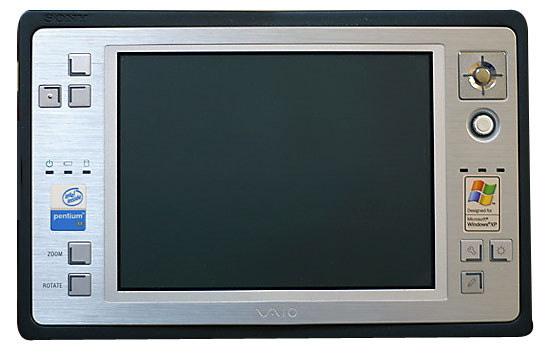

Sony Vaio U-71 @ Dave's iPAQ
Sony Vaio U-71 @ Dave's iPAQ: "any of you are probably wondering how I got my hands on an ultra portable computer that is only available in Japan? Well a company named Dynamism specializes in importing ultra-cool Japanese portable computers and shipping them to eager enthusiasts around the world. We are also lucky enough to be an affiliate through Mobile Planet to offer these great ultra portable computers to you directly. After reading this review you will know why I want to keep this small pda like computer. The device I received was the Sony U-71 sporting a 1.2 GHz Pentium M processor with 512MB of memory and a 30 gig hard drive, 802.11b/g Wireless LAN, CF Card Slot; Memory and the traditional Sony Memory Stick slot! Users should note the U-71 does not come with any sort of optical drive since they consider them option accessories.
Experience
The U-71 is designed to be operated for the mobile user on the go. The pointing stick is on the right hand side of the screen, and the mouse buttons are on the left. The left mouse click key has a small notch, so your fingers identify immediately. Of course, you can also use a stylus (not included) or finger on the touch-sensitive screen to navigate--a fantastically fast and efficient method which I used most of the time. I did notice the fin-like stylus is much more comfortable than the regular stick-stylus. Text input can be through the external, foldable USB keyboard which is included. The keyboard folds up to a sleek profile, and can be connected directly to the Vaio or through the included port replicator. An eraser-type pointer and mouse buttons are integrated into the keyboard. Or, you could write directly onto the screen, via Sony's handwriting recognition software. There is also a software-based on-screen keyboard but I did have some issues using the bundled software so I downloaded a new beta software by NostramU Board which made the keyboard more of an onscreen thumb keyboard which makes th"
Experience
The U-71 is designed to be operated for the mobile user on the go. The pointing stick is on the right hand side of the screen, and the mouse buttons are on the left. The left mouse click key has a small notch, so your fingers identify immediately. Of course, you can also use a stylus (not included) or finger on the touch-sensitive screen to navigate--a fantastically fast and efficient method which I used most of the time. I did notice the fin-like stylus is much more comfortable than the regular stick-stylus. Text input can be through the external, foldable USB keyboard which is included. The keyboard folds up to a sleek profile, and can be connected directly to the Vaio or through the included port replicator. An eraser-type pointer and mouse buttons are integrated into the keyboard. Or, you could write directly onto the screen, via Sony's handwriting recognition software. There is also a software-based on-screen keyboard but I did have some issues using the bundled software so I downloaded a new beta software by NostramU Board which made the keyboard more of an onscreen thumb keyboard which makes th"
MobilePlanet acquired by eXpansys Group for $3.75 million in cash transaction. @ Dave's iPAQ
MobilePlanet acquired by eXpansys Group for $3.75 million in cash transaction. @ Dave's iPAQ: MobilePlanet acquired by eXpansys Group for $3.75 million in cash transaction.
By David Ciccone, posted 10 hours ago
Reader Comments: 2
Pageviews: 1,162
Chatsworth, California. -- April. 4, 2005 - The UK based eXpansys Group today announced that they have acquired MobilePlanet Inc., the leading US multi-channel reseller of mobile computing and wireless products. MobilePlanet posted revenues of USD $21 million in 2004.
The Acquisition will help to secure the groups position as the premier specialist online retailer of mobile devices in the world with a forecast turnover of $200 Million for the next financial year.
MobilePlanet will continue operations under its own brand name and as a separate company taking advantage of Expansys' warehousing, logistics and software development facilities, the company plans to maintain all existing customer, supplier and partner relationships and will actively seek new partners of all kinds for the combined business over the coming months.
Roger Butterworth CEO of eXpansys Group said " We are delighted to be completing this deal to bring together the two largest players in the online market for mobile devices in the USA, we are looking forward to bringing the best of MobilePlanet and eXpansys to all of our customers worldwide " eXpansys Holdings Ltd, a company based in Manchester, England is the leading worldwide specialist distributor of mobile technology which owns eXpansys and Portable Add-Ons. With operations in the U.K., U.S., Europe and Asia the companies serve customers in over 140 different countries. By expanding its position in the U.S. market, this acquisition is a major step in the international development of the business.
The U.K. group plans to use the MobilePlanet brand name in the U.S. and other key markets to accommodate this the group holding company, eXpansys holdings Ltd will be re-named as Mobile and Wireless Group Ltd (M&WG), eXpansys and Mobile Planet will continue to trade separately. CONTACTS
Media: Roger Buterworth +44 7973 629916
Websites: www.mobileplanet.com www.expansys.com
By David Ciccone, posted 10 hours ago
Reader Comments: 2
Pageviews: 1,162
Chatsworth, California. -- April. 4, 2005 - The UK based eXpansys Group today announced that they have acquired MobilePlanet Inc., the leading US multi-channel reseller of mobile computing and wireless products. MobilePlanet posted revenues of USD $21 million in 2004.
The Acquisition will help to secure the groups position as the premier specialist online retailer of mobile devices in the world with a forecast turnover of $200 Million for the next financial year.
MobilePlanet will continue operations under its own brand name and as a separate company taking advantage of Expansys' warehousing, logistics and software development facilities, the company plans to maintain all existing customer, supplier and partner relationships and will actively seek new partners of all kinds for the combined business over the coming months.
Roger Butterworth CEO of eXpansys Group said " We are delighted to be completing this deal to bring together the two largest players in the online market for mobile devices in the USA, we are looking forward to bringing the best of MobilePlanet and eXpansys to all of our customers worldwide " eXpansys Holdings Ltd, a company based in Manchester, England is the leading worldwide specialist distributor of mobile technology which owns eXpansys and Portable Add-Ons. With operations in the U.K., U.S., Europe and Asia the companies serve customers in over 140 different countries. By expanding its position in the U.S. market, this acquisition is a major step in the international development of the business.
The U.K. group plans to use the MobilePlanet brand name in the U.S. and other key markets to accommodate this the group holding company, eXpansys holdings Ltd will be re-named as Mobile and Wireless Group Ltd (M&WG), eXpansys and Mobile Planet will continue to trade separately. CONTACTS
Media: Roger Buterworth +44 7973 629916
Websites: www.mobileplanet.com www.expansys.com
Thursday, April 21, 2005
Tuesday, April 19, 2005

Pocket PC Thoughts - Daily News, Views, Rants and Raves
Pocket PC Thoughts - Daily News, Views, Rants and Raves: "Monday, April 18, 2005
THE COMPETITION What Do You Prefer -- A Mini-Tablet or a Pocket PC?
Posted by Janak Parekh @ 09:00 AM
Akihabara News reported on a new 'handheld-sized' prototype Tablet PC with integrated thumbboard being unveiled at IDF Japan last week. Dubbed 'Ruby', it weighs in at 450g (15.8oz), uses a Pentium M 600MHz, and has an electrostatic (non-touch-sensitive) digitizer.
"
THE COMPETITION What Do You Prefer -- A Mini-Tablet or a Pocket PC?
Posted by Janak Parekh @ 09:00 AM
Akihabara News reported on a new 'handheld-sized' prototype Tablet PC with integrated thumbboard being unveiled at IDF Japan last week. Dubbed 'Ruby', it weighs in at 450g (15.8oz), uses a Pentium M 600MHz, and has an electrostatic (non-touch-sensitive) digitizer.
"
PocketBreeze 4.3 - New Release @ Dave's iPAQ
PocketBreeze 4.3 - New Release @ Dave's iPAQ: "PocketBreeze 4.3 - New Release
By Jack, posted 20 hours ago
Reader Comments: 0
Pageviews: 260
PocketBreeze new major version is out! with version 4.3 you will find lots of new features and improvements making PocketBreeze the most powerful Today screen plug-in.
Three of the major improvements you will find with PocketBreeze 4.3:
The Custom Tab - Using the new and exciting Custom Tab feature you can include any other Today screen plug-in inside PocketBreeze as a new PocketBreeze tab! This gives you the most efficient solution for managing your Today screen real estate.
The Dynamic Tab Loadin technology - With the new Dynamic Tab Loading PocketBreeze tabs can be loaded dynamically only when you access them, offering the best memory usage solution for Today screen plugins. The Custom Tab feature is also loaded using the Dynamic Tab Loading technology.
Brand new VGA look - The new version offers a complete re-do for VGA users with a new and fresh look! We also had many new VGA and QVGA skins added to our skins page. We invite you to visit our QVGA skins page and VGA skins page.
By Jack, posted 20 hours ago
Reader Comments: 0
Pageviews: 260
PocketBreeze new major version is out! with version 4.3 you will find lots of new features and improvements making PocketBreeze the most powerful Today screen plug-in.
Three of the major improvements you will find with PocketBreeze 4.3:
The Custom Tab - Using the new and exciting Custom Tab feature you can include any other Today screen plug-in inside PocketBreeze as a new PocketBreeze tab! This gives you the most efficient solution for managing your Today screen real estate.
The Dynamic Tab Loadin technology - With the new Dynamic Tab Loading PocketBreeze tabs can be loaded dynamically only when you access them, offering the best memory usage solution for Today screen plugins. The Custom Tab feature is also loaded using the Dynamic Tab Loading technology.
Brand new VGA look - The new version offers a complete re-do for VGA users with a new and fresh look! We also had many new VGA and QVGA skins added to our skins page. We invite you to visit our QVGA skins page and VGA skins page.
"My Favorite Utilities" :: April 2005
"My Favorite Utilities" :: April 2005: " April 2005
'My Favorite Utilities'
From the Judges of the Pocket PC magazine Best Software Awards 2004
This past year, over 80 experts judged 543 Pocket PC and Smartphone nominations for Pocket PC magazine Best Software Awards 2004. Our judges had plenty to say about their favorite products. In this issue we are publishing their comments about the programs nominated for the Utilities software category. The purpose of publishing the comments is to give insights into a variety of products-not to show how the judges voted. The winners and finalists can be found on our Web site (http://www.pocketpcmag.com/a.... For the sake of brevity, we've included only one comment per product and edited them for clarity and brevity."
'My Favorite Utilities'
From the Judges of the Pocket PC magazine Best Software Awards 2004
This past year, over 80 experts judged 543 Pocket PC and Smartphone nominations for Pocket PC magazine Best Software Awards 2004. Our judges had plenty to say about their favorite products. In this issue we are publishing their comments about the programs nominated for the Utilities software category. The purpose of publishing the comments is to give insights into a variety of products-not to show how the judges voted. The winners and finalists can be found on our Web site (http://www.pocketpcmag.com/a.... For the sake of brevity, we've included only one comment per product and edited them for clarity and brevity."
IBM ThinkPad T43 Intro - IBM ThinkPad T43 review - Notebooks - CNET Reviews
IBM ThinkPad T43 Intro - IBM ThinkPad T43 review - Notebooks - CNET Reviews: "The latest iteration of IBM's corporate thin-and-light, the ThinkPad T43, features the same sturdy case as that of the previous model, the ThinkPad T42--a CNET Editors' Choice. The T43 also features some new components, including Intel's latest-generation Centrino chipset. Unfortunately, the new parts don't contribute any significant performance gains, and in fact, they seem to detract from the system's battery life. As a result, we think the ThinkPad T42 remains the better buy.
Our ThinkPad T43 test model measured 12.2 inches wide, 10 inches deep, and just 1 inch thick. At 5.5 pounds, the ThinkPad T43 is of average weight for the thin-and-light category. The blackboard eraser-size AC adapter adds another 0.8 pound to its overall travel weight.
It's far from the sexiest laptop on the market, but the ThinkPad T43 is well designed, and it has a number of thoughtful touches, such as a spill-proof keyboard with drain holes. The notebook includes IBM's signature red eraser-head pointing stick, which has a nice, flat top that supports your finger better than the rounded tops on most pointing sticks; two corresponding mouse buttons and a handy scroll button sit just below the keyboard. Below its keyboard, the ThinkPad T43 also features a touch pad with its own two mouse buttons, which are a bit too small. The keyboard itself is wide and comfortable to use. Though there aren't many multimedia controls here--this is a business laptop, after all--you do get external volume controls, including a mute button, as well as a blue IBM button that brings up support information. Our ThinkPad T43 test unit featured a fingerprint sensor on the right-hand side of the wrist rest; swiping your finger over the sensor logs you onto the notebook in lieu of typing in a password (for more details about this biometric security feature, check out our review of the ThinkPad T42).
IBM's "
Our ThinkPad T43 test model measured 12.2 inches wide, 10 inches deep, and just 1 inch thick. At 5.5 pounds, the ThinkPad T43 is of average weight for the thin-and-light category. The blackboard eraser-size AC adapter adds another 0.8 pound to its overall travel weight.
It's far from the sexiest laptop on the market, but the ThinkPad T43 is well designed, and it has a number of thoughtful touches, such as a spill-proof keyboard with drain holes. The notebook includes IBM's signature red eraser-head pointing stick, which has a nice, flat top that supports your finger better than the rounded tops on most pointing sticks; two corresponding mouse buttons and a handy scroll button sit just below the keyboard. Below its keyboard, the ThinkPad T43 also features a touch pad with its own two mouse buttons, which are a bit too small. The keyboard itself is wide and comfortable to use. Though there aren't many multimedia controls here--this is a business laptop, after all--you do get external volume controls, including a mute button, as well as a blue IBM button that brings up support information. Our ThinkPad T43 test unit featured a fingerprint sensor on the right-hand side of the wrist rest; swiping your finger over the sensor logs you onto the notebook in lieu of typing in a password (for more details about this biometric security feature, check out our review of the ThinkPad T42).
IBM's "
Subscribe to:
Posts (Atom)