Saturday, November 14, 2026


Friday, November 13, 2026
Microsoft scrambles to fix global outage affecting Teams and Outlook
Microsoft scrambles to fix global outage affecting Teams and Outlook
“The article describes a global outage affecting Microsoft Teams and Outlook, causing disruptions for millions of users worldwide. Microsoft is investigating the cause of the outage, stating that there are no indications of a cyber-attack. The outage has affected various industries, including healthcare, finance, and technology, causing disruptions in communication, collaboration, and productivity.
Tech firm says it is making progress in attempts to restore services and there is no indication problem was caused by cyber-attack

Microsoft is scrambling to fix an outage of some of its systems that has caused huge disruption to users, organisations and businesses across the globe.
In its latest update, the tech company said it was making progress in its attempts to restore services after a global outage affected millions of users from Thursday evening and into Friday.
The issue appears patchy, with some but not all users reporting problems with services including Microsoft Teams and Outlook email.
In an update shortly after midday GMT, Microsoft said: “We’re seeing encouraging recovery progress in Europe, with service availability and email delivery performance improving across a growing portion of affected Microsoft 365 infrastructure.
“Japan remains comparatively more stable, while North America is also improving; however, some users may still experience intermittent issues as recovery actions continue.”
After 2pm, it added: “We’re continuing to see improvements in service availability, with email queues significantly reduced and approaching normal levels.”
More than 430 million people use Microsoft 365 apps, and more than 90% of Fortune 500 companies use Copilot, Microsoft’s AI chatbot, according to the company.
Microsoft said there were no indications that the outage had been caused by a cyber-attack.
Earlier, the company said it was seeing only “marginal success” from its efforts to bring its systems fully back online. It had said that a portion of its infrastructure was “experiencing elevated load” – which was “likely contributing to the connectivity errors”.
The company determined a number of servers were “unexpectedly unavailable” because of a problem that caused them to fail during automated checks.
The outage website Down Detector showed an increase in Microsoft 365 problems at about 6pm GMT on Thursday, with nearly 130,000 reports of problems in 74 countries affecting access to Word, Excel, PowerPoint, Outlook and Teams as well as enterprise services such as SharePoint and OneDrive. Copilot was also affected.
Microsoft has suggested the outage may have been caused by problems with the settings applied to servers responsible for keeping Microsoft 365 up and running.
Microsoft’s executive vice-president of Copilot, Charles Lamanna, said: “We regret that today’s outages caused disruptions for our customers, and we are working to address the issue.”
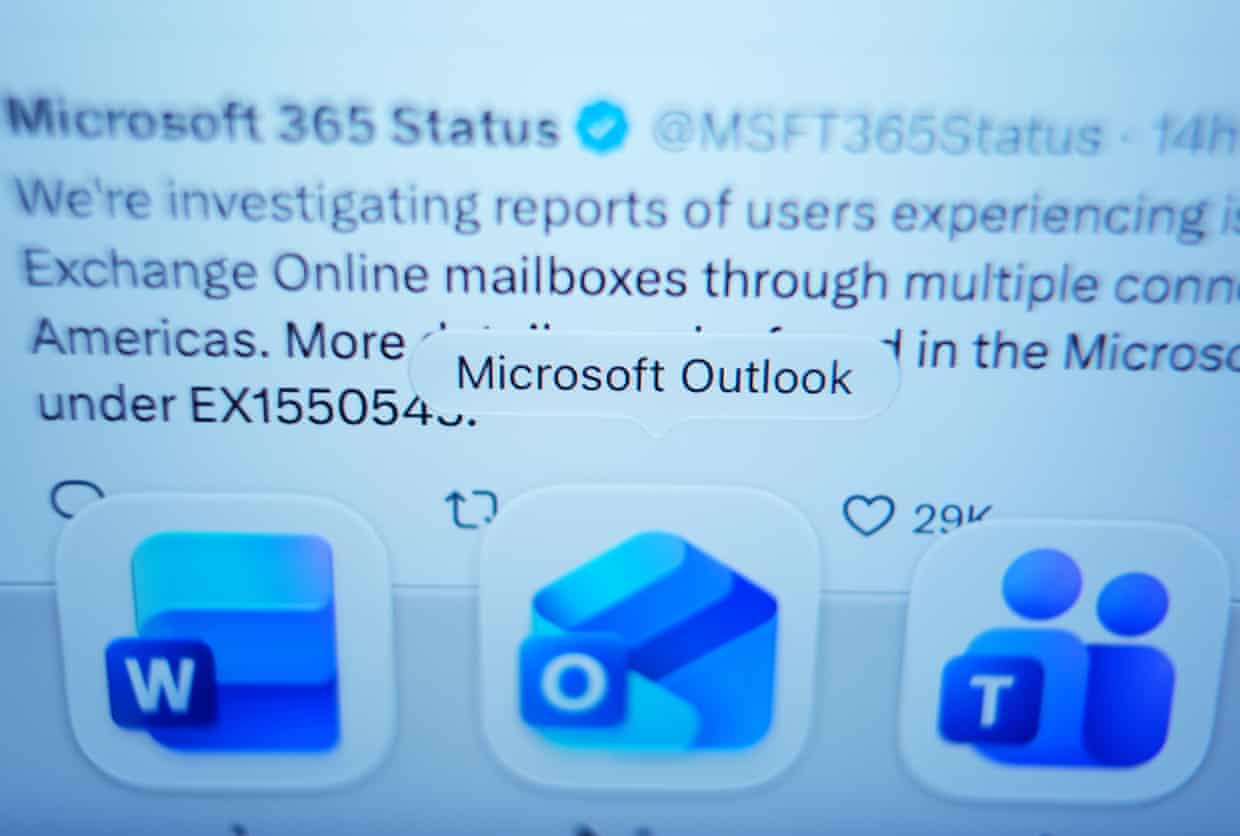
The Microsoft outage also hit connectors used by OpenAI’s and Anthropic’s AI services.
OpenAI said it was investigating a problem with Microsoft connectors in which new connections may be broken and tools were not working as expected. Anthropic said it had identified an issue with an upstream provider affecting its Microsoft 365 connector.
The outage has affected businesses and organisations across the world that use Microsoft products.
In the UK, healthcare systems were disrupted and several UK police forces urged people not to try to report crimes online and to phone them in instead.
Some schools in the UK notified parents that reporting attendance or absence issues had to be done via phone. National Rail, which provides information across the UK network, warned that people may not be able to access tickets that have been emailed to them.
US government offices across the country have been affected by the outage, including congressional offices that heavily rely on Outlook email. The US House’s chief administrative officer that handles IT for the chamber sent out a “campus-wide alert” to staffer on Thursday about the outage, Politicoreported.
Multiple cities, including the City of Tampa, posted notices on their municipal websites to say that they are affected by the outage.
Law enforcement offices across the US have also been affected, with one sheriff’s county in Colorado saying that it is unable to process bond payments because Outlook email is down and requesting that anyone who needs to post bond do so in person.
When stock market trading opened on Wall Street, shares in Microsoft dipped slightly, down 1.1% at $516.86.
The Indian airlines IndiGo and Akasa Air said their email support services were affected, and Taiwanese security firms, life insurers and investment trust companies said fund management services had been disrupted.
In financial markets some portfolio managers have been unable to check emails, making it hard to access on some trading platforms.
In Japan, the shipping company Sagawa Express said it was unable to accept online reservations for some of its services at airports and train stations while Taisho, a leading pharmaceutical company, said it was having to handle orders by phone.
Microsoft last month reported an outage of its Azure cloud platform that affected a suite of productivity software and a range of industries worldwide.
Mark Gregory, an associate professor in the School of Engineering at RMIT University in Melbourne, said the outage appeared to be affecting the network layer in Microsoft’s systems, and was potentially similar to the configuration issue that brought down Optus’s network in 2023.
He said that when some of the servers had configuration issues, it meant customers were forced to share a smaller pool of servers to access the cloud services.
“If you lose part of that pool, then all of the users are trying to access the remaining servers, and that overloads them. And then they go down. And so you end up with a cascading problem. Then it takes time to find the underlying problem, in this case, a misconfiguration in the network layer.”
Gregory said businesses reliant on cloud services such as Microsoft 365 should have backup options.
Associated Press and Reuters contributed to this report“
Thursday, November 12, 2026
Nvidia CEO Jensen Huang Resigns
Nvidia CEO Jensen Huang Resigns
“Jensen Huang resigned as Nvidia CEO following reports of multiple affairs, including one with Alice Huang, allegedly tied to Chinese intelligence. Colette Kress is interim CEO. An investigation and class-action lawsuit follow.
AI Generated
The company's founder stepped down after reports of multiple affairs.

The company's founder stepped down after reports of multiple affairs.
Jensen Huang has resigned as CEO of $4 trillion chip giant Nvidia, just days after news broke that he was having an affair with a Chinese data center executive alleged to have ties to China’s intelligence community.
The company named Colette Kress, its chief financial officer, as interim CEO. Nvidia confirmed the news in a press release Thursday morning.
As reported Wednesday by The Wall Street Journal, the removal of Huang as CEO follows the revelation over the weekend that the company’s board of directors had opened an investigation into whether the company’s chief executive and founder had been targeted by foreign intelligence.
Huang had been revealed to be having an affair with Alice Huang (no relation), a Chinese citizen and executive at Megaspeed, a Singapore-based data center company that buys chips from Nvidia to run data centers that sell computing power to Chinese AI labs. News reports citing US intelligence officials have claimed Alice Huang was working as a spy for China. She was reportedly under surveillance by US intelligence, as reported in late October by The New York Times.
The Information reported on Tuesday that Alice Huang is believed to be involved with a network of Chinese companies that facilitated the sales of $7.5 billion in chips to China. The US has tried to control China’s access to advanced chips for years, but reports show that there are still illegal operations smuggling chips on the banned list from the US to China.
The New York Times also reported on Wednesday a separate affair between Huang and one of his direct reports at Nvidia.
The announcement of an investigation has rocked the AI chip behemoth, which makes the cutting-edge chips that enable AI and AI data centers. A proposed class-action lawsuit was filed on Monday against Nvidia, charging the company made false or misleading statements about Huang’s affair and the company’s relationship with Megaspeed.
On Tuesday, the Nvidia board said it had “retained former acting US Attorney for the Southern District of New York Joon H. Kim and his firm Wachtell, Lipton, Rosen & Katz to conduct a thorough and independent investigation.”
Steven Musil is a senior news editor at CNET News. He's been hooked on tech since learning BASIC in the late '70s. When not cleaning up after his daughter and son, Steven can be found pedaling around the San Francisco Bay Area. Before joining CNET in 2000, Steven spent 10 years at various Bay Area newspapers and had a brief stint at MacWeek.
Corinne Reichert (she/her) grew up in Sydney, Australia and moved to California in 2019. She holds degrees in law and communications, and currently writes news, analysis and features for CNET across the topics of electric vehicles, broadband networks, mobile devices, big tech, artificial intelligence, home technology and entertainment. In her spare time, she watches soccer games and F1 races, and goes to Disneyland as often as possible. See full bio“
Wednesday, November 11, 2026
Tuesday, November 10, 2026
Monday, November 09, 2026
Commerce Dept. Chip Inquiry Was Halted After Nvidia Intervention
Commerce Dept. Chip Inquiry Was Halted After Nvidia Intervention
“The Commerce Department’s investigation into Megaspeed, suspected of smuggling Nvidia chips into China, halted and transferred to the Justice Department after Nvidia’s general counsel contacted officials. Nvidia is investigating CEO Jensen Huang’s relationship with Megaspeed’s executive, allegedly a Chinese spy.
AI Generated
An investigation into Megaspeed, a Singapore company that was buying advanced Nvidia A.I. chips, was transferred to the Justice Department after a top Nvidia executive reached out to Commerce Department officials.

By Ana Swanson and Devlin Barrett
Ana Swanson covers trade and the Commerce Department and Devlin Barrett covers the Justice Department. They reported from Washington
Investigators at the Commerce Department were deep into a monthslong investigation of a Singaporean company that they suspected of smuggling Nvidia’s artificial intelligence chips into China when their work came to a sudden halt late last year.
The investigation centered on Megaspeed, a data center company led by an executive who U.S. officials now believe to be a Chinese spy who had a relationship with Nvidia’s chief executive, Jensen Huang.
But the case was abruptly transferred to the Justice Department last year. The shift came after Commerce Department investigators working on the case received an email from Nvidia’s general counsel seeking information about the inquiry into Megaspeed.
It is not necessarily unusual for Commerce Department agents working on a case to speak with a company’s representatives about issues involving their firm. But what was unusual was the content of the message. Tim Teter, Nvidia’s general counsel, said that Jeff Kessler, a top official at the department, had given Nvidia permission to reach out about the case.
The agents were alarmed that Nvidia had invoked the name of Mr. Kessler, their superior, who was nominated to his role by President Trump. Some viewed Mr. Kessler’s interaction with Nvidia as violating government procedure and potentially tainting the case, according to current and former government officials and others familiar with the incident.
It is not clear what led to Mr. Teter’s outreach to the department, but the recent revelations about Mr. Huang’s acknowledged affair with a Megaspeed executive have only intensified scrutiny of Nvidia’s role in influencing policy on chip sales to China. The New York Times reported last month that the U.S. government had concluded that Huang Le, or Alice Huang, a top executive at the firm, was a spy working on behalf of the Chinese government.
On Sunday, Nvidia said it was opening an investigation into Mr. Huang, after he acknowledged to the company’s board that he had been intimate with Ms. Huang. The pair, who are not related, had been photographed together on multiple occasions, including at a bar and a restaurant in Taiwan alongside other tech executives.
The incident raised questions about what Mr. Kessler, who reports directly to Commerce Secretary Howard Lutnick, had discussed with Nvidia. It also raised the possibility that those discussions could become their own subject of inquiry.
Perhaps inadvertently, some officials said, Mr. Kessler had opened himself to accusations of undue influence and potentially jeopardized his department’s work on Megaspeed.
The case was quickly transferred to the Justice Department in an effort to avoid any potential compromise of the government’s investigation of Megaspeed, these people said. The Justice Department is conducting a criminal inquiry into Megaspeed, according to people familiar with the matter.
A Justice Department spokeswoman said the agency does not comment on continuing investigations. A Commerce Department spokesman said that department had been aggressively enforcing its rules and had conducted this and other actions strictly by the book.
John Rizzo, a spokesman for Nvidia, said the company consults with officials “to answer their questions, provide information we have gathered from the field, request their guidance and instructions and ask whether they have any follow-ups.”
The company works “to help government and our partners halt any would-be smugglers while serving the critical market of lawful customers that help America win worldwide,” he added.
A representative for Megaspeed said the company was conducting an internal investigation into allegations of chip diversion and had repeatedly offered to cooperate with the U.S. government but that those offers had gone unanswered.
The United States began investigating Megaspeed and Ms. Huang in 2024, after the company started importing billions of dollars’ worth of advanced Nvidia A.I. equipment into Malaysia. Megaspeed had been planning and constructing data centers around Southeast Asia to serve Chinese clients, including Alibaba, the Chinese tech giant. While that behavior is legal, U.S. officials were concerned that some of the Nvidia chips the company had bought were illegally routed into China.
The United States has imposed restrictions on which technologies could be sold to China through export controls, which ban certain chips from being sold there and require U.S. companies to get licenses to sell others. Nvidia has opposed those controls and argued for selling its products more freely.
Sign up for the On Politics newsletter. It's a pivotal moment for American politics. Join us for 2026 and beyond.
In August 2025, officials at the Commerce Department’s Bureau of Industry and Security who were pursuing the case received an email from Mr. Teter, the general counsel of Nvidia, people familiar with the incident said. In a message to the agents, Mr. Teter said that Mr. Kessler had given him permission to reach out about the case.
A Commerce Department official said that Nvidia had contacted the employees directly to request a meeting with one of them. When the employees declined the meeting, Mr. Teter responded to the employees by saying he was unsure what the issue was because Mr. Kessler had said Nvidia could communicate with the bureau’s employees.
The employees forwarded the email chain to Mr. Kessler. Hours later, Mr. Kessler responded, saying they should continue to handle the case strictly by the book, the official said.
Mr. Kessler did not order his employees to divulge information to Nvidia, and he did not weigh in with the agents on what meetings to take or what information to divulge, that official said.
Mr. Kessler did not respond to requests for comment.
As an under secretary, Mr. Kessler would typically be walled off from the finer details of such an investigation given that he might be called on to serve as a neutral arbiter in the case. Mr. Kessler’s interactions with Nvidia could also be subject to legal discovery or a subpoena if the department were to pursue future legal action against Megaspeed, officials said.
It is not clear if other factors contributed to the decision to suspend the Commerce Department’s work. That decision also coincided with the collection of U.S. intelligence that would conclude that Ms. Huang had spied for the Chinese government. Mr. Trump was briefed in October 2025 that Ms. Huang had a relationship with Mr. Huang and was presumed to be a spy, but the president chose not to do anything with that intelligence.
The Justice and Commerce Departments often pursue export control cases in tandem, but the Justice Department can take the lead in cases involving criminality and intelligence. The Justice Department can pursue criminal penalties that often require a higher burden of proof, while the Commerce Department levies civil penalties including fines.
But officials described the way the case was handed off from the Commerce Department as unusual and concerning.
Several officials, who requested anonymity to discuss a highly sensitive issue, questioned why the Commerce Department was discussing the case with Nvidia, a party that had not been ruled out as a subject of the investigation.
After the email from Mr. Teter, Commerce officials convened meetings to discuss the incident and rapidly disclosed it to partner law enforcement agencies. The Justice Department requested that the Commerce Department pause its work on the investigation, and Commerce complied, one person familiar with the case said.
The outcome was a source of frustration to agents investigating Megaspeed, who had spent months building a case. It may also have prevented the Commerce Department from taking quicker action to stop technology shipments to Megaspeed.
Government officials inside and outside the Commerce Department already had concerns about the Trump administration’s deference to Nvidia, a driving force behind America’s A.I. growth and the U.S. stock market. Mr. Huang has been an influential voice on export control policy with both Mr. Trump and Mr. Lutnick, the secretary in charge of the Commerce Department, which controls American technology exports.
The Trump administration, including the Justice Department, has also taken the view that the federal government should avoid making regulatory or enforcement decisions that limit American companies’ ability to dominate the artificial intelligence industry. Nvidia’s chips are a major driver of that industry.
Since Mr. Trump’s return to office, Mr. Kessler and other leaders at the department had mandated that any investigations into Nvidia and other outreach to the company first receive their approval. Mr. Kessler, who reports directly to Mr. Lutnick, has also maintained tight control over the licenses granted by the department, many of which involve Nvidia technology, as well as the department’s communications with the company.
While other agencies have proposed placing Megaspeed on the entity list, a trade blacklist overseen by the Commerce Department, though the department has not moved forward with the action. The department has not added a company to the entity list in over a year, the longest stretch without such a listing in 18 years.
Ana Swanson covers trade and international economics for The Times and is based in Washington. She has been a journalist for more than a decade“
Sunday, November 08, 2026
Saturday, November 07, 2026
Subscribe to:
Posts (Atom)