Wednesday, January 08, 2025


Tuesday, January 07, 2025
M4 iMac Review: Gloriously niche

The iMac, redesigned for Apple silicon in 2021, is a gorgeous reinvention of Apple’s venerable all-in-one. It’s colorful (if you want it to be), powerful (enough), and designed to show itself off at home and in public spaces.
After a very basic update to M3 last year, Apple has now updated the iMac again, adding the more powerful M4 processor—and addressing a few of this fun desktop computer’s few shortcomings.
What hasn’t changed
Like its two predecessors, the M4 iMac is an ultra-thin (11.5mm) slab that looks like an oversized iPad attached to a stand (or optional VESA mount). It comes in seven different color options, which have been tweaked a bit (except silver) but are still as striking as they were before. A magnetic connector attaches the iMac to an external power brick that (optionally for the base model) also integrates an Ethernet jack. The 24-inch screen is at 4.5K resolution and is bright and colorful, though it can’t pop the brightness in dynamic range content like a MacBook Pro display can (it’s limited to 500 nits). It comes with color-matched accessories, now charged by color-matched USB-C cables.
As before, Apple has essentially built a $1299 budget model with a reduced feature set. It has two fewer processor and GPU cores, only two Thunderbolt ports, an Ethernet jack, and a Touch ID-capable keyboard, which are extra-cost options. It can only drive one external display. I reviewed one of the higher-end models (which start at $1499), which has a full set of 10 CPU and GPU cores.
In a world of laptops, the iMac is designed to fill some very specific niches. Sometimes, you just want a home computer station that anyone can sit down and use, and the iMac obliges. Some businesses want them at reception, hotels at check-in, or even schools in a computer lab. The iMac isn’t the definitive Mac model. It was back in the late ’90s and early 2000s, and the modern iMac is designed to fit into your life or workplace and stand out. (If you think about it a certain way, you can almost look at it as a laptop with a really, really big screen. It’s certainly thin enough!)
Take a bow, Center Stage

Three years ago, Apple introduced a new feature called Center Stage. This feature uses a 12-megapixel ultrawide camera pointed at the user to capture a scene. Then, machine-learning software automatically crops, pans, and zooms the picture as if a camera operator were shooting your FaceTime calls and Zoom meetings.
Frustratingly, the M1 iMac was released after the first iPad with Center Stage, and yet it didn’t offer the feature—instead, it just had a basic 1080p webcam left over from the last-generation Intel iMac design. It’s an example of how Apple’s product lines sometimes get weirdly out of sync since the iMac seems to be the perfect system for such a feature—as it’s a big screen sitting on a desk with limited opportunity to be repositioned.
However, maybe it was all for the best? When the Center Stage camera did debut on a big screen sitting on a desk, it was in the Apple Studio Display. Over time, the 12MP ultrawide camera it used has been exposed as having severe limitations in poor lighting conditions, especially when zoomed in on a small portion of the image. In plenty of circumstances, it looked worse than a standard, boring, locked-in-place webcam. (Try using an iPhone camera as your Center Stage camera via Continuity Camera sometime—it looks so much better.)
With the M4 iMac, the FaceTime camera has finally been upgraded to Center Stage. And maybe it was worth the wait, because this isn’t the same 12MP sensor as in some previous Center Stage cameras. It’s new and improved—so improved that I could tell the difference the first second that I turned it on.
In a challenging low-light environment, the original Center Stage camera on an Apple Studio Display can look fuzzy, blotchy, and low contrast. The new Center Stage camera on the M4 iMac looks sharper, with more contrast and much more natural-looking skin tones. It’s what Center Stage should’ve looked like all along, and it’s a nice upgrade.
With Center Stage, you also get Desk View, a feature that lets the Center Stage camera share video of items (such as documents) placed on the surface the iMac is sitting on. This is a feature that requires some open space in front of the iMac, but it’s much more reasonable to use on an iMac than it would be on an iPad or laptop.
Fantastic four

We already know about how fast the M4 chip is, because it debuted earlier this year in the iPad Pro:
Regarding the M4 as a whole, the early returns are encouraging. The M4 single-core score was 24% higher than an M3 MacBook Air and 45% faster than the M2 iPad Pro. In multi-core operations, the 10-core M4 bested an eight-core M3 by 22%, and the eight-core M2 iPad Pro by 50%.
The same holds for the M4 when used in a device running macOS. My tests showed the M4 model outpacing the M3 model nicely on all fronts. But of course, most people will not be buying the M4 iMac to upgrade from an M3. Instead, they’ll presumably be putting old Intel iMacs out of service—and the speed boost from even a high-end Intel iMac will be dramatic. (To be fair, the M1 iMac was already faster than almost every iMac that preceded it. This one’s that much faster.)

I also appreciate that, with the exception of the base model, this iMac features four full Thunderbolt ports on the back. Previous models featured two Thunderbolt ports and two USB-C ports, which required the Thunderbolt-having ports to be labeled. The whole thing seemed very un-Apple-like to me. Now they’re all Thunderbolt, which is good.

And yes, Apple has updated its keyboard, mouse, and trackpad to charge and pair via USB-C instead of Lightning. Otherwise, they’re unchanged, and they remain color-matched (right down to the charging cable) with the iMac you buy. (If you want to buy colorful peripherals separately, you can’t—seeking them on eBay from someone who doesn’t want theirs is the only way to get the orange keyboard of your dreams.) I’m a little perplexed that Apple doesn’t seem to let iMac buyers pay for both a color-matched mouse and trackpad—that seems like an oversight that the company should correct.
The screen’s the thing
The modern iMac really is a 24-inch flatscreen with a tiny computer hidden inside. It’s a nice screen, though it’s not any brighter than the previous models. If you’re someone who has been hoping to replace an old 27-inch iMac with a display of similar size, there’s no news on this front. If you want a 27-inch display right now, you’ll need to buy an external display and connect a Mac mini or laptop to it.
But there is one new wrinkle when it comes to this display: a $200 antiglare nano-texture option. (It’s not available on the base-model iMac, of course.) Apple’s slowly been rolling out this anti-glare surface on many of its devices, from iPads to Macs to external displays, and now it’s reached the M4 iMac (as well as the M4 MacBook Pro).
I used to work in an office where my display was pointed directly at the window, and there was very little I could do to change that. I used a screen with an anti-glare texture that made it bearable, but everything looked a little foggy. This technology has gotten a lot better in the intervening 15 years. Using a nano-texture-covered display is a little weird—the reflections just stop at the screen edge, as if by magic. It works incredibly well. And most of the time, in more normal lighting conditions, I didn’t really notice the nano-texture being there. (Yes, if you look closely you will notice a light scatter that can reduce contrast a bit.)
Choosing whether to add the $200 nano-texture upgrade really depends on how you plan on deploying the iMac. Oftentimes, iMacs end up getting placed where they fit, regardless of lighting conditions. If there’s going to be a bright reflection in view of the person using it, the nano-texture options seems like a no-brainer. If you can put the iMac somewhere else, or if it’s going to be used in a fairly dark space, you could save some money and gain a little extra contrast in the bargain.
One disappointment is that Apple continues to churn out nice 24-inch iMacs without keeping an eye on their long-term usability. I anticipate that Apple silicon Macs will have a usable lifetime far beyond that of Intel Macs, but at least theoretically the iMac display should last even longer. As I pointed out last year:
Since Apple moved the iMac to Retina displays nearly a decade ago, the company has abandoned its old concept of a “target display mode,” which allowed an unused iMac to be repurposed as an external display for a different computer. It’s already a little painful to think about how wasteful an all-in-one computer can be, given that displays can have lifespans vastly longer than the computers they’re attached to. Apple could assuage a lot of that frustration if it would engineer the iMac to double as a display for another device. Given the company’s commitment to the environment, perhaps it’s time to build a new Target Display Mode.
Here’s another possible use case that has occurred to me: Maybe a MacBook Air user might find it useful to sometimes plug in and use the family’s 24-inch iMac as an external display when they work from home?
Apple talks a lot about how it wants to reduce waste and be a better environmental force in the world. Making iMacs with perfectly good displays that can’t ever be repurposed into something else doesn’t seem to fit with that attitude. It’s unfortunate.
Too good for this world
I love the Apple silicon era of the iMac. Its colors and thin design make it not just a computer, but a conversation piece. (It’s the rare Mac to flash bold colors—I wish Apple would do that more often.) Apple’s modern chips give it plenty of power for 99% of users.
The iMac is so good that I wish we didn’t live in a world where most of our computers are laptops. Desktop computers can be great, but these days they’re a niche device. Fortunately, sometimes what you want is to plop down a Mac with a big screen in a particular place, and let it do its job. And if you want that Mac to be purple, or blue, or orange, or whatever, the M4 iMac will be up to the challenge.
'Blood on your hands': A look back at Mark Zuckerberg's tense moments in congressional hearings
'Blood on your hands': A look back at Mark Zuckerberg's tense moments in congressional hearings
“Mark Zuckerberg, CEO of Meta, faces criticism from both sides of the aisle for Meta’s content moderation policies. Zuckerberg defends Meta’s actions, including its fact-checking program, while acknowledging mistakes and the need for improvement. Despite facing pressure from both the Biden and Trump administrations, Zuckerberg emphasizes Meta’s commitment to free expression and transparency.
A look back at a few of Zuckerberg's most contentious congressional moments
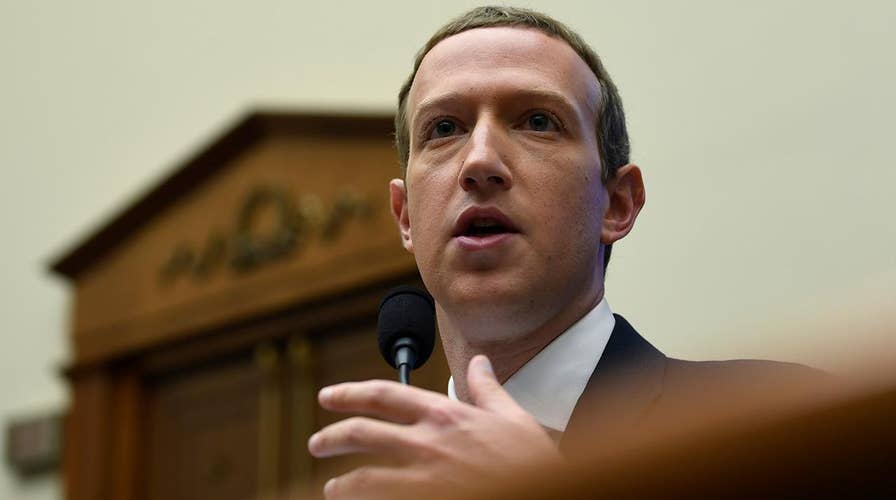
Democrats including the 'Squad' grill Zuckerberg over Facebook fact-checking practices
Facebook CEO Mark Zuckerberg is hammered on fact-checking, hate speech, political ads and his cryptocurrency plan on Capitol Hill; Griff Jenkins has a recap.
Meta CEO Mark Zuckerberg's newly unveiled freedom of speech policies signal a major shift in the Facebook social media platform's content moderation strategy, following years of congressional clashes over alleged "censorship" and the regulation of political information.
"We’re going to get back to our roots and focus on reducing mistakes, simplifying our policies and restoring free expression on our platforms," Zuckerberg said in a video posted Tuesday morning. "More specifically, we’re going to get rid of fact-checkers and replace them with Community Notes similar to X, starting in the U.S."
META ENDS FACT-CHECKING PROGRAM AS ZUCKERBERG VOWS TO RESTORE FREE EXPRESSION ON FACEBOOK, INSTAGRAM
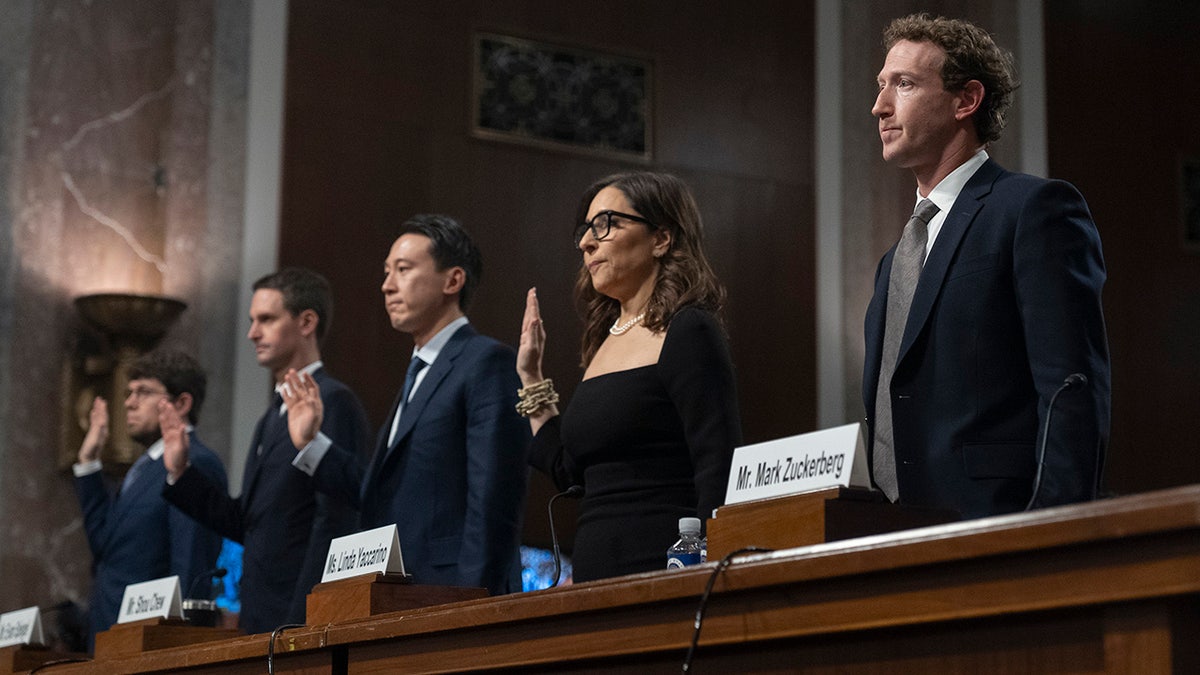
From left, Discord CEO Jason Citron, Snap CEO Evan Spiegel, TikTok CEO Shou Zi Chew, X CEO Linda Yaccarino and Meta CEO Mark Zuckerberg, are sworn in during a Senate Judiciary Committee hearing on Capitol Hill, Jan. 31, 2024, to discuss child safety. (AP Photo/Manuel Balce Ceneta, File)
Zuckerberg's shift in content moderation comes amid a history of being grilled by politicians on both sides of the aisle on Capitol Hill.
In January 2024, Sen. Josh Hawley, R-Mo., confronted Zuckerberg during a heated exchange about the harmful impact of social media on users, particularly young girls. The questioning followed revelations from internal Meta studies that indicated a significant number of teenage girls were exposed to harmful content, including unwanted nudity, sexual advances, and material promoting self-harm, within just one week.
"So, you didn’t take any action, you didn’t fire anybody, you haven’t compensated a single victim. Let me ask you this. There are families of victims here today. Have you apologized to the victims? Would you like to apologize now?" Hawley said, drawing applause from the audience.
In response, Zuckerberg rose from his seat and addressed the crowd directly, saying, "I’m sorry for everything you’ve all been through. No one should have to go through the things that your families suffered."
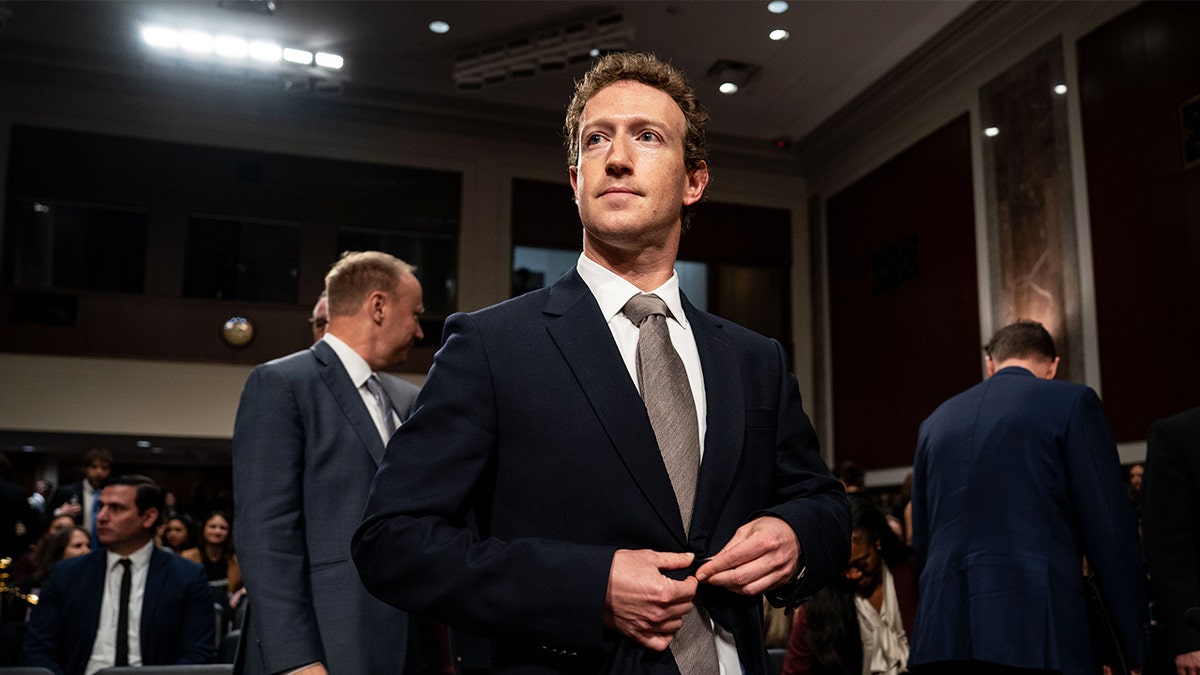
A PoltiFact executive torched Meta CEO Mark Zuckerberg for announcing the end of fact-checking on his social media platforms. (Kent Nishimura/Getty Images)
Zuckerberg added, "This is why we’ve invested so much… and will continue through industry-leading efforts to make sure that no [one has] to go through what your families have had to suffer."
In that same hearing, Sen. Lindsey Graham, R-S.C., the ranking member of the Senate Judiciary Committee, delivered a scathing rebuke of the tech giant CEO.
"Mr. Zuckerberg, you and the companies before us. I know you don't mean it to be so, but you have blood on your hands," Graham said. "You have a product that's killing people."
Graham's remark came in light of South Carolina state Rep. Brandon Guffey suing Instagram following the suicide of his 17-year-old son, Gavin. Gavin took his own life after falling victim to an extortion scheme run by a group operating through the Meta-owned app.
In 2018, then-House lawmakers grilled Zuckerberg over the site’s failure to protect the personal information of 87 million users. Zuckerberg, who co-founded Facebook in 2004 from his Harvard dorm room, said in a Facebook post at the time, "Looking back, it’s clear we were too slow identifying election interference in 2016, and we need to do better in future elections."
In November 2020, then-Twitter CEO Jack Dorsey and Zuckerberg both faced the Senate Judiciary Committee in a hearing titled "Breaking the News: Censorship, Suppression, and the 2020 Election." The session put the spotlight on the tech giants' controversial content moderation decisions, including the suppression of the New York Post story about Hunter Biden just weeks before the presidential election.
HOUSE WEAPONIZATION PANEL RELEASES 17,000-PAGE REPORT EXPOSING 'TWO-TIERED SYSTEM OF GOVERNMENT'
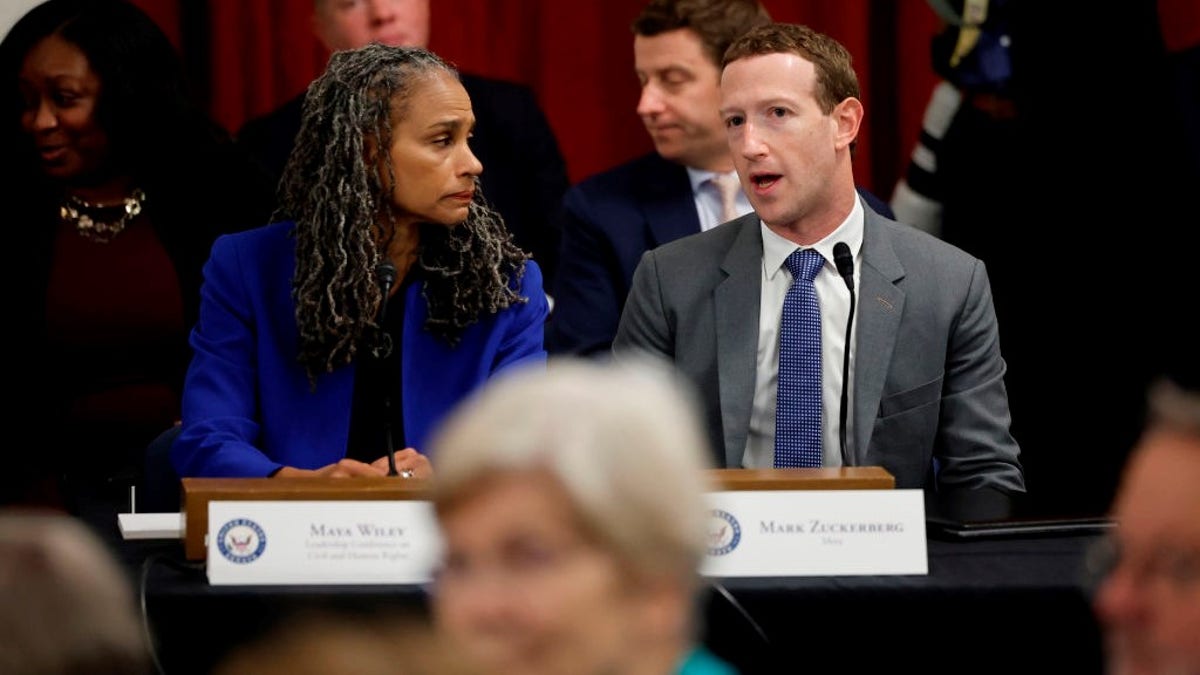
Human Rights President and CEO Maya Wiley and Meta CEO Mark Zuckerberg attend the "AI Insight Forum" in the Russell Senate Office Building on Capitol Hill on Sept. 13, 2023. (Chip Somodevilla/Getty Images)
Testifying remotely, both CEOs acknowledged missteps and outlined how they'd handle similar challenges in the future. Zuckerberg highlighted Facebook's expansive voting initiatives, which he called "the largest voting information campaign in American history." According to his testimony, over 140 million users visited the Voting Information Center on Facebook and Instagram, with 33 million accessing it on Election Day alone. The campaign reportedly helped 4.5 million people register to vote.
To combat misinformation and voter suppression, Zuckerberg detailed measures like partnerships with election officials, the removal of false claims, and warnings applied to over 150 million pieces of content reviewed by independent fact-checkers. Facebook also implemented "policies prohibiting explicit or implicit misrepresentations about how or when to vote as well as attempts to use threats related to COVID-19 to scare people into not voting," according to Zuckerberg’s testimony.
Meta’s third-party fact-checking program was put in place after the 2016 election and had been used to "manage content" and misinformation on its platforms, largely due to "political pressure," executives said, but admitted the system has "gone too far."
Last year, Zuckerberg sent a letter to the House Judiciary Committee, in which he admitted that he felt pressure from the Biden administration, particularly with regard to COVID-19 content, and even subjects like satire and humor.
CLICK HERE TO GET THE FOX NEWS APP
"The thing is, as American companies, when other governments around the world that don’t have our tradition or our First Amendment, when they see the United States government pressuring U.S. companies to take down content, it is just open season then for those governments to put more pressure [on their companies]," explained Meta’s chief global affairs officer, Joel Kaplan. "We do think it is a real opportunity to work with the Trump administration and to work on free expression at home."
In a statement to Fox News Digital, Liz Huston, Trump-Vance transition spokesperson said, "President Trump has always been a champion of free speech, and his landslide victory put an end to the Biden era of oppressive censorship."
'President Trump's return to the White House is a signal to Americans that their fundamental right to free speech is once again safe," she added.
Fox News Digital's Brooke Singman and Adonis Hoffman contributed to this report.
Jamie Joseph is a writer who covers politics. She leads Fox News Digital coverage of the Senate. “
Friday, January 03, 2025
Opinion | Musk’s Misinformation About Tech Visas - The New York Times
Musk’s Misinformation About Tech Visas

"Elon Musk and the other tech moguls fluttering around Donald Trump claim that Silicon Valley needs more H-1B visas to bring in foreign workers because there aren’t enough Americans studying science and tech. American innovation requires “critical people” from abroad like Musk himself, they say, because Americans just don’t want to learn that stuff.
There’s some truth to that. But what they don’t tell you is that for more than a decade, Americans working in the tech industry have been systematically laid off and replaced by cheaper H-1B visa holders.
I discovered this in 2013 when I reported an investigative project for The Boston Globeabout widespread fraud in and abuse of the H-1B visa program. At the time, three companies got the largest number of visas in the H-1B lottery: Infosys, Tata and Cognizant. All three used a business model that cut costs by bringing over temporary workers from India and leasing them out to American firms like indentured servants. Prominent companies were jettisoning their locally hired I.T. departments and outsourcing those jobs.
Not much has changed. Today, those three companies are still among the top five recipients of the visas. When Americans realize they can’t make a living as software engineers, they leave the industry. The H-1B program worsens the very shortages it was supposed to address.
Most H-1B visa holders are lower-paid labor, not top talent. In May, Musk laid off more than 14,000 Tesla workers, including many H-1B visa holders. Reddit threads filled with laments by workers who had moved to the United States from India only to be let go with no warning. They were desperate to remain in the country, but because H-1B visas are owned by the employer, they had few options for doing so.
That’s why these workers stay compliant and cheap: They can’t leave the companies that control the visas. If they were really top talent, they should be getting green cards, not enduring six years of underpaid servitude.
Such mass layoffs in the tech industry should make us question the premise that more H-1B visas are needed.
“How do they get away with mass layoffs — then claim shortages?” Ron Hira, a Howard University professor who has written about this issue for two decades, asked me.
Confronted on X with evidence of relatively low pay for H-1B positions, Musk admitted what many of us already knew: The “program is broken and needs major reform.”
Does that mean he’s going to push for it to be fixed by raising the wages for temporary workers and making it based more on unique skills than on a lottery? Don’t hold your breath."
Thursday, January 02, 2025
In blow to Democrats, federal appeals court strikes down net neutrality
In blow to Democrats, federal appeals court strikes down net neutrality
“The Biden administration’s FCC had considered its reinstatement of the rules on internet service providers a signature accomplishment.

The U.S. Court of Appeals for the 6th Circuit struck down the FCC’s net neutrality rules governing internet service providers Thursday in an early policy win for Republicans seeking to reverse Biden-era industry regulation.
Democrats at the Federal Communications Commission had considered the reinstatement of net neutrality a major accomplishment under the Biden administration. The reversal is a glimpse of the years ahead, during which President-elect Donald Trump’s team has vowed to broadly undo his predecessor’s regulation of private-sector companies.
The net neutrality issue revolves around how heavily federal regulators should control the companies that build and operate the internet. Democrats favor heavier oversight along the lines of how traditional telephone networks are regulated, while Republicans have argued for a lighter touch. Net neutrality was adopted by the FCC under the Obama administration, reversed under Trump, then reinstated under President Joe Biden.
“I think that net neutrality is going to have a long respite,” said Marc Martin, a partner at Perkins Coie and a former FCC official, adding that he sees the prospect of the Supreme Court overruling the 6th Circuit as slim. “It would have to take future bad acts that get a lot of attention to maybe bring a different Congress to act and give the FCC authority. Short of that, I think it’s over.”
The 6th Circuit said in its decision Thursday that internet service providers were not just dumb pipes, as the FCC has contended, and for that reason, internet service cannot be regulated as a mere utility service like power, water and traditional telephone lines.
“The FCC’s reading is inconsistent with the plain language of the Communications Act [of 1934],” the court in Cincinnati said, referring to the law outlining the FCC’s authority.
The court cited a major Supreme Court ruling in June, in Loper Bright Enterprises v. Raimondo, that struck down the principle known as Chevron deference, a 40-year-old legal precedent that had broadly allowed federal agencies to set technical regulations for industries in the absence of detailed federal law.
The three 6th Circuit judges said that, by applying Loper Bright, they could “end the FCC’s vacillations.” More court challenges against federal regulations based on the Supreme Court’s June ruling are in the pipeline.
A conservative-led FCC under the second Trump administration was widely expected to move to overturn net neutrality if court challenges failed. On Thursday, the FCC declined to say whether it would appeal the court decision, with Chairwoman Jessica Rosenworcel calling instead for Congress to take action.
“Consumers across the country have told us again and again that they want an internet that is fast, open and fair,” she said in a statement. “With this decision it is clear that Congress now needs to heed their call, take up the charge for net neutrality, and put open internet principles in federal law.”
Brendan Carr, Trump’s pick for FCC chairman, praised the court Thursday for striking down what he called “President Biden’s Internet power grab” and promised more deregulatory moves for his tenure as head of the agency.
“The work to unwind the Biden Administration’s regulatory overreach will continue,” he said.
Advocates of net neutrality have long argued that such rules are necessary to keep internet service providers from abusing their power against consumers — for instance, by slowing down access to certain websites or types of content. Opponents say that there is limited evidence that internet service providers choose to discriminate against content this way, and that heavier oversight would weigh on innovation.
“For a decade, I’ve argued that so-called ‘net neutrality’ regulations are unlawful (not to mention pointless),” Ajit Pai, who was FCC chairman during Trump’s first term, wrote on X. “ … It’s time for regulators and activists to give up on this tired non-issue once and for all and focus on what actually matters to American consumers—like improving internet access and promoting online innovation.”
In recent years, amid rising concerns about hacking from China and Russia, net neutrality proponents have highlighted that these rules, formally called Title II authority, also give the FCC more power to protect networks against foreign hackers.
Andrew Jay Schwartzman, senior counsel at the Benton Institute for Broadband & Society, said Title II authority would allow the FCC to revoke authorizations of certain foreign-owned internet service providers deemed national security risks; to mandate cybersecurity standards for broadband providers; to prohibit interconnection between broadband providers and data centers controlled by non-U.S. owners where a national security threat is found; and to better address outage reporting.
“This is bad for consumers, for businesses that rely on the internet, and for protecting broadband networks from intrusions by nation states,” he said of the court decision.
The issue of cybersecurity of telecom networks has been in the spotlight in the wake of the Salt Typhoon hacks, which lawmakers have called the worst in the nation’s history. Carr has called it a priority.
With the reversal of net neutrality, the FCC retains broad Title II authority to regulate phone networks but has weaker authority over the separate — but partially overlapping — domain of internet networks.“
Sunday, December 29, 2024
Is That Drink Worth It to You? - The New York Times
Is That Drink Worth It to You?
"Alcohol is riskier than previously thought, but weighing the trade-offs of health risks can be deeply personal.

About a year ago, a friend of mine started evading my invitations to grab a drink. It was only when we caught up for a walk that she explained she wasn’t putting me off for any personal reason — it was just that she had stopped drinking. She wasn’t a heavy drinker — she had a glass of wine with dinner, the occasional Aperol spritz — but she’d been hearing on podcasts and reading in the news that even a small amount of alcohol was much worse for her health than had previously been understood.
Listen to this article, read by Kirsten Potter
My friend was picking up on a swing in the public-health messaging around alcohol. For many years, she might have felt that she was making a healthy choice in having a glass of wine or a beer with dinner. Right around the time when she came of legal age to drink, the early 1990s, some prominent researchers were promoting, and the media helped popularize, the idea that moderate drinking — for women, a drink a night; for men, two — was linked to greater longevity. The cause of that association was not clear, but red wine, researchers theorized, might have anti-inflammatory properties that extended life and protected cardiovascular health. Major health organizations and some doctors always warned that alcohol consumption was linked to higher cancer risk, but the dominant message moderate drinkers heard was one of not just reassurance but encouragement.
More recently, though, research has piled up debunking the idea that moderate drinking is good for you. Last year, a major meta-analysis that re-examined 107 studies over 40 years came to the conclusion that no amount of alcohol improves health; and in 2022, a well-designed study found that consuming even a small amount brought some risk to heart health. That same year, Nature published research stating that consuming as little as one or two drinks a day (even less for women) was associated with shrinkage in the brain — a phenomenon normally associated with aging.
Drinking increased during the pandemic, which may be why news of any kind about alcohol seems to have found a receptive audience in recent years. In 2022, an episode of the podcast “Huberman Lab” that was devoted to elaborating alcohol’s various risks to body and brain was one of the show’s most popular of that year. Nonalcoholic spirits have gained such traction that they’ve started forming the basis for entire nightlife guides; and more people are now reporting that they consume cannabis than alcohol on a daily basis.
Some governments are responding to the new research by overhauling their messaging. Last year, Ireland became the first country to pass legislation requiring a cancer warning on all alcohol products sold there, similar to those found on cigarettes: “There is a direct link between alcohol and fatal cancers,” the language will read. And in Canada, a government-funded organization recently proposed revised alcohol guidelines, announcing, “We now know that even a small amount of alcohol can be damaging to health.” The proposed guidelines characterize one to two drinks a week as carrying “low risk” and three to six drinks as carrying “moderate risk.” (The current guidelines suggest that women limit themselves to no more than two standard drinks most days, and that men place that limit at three.)
No amount of alcohol is good for you — that much is clear. But one might reasonably ask: Just how bad is it? The information we receive on health risks often glide over the specifics of how much actual risk a person faces, as if those were not details worth knowing. These days, when I contemplate a drink with dinner, I find myself wondering about how much to adjust my behavior in light of this new research. Over the years, we’ve been told so many things are either very good or very bad for us — drinking coffee, running, running barefoot, restricting calories, eating all protein, eating all carbs. The conversation in my head goes something like this: “Should I worry? Clearly, to some degree, yes. But how much, exactly?”
The Trick of Defining ‘Low Risk’
Tim Stockwell, a scientist at the Canadian Institute for Substance Use Research, is one of the people most responsible for our cultural course correction on alcohol, a credit that’s all the more notable since he used to be convinced of its health benefits. Stockwell believed so strongly in the soundness of moderate drinking that he wrote, in a commentary in Australia’s premier medical journal in 2000, that skeptics on that subject might reasonably be lumped into the same category as “doubters of manned lunar missions and members of the Flat Earth Society.”
Not long after that, Stockwell received a phone call from Kaye Middleton Fillmore, a sociologist at the University of California, San Francisco, who told him that she had her doubts about the research that Stockwell considered so sound. Fillmore was concerned about possible misleading variables in the studies: To start, they included ex-drinkers in the category of “abstainers,” which meant they were failing to account for the possibility that some people had stopped drinking specifically because of illness. The moderate drinkers looked healthy by comparison, creating the illusion that a moderate amount of alcohol was beneficial.
Fillmore was looking for funding to prove her point, and after listening to her talk for a while, Stockwell was intrigued enough that he not only found her a source of funding but joined ranks with her. The results of this collaboration, published in 2006, confirmed Fillmore’s suspicions. Stockwell, increasingly convinced that an entire field of research suffered from the same fundamental error, continued with the line of research, work that led to the 2023 meta-analysis, which triggered many of the headlines and reappraisals we’re seeing now. Stockwell and his colleagues detected a statistically significant increase in risk for all-cause mortality — the risk of dying from any cause, be it medical or accidental — for women who drank just under two drinks a day and for men who consumed more than three a day.

Based on the research that formed the basis of Canada’s new guidelines, which he helped write, Stockwell walked me through the risks for a woman my age: If I indulged in, say, around six drinks a week, he said, I was increasing my lifetime risk of dying from an alcohol-related cause by a factor of 10, compared with those who drank about only one or two drinks a week. That jump sounded worrisome, until Stockwell put it in context. If I consumed six drinks a week, the risk I was facing of dying of some alcohol-related cause was still, by any measure, small on average — only about 1 percent. And if my risk of all-cause mortality was pretty low — Stockwell assured me that at 53, it was — then any incremental added risk on top of that was also clearly going to be very low.
Stockwell offered me another way of thinking about it, which is even more bottom-line oriented: How much time does a certain amount of drinking shave off your life? For those who have two drinks a week, that choice amounts to less than one week of lost life on average, he said. Consume seven alcoholic beverages a week, and that amount goes up to about two and a half months. Those who push five drinks a day or more face the risk of losing, on average, upward of two years, said Stockwell. He emphasized that all those numbers were averages — and that it was impossible to predict the level of impact an individual person would experience.
Stockwell might be expected to have the zeal of the convert, but his role in the Canadian working group suggests otherwise. He objected to the group’s decision to label one or two drinks a week “low risk” since it increased a person’s risk of mortality by a mere 0.1 percent, compared with those who didn’t drink at all. “I think the three-to-six-drinks-a-week category would be more like what I would call ‘low risk,’” Stockwell said. The language in such guidelines is somewhat subjective, he pointed out.
It can be hard to address the assumptions of the past without overcorrecting. An article in The Washington Post earlier this year, for example, ran with the headline “More Than One Alcoholic Drink a Day Raises Heart Disease Risk for Women.” The cardiologist behind the study, Jamal Rana, who is with the Permanente Medical Group, was quoted as saying that even young and middle-aged women who drank eight or more drinks a week and who binge drink “are at risk for coronary heart disease.” Women are at increased risk, based on his research, but his phrasing lacked context; it seems loaded with the intent of shaping behavior rather than fully informing people about how to understand that risk.
Asked about his findings, Rana acknowledged that the increased risk is, in fact, “small and incremental” — and emphasized that he considered his work important in that it further contradicted the notion that drinking was good for the heart.
Individual Risks vs. Collective Harms
The cultural grip of alcohol is so powerful, its symbolism as a source of pleasure so entrenched that even I, a halfhearted drinker at most, was nearly at a loss for figuring out how I would socialize with a dear friend if it wasn’t with a cocktail in front of each of us. Consider the millions of love affairs that would have gone unstarted but for a few drinks, the workplace rapport that can dramatically transform for the better after one fun night out at a bar. Bonding comes of that collective loosening, from the mutual decision that two or more people make to let go, even a little, in each other’s presence. “History shows that without good food and (often many) good drinks, very little international diplomacy gets done,” said J.T. Rogers, whose play “Oslo,” about the Oslo peace accords, reflected the role that alcohol played in building trust among figures taking great political risks.
Its outsize role in our culture is only one reason it is challenging to fit alcohol into the usual kinds of risk-benefit analyses that apply to so many routine choices. Most of those choices — like driving, or taking certain medications — have some practical offset that make the downsides justifiable; few of them are addictive. Alcohol is somewhat unusual in that its upside, most broadly conceived, is pleasure.
Alcohol’s risk profile also has an added layer: the direct risk posed to others. A woman who has two strong cocktails with friends or a man who has three beers on a night out may be more likely than someone sober to do harm to those around them — more likely to make an ill-advised left turn as another car is speeding their way; or to fail to notice, once home, that the baby has something in her mouth; or to have unsafe sex.
That’s why thinking about alcohol in terms of your own individual risk is a limited exercise, says Jim McCambridge, chair in addictive behaviors and public health at the University of York in England. He encourages the public to think instead about the number of lives lost globally to alcohol, which research puts at about three million a year. (For perspective, that’s about four times more than the number of women who die of breast cancer every year.) Individual risk associated with moderate consumption may be small, but across the population, the damage of alcohol is vast because the number of people who consume it is so high. Even as drinking has declined among young people in the United States and Britain, among those middle-aged and older, and among women, consumption is up.
The Centers for Disease Control and Prevention has reported that alcohol-related deaths in the United States each year have, if anything, increased. They compared data from 2020-21 with data from 2016-17 and found a rise of 29.3 percent, which they largely attribute to the pandemic, the greater availability of alcohol and its recently dropping cost when adjusted for inflation: The last time a federal tax increase was put on alcohol was 1991, and taxes on some spirits were actually cut in late 2020. “Any sentence about drug policy that doesn’t end with ‘raise alcohol taxes’ is an incoherent sentence,” the influential drug-policy researcher Mark Kleiman once told The Washington Post, pointing out that at that time, if you tripled the alcohol tax, you would have 6 percent fewer homicides without putting a single additional person in prison.
The more I thought about alcohol and its collective harms, the more I questioned why I drank at all. I briefly resolved to limit myself to just a drink or two a week, but alcohol was like a friend who kept turning up in my life despite my ambivalence, tugging at my attention at a graduation party or a gathering with friends to celebrate some good news. One function that drinking plays in so many people’s lives — and one reason it’s so heavily associated with important life events, like weddings and wakes — is that it’s a way to turn off the part of our brains that unhappily obsesses over rational calculations, allowing us to feel like we’re living in the moment, even as we’re blaming ourselves for not finding another, healthier way to do so.
I recently went to an annual neighborhood party where mixed drinks, beautifully presented with garnishes and frozen melon balls for ice, were on offer. I sipped on something strong and sweet, trying to remember if I’d had one or two glasses of wine the night before. I sat for a bit with the friend who had told me weeks earlier that she was abstaining altogether, partly as a way to hold myself accountable. I left on the early side and texted her the next day to debrief about the night.
“I drank!” she wrote back. “Too much!”
Read by Kirsten Potter
Narration produced by Emma Kehlbeck and Krish Seenivasan
Engineered by Jeremy McLennan
Source photographs for illustrations: Tomohiro Iwanaga/Getty Images; Natasha Breen/Getty Images
June 18, 2024
:An earlier version of this article misstated the status of the Canadian government’s guidelines on alcohol drinking. While new guidelines have been proposed, they have not yet been officially adopted.
Susan Dominus is a staff writer for The New York Times Magazine. In 2018, she was part of a team that reported on workplace sexual harassment issues and won a Pulitzer Prize for public service. More about Susan Dominus"