Contact Me By Email

Tuesday, May 25, 2021

UFOs are real but that doesn't mean we've been visited by aliens - CNET

UFOs are real but that doesn't mean we've been visited by aliens

"Commentary: The Pentagon's UFO videos have us excited about extraterrestrials but don't expect to meet aliens anytime soon.

Over the past two weeks, we've been Naruto-running headfirst into an extraterrestrial epidemic. 

An upcoming unclassified report, expected to be delivered to the US Congress by June 25, has sparked renewed interest in UFOs, alien visitation and government cover-ups. The report, written by a crack team of experts from the Pentagon, the FBI and the Office of Naval Intelligence, is expected to feature evidence of "unidentified aerial phenomena," or UAP. 

So, aliens are back in vogue. Their popularity is approaching levels not seen since the "Storm Area 51" raid of 2019, when a viral Facebook event became a meme and turned the town of Rachel, Nevada, upside down. 

Jump on social media and you'll find an endless stream of grainy video evidence and wild theories trying to explain exactly what these UAP are. Planes? Balloons? Drones? Some even suspect life from other planets.

Our appetite for aliens has only ramped up throughout 2021. On April 30, The New Yorker ran a piece about the Pentagon taking UFOs seriously. On May 16, an interview with Lt. Cmdr. Alex Dietrich, a US Navy fighter pilot, aired by US news program 60 Minutes, discussed first-hand evidence of her strange encounters with unidentified flying objects. 

The stories keep on coming as we approach the release of the unclassified report. With each new headline, mundane truths get buried with hype about aircraft performing impossible feats of physics suggestive only of extraterrestrial tourism. We're taking an inch-long flying saucer and running an intergalactic mile.

Maybe you heard that  former US President Barack Obama said "there's footage and records of objects in the skies that we don't know exactly what they are" resulting in headlines like "Barack Obama just said something *very* interesting about UFOs." Perhaps you saw UK publication The Telegraph report on Friday that "the Pentagon thinks UFOs may exist after all," claiming the US government is now "taking aliens seriously."

Media coverage might be ramping up, but are we getting any closer to The Truth?

"I think the media is giving it vastly more interest than it deserves," says Mick West, who debunks conspiracy theories at his website Metabunk.com and has analyzed the leaked UFO footage. 

"There really isn't any high-quality evidence."

Expectation vs. reality

I'm not here to tell you to stop believing in UFOs. Au contraire! Unidentified flying objects are real. That's a fact. There's no need for further discussion. 

The issue is UFOs -- "things in the sky we can't explain" -- have become synonymous with alien visitation. Many dictionary definitions include reference to extraterrestrials under "UFO." It's probably time we updated those definitions.

There's absolutely no doubt the Pentagon investigated UFOs and UAP in the past. It ran a covert program between 2007 and 2012 that has since been disbanded. The Office of Naval Intelligence continued to investigate UAP and, in August last year, the Department of Defense announced it had established a UAP Task Force.

Considering unidentified aerial phenomena might pose a problem for national security, that's a smart thing to do. Defense agencies across the globe are concerned UAP might be spy planes from a rival nation, for instance. Investigating any reports makes perfect sense.

"UAPs represent a real issue in terms of airspace incursions, drones and the challenge of identifying things that are too far away," West said. 

But there's a gaping chasm between seeing something in the sky that you can't explain and believing it comes from another planet. 

And yet, more and more publications are seriously entertaining the idea of E.T. without rigorously evaluating the available evidence. In a not-an-April-Fools'-Joke piece earlier this year, the Washington Post published a column that suggested "perhaps we need at least to consider the possibility that these UAPs might also be extraterrestrial in origin."

These types of claims make the scientific method look pointless and provide a false balance.

monolithabq2

Remember the monoliths? That wasn't aliens.

Tim Keller

As far as we can tell, there's no life in the solar system (despite what some Mars fanatics might have you believe), and right now there's no evidence of life outside it, either. 

There are some tough questions here: Where did the spacecraft come from? How did they get here? Why didn't we see them arrive? Why are they here? Is there any evidence in other countries? What are these aliens trying to do? Is our entire understanding of the laws of physics broken? 

Despite our ever expanding stockpile of camera phones with triple-digit-megapixel resolutions and zooms, we're still relying on grainy footage from years ago, captured by Navy vessels off the coast of wherever to provide the strongest evidence for aliens? Baloney. Codswallop. 

If aliens are visiting here now, in the 21st century, someone would have stumbled upon unexplainable debris somewhere in the desert and been vaporized by the latent gamma radiation contained within. Or there'd be a children's birthday party in Passo Fundo with shaky-cam footage of them strolling by a window. 

And speaking of parties, no, I am no fun at them.

Where are you?

I'm not here to tell you to stop believing in E.T. 

Science is about accruing evidence with repeated observations. Ideas must be testable. It's perfectly reasonable to call for further investigation into UFOs or UAP, but our current understanding of the universe should lead us to believe there's some pretty simple explanations for them. 

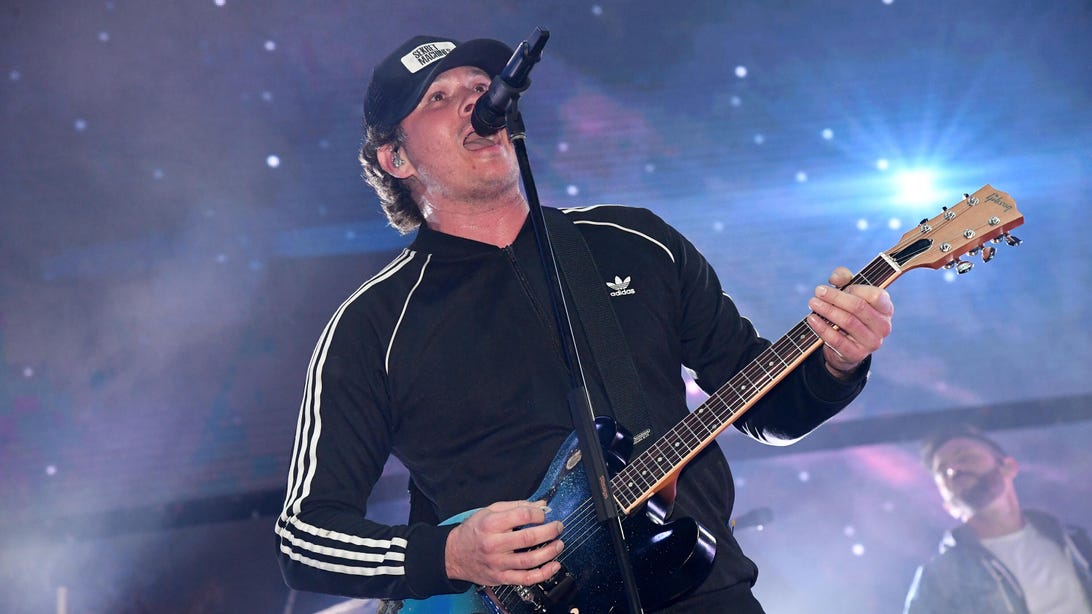
West, the skeptic at Metabunk.com, has provided a trove of reasoned arguments and analysis of the UFO videos, including the two videos reported by The New York Times and another dropped by To The Stars Academy, an organization founded by Blink-182 singer Tom Delonge. He explains them succinctly, suggesting the Tic Tac-shaped objects could be balloons, distant planes and infrared glare from engines. And more recent reports of "pyramid UFOs" in the sky were shown to likely just be planes, too.
gettyimages-1187067839

Tom Delonge, pop punk royalty and also very into aliens.

Jeff Kravitz/Getty

There are detractors, of course. UFO enthusiasts, West says, are often very passionate and don't like their experiences being questioned. His investigations into other conspiracy theories, such as those surrounding chemtrails, haven't received quite as much heat. "I've got far more hate from bits of the UFO community than from any of the other conspiracy theories," he says.

"Even the Flat Earthers are nicer."

We've seen the grim consequences of misinformation and pseudoscience during the pandemic. Overhyped media reports that lend legitimacy to bunk science have led to real-world consequences. 

Belief in alien UFOs might not seem, on the surface, as dangerous as the discredited belief vaccines cause autism, but as theories pick up steam, they can mutate into something more troublesome. Just look at Pizzagate.

Nevertheless, the Pentagon's report is just a few weeks away. The "truth" will be out there -- in your Twitter feed, on your news apps and playing on your local TV station. Will it prove we're not alone in the universe? I doubt it, but the headlines might make you want to believe.


UFOs are real but that doesn't mean we've been visited by aliens - CNET

2021 Apple iPad Pro 12.9 Review - M1 and Mini LED Display

NEW Magic Keyboard for iPad Pro - Should You Buy One?

Wednesday, May 05, 2021

Facebook Oversight Board Upholds Social Network’s Ban of Trump A company-appointed panel ruled that the ban was justified at the time but added that the company should reassess its action and make a final decision in six months.

Facebook Oversight Board Upholds Social Network’s Ban of Trump

“A company-appointed panel ruled that the ban was justified at the time but added that the company should reassess its action and make a final decision in six months.

Donald J. Trump was barred from Facebook on Jan. 7 after he used the site to foment an insurrection in Washington.
Erin Schaff/The New York Times

SAN FRANCISCO — A Facebook-appointed panel of journalists, activists and lawyers on Wednesday upheld the social network’s ban of former President Donald J. Trump, ending any immediate return by Mr. Trump to mainstream social media and renewing a debate about tech power over online speech.

Facebook’s Oversight Board, which acts as a quasi-court over the company’s content decisions, ruled the social network was right to bar Mr. Trump after the insurrection in Washington in January, saying he “created an environment where a serious risk of violence was possible.” The panel said that ongoing risk “justified” the move.

But the board also kicked the case back to Facebook and its top executives. It said that an indefinite suspension was “not appropriate” because it was not a penalty defined in Facebook’s policies and that the company should apply a standard punishment, such as a time-bound suspension or a permanent ban. The board gave Facebook six months to make a final decision on Mr. Trump’s account status.

“Our sole job is to hold this extremely powerful organization, Facebook,accountable,” Michael McConnell, co-chair of the Oversight Board, said on a call with reporters. The ban on Mr. Trump “did not meet these standards,” he said.

The decision adds difficulties to Mr. Trump rejoining mainstream social media, a key source of his clout that he used during his White House years to directly cajole his tens of millions of followers, exploit their grievances, set policy and criticize opponents. Twitter and YouTube had also cut off Mr. Trump in January after the insurrection at the Capitol building, saying the risk and potential for violence that he created were too great.

But while Mr. Trump’s Facebook account remains suspended, he may be able to return to the social network once the company reviews its action. Mr. Trump still holds tremendous sway over Republicans, with his false claims of a stolen election continuing to reverberate. On Wednesday, House Republican leaders moved to expel Representative Liz Cheney of Wyoming from her leadership post for criticizing Mr. Trump and his election lies.

In a statement, Mr. Trump did not directly address the board’s ruling. But he slammed Facebook, Google and Twitter — some of which have been major fund-raising platforms for him — and called them corrupt.

“Free Speech has been taken away from the President of the United States because the Radical Left Lunatics are afraid of the truth,” he said. 

Mr. Trump’s continued Facebook suspension gave Republicans, who have accused social media companies of suppressing conservative voices, new fuel against the platforms. Mark Zuckerberg, Facebook’s chief executive, has testified in Congress several times about whether the social network has shown bias against conservative political views. He has denied it.

Senator Marsha Blackburn, Republican of Tennessee, said the Facebook board’s decision was “extremely disappointing” and that it was “clear that Mark Zuckerberg views himself as the arbiter of free speech.” And Representative Jim Jordan, Republican of Ohio, said Facebook, which faces antitrust scrutiny, should be broken up.

Democrats were also unhappy. Frank Pallone, the chairman of the House energy and commerce committee, tweeted, “Donald Trump has played a big role in helping Facebook spread disinformation, but whether he’s on the platform or not, Facebook and other social media platforms with the same business model will find ways to highlight divisive content to drive advertising revenues.”

The decision underlined the power of tech companies in determining who gets to say what online. While Mr. Zuckerberg has said that he does not wish his company to be “the arbiter of truth” in social discourse, Facebook has become increasingly active about the kinds of content it allows. To prevent the spread of misinformation, the company has cracked down on QAnon conspiracy theory groups, election falsehoods and anti-vaccination content in recent months, before culminating in the blocking of Mr. Trump in January.

“This case has dramatic implications for the future of speech online because the public and other platforms are looking at how the oversight board will handle what is a difficult controversy that will arise again around the world,” said Nate Persily, a professor at Stanford University’s law school.

He added, “President Trump has pushed the envelope about what is permissible speech on these platforms and he has set the outer limits such that if you are unwilling to go after him, you are allowing a large amount of incitement and hate speech and disinformation online that others are going to propagate.”

In a statement, Facebook said it was “pleased” that the board recognized that its barring of Mr. Trump in January was justified. It said it would consider the ruling and “determine an action that is clear and proportionate.”

Mr. Trump’s case is the most prominent that the Facebook Oversight Board, which was conceived in 2018, has handled. The board, which is made up of 20 journalists, activists and former politicians, reviews and adjudicates the company’s most contested content moderation decisions. Mr. Zuckerberg has repeatedly referred to it as the “Facebook Supreme Court.”

But while the panel is positioned as independent, it was founded and funded by Facebook and has no legal or enforcement authority. Critics have been skeptical of the board’s autonomy and have said it gives Facebook the ability to punt on difficult decisions.

Each of its cases is decided by a five-person panel selected from among the board’s 20 members, one of whom must be from the country in which the case originated. The panel reviews the comments on the case and makes recommendations to the full board, which decides through a majority vote. After a ruling, Facebook has seven days to act on the board’s decision.

Mark Zuckerberg, the Facebook chief executive, testified before during the Senate judiciary committee last year. He has denied that the platform showed political bias.
Pool photo by Hannah Mckay/EPA, via Shutterstock

Since the board began issuing rulings in January, it has overturned Facebook’s decisions in four out of the five cases it has reviewed. In one case, the board asked Facebook to restore a post that used Joseph Goebbels, the Nazi propaganda chief, to make a point about the Trump presidency. Facebook had earlier removed the post because it “promoted dangerous individuals,” but complied with the board’s decision.

In another case, the board ruled that Facebook had overreached by taking down a French user’s post that erroneously suggested the drug hydroxychloroquine could be used to cure Covid-19. Facebook restored the post but also said it would keep removing the false information following guidance by the Centers for Disease Control and Prevention and the World Health Organization.

In Mr. Trump’s case, Facebook also asked the board for recommendations on how to handle the accounts of political leaders. On Wednesday, the board suggested the company should publicly explain when it was applying special rules to influential figures, though it should impose definite time limits when doing so. The board also said Facebook should clarify its strikes and penalties process, and develop and publish a policy that governs responses to crises or novel situations where its regular processes would not prevent imminent harm.

“Facebook has been clearly abused by influential users,” said Helle Thorning-Schmidt, a co-chair of the Oversight Board.

Facebook does not have to adopt these recommendations but said it “will carefully review” them.

For Mr. Trump, Facebook was long a place to rally his digital base and support other Republicans. More than 32 million people followed him on Facebook, though that was far fewer than the more than 88 million followers he had on Twitter.

Over the years, Mr. Trump and Mr. Zuckerberg shared a testy relationship. Mr. Trump regularly assailed Silicon Valley executives for what he perceived to be their suppression of conservative speech. He also threatened to revoke Section 230, a legal shield that protects companies like Facebook from liability for what users post.

Mr. Zuckerberg occasionally criticized some of Mr. Trump’s policies, including the handling of the pandemic and immigration. But as calls from lawmakers, civil rights leaders and even Facebook’s own employees grew to rein in Mr. Trump on social media, Mr. Zuckerberg declined to act. He said speech by political leaders — even if they spread lies — was newsworthy and in the public interest.

The two men appeared cordial during occasional meetings in Washington. Mr. Zuckerberg visited the White House more than once, dining privately with Mr. Trump.

The politeness ended on Jan. 6. Hours before his supporters stormed the Capitol, Mr. Trump used Facebook and other social media to try to cast doubt on the results of the presidential election, which he had lost to Joseph R. Biden Jr. Mr. Trump wrote on Facebook, “Our Country has had enough, they won’t take it anymore!”

Less than 24 hours later, Mr. Trump was barred from the platform indefinitely. While his Facebook page has remained up, it has been dormant. His last Facebook post, on Jan. 6, read, “I am asking for everyone at the U.S. Capitol to remain peaceful. No violence!”

Cecilia Kang contributed reporting from Washington.