Contact Me By Email

Saturday, September 16, 2023

James Webb Space Telescope could detect life on Earth from across the galaxy, new study suggests
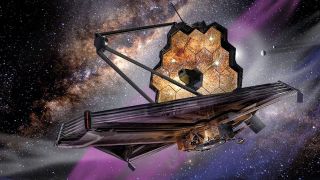
James Vaughan's rendering of the James Webb Space Telescope focuses on the observatory's giant mirror.
“A new study suggests that the James Webb Space Telescope could detect Earth's human civilization from across the galaxy (Image credit: James Vaughan)

The James Webb Space Telescope (JWST) would be able to spot the signs of our civilization on Earth if it was spying on us from another star system in the Milky Way, a new study shows. 

The finding raises hopes that the state-of-the-art spacecraft could detect alien civilizations as it stares out toward distant worlds in our galaxy.

Since launching in late 2021, has been predominantly peering out into the in search of clues about how the early universe formed. But one of the telescope's secondary objectives is to analyze the atmospheres of nearby exoplanets, or planets beyond the solar system, to look for gases produced by biological life, known as biosignatures, and chemicals produced by advanced alien civilizations, known as technosignatures.

Related: 

Measuring the expansion rate of the Universe - Hubble constant tension explained

But despite being the most advanced telescope currently in operation, it is still unclear how well JWST will be able to spot the tell-tale signs of intelligent life. To answer this question, researchers decided to test whether the space telescope could successfully detect intelligent life from the only planet in the universe that is known to be both habitable and currently inhabited — Earth.

In the new study, uploaded to the pre-print server on Aug. 28, researchers took a spectrum of Earth's atmosphere and deliberately decreased the quality of the data to mimic how it would look to an observer dozens of light-years away. The team then used a computer model, which replicated JWST's sensor capabilities, to see if the spacecraft could detect the key biosignatures and technosignatures from the dataset, such as methane and oxygen, produced by biological life, and nitrogen dioxide and chlorofluorocarbons (CFCs), which are produced by humans.

The results, which have not yet been peer-reviewed, show that JWST could likely detect all the key markers of non-intelligent and intelligent life in our planet's atmosphere.

A graph showing the spectrum of Earth's atmosphere

This graph shows the raw atmospheric data used in the new study. Specific biosignatures and technosignatures are highlighted in different colors. (Image credit: Lustig-Yaeger, et al)

The researchers noted that the quality of the altered dataset is roughly equivalent to JWST observations of planets from — a star system containing seven exoplanets that orbit a red dwarf star around 40 light-years from Earth. This suggests the telescope should be able to detect life or alien civilizations on exoplanets within 40 light-years of Earth. But the team believes JWST could possibly detect signs of extraterrestrial life up to 50 light-years from Earth.

Only around 20 have been officially discovered within a 50-light-year radius of Earth, but based on the number of suspected stars in this region of space, experts predict that there may actually be as many as 4,000 exoplanets within JWST's reach, according to , an international astronomical collaboration dedicated to finding potentially habitable planets close to Earth.

However, this doesn't guarantee that JWST would be able to detect life on other planets.

seven planets surrounding a star

An artist's interpretation of what the TRAPPIST-1 system might look like. (Image credit: Getty Images)

Detecting biosignatures and technosignatures on other worlds "may prove challenging to interpret without contextual knowledge about the habitable environment," the researchers wrote. In this study, the team already knew which markers to look for, but on an exoplanet with different conditions and alternate potential life forms or technologies those life-signatures may not be as obvious, they added.

JWST has already made some interesting discoveries about exoplanets near Earth. The telescope , which is around 40 light-years from Earth, and found that TRAPPIST-1b, the second-closest exoplanet to the star in the TRAPPIST-1 system, due to its extreme heat. The spacecraft also glimpsed a , a "super-Jupiter" exoplanet 40 light-years from Earth.

Closer to home, JWST has also detected , which could contain the chemical ingredients needed for life. And further out into the cosmos, the spacecraft has also more than 1,000 light-years from Earth.

to keep talking space on the latest missions, night sky and more! And if you have a news tip, correction or comment, let us know at: 

Get the Space.com Newsletter

Breaking space news, the latest updates on rocket launches, skywatching events and more!

Harry is a U.K.-based staff writer at Live Science. He studied Marine Biology at the University of Exeter (Penryn campus) and after graduating started his own blog site "Marine Madness," which he continues to run with other ocean enthusiasts. He is also interested in evolution, climate change, robots, space exploration, environmental conservation and anything that's been fossilized. When not at work he can be found watching sci-fi films, playing old Pokemon games or running (probably slower than he'd like). 

Latest

Most Popular

By 

By 

By 

Sunday, September 10, 2023

The Technology Facebook and Google Didn’t Dare Release - The New York Times

The Technology Facebook and Google Didn’t Dare Release

"Engineers at the tech giants built tools years ago that could put a name to any face but, for once, Silicon Valley did not want to move fast and break things.

By Shira Inbar

By Kashmir Hill

Kashmir Hill covers technology for The New York Times. She is the author of “Your Face Belongs to Us: A Secretive Startup’s Quest to End Privacy as We Know It,” from which this article is adapted.

One afternoon in early 2017, at Facebook’s headquarters in Menlo Park, Calif., an engineer named Tommer Leyvand sat in a conference room with a smartphone standing on the brim of his baseball cap. Rubber bands helped anchor it in place with the camera facing out. The absurd hat-phone, a particularly uncool version of the future, contained a secret tool known only to a small group of employees. What it could do was remarkable.

The handful of men in the room were laughing and speaking over one another in excitement, as captured in a video taken that day, until one of them asked for quiet. The room went silent; the demo was underway.

Mr. Leyvand turned toward a man across the table from him. The smartphone’s camera lens — round, black, unblinking — hovered above Mr. Leyvand’s forehead like a Cyclops eye as it took in the face before it. Two seconds later, a robotic female voice declared, “Zach Howard.”

“That’s me,” confirmed Mr. Howard, a mechanical engineer.

An employee who saw the tech demonstration thought it was supposed to be a joke. But when the phone started correctly calling out names, he found it creepy, like something out of a dystopian movie.

The person-identifying hat-phone would be a godsend for someone with vision problems or face blindness, but it was risky. Facebook’s previous deployment of facial recognition technology, to help people tag friends in photos, had caused an outcry from privacy advocates and led to a class-action lawsuit in Illinois in 2015 that ultimately cost the company $650 million.

With technology like that on Mr. Leyvand’s head, Facebook could prevent users from ever forgetting a colleague’s name, give a reminder at a cocktail party that an acquaintance had kids to ask about or help find someone at a crowded conference. However, six years later, the company now known as Meta has not released a version of that product and Mr. Leyvand has departed for Apple to work on its Vision Pro augmented reality glasses.

In recent years, the start-ups Clearview AI and PimEyes have pushed the boundaries of what the public thought was possible by releasing face search engines paired with millions of photos from the public web (PimEyes) or even billions (Clearview). With these tools, available to the police in the case of Clearview AI and the public at large in the case of PimEyes, a snapshot of someone can be used to find other online photos where that face appears, potentially revealing a name, social media profiles or information a person would never want to be linked to publicly, such as risqué photos.

What these start-ups had done wasn’t a technological breakthrough; it was an ethical one. Tech giants had developed the ability to recognize unknown people’s faces years earlier, but had chosen to hold the technology back, deciding that the most extreme version — putting a name to a stranger’s face — was too dangerous to make widely available.

Now that the taboo has been broken, facial recognition technology could become ubiquitous. Currently used by the police to solve crimes, authoritarian governments to monitor their citizens and businesses to keep out their enemies, it may soon be a tool in all our hands, an app on our phone — or in augmented reality glasses — that would usher in a world with no strangers.

Hoan Ton-That seated at a table in a house and wearing A.R. glasses
The Clearview AI co-founder Hoan Ton-That wearing the A.R. glasses version of Clearview AI.Kashmir Hill/The New York Times

‘We decided to stop’

As early as 2011, a Google engineer revealed he had been working on a tool to Google someone’s face and bring up other online photos of them. Months later, Google’s chairman, Eric Schmidt, said in an onstage interview that Google “built that technology, and we withheld it.”

“As far as I know, it’s the only technology that Google built and, after looking at it, we decided to stop,” Mr. Schmidt said.

Advertently or not, the tech giants also helped hold the technology back from general circulation by snapping up the most advanced start-ups that offered it. In 2010, Apple bought a promising Swedish facial recognition company called Polar Rose. In 2011, Google acquired a U.S. face recognition company popular with federal agencies called PittPatt. And in 2012, Facebook purchased the Israeli company Face.com. In each case, the new owners shut down the acquired companies’ services to outsiders. The Silicon Valley heavyweights were the de facto gatekeepers for how and whether the tech would be used.

Facebook, Google and Apple deployed facial recognition technology in what they considered to be relatively benign ways: as a security tool to unlock a smartphone, a more efficient way to tag known friends in photos and an organizational tool to categorize smartphone photos by the faces of the people in them.

In the last few years, though, the gates have been trampled by smaller, more aggressive companies, such as Clearview AI and PimEyes. What allowed the shift was the open-source nature of neural network technology, which now underpins most artificial intelligence software.

Understanding the path of facial recognition technology will help us navigate what is to come with other advancements in A.I., such as image- and text-generation tools. The power to decide what they can and can’t do will increasingly be determined by anyone with a bit of tech savvy, who may not pay heed to what the general public considers acceptable.

‘Standing on the shoulders of giants’

How did we get to this point where someone can spot a “hot dad” on a Manhattan sidewalk and then use PimEyes to try to find out who he is and where he works? The short answer is a combination of free code shared online, a vast array of public photos, academic papers explaining how to put it all together and a cavalier attitude toward laws governing privacy.

The Clearview AI co-founder Hoan Ton-That, who led his company’s technological development, had no special background in biometrics. Before Clearview AI, he made Facebook quizzes, iPhone games and silly apps, such as “Trump Hair” to make a person in a photo appear to be coifed like the former president.

In his quest to create a groundbreaking and more lucrative app, Mr. Ton-That turned to free online resources, such as OpenFace — a “face recognition library” created by a group at Carnegie Mellon University. The code library was available on GitHub, with a warning: “Please use responsibly!”

“We do not support the use of this project in applications that violate privacy and security,” read the statement. “We are using this to help cognitively impaired users sense and understand the world around them.”

It was a noble request but completely unenforceable.

Mr. Ton-That got the OpenFace code up and running, but it wasn’t perfect, so he kept searching, wandering through the academic literature and code repositories, trying out this and that to see what worked. He was like a person walking through an orchard, sampling the fruit of decades of research, ripe for the picking and gloriously free.

“I couldn’t have done it if I had to build it from scratch,” he said, name-dropping some of the researchers who had advanced computer vision and artificial intelligence, including Geoffrey Hinton, “the godfather of A.I.” “I was standing on the shoulders of giants.”

Mr. Ton-That is still building. Clearview has developed a version of its app that works with augmented reality glasses, a more fully formed realization of the face-calling hat that the Facebook engineering team had rigged up years earlier.

The end of anonymity

Mr. Ton-That demonstrates the company’s facial recognition software using a photo of himself.
Seth Wenig/Associated Press

The $999 pair of augmented reality glasses, made by a company called Vuzix, connects the wearer to Clearview’s database of 30 billion faces. Clearview’s A.R. app, which can identity someone up to 10 feet away, is not yet publicly available, but the Air Force has provided funding for its possible use at military bases.

On a fall afternoon, Mr. Ton-That demonstrated the glasses for me at his spokeswoman’s apartment on the Upper West Side of Manhattan, putting them on and looking toward me.

“Ooooh, 176 photos,” he said. “Aspen Ideas Festival. Kashmir Hill,” he read from the image caption on one of the photos that came up.

Then he handed the glasses to me. I put them on. Though they looked clunky, they were lightweight and fit naturally. Mr. Ton-That said he had tried out other augmented reality glasses, but these had performed best. “They’ve got a new version coming,” he said. “And they’ll look cooler, more hipster.”

When I looked at Mr. Ton-That through the glasses, a green circle appeared around his face. I tapped a touch pad at my right temple. A message came up on a square display that only I could see on the right lens of the glasses: “Searching …”

And then the square filled with photos of him, a caption beneath each one. I scrolled through them using the touch pad. I tapped to select one that read “Clearview CEO, Hoan Ton-That;” it included a link that showed me that it had come from Clearview’s website.

I looked at his spokeswoman, searched her face, and 49 photos came up, including one with a client that she asked me not to mention. This casually revealed just how intrusive a search of someone’s face can be, even for a person whose job is to get the world to embrace this technology.

I wanted to take the glasses outside to see how they worked on people I didn’t actually know, but Mr. Ton-That said we couldn’t, both because the glasses required a Wi-Fi connection and because someone might recognize him and realize immediately what the glasses were and what they could do.

It didn’t frighten me, though I knew it should. It was clear that people who own a tool like this will inevitably have power over those who don’t. But there was a certain thrill in seeing it work, like a magic trick successfully performed.

A lost opportunity?

Andrew Bosworth, chief technology officer of Meta, said that face recognition was “hugely controversial” and that granting broad access to it was “a debate we need to have with the public.”
David Paul Morris/Bloomberg

Meta has been working for years on its own augmented reality glasses. In an internal meeting in early 2021, the company’s chief technology officer, Andrew Bosworth, said he would love to equip them with facial recognition capabilities.

In a recording of the internal meeting, Mr. Bosworth said that leaving facial recognition out of augmented reality glasses was a lost opportunity for enhancing human memory. He talked about the universal experience of going to a dinner party and seeing someone you know but failing to recall their name.

“We could put a little name tag on them,” he said in the recording, with a short chuckle. “We could. We have that ability.”

But he expressed concern about the legality of offering such a tool. Buzzfeed reported on his remarks at the time. In response, Mr. Bosworth said that face recognition was “hugely controversial” and that granting broad access to it was “a debate we need to have with the public.”

While Meta’s augmented reality glasses are still in development, the company shut down the facial recognition system deployed on Facebook to tag friends in photos and deleted the more than one billion face prints it had created of its users.

It would be easy enough to turn such a system back on. When I asked a Meta spokesman about Mr. Bosworth’s comments and whether the company might put facial recognition into its augmented reality glasses one day, he would not rule out the possibility."

The Technology Facebook and Google Didn’t Dare Release - The New York Times

DJI OSMO ACTION 4 vs GOPRO HERO 12 | Which Action Camera to buy in 2023?...

Saturday, September 02, 2023

Apple's iPhone Event Set For September 12th! The latest iPhone 15/15 Pro Details!

Opinion | Is There a Crisis in Cosmology? - The New York Times

The Story of Our Universe May Be Starting to Unravel

Virginia Gabrielli

By Adam Frank and Marcelo Gleiser

"Dr. Frank is an astrophysicist at the University of Rochester. Dr. Gleiser is a theoretical physicist at Dartmouth College.

Not long after the James Webb Space Telescope began beaming back from outer space its stunning images of planets and nebulae last year, astronomers, though dazzled, had to admit that something was amiss. Eight months later, based in part on what the telescope has revealed, it’s beginning to look as if we may need to rethink key features of the origin and development of the universe.

Launched at the end of 2021 as a joint project of NASA, the European Space Agency and the Canadian Space Agency, the Webb, a tool with unmatched powers of observation, is on an exciting mission to look back in time, in effect, at the first stars and galaxies. But one of the Webb’s first major findings was exciting in an uncomfortable sense: It discovered the existence of fully formed galaxies far earlier than should have been possible according to the so-called standard model of cosmology.

According to the standard model, which is the basis for essentially all research in the field, there is a fixed and precise sequence of events that followed the Big Bang: First, the force of gravity pulled together denser regions in the cooling cosmic gas, which grew to become stars and black holes; then, the force of gravity pulled together the stars into galaxies.

The Webb data, though, revealed that some very large galaxies formed really fast, in too short a time, at least according to the standard model. This was no minor discrepancy. The finding is akin to parents and their children appearing in a story when the grandparents are still children themselves.

It was not, unfortunately, an isolated incident. There have been other recent occasions in which the evidence behind science’s basic understanding of the universe has been found to be alarmingly inconsistent.

Take the matter of how fast the universe is expanding. This is a foundational fact in cosmological science — the so-called Hubble constant — yet scientists have not been able to settle on a number. There are two main ways to calculate it: One involves measurements of the early universe (such as the sort that the Webb is providing); the other involves measurements of nearby stars in the modern universe. Despite decades of effort, these two methods continue to yield different answers.

At first, scientists expected this discrepancy to resolve as the data got better. But the problem has stubbornly persisted even as the data have gotten far more precise. And now new data from the Webb have exacerbated the problem. This trend suggests a flaw in the model, not in the data.

Two serious issues with the standard model of cosmology would be concerning enough. But the model has already been patched up numerous times over the past half century to better conform with the best available data — alterations that may well be necessary and correct, but which, in light of the problems we are now confronting, could strike a skeptic as a bit too convenient.

Physicists and astronomers are starting to get the sense that something may be really wrong. It’s not just that some of us believe we might have to rethink the standard model of cosmology; we might also have to change the way we think about some of the most basic features of our universe — a conceptual revolution that would have implications far beyond the world of science.

A potent mix of hard-won data and rarefied abstract mathematical physics, the standard model of cosmology is rightfully understood as a triumph of human ingenuity. It has its origins in Edwin Hubble’s discovery in the 1920s that the universe was expanding — the first piece of evidence for the Big Bang. Then, in 1964, radio astronomers discovered the so-called Cosmic Microwave Background, the “fossil” radiation reaching us from shortly after the universe began expanding. That finding told us that the early universe was a hot, dense soup of subatomic particles that has been continually cooling and becoming less dense ever since.

Over the past 60 years, cosmology has become ever more precise in its ability to account for the best available data about the universe. But along the way, to gain such a high degree of precision, astrophysicists have had to postulate the existence of components of the universe for which we have no direct evidence. The standard model today holds that “normal” matter — the stuff that makes up people and planets and everything else we can see — constitutes only about 4 percent of the universe. The rest is invisible stuff called dark matter and dark energy (roughly 27 percent and 68 percent).

Cosmic inflation is an example of yet another exotic adjustment made to the standard model. Devised in 1981 to resolve paradoxes arising from an older version of the Big Bang, the theory holds that the early universe expanded exponentially fast for a fraction of a second after the Big Bang. This theory solves certain problems but creates others. Notably, according to most versions of the theory, rather than there being one universe, ours is just one universe in a multiverse — an infinite number of universes, the others of which may be forever unobservable to us not just in practice but also in principle.

There is nothing inherently fishy about these features of the standard model. Scientists often discover good indirect evidence for things that we cannot see, such as the hyperdense singularities inside a black hole. But in the wake of the Webb’s confounding data about galaxy formation, and the worsening problem with the Hubble constant, you can’t be blamed for starting to wonder if the model is out of joint.

A familiar narrative about how science works is often trotted out at this point to assuage anxieties. It goes like this: Researchers think they have a successful theory, but new data show it is flawed. Courageously rolling up their sleeves, the scientists go back to their blackboards and come up with new ideas that allow them to improve their theory by better matching the evidence.

It’s a story of both humility and triumph, and we scientists love to tell it. And it may be what happens in this case, too. Perhaps the solution to the problems the Webb is forcing us to confront will require only that cosmologists come up with a new “dark” something or other that will allow our picture of the universe to continue to match the best cosmological data.

There is, however, another possibility. We may be at a point where we need a radical departure from the standard model, one that may even require us to change how we think of the elemental components of the universe, possibly even the nature of space and time.

Cosmology is not like other sciences. It’s not like studying mice in a maze or watching chemicals boil in a beaker in a lab. The universe is everything there is; there’s only one and we can’t look at it from the outside. You can’t put it in a box on a table and run controlled experiments on it. Because it is all-encompassing, cosmology forces scientists to tackle questions about the very environment in which science operates: the nature of time, the nature of space, the nature of lawlike regularity, the role of the observers doing the observations.

These rarefied issues don’t come up in most “regular” science (though one encounters similarly shadowy issues in the science of consciousness and in quantum physics). Working so close to the boundary between science and philosophy, cosmologists are continually haunted by the ghosts of basic assumptions hiding unseen in the tools we use — such as the assumption that scientific laws don’t change over time.

But that’s precisely the sort of assumption we might have to start questioning in order to figure out what’s wrong with the standard model. One possibility, raised by the physicist Lee Smolin and the philosopher Roberto Mangabeira Unger, is that the laws of physics can evolve and change over time. Different laws might even compete for effectiveness. An even more radical possibility, discussed by the physicist John Wheeler, is that every act of observation influences the future and even the past history of the universe. (Dr. Wheeler, working to understand the paradoxes of quantum mechanics, conceived of a “participatory universe” in which every act of observation was in some sense a new act of creation.)

It is not obvious, to say the least, how such revolutionary reconsiderations of our science might help us better understand the cosmological data that is flummoxing us. (Part of the difficulty is that the data themselves are shaped by the theoretical assumptions of those who collect them.) It would necessarily be a leap of faith to step back and rethink such fundamentals about our science.

But a revolution may end up being the best path to progress. That has certainly been the case in the past with scientific breakthroughs like Copernicus’s heliocentrism, Darwin’s theory of evolution and Einstein’s relativity. All three of those theories also ended up having enormous cultural influence — threatening our sense of our special place in the cosmos, challenging our intuition that we were fundamentally different than other animals, upending our faith in common sense ideas about the flow of time. Any scientific revolution of the sort we’re imagining would presumably have comparable reverberations in our understanding of ourselves.

The philosopher Robert Crease has written that philosophy is what’s required when doing more science may not answer a scientific question. It’s not clear yet if that’s what’s needed to overcome the crisis in cosmology. But if more tweaks and adjustments don’t do the trick, we may need not just a new story of the universe but also a new way to tell stories about it.

Adam Frank (@AdamFrank4) is a professor of astrophysics at the University of Rochester and the author of the forthcoming book “The Little Book of Aliens.” Marcelo Gleiser (@MGleiser) is a professor of physics and astronomy at Dartmouth College and the author of “The Dawn of a Mindful Universe: A Manifesto for Humanity’s Future.”

Opinion | Is There a Crisis in Cosmology? - The New York Times

Sunday, August 27, 2023

‘Strange New Worlds’ Actor Adrian Holmes Talks Bringing Mythic ‘Star Trek’ Character to Life and Endearing Note From LeVar Burton

‘Strange New Worlds’ Actor Adrian Holmes Talks Bringing Mythic ‘Star Trek’ Character to Life and Endearing Note From LeVar Burton

“Admiral Robert April was first introduced, albeit briefly, in 'Star Trek: The Animated Series,' which ran for two seasons in the early '70s.

Adrian Holmes as Admiral April in STAR TREK STRANGE NEW WORLDS.

Adrian Holmes was stunned.

The euphoria of being cast in Star Trek: Strange New Worlds was still coursing through him as he began to do research into his character, Admiral Robert April.

Not only was he the very first captain of the U.S.S. Enterprise in Star Trek lore, April was the lead when the legendary Gene Roddenberry created the series — before it was retooled for Christopher Pike and then a third time for James T. Kirk.

Admiral Robert April was first introduced, albeit briefly, in Star Trek: The Animated Series, which ran for two seasons in the early ’70s. He would not be portrayed again until Holmes landed the role for the new Paramount+ series.

Calling it an “honor” and “a dream” while talking with The Hollywood Reporterabout his time on Strange New Worlds, Holmes noted that he has been a fan of the franchise since his youth. In addition to the rapport built with castmate Anson Mount, who plays Capt. Pike, Holmes tells THR he is thrilled to see where this journey to the stars will take him.

Popular on THR 

 How did you become involved with the series? 

I got a call from my agent and was told about it. I put together a [taped audition], sent it in, and went on with my life. And then they reached back and said they wanted to give me some notes and had me do it again. And then they said, “You’re great. You got the part.” I was just like, “Wow!”

I started doing research on the character because, at first, I wasn’t too familiar with Robert April when I was cast. Then I started going through the backstory, and I understood the gravity of this man, the importance and significance of his involvement in Starfleet.

I’m glad that you talked about diving into the character. He’s so mythic in Star Trek lore. Were you given a backstory to help you develop the character, or did you develop your backstory, or was it all canon? 

April was Gene Roddenberry’s original pitch back in 1964 to CBS for the captain role, but he was changed to Capt. Pike later when NBC accepted it. That was cool to discover. And then, in the 1974 animated series, he was really introduced in “The Counter-Clock Incident.” So, it’s cool how it all came together.  I’m learning a lot. I grew up a big sci-fi fan.

A friend of mine is friends with LeVar Burton, and LeVar was so kind. He sent me a video welcoming me to the franchise, and I was just so moved by his generosity. He basically said, “Welcome. We are family, and we’re just proud to have you.” He said that when Gene set out to make Star Trek, he knew that as human beings, we could get our shit together. And if we were to become a space-faring civilization, we had to solve the problems that lie in here now. That is the core of Star Treks ethos. It’s about us all working together to build a better future.

What I love is the diversity and inclusivity of the franchise. It’s very progressive and forward-thinking, which goes to support the building of a better future. Representation matters.

Anson Mount as Pike and Adrian Holmes as Admiral April of in STAR TREK: STRANGE NEW WORLDS.
Anson Mount as Pike and Adrian Holmes as Admiral April in Star Trek: Strange New Worlds Courtesy of Marni Grossman/Paramount+none

Thus far, you’ve worked with Anson the most. How has it been building that deep rapport your characters have for one another? He told me in a previous interview that the opening snow scene was pretty chilly for you two. 

(Laughs.) Yeah, if you look at that scene, you’ll see that I look a lot bigger than I normally am, and that’s because I have about 15 layers underneath that jacket. We had a very cold day of shooting, but I tell you, it looks so magnificent onscreen with him on the horse and the ship coming down, kicking up the snow. I thought it was just such a beautiful teaser and introduction for my character.

And Anson, he is just a constant professional. He pays very close attention to detail. He knows the ins and outs of the script and the characters and what works and what doesn’t. He’s very easygoing and makes us all feel safe and comfortable. I’m looking forward to going back and cooking it up with him again.

That’s great and leads me to my final question. I know you can’t say much, but is there anything you’re able to tease about the Admiral April’s future? I’m hoping we see a heck of a lot more of him.

You know, your lips to God’s ears, man. (Laughs.) I feel the same way, but to be honest with you, I have no idea. I know he’s alive. (Laughs.) And I returned to shoot some more, but I don’t know where my journey is taking me. We’re just going to have to wait and see what happens.

Interview edited for length and clarity.

Star Trek: Strange New Worlds streams new episodes Thursday on Paramount+.“