Contact Me By Email

Wednesday, February 15, 2023

‘Star Trek: Picard’ Gets the ‘Next Generation’ Band Back Together - The New York Times

‘Picard’ Gets the ‘Next Generation’ Band Back Together

"The new season provides a victory lap for some of the most beloved “Star Trek” characters and actors. “I had long since given up on any hope of a conclusion as satisfying as this one is,” LeVar Burton said.

A group of four men and a woman pose for a formal portrait in front of a black background.
Clockwise from top left: Michael Dorn, Gates McFadden, Jonathan Frakes, LeVar Burton and Patrick Stewart of “The Next Generation,” which ran for seven seasons starting in 1987.Ryan Pfluger for The New York Times

LOS ANGELES — In a 1987 review of “Star Trek: The Next Generation,” a New York Times TV critic wrote of the premiere, “On this initial voyage, the Enterprise and its new crew simply fail to take flight.”

This was a common sentiment through the show’s early days, one shared by many fans, critics and even some of those involved in the series. As the first version of “Star Trek” to not involve the beloved Kirk, Spock and McCoy from the original series and multiple films, “The Next Generation” had to overcome plenty of distrust and resentment before finding its footing.

Decades later, after a popular seven-season run and several movies, it’s hard to believe anyone ever doubted “The Next Generation.” Go to any convention panel featuring members of the cast, and fans will line up to say that Deanna Troi (Marina Sirtis) inspired them to become psychologists, or that Beverly Crusher (Gates McFadden) did the same for doctors. Or that Geordi La Forge (LeVar Burton) influenced a generation of engineers.

For years, such events were the only way to see the stoic and thoughtful Jean-Luc Picard (Patrick Stewart) and Co. gathered together. But now much of the original “Next Generation” cast has been reunited in the new season of “Star Trek: Picard,” which premieres Thursday on Paramount+. While there is plenty of fan service to go around, the story lines offer a fresh take on familiar faces who have taken drastically different paths.

If not exactly a “Next Generation” revival, the story could function as another, perhaps better, send-off for some of the most beloved characters in the “Star Trek” universe, who were last all together onscreen two decades ago in the movie “Star Trek: Nemesis.” Panned by critics, fans and even some of the actors, the film seemed like the end of the road for the cast.

But the universe where their ship had once boldly gone had more in store.

When the core cast got together for an interview last week, the gathering had the atmosphere of a family reunion. Stewart broke into song with Jonathan Frakes, who plays Picard’s longtime No. 1, William Riker, while Michael Dorn (who plays the honorable Klingon Worf) cackled nearby. In the conversation that followed, they, along with Burton, McFadden and Brent Spiner (the android Data), talked about what it was like to revisit their most famous characters and work with one another again. (Sirtis was unavailable; Spiner joined by video.)

These are edited excerpts from the interview.

I was fascinated to learn that Jean-Luc Picard was originally based loosely on Horatio Hornblower, the fictional Royal Navy officer protagonist of the C.S. Forester novels. Patrick, you’ve obviously made the character your own since. What did you draw on for the Admiral Picard we see in the current series?

PATRICK STEWART Well, a lot of it is based on disappointment, frustration. I was promoted, which meant a bit of farewell. A goodbye. But the admiral job turned out to be an office trip, basically. It was not what he had known all his life, which was being on a ship. I’ve heard this from Navy people, that they have the same thing.

So he had gone back to France and was running his vineyard and then he encounters this profoundly troubled young woman and feels that he needs to do something. That’s where the engagement begins, and it is also the last time that, as an actor, I ran up a flight of stairs. You’ll never see me do that again.

A close-up, black-and-white portrait of an bald man on a black background.
Patrick Stewart, who plays Jean-Luc Picard, said he had felt “disappointment” at the way “Star Trek: Nemesis” seemed to conclude the stories of many “Next Generation” characters.Ryan Pfluger for The New York Times

I saw an interview where you said that sometimes you don’t know where Picard ends and Patrick Stewart begins. Do the rest of you feel that way about your characters?

MICHAEL DORN Not me.

JONATHAN FRAKES What about your new Worf?

DORN What about him?

FRAKES He’s a little more like Michael.

DORN Did I say no? I meant yes.

[Laughter.]

LEVAR BURTON I’ve tried to bring as much LeVar into Geordi as has made sense. I won’t say that there’s an absolute melding of the two, but there’s a little Geordi in me now, absolutely.

BRENT SPINER I’ve said this before, and it may be redundant, but I think there’s a little Data in every man. But since I am Data, there’s more of it in me.

Who here needed the most convincing to reprise his or her character?

SPINER Dorn, I think. Right?

DORN Everything was fine except the makeup. That was the issue that I had: making sure the makeup was not three hours as it was before.

Was it better?

DORN Much better. Actually, the makeup was less than an hour.

“Our relationship was so gentle,” Frakes (left, with Stewart) said about “The Next Generation,” but in “Picard,” “we really had big issues, and that made the drama better.”Trae Paatton/Paramount+

FRAKES Never looked better, I’ve got to say. The beard was beautiful.

How challenging was it to play evolved versions of your characters?

FRAKES I thought Terry [the showrunner, Terry Matalas] wrote Riker better than he had ever been written.

How so?

FRAKES He had Patrick and me to lunch, and he said, “What I’d like to do is write conflict for you two guys who never really had any conflict.” To which we both said: “That’s great.” Roddenberry [Gene Roddenberry, the “Star Trek” creator] wanted our ship to exist in a bubble in which the family lived without conflict, which is unrealistic and uninteresting in many ways and is undramatic. So for Picard and Riker to be at loggerheads was great for us. To look at Patrick’s eyes and the characters disagree — it was so much different than bringing him reports. Our relationship was so gentle, and here we really had big issues, and that made the drama better. It made the story better.

McFadden, who plays Beverly Crusher.Ryan Pfluger for The New York Times
Burton, who plays Geordi La Forge.Ryan Pfluger for The New York Times

Brent, there’s a running joke among fans about how every time there’s a new “Star Trek” story, there’s a new character for you to play. [Data has multiple clones and human quasi-ancestors.] Is there a part of you that wishes your original version of Data, who died in “Nemesis,” could be part of this rendition?

SPINER I don’t think so, because then I couldn’t have played those other things. You know, I was perfectly happy with the ending of “Nemesis,” even though I know that a lot of fans weren’t. And then I feel that was sort of redeemed, in a way, for the fans in the first season of “Picard.” I would hate to have missed both those moments.

So no, I’m perfectly happy with the way it’s gone. I can’t say much more. I haven’t really seen much of the show — they’ve kept it away from me because they know I’ll blow it.

Trae Patton/Paramount+

How did the rest of you feel about where the “Next Generation” franchise was left after “Nemesis”?

BURTON I always felt it was a missed opportunity to create a story and play a story line that had a fitting and proper conclusion to it. None of us knew that was going to be our last outing. So there was always, at least for me, a sense of a missed opportunity, something unfulfilled.

FRAKES Which is what Season 3 of “Picard” has been, which we didn’t dare hope for.

BURTON That ship had sailed. Two decades have passed. I had long since given up on any hope of a conclusion as satisfying as this one is.

GATES McFADDEN I had given up hope. I felt that my character in the movies was practically nonexistent; it was just bizarre. In this one, I felt more like the way I felt in “All Good Things” [the series finale]. “All Good Things” was a brilliant end. We all had great story lines, and in this, I think, the same thing is true. You feel the past — I felt my past connection with each of these characters, and that was something I didn’t feel in the films. Then I felt like I was just filling a role of, “Well, we have to have Crusher in here because she’s part of the cast.” There wasn’t really a sense that I had a through-line or real character intention. So this was unexpected, and I’m very happy with it. I think it’s an incredible season.

“People need role models,” said McFadden, pictured in a scene from “Star Trek: Picard." “I don’t think I understood that when I first started doing the show. Trae Paatton/Paramount+
Dorn (right, with Stewart) took at least a little convincing to reprise his character, specifically, “making sure the makeup was not three hours as it was before,” he said.Trae Paatton/Paramount+

DORN I didn’t have any idea that [“Nemesis”] was going to be the last one. I thought that there was going to be another shot at some point. After 10 years go by, you go, “I don’t know if it’s going to come back.”

Patrick, did you think you were saying goodbye to Jean-Luc after “Nemesis?”

STEWART Oh, yes, but with disappointment.

[To Spiner:] Brent, there had been a lot of conversation about you and John Logan [who co-wrote “Nemesis”] writing a new film script, and that appealed to me enormously. But of course that was dumped along with everything else. And I felt frustration and disappointment about that because what we went out with wasn’t good, I don’t think.

SPINER There are things about “Nemesis” that didn’t work. I think we went into it with the feeling that it was probably going to be our last film, which was why we let Data’s demise happen. We thought a great dramatic conclusion to one of the characters would be a fitting end to the series.

I don’t want to put the blame on anybody for why “Nemesis” didn’t work, but I think we could have come back and done another film. As we’ve seen, Data did come back in the first season of “Picard,” so there were ways of doing that.

McFADDEN The franchise is very different now, though. I think that we’ve had so many wonderful captains of new shows, and it’s gone on enough to be able to make fun of itself in “Lower Decks.” In particular, if I can speak for the role of women in the franchise, it’s just night and day from when Marina and I began. There’s a huge difference to me, and that view is manifest in this season.

Jonathan Frakes, who plays William Riker.Ryan Pfluger for The New York Times
Michael Dorn, who plays the Klingon Worf.Ryan Pfluger for The New York Times

You all have talked in the past about how fun the “Next Generation” set was. What was the dynamic like in working together again?

DORN It was different.

In what ways?

DORN I mean, for me, we weren’t all together all the time.

FRAKES We didn’t have the opportunity to get back into that weird rhythm. [With the original series,] we did 26 episodes a year, but we played on the bridge together for days on end. That’s when we got a reputation as being so rambunctious and unmanageable that the director had to yell action to get us to shut up.

McFADDEN There were times where we were all together as well.

Since his role playing the android Data in “Next Generation,” Brent Spiner has also played Data’s multiple clones and human quasi-ancestors.James Dimmock/Paramount+

SPINER For me, it was very similar to the way it used to be, except much slower.

[Laughter.]

What do you mean by that?

SPINER We’re old.

What is it about these characters that still resonates decades later?

McFADDEN People need role models; I don’t think I understood that when I first started doing the show. By doing the conventions, I have been introduced — we all have — to people whose lives have been changed by watching the show, or maybe that was the only thing on in the hospital room. And it is a show that is intelligent and has scientific basis to it but also has great humanity.

I think this season of “Picard,” our characters are the most human they’ve ever been, actually. We are expressing things in ways that we weren’t quite expressing them in any other show. The fans have taught me a lot and brought me to understanding how important it is to have a show that talks about a positive future, a future where people can collaborate, that’s inclusive.

SPINER I think it also has to do with our affection for each other as a family. It’s the connection we have with each other that they appreciate. They can then symbiotically be a part of the familial situation that we have onscreen and, frankly, offscreen as well."


‘Star Trek: Picard’ Gets the ‘Next Generation’ Band Back Together - The New York Times

Monday, February 13, 2023

DeSantis’s corporate donors under fire for ‘hypocrisy’ over Black History Month

DeSantis’s corporate donors under fire for ‘hypocrisy’ over Black History Month

Companies such as Amazon, Disney and Walmart funded Florida governor who has imposed curbs on teaching about race in schools

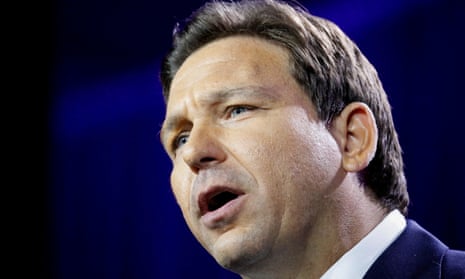
Republican Florida Governor Ron DeSantis speaks during his 2022 U.S. midterm elections night party in Tampa, Florida.
Florida’s controversial rightwing governor, Ron DeSantis, sought reelection in 2022. Many expect him to face Donald Trump in 2024. Photograph: Marco Bello/Reuters

Political activists in Florida have condemned the “hypocrisy” of large corporations that use Black History Month to denounce racism while donating hundreds of thousands dollars to the state’s rightwing governor, Ron DeSantis.

Amazon, AT&T, Comcast, Disney and Walmart are among the companies that publicly proclaim their commitment to anti-racist values, especially after the 2020 police murder of George Floyd, an African American man in Minneapolis.

But research by the Center for Political Accountability, a non-profit organisation that tracks corporate political spending, shows that these same businesses donated directly and indirectly to the 2022 re-election campaign of DeSantis, who has imposed limits on how race and racism can be taught in Florida schools.

“These corporations can say that they stand with the Black community but then also fund the governor and his work around dismantling Black history,” said Jasmine Burney-Clark, founder of Equal Ground, a progressive group based in Orlando, Florida. “It’s a huge level of hypocrisy.”

Corporations have increasingly taken a stand on social and racial justice issues in recent years and often see Black History Month as an ideal opportunity to promote themselves. Many express solidarity on social media or tout programs within the company to highlight the contributions of Black employees.

Amazon, AT&T, Coca-Cola, Comcast, DoorDash, General Motors and Walmart have all made public statements in celebration of Black History Month. Google posted online on 1 February: “Learn how Google is recognizing and celebrating Black voices, joy and success this Black History Month.”

But the Center for Political Accountability found that each of these companies donated significant sums of money to political groups that prominently supported DeSantis.

Disney writes on its Resorts website: “During Black History Month in February, the Disney Parks Blog will celebrate Black stories and highlight special experiences at Disneyland Resort and Walt Disney World Resort.”

Yet early in the election cycle – and before its relationship with DeSantis fully soured – Disney contributed $50,000 to his re-election campaign and $125,000 to the Republican party of Florida, which supported his campaign and inauguration.

Charter Communications, a telecommunication firm, regularly celebrates Black History Month on its corporate site. It also gave $200,000 to Friends of Ron DeSantis, a political action committee supporting his re-election, as well as $125,000 to the Republican party of Florida and $205,000 to the Republican Governors Association – both huge donors to DeSantis.

Duke Energy tweeted on 1 February: “Sharene Pierce, Chief D&I Officer, reflects on influential figures who left an impression on her life. While #BlackHistoryMonth is a time to celebrate the impact of African Americans, our commitment to fostering a culture of diversity, equity & inclusion is year round.” The company also gave $2m to the Republican party of Florida, which has embraced DeSantis’s crackdown on “woke” policies on race, gender and public health.

DeSantis has sought to position himself on the frontlines of American “culture wars”, as he considers a 2024 bid for the White House and tries to outflank former president Donald Trump, the only official well-known candidate so far.

Earlier this month, the second-term governor announced plans to block state colleges from having programs on diversity, equity and inclusion as well as critical race theory, or CRT, which examines the ways in which racism was embedded into American law and other modern institutions, maintaining the dominance of white people.

The DeSantis administration also blocked a new advanced placement course on African American studies from being taught in high schools, saying it violates state law and is historically inaccurate. In the new framework, topics including Black Lives Matter, reparations and queer theory are not part of the exam.

And last year, DeSantis signed the “Stop Woke Act” that restricts certain race-based conversations and analysis in schools and businesses. The law bars instruction that defines people as necessarily oppressed or privileged based on their race.

The governor has imposed sweeping restrictions on books in public schools, forcing some teachers to remove books from their libraries or use paper to cover up their shelves. They face felony charges if unsanctioned books are present in their classrooms.

The implications reach far beyond Florida. At least 25 states have considered legislation or other steps to limit how race can be taught, according to an analysis by Education Week. Eight states have banned or limited the teaching of critical race theory or similar concepts through laws or administrative actions.

Burney-Clark said: “This man is attempting to be president of the United States. We could draw the line right now; these corporations had the true capacity and not the performative capacity to do that.”

Last year, Disney, under pressure from consumers and its own staff, took a stand against Florida’s “don’t say gay” law, which bars instruction on sexual orientation and gender identity in kindergarten through third grade as well as lessons deemed not age-appropriate. DeSantis sought retribution, and last week, Florida Republicans approved proposals to strip the company of its self-governing status in Walt Disney World’s Reedy Creek Improvement District.

But Burney-Clark urged companies not to be intimidated. “Disney, unfortunately, is going through a difficult time but has the power and capacity to be doing more than they’re actually doing.

“I don’t think that they should worry about the threat of losing support or favor with the governor. They should be focused on the consumers who have built these publicly held corporations to where they currently are right now with the scale that they have.”

The Center for Political Accountability, based in Washington, has been engaging companies about a model code of conduct that would give them control over spending and protect them from the type of threat that Disney and others are facing.

Bruce Freed, president of the Center, said DeSantis is attracting money for two reasons. “One, because he’s the governor of Florida up for re-election and he’s the dominant figure in the state so you have the whole issue of giving for access.

“Secondly, he is a potential presidential candidate and so you have companies looking to build relationships. But today that’s fraught with much greater risk because of the sharp polarisation that we have and the positions that he has taken that in quite a few instances conflict with company policy positions.”

That could be a problem. Studies show that consumers are more willing to boycott brands, and would-be employees are more likely to reject opportunities at companies that do not align with their values.

Jeanne Hanna, the Center’s research director, said: “Companies are trying to engage in politics as usual but consumers and employees and shareholders are recognizing the change in the cultural norms around companies and political engagement. They want to see companies taking proactive stances to back up their values with action and then who they engage with when it comes to politics.”

Opinion The Chiefs proudly broke racial barriers. Kansas City erected them.

“Opinion The Chiefs proudly broke racial barriers. Kansas City erected them.

February 9, 2023 at 8:00 a.m. EST

(Washington Post Staff illustration; AP photo

When Mike Garrett, a Heisman Trophy winner from the University of Southern California, was drafted by the Kansas City Chiefs in 1966, the only thing he knew about his new home was the song.

The city surprised him. The 12th Street and Vine jazz district praised by Jerry Leiber and Mike Stoller in “Kansas City” was floundering, but the Country Club Plaza — a Spanish-influenced medley of department stores, boutiques, restaurants and luxury apartments that is the city’s equivalent of Georgetown — seemed like a great place to live.

Garrett was turned down at every open apartment he visited.

The Chiefs, who play the Philadelphia Eagles on Sunday in a Super Bowl featuring two Black starting quarterbacks for the first time, have a proud legacy of elevating Black talent. The franchise’s early teams were stocked with overlooked stars from historically Black colleges and universities. Lamar Hunt, the team’s owner, saw the NFL’s racial biases as a market inefficiency to exploit.

But the city wasn’t nearly as hospitable. Black players such as Garrett struggled to find housing in a metro area that was among the most redlined in the country.

No place epitomized segregation like the Country Club District. In the first half of the 20th century, developer J.C. Nichols built a wonderland of posh homes, tree-lined vistas and cul-de-sacs that spanned more than 5,000 acres, emanating from the middle of Kansas City, Mo., into Kansas, where he planned several more suburban communities. “If Webster was asked to provide another synonym for city planning,” wrote one New York City journalist in 1925, “his answer would be Jesse Clyde Nichols, Kansas City, Mo.”

Restrictive covenants were key to Nichols’s neighborhoods. He legally bound entire subdivisions to ban Black people from buying homes. To ensure no one broke the covenants, he created homeowners associations to enforce the rules. Nichols wasn’t the first person to use these innovations, but he was the first to apply them over such a large area in a systematic fashion, and he spread his techniques across the country as an influential member of various real estate trade groups.

The story of Nichols and Kansas City’s extreme segregation, exemplified by a de facto dividing line at Troost Avenue, have become an increasingly discussed subject among residents over the past decade. What is less known is how those policies were applied to Kansas City’s emblem of pioneering equality in the NFL: the Chiefs.

When the American Football League’s Dallas Texans moved to Kansas City and became the Chiefs for the 1963 season, the team’s Black players discovered Kansas City’s segregation patterns applied to them. In August of that year, running back Curtis McClinton, the son of a prominent Kansas legislator, enthralled Kansas City fans by scoring the team’s first home touchdown on a 73-yard run during the preseason. He lived in a Kansas City basement apartment he rented for $7 a week.

It wasn’t any better in the suburbs. Future Hall of Fame linebacker Bobby Bell says he looked at more than 200 houses for his family in the mid-1960s, getting denied by realtors and bankers who refused to underwrite his mortgage. Head coach Hank Stram, who was White and lived in the Nichols-planned suburb Prairie Village, Kan., made calls on Bell’s behalf to no avail. “You couldn’t do anything,” Bell said. “They didn’t want to take you.”

The discrimination diminished the team’s roster. After Kansas Jayhawks running back Gale Sayers, another future Hall of Famer, was drafted by the AFL’s Chiefs in 1965, he chose to play for the NFL’s Chicago Bears instead. “He knew Kansas City,” McClinton said at the time. “He knew what the housing situation was.”

McClinton, with the financial backing of Bell and other teammates, proposed an integrated apartment complex that featured central air conditioning and a pool shaped like a football. The city council denied the plan over zoning issues.

He pushed on, starting a branch of Jim Brown’s Black Economic Union to promote business opportunities for Black Kansas Citians and joining Freedom Inc., a local civil rights group, to push for housing reform. The activists’ work culminated in Kansas City passing a fair-housing ordinance that forbade racial discrimination in July 1967, six months after the Chiefs played in the first Super Bowl.

Garrett believes the Chiefs’ success helped improve the city’s race relations. When he looked at the Plaza again in 1968, he got an apartment.

Similar laws came to the suburbs. Bell eventually bought a house in Prairie Village in 1968, after a White man purchased it and rented to Bell until he could find a willing mortgage underwriter. Shortly after Bell moved in, a White neighbor showed up at his door with a flier organizing a protest against him. Bell was undeterred: He stayed at the house and, soon, other Black teammates moved nearby. After the Chiefs won the Super Bowl in 1970, the mayor of Prairie Village gave him a key to the city.

Decades later, the racial dividing line of Troost Avenue has blurred in certain neighborhoods, the suburbs have started to diversify, and residents pushed for the removal of Nichols’s name from a prominent fountain and street by the Plaza in 2020. After working as the athletic director at USC, Garrett moved back to Kansas City a few years ago — and into a J.C. Nichols neighborhood.

Yet Kansas City is also seeing the displacement of working-class and Black residents as rents increase in long-neglected neighborhoods that still have limited economic opportunities. The Chiefs, even with Patrick Mahomes at quarterback, can’t fix all of the city’s deep-rooted problems. Still, the team — and especially Mahomes — is a balm. No matter the neighborhood, red-and-gold flags abound. So do No. 15 jerseys.

In the 1960s and ’70s, when Kansas City thrilled to the Chiefs’ first Super Bowl teams, the city was split on its favorite player, one longtime Kansas Citian told me. Most White Kansas City fans tended to favor quarterback Len Dawson, and most Black fans favored wide receiver Otis Taylor. Now, Mahomes is almost everyone’s favorite.

“His presence makes us more tolerant of one another,” the longtime resident, who is Black, said, “more accepting of one another, more likely to engage in conversation with one another that can have some meaningful results.”

Especially if the Chiefs keep winning.“

Opinion The Chiefs proudly broke racial barriers. Kansas City erected them.Opinion The Chiefs proudly broke racial barriers. Kansas City erected them.“Opinion The Chiefs proudly broke racial barriers. Kansas City erected them

There’s a Ring Around This Dwarf Planet. It Shouldn’t Be There.

There’s a Ring Around This Dwarf Planet. It Shouldn’t Be There.

“Quaoar, which orbits the sun in the distant Kuiper belt, is the latest small object shown to have a ring like the ones around Saturn.

An illustration shows a small brown planetary body encircled with a ring. The sun is a distant bright spot at right and a tiny brown moon is at left against the star-speckled blackness of space.
An artist’s concept of Quaoar, a small icy world about four billion miles from the sun. Even the most powerful telescopes have revealed Quaoar as only an indistinct blob, which also has a moon, Weywot.European Space Agency

A small icy world far beyond Neptune possesses a ring like the ones around Saturn. Perplexingly, the ring is at a distance where simple gravitational calculations suggest there should be none.

“That’s very strange,” said Bruno Morgado, a professor at the Federal University of Rio de Janeiro in Brazil. Dr. Morgado is the lead author of a paper published in the journal Nature on Wednesday that describes the ring that encircles Quaoar, a planetary body about 700 miles in diameter that orbits the sun at a distance of about four billion miles.

Quaoar (pronounced KWA-wahr, the name of the creator god for the Indigenous Tongva people who live around Los Angeles) is a little less than half the diameter of Pluto and about a third of the diameter of Earth’s moon. It is likely to be big enough to qualify as a dwarf planet, pulled by its gravity into a round shape. But no one can say that for sure, because images taken by even the most powerful telescopes have revealed Quaoar as only an indistinct blob. The blob also has a moon, Weywot (the son of Quaoar in Tongva belief).

Quaoar orbits the sun in the Kuiper belt, a region of frozen debris beyond Neptune that includes Pluto.

Story continues below advertisement

The ring is not visible in telescope images. Rather, astronomers found it indirectly, when distant stars happened to pass behind Quaoar, blocking the starlight. From 2018 through 2021, Quaoar passed in front of four stars, and astronomers on Earth were able to observe the shadow of the eclipses, also known as stellar occultations.

However, they also observed some dimming of the starlight before and after the star blinked out. That pointed to a ring obscuring part of the light, an international team of astronomers concluded in Wednesday’s Nature paper. (Another stellar occultation occurred in 2022, not reported in the Nature paper. “We saw the ring again,” Dr. Morgado said.)

The ring appears to be uneven. In some places, it seems to be very thin, a few miles wide, while in other parts, it may be more like a couple of hundred miles wide. The ring particles, if collected, would form a moon about three miles wide, Dr. Morgado said.

“I’m impressed by the thoroughness of the analysis that they did,” said Richard G. French, an emeritus professor of astrophysics at Wellesley College in Massachusetts who has studied planetary rings for decades. He was not involved with the research.

For a long time, astronomers thought asteroids and other small bodies were too small to have companions like moons and rings. But in the past few decades, they discovered moons around many asteroids and Kuiper belt objects. They then spotted rings — essentially moons that failed to coalesce — around smaller objects.

Story continues below advertisement

In 2013, astronomers discovered a couple of rings around Chariklo, a body known as a centaur that orbits the sun between Saturn and Uranus. In 2017, a ring was discovered around another Kuiper belt object, Haumea, also from dimming during a stellar occultation. But those rings are fairly close to their worlds.

In 1848, Édouard Roche, a French astronomer, calculated what is now known as the Roche limit. Material orbiting closer than this distance would tend to be pulled apart by tidal forces exerted by the parent body. Thus, a ring within the Roche limit would tend to remain a ring, while a ring of debris outside the Roche limit would usually coalesce into a moon.

The rings around the giant planets of the solar system — JupiterSaturnUranus and Neptune — generally fit within the constraints of the Roche limit. Among the distant smaller worlds, Chariklo’s rings actually lie a bit beyond the Roche limit. The ring around Haumea is within the limit.

Then there is the Quaoar ring.

At a distance of 2,500 miles, it is way beyond the Roche limit, which the scientists calculated to be 1,100 miles. At that distance, according to the physics underlying Roche’s calculations, the particles should have coalesced into a moon in 10 to 20 years, Dr. Morgado said.

“It really shouldn’t be there,” he said. “We should look at this limit again and better understand how the satellites are formed.”

A potential explanation for Quaoar’s distant ring is the presence of Weywot. The moon may have created gravitational disturbances that prevented the ring particles from accreting into another moon. At the ultracold temperatures in the outer solar system, icy particles are also bouncier and are less likely to stick together when they collide.

Michael E. Brown, an astronomer at the California Institute of Technology who was a co-discoverer of Quaoar in 2002, said the discovery of the ring baffled him.

Story continues below advertisement

“If the data weren’t so convincing, I would insist they weren’t real,” he said.

Dr. French said the discovery demonstrated how much remained to be learned about rings and that many more are likely to be discovered around the small bodies in the outer solar system.

“The fact that we’ve found rings around three of them already means that rings around things are really pretty common,” Dr. French said.

Rings around small solar system bodies billions of miles away may seem esoteric, but the clumping — or non-clumping — of the particles is key to understanding the beginnings of the solar system.

“You might think that a small ring around a small object in the distant solar system doesn’t have broad applicability,” Dr. French said. “But actually this process, of how particles accrete, is really the beginning step of planet formation.”