Brighthand — More Evidence iPAQ hw6500 Coming to Cingular (Updated):More Evidence iPAQ hw6500 Coming to Cingular (Updated)
By Ed Hardy | Editor-in-Chief
Apr 26, 2005
Although it has been widely assumed that HP's upcoming cellular-wireless Pocket PC will be offered by Cingular, there's been no evidence of that.
However, while it's hardly conclusive, a Microsoft MVP has essentially promised that the iPAQ hw6500 will be offered by Cingular.
A Little Background Info
HP iPAQ hw6500Everyone has been assuming that this model will be offered by Cingular because HP is heavily touting its support for EDGE high-speed wireless networks.
Cingular is the only U.S. company with a significant EDGE wireless network.
New Info
Recently, Joe Schurman, a Microsoft MVP, posted on his web site a PowerPoint presentation discussing the iPAQ hw6500.
In this, he specifically says that this handheld will be offered by Cingular.
As a Microsoft MVP specializing in the Windows Mobile operating system, Schurman is in the position to have inside information on this device.
This doesn't mean that Cingular will be the only carrier to offer this handheld. It uses GSM/GPRS wireless networks, so it can function as a voice and data device on most of the wireless service providers' networks worldwide. However, the data transfer speed won't be as high as it is with Cingular.
Update: Joe Schurman has released the following statement:
"I received information on HP partnering with Cingular for the hw6500 from another website before I put this presentation together and spoke in conversation to a fellow HP rep. At this time, HP has not made an announcement as to who the carrier is and therefore, I have removed the last bullet under the Cingular slide due to a request that I received today. I am among those who are anxious to see when this device will be released and who will provide service for it."
Overview of the iPAQ hw6500
The iPAQ hw6500 will run the Phone Edition of Windows Mobile 2003 SE on a 312 MHz Intel XScale processor.
It will have 64 MB of RAM, of which 46 MB is user accessible. This handheld will include an 8 MB File Store.
This will be the first Pocket PC from any company with a square (240 by 240 pixel) screen. This will be 2.2 inches on each side.
Below the screen will be a backlit QWERTY keyboard.
The hw6500 will have a pair of memory card slots, one for SD/SDIO cards and a second for miniSD cards.
It will include a built-in GPS receiver and TomTom Navigator software. Users will be able to download one city map for free. Additional maps will cost extra.
The hw6500 will run on GSM/GPRS wireless networks, and support EDGE, a wireless networking standard that can provide average speeds of 100 kbps to 130 kbps.
It will have Bluetooth short-range wireless networking, but not Wi-Fi.
Some, but not all, versions of the hw6500 will have a 1.2 megapixel camera capable of taking 1280-by-1024-pixel still pictures or 640-by-480-pixel MPEG4 video. This will be accompanied by an LED flash.
This device will be 4.7 inches tall, 2.8 inches wide, and 0.8 inches thick (118 mm by 71 mm by 21 mm). It will weigh 5.8 ounces (165 g).
HP says this device will be available in the second half of April. The exact price is still not known, but it is expected to cost about the same as HP's other cellular-wireless Pocket PC, the iPAQ h6315.
Thanks to Dave's iPAQ for the tip.
Friday, April 29, 2005


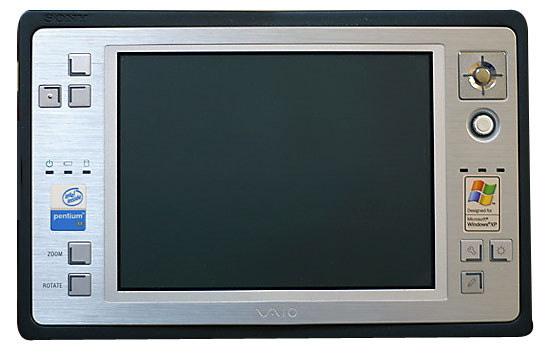

Sony Vaio U-71 @ Dave's iPAQ
Sony Vaio U-71 @ Dave's iPAQ: "any of you are probably wondering how I got my hands on an ultra portable computer that is only available in Japan? Well a company named Dynamism specializes in importing ultra-cool Japanese portable computers and shipping them to eager enthusiasts around the world. We are also lucky enough to be an affiliate through Mobile Planet to offer these great ultra portable computers to you directly. After reading this review you will know why I want to keep this small pda like computer. The device I received was the Sony U-71 sporting a 1.2 GHz Pentium M processor with 512MB of memory and a 30 gig hard drive, 802.11b/g Wireless LAN, CF Card Slot; Memory and the traditional Sony Memory Stick slot! Users should note the U-71 does not come with any sort of optical drive since they consider them option accessories.
Experience
The U-71 is designed to be operated for the mobile user on the go. The pointing stick is on the right hand side of the screen, and the mouse buttons are on the left. The left mouse click key has a small notch, so your fingers identify immediately. Of course, you can also use a stylus (not included) or finger on the touch-sensitive screen to navigate--a fantastically fast and efficient method which I used most of the time. I did notice the fin-like stylus is much more comfortable than the regular stick-stylus. Text input can be through the external, foldable USB keyboard which is included. The keyboard folds up to a sleek profile, and can be connected directly to the Vaio or through the included port replicator. An eraser-type pointer and mouse buttons are integrated into the keyboard. Or, you could write directly onto the screen, via Sony's handwriting recognition software. There is also a software-based on-screen keyboard but I did have some issues using the bundled software so I downloaded a new beta software by NostramU Board which made the keyboard more of an onscreen thumb keyboard which makes th"
Experience
The U-71 is designed to be operated for the mobile user on the go. The pointing stick is on the right hand side of the screen, and the mouse buttons are on the left. The left mouse click key has a small notch, so your fingers identify immediately. Of course, you can also use a stylus (not included) or finger on the touch-sensitive screen to navigate--a fantastically fast and efficient method which I used most of the time. I did notice the fin-like stylus is much more comfortable than the regular stick-stylus. Text input can be through the external, foldable USB keyboard which is included. The keyboard folds up to a sleek profile, and can be connected directly to the Vaio or through the included port replicator. An eraser-type pointer and mouse buttons are integrated into the keyboard. Or, you could write directly onto the screen, via Sony's handwriting recognition software. There is also a software-based on-screen keyboard but I did have some issues using the bundled software so I downloaded a new beta software by NostramU Board which made the keyboard more of an onscreen thumb keyboard which makes th"
MobilePlanet acquired by eXpansys Group for $3.75 million in cash transaction. @ Dave's iPAQ
MobilePlanet acquired by eXpansys Group for $3.75 million in cash transaction. @ Dave's iPAQ: MobilePlanet acquired by eXpansys Group for $3.75 million in cash transaction.
By David Ciccone, posted 10 hours ago
Reader Comments: 2
Pageviews: 1,162
Chatsworth, California. -- April. 4, 2005 - The UK based eXpansys Group today announced that they have acquired MobilePlanet Inc., the leading US multi-channel reseller of mobile computing and wireless products. MobilePlanet posted revenues of USD $21 million in 2004.
The Acquisition will help to secure the groups position as the premier specialist online retailer of mobile devices in the world with a forecast turnover of $200 Million for the next financial year.
MobilePlanet will continue operations under its own brand name and as a separate company taking advantage of Expansys' warehousing, logistics and software development facilities, the company plans to maintain all existing customer, supplier and partner relationships and will actively seek new partners of all kinds for the combined business over the coming months.
Roger Butterworth CEO of eXpansys Group said " We are delighted to be completing this deal to bring together the two largest players in the online market for mobile devices in the USA, we are looking forward to bringing the best of MobilePlanet and eXpansys to all of our customers worldwide " eXpansys Holdings Ltd, a company based in Manchester, England is the leading worldwide specialist distributor of mobile technology which owns eXpansys and Portable Add-Ons. With operations in the U.K., U.S., Europe and Asia the companies serve customers in over 140 different countries. By expanding its position in the U.S. market, this acquisition is a major step in the international development of the business.
The U.K. group plans to use the MobilePlanet brand name in the U.S. and other key markets to accommodate this the group holding company, eXpansys holdings Ltd will be re-named as Mobile and Wireless Group Ltd (M&WG), eXpansys and Mobile Planet will continue to trade separately. CONTACTS
Media: Roger Buterworth +44 7973 629916
Websites: www.mobileplanet.com www.expansys.com
By David Ciccone, posted 10 hours ago
Reader Comments: 2
Pageviews: 1,162
Chatsworth, California. -- April. 4, 2005 - The UK based eXpansys Group today announced that they have acquired MobilePlanet Inc., the leading US multi-channel reseller of mobile computing and wireless products. MobilePlanet posted revenues of USD $21 million in 2004.
The Acquisition will help to secure the groups position as the premier specialist online retailer of mobile devices in the world with a forecast turnover of $200 Million for the next financial year.
MobilePlanet will continue operations under its own brand name and as a separate company taking advantage of Expansys' warehousing, logistics and software development facilities, the company plans to maintain all existing customer, supplier and partner relationships and will actively seek new partners of all kinds for the combined business over the coming months.
Roger Butterworth CEO of eXpansys Group said " We are delighted to be completing this deal to bring together the two largest players in the online market for mobile devices in the USA, we are looking forward to bringing the best of MobilePlanet and eXpansys to all of our customers worldwide " eXpansys Holdings Ltd, a company based in Manchester, England is the leading worldwide specialist distributor of mobile technology which owns eXpansys and Portable Add-Ons. With operations in the U.K., U.S., Europe and Asia the companies serve customers in over 140 different countries. By expanding its position in the U.S. market, this acquisition is a major step in the international development of the business.
The U.K. group plans to use the MobilePlanet brand name in the U.S. and other key markets to accommodate this the group holding company, eXpansys holdings Ltd will be re-named as Mobile and Wireless Group Ltd (M&WG), eXpansys and Mobile Planet will continue to trade separately. CONTACTS
Media: Roger Buterworth +44 7973 629916
Websites: www.mobileplanet.com www.expansys.com
Thursday, April 21, 2005
Tuesday, April 19, 2005

Pocket PC Thoughts - Daily News, Views, Rants and Raves
Pocket PC Thoughts - Daily News, Views, Rants and Raves: "Monday, April 18, 2005
THE COMPETITION What Do You Prefer -- A Mini-Tablet or a Pocket PC?
Posted by Janak Parekh @ 09:00 AM
Akihabara News reported on a new 'handheld-sized' prototype Tablet PC with integrated thumbboard being unveiled at IDF Japan last week. Dubbed 'Ruby', it weighs in at 450g (15.8oz), uses a Pentium M 600MHz, and has an electrostatic (non-touch-sensitive) digitizer.
"
THE COMPETITION What Do You Prefer -- A Mini-Tablet or a Pocket PC?
Posted by Janak Parekh @ 09:00 AM
Akihabara News reported on a new 'handheld-sized' prototype Tablet PC with integrated thumbboard being unveiled at IDF Japan last week. Dubbed 'Ruby', it weighs in at 450g (15.8oz), uses a Pentium M 600MHz, and has an electrostatic (non-touch-sensitive) digitizer.
"
PocketBreeze 4.3 - New Release @ Dave's iPAQ
PocketBreeze 4.3 - New Release @ Dave's iPAQ: "PocketBreeze 4.3 - New Release
By Jack, posted 20 hours ago
Reader Comments: 0
Pageviews: 260
PocketBreeze new major version is out! with version 4.3 you will find lots of new features and improvements making PocketBreeze the most powerful Today screen plug-in.
Three of the major improvements you will find with PocketBreeze 4.3:
The Custom Tab - Using the new and exciting Custom Tab feature you can include any other Today screen plug-in inside PocketBreeze as a new PocketBreeze tab! This gives you the most efficient solution for managing your Today screen real estate.
The Dynamic Tab Loadin technology - With the new Dynamic Tab Loading PocketBreeze tabs can be loaded dynamically only when you access them, offering the best memory usage solution for Today screen plugins. The Custom Tab feature is also loaded using the Dynamic Tab Loading technology.
Brand new VGA look - The new version offers a complete re-do for VGA users with a new and fresh look! We also had many new VGA and QVGA skins added to our skins page. We invite you to visit our QVGA skins page and VGA skins page.
By Jack, posted 20 hours ago
Reader Comments: 0
Pageviews: 260
PocketBreeze new major version is out! with version 4.3 you will find lots of new features and improvements making PocketBreeze the most powerful Today screen plug-in.
Three of the major improvements you will find with PocketBreeze 4.3:
The Custom Tab - Using the new and exciting Custom Tab feature you can include any other Today screen plug-in inside PocketBreeze as a new PocketBreeze tab! This gives you the most efficient solution for managing your Today screen real estate.
The Dynamic Tab Loadin technology - With the new Dynamic Tab Loading PocketBreeze tabs can be loaded dynamically only when you access them, offering the best memory usage solution for Today screen plugins. The Custom Tab feature is also loaded using the Dynamic Tab Loading technology.
Brand new VGA look - The new version offers a complete re-do for VGA users with a new and fresh look! We also had many new VGA and QVGA skins added to our skins page. We invite you to visit our QVGA skins page and VGA skins page.
"My Favorite Utilities" :: April 2005
"My Favorite Utilities" :: April 2005: " April 2005
'My Favorite Utilities'
From the Judges of the Pocket PC magazine Best Software Awards 2004
This past year, over 80 experts judged 543 Pocket PC and Smartphone nominations for Pocket PC magazine Best Software Awards 2004. Our judges had plenty to say about their favorite products. In this issue we are publishing their comments about the programs nominated for the Utilities software category. The purpose of publishing the comments is to give insights into a variety of products-not to show how the judges voted. The winners and finalists can be found on our Web site (http://www.pocketpcmag.com/a.... For the sake of brevity, we've included only one comment per product and edited them for clarity and brevity."
'My Favorite Utilities'
From the Judges of the Pocket PC magazine Best Software Awards 2004
This past year, over 80 experts judged 543 Pocket PC and Smartphone nominations for Pocket PC magazine Best Software Awards 2004. Our judges had plenty to say about their favorite products. In this issue we are publishing their comments about the programs nominated for the Utilities software category. The purpose of publishing the comments is to give insights into a variety of products-not to show how the judges voted. The winners and finalists can be found on our Web site (http://www.pocketpcmag.com/a.... For the sake of brevity, we've included only one comment per product and edited them for clarity and brevity."
IBM ThinkPad T43 Intro - IBM ThinkPad T43 review - Notebooks - CNET Reviews
IBM ThinkPad T43 Intro - IBM ThinkPad T43 review - Notebooks - CNET Reviews: "The latest iteration of IBM's corporate thin-and-light, the ThinkPad T43, features the same sturdy case as that of the previous model, the ThinkPad T42--a CNET Editors' Choice. The T43 also features some new components, including Intel's latest-generation Centrino chipset. Unfortunately, the new parts don't contribute any significant performance gains, and in fact, they seem to detract from the system's battery life. As a result, we think the ThinkPad T42 remains the better buy.
Our ThinkPad T43 test model measured 12.2 inches wide, 10 inches deep, and just 1 inch thick. At 5.5 pounds, the ThinkPad T43 is of average weight for the thin-and-light category. The blackboard eraser-size AC adapter adds another 0.8 pound to its overall travel weight.
It's far from the sexiest laptop on the market, but the ThinkPad T43 is well designed, and it has a number of thoughtful touches, such as a spill-proof keyboard with drain holes. The notebook includes IBM's signature red eraser-head pointing stick, which has a nice, flat top that supports your finger better than the rounded tops on most pointing sticks; two corresponding mouse buttons and a handy scroll button sit just below the keyboard. Below its keyboard, the ThinkPad T43 also features a touch pad with its own two mouse buttons, which are a bit too small. The keyboard itself is wide and comfortable to use. Though there aren't many multimedia controls here--this is a business laptop, after all--you do get external volume controls, including a mute button, as well as a blue IBM button that brings up support information. Our ThinkPad T43 test unit featured a fingerprint sensor on the right-hand side of the wrist rest; swiping your finger over the sensor logs you onto the notebook in lieu of typing in a password (for more details about this biometric security feature, check out our review of the ThinkPad T42).
IBM's "
Our ThinkPad T43 test model measured 12.2 inches wide, 10 inches deep, and just 1 inch thick. At 5.5 pounds, the ThinkPad T43 is of average weight for the thin-and-light category. The blackboard eraser-size AC adapter adds another 0.8 pound to its overall travel weight.
It's far from the sexiest laptop on the market, but the ThinkPad T43 is well designed, and it has a number of thoughtful touches, such as a spill-proof keyboard with drain holes. The notebook includes IBM's signature red eraser-head pointing stick, which has a nice, flat top that supports your finger better than the rounded tops on most pointing sticks; two corresponding mouse buttons and a handy scroll button sit just below the keyboard. Below its keyboard, the ThinkPad T43 also features a touch pad with its own two mouse buttons, which are a bit too small. The keyboard itself is wide and comfortable to use. Though there aren't many multimedia controls here--this is a business laptop, after all--you do get external volume controls, including a mute button, as well as a blue IBM button that brings up support information. Our ThinkPad T43 test unit featured a fingerprint sensor on the right-hand side of the wrist rest; swiping your finger over the sensor logs you onto the notebook in lieu of typing in a password (for more details about this biometric security feature, check out our review of the ThinkPad T42).
IBM's "
msmobiles.com - Windows Mobile podcasts - meet new, massive, grassroots movement !
msmobiles.com - Windows Mobile podcasts - meet new, massive, grassroots movement !: "Windows Mobile podcasts - meet new, massive, grassroots movement !
April 19, 2005 [General]
Some issues can't just be swept neatly under the carpet. Some trends can't be ignored because later on it will be too difficult to catch up with competition. Meet podcasting - the next, after blogging, Internet revolution in progress!
Make no mistake: Podcasting is not just a technical solution to deliver audio content automatically to mobile devices (so that existing audio content can be exposed as podcast feeds):
"
April 19, 2005 [General]
Some issues can't just be swept neatly under the carpet. Some trends can't be ignored because later on it will be too difficult to catch up with competition. Meet podcasting - the next, after blogging, Internet revolution in progress!
Make no mistake: Podcasting is not just a technical solution to deliver audio content automatically to mobile devices (so that existing audio content can be exposed as podcast feeds):
"
Monday, April 18, 2005
Pocket PC Thoughts - Daily News, Views, Rants and Raves
Pocket PC Thoughts - Daily News, Views, Rants and Raves: "SBSH PocketBreeze 4.3 Released
Posted by Darius Wey @ 03:30 AM
'PocketBreeze - a Today screen plug-in for Pocket PC devices allowing you to view appointments, tasks, and email accounts status directly on your Today screen. Giving you a more intuitive interface to manage your daily agenda with up to 30 days agenda display, appointments and tasks in a joint display, advance tasks management and your contacts' birthdays and anniversaries. PocketBreeze integrates seamlessly with Agenda Fusion, Pocket Informant, and the default PIM. PocketBreeze new major version is out! with version 4.3 you will find lots of new features and improvements making PocketBreeze the most powerful Today screen plug-in.'"
Posted by Darius Wey @ 03:30 AM
'PocketBreeze - a Today screen plug-in for Pocket PC devices allowing you to view appointments, tasks, and email accounts status directly on your Today screen. Giving you a more intuitive interface to manage your daily agenda with up to 30 days agenda display, appointments and tasks in a joint display, advance tasks management and your contacts' birthdays and anniversaries. PocketBreeze integrates seamlessly with Agenda Fusion, Pocket Informant, and the default PIM. PocketBreeze new major version is out! with version 4.3 you will find lots of new features and improvements making PocketBreeze the most powerful Today screen plug-in.'"
The New York Times > Technology > When the Blogger Blogs, Can the Employer Intervene?
The New York Times > Technology > When the Blogger Blogs, Can the Employer Intervene?: "April 18, 2005
April 18, 2005
When the Blogger Blogs, Can the Employer Intervene?
By TOM ZELLER Jr.
There are about 10 million blogs out there, give or take, including one belonging to Niall Kennedy, an employee at Technorati, a small San Francisco-based company that, yes, tracks blogs.
Like many employees at many companies, Mr. Kennedy has opinions, even when he is not working. One evening last month, he channeled one of those off-duty opinions into a satiric bit of artwork - an appropriation of a "loose lips sink ships" World War II-era propaganda poster altered to provide a harsh comment on the growing fears among corporations over the blogging activities of their employees. He then posted it on his personal Web log.
But in a paradoxical turn, Mr. Kennedy's employer, having received some complaints about the artwork, stepped in and asked him to reconsider the posting and Mr. Kennedy complied, taking the image down.
"The past day has been a huge wake-up call," Mr. Kennedy wrote soon afterward. "I see now that the voice of a company is not limited to top-level executives, vice presidents and public relations officers."
As the practice of blogging has spread, employees like Mr. Kennedy are coming to the realization that corporations, which spend millions of dollars protecting their brands, are under no particular obligation to tolerate threats, real or perceived, from the activities of people who become identified with those brands, even if it is on their personal Web sites.
They are also learning that the law offers no special protections for blogging - certainly no more than for any other off-duty activity.
As Annalee Newitz, a policy analyst with the Electronic Frontier Foundation, a digital rights advocacy group in Washington, put it, "What we found is there really is quite a bit of diversity in how employers are responding to blogging."
A rising tide of employees have recently been reprimanded or let go for running afoul of their employers' taste or temperament on personal blogs, including a flight attendant for Delta Air Lines who learned the hard way that the carrier frowns on cheeky photos while in uniform and a Google employee who mused on the company's financial condition and was fired.
Some interpreted these actions as meaning that even in their living rooms, even in their private basement computer caves, employees are required to be at least a little bit worried about losing their jobs if they write or post the wrong thing on their personal Web logs.
"I would have expected that some of the louder, more strident voices on the Internet would have risen up in a frenzy over this," said Stowe Boyd, the president of Corante, a daily online news digest on the technology sector. "But that didn't happen."
In Mr. Boyd's opinion, everything about what Mr. Kennedy did was protected speech. The use of trademarks was fair use in a satirical work, Mr. Boyd said, and it seemed unlikely that the company would be somehow liable for the off-duty actions of an employee, as Technorati executives argued. It was, in Mr. Boyd's eyes, an indication that corporate interests were eclipsing individual rights.
"I don't know what else to say," he declared. "I'm astonished."
But Ms. Newitz and others have cautioned that employees must be careful not to confuse freedom of speech with a freedom from consequences that might follow from what they say. Indeed, the vast majority of states are considered "at will" states - meaning that employees can quit, and employers can fire them, at will - without evident reason (barring statutory exceptions like race or religion, where discrimination would have to be proved).
"There really are no laws that protect you," Ms. Newitz said.
Martin H. Malin, a professor of law and director of the Institute for Law and the Workplace at the Chicago-Kent College of Law, said there were only a few exceptions.
"It depends on what the blog is," he said, "what the content is, and whether there's any contractual protection for the employee."
Those who work for the United States Postal Service, for instance, or a local sanitation department may have some special blogging privileges. That is because, depending on the circumstances, the online speech of public employees can be considered "of public concern," and enjoys a measure of protection, Professor Malin explained.
Employees protected under some union contracts may also be shielded from summary dismissal for off-duty activities, at least without some sort of arbitration. "Lifestyle law" trends of the late 1980's and early 90's - sometimes driven by tobacco and alcohol lobbies - created state laws that protected employees from being fired for engaging in legal, off-duty activities, though no one is likely to be fired simply for blogging, but rather for violating some policy or practice in a blog.
And bloggers who are neither supervisors nor managers and who can demonstrate that they are communicating with other workers about "wages, hours or working conditions" may warrant some protection under the National Labor Relations Act, Professor Malin said - even in nonunion enterprises.
None of this, of course, answers the question of where the status of employee ends and that of private citizen begins.
Some companies, like Sun Microsystems, have wrapped both arms around blogging. Sun provides space for employees to blog (blogs.sun.com), and while their darker impulses are presumably kept at bay by the arrangement, there are hundreds of freewheeling and largely unmonitored diaries supported by the company.
Microsoft, too, has benefited from the organic growth of online journaling by celebrity geeks now in its employ, like Robert Scoble, whose frank and uncensored musings about the company have developed a loyal following and given Microsoft some street credibility.
But other companies are seeing a need for formalized blogging policies.
Mark Jen, who was fired from Google in January after just two weeks, having made some ill-advised comments about the company on his blog (Google would not comment on Mr. Jen's dismissal, but confirmed that he no longer works for it), is now busy helping to draft a blogging policy for his new employer, Plaxo, an electronic address book updating service in Mountain View, Calif.
"It was a very quick education for me at Google," Mr. Jen said. "I learned very quickly the complexities of a corporate environment."
With Plaxo's blessing, Mr. Jen is soliciting public comment on the new blogging policy at blog.plaxoed.com.
Most of the points are the kinds of common-sense items that employees would do well to remember, particularly if they plan on identifying themselves as employees in their blogs, or discussing office matters online: don't post material that is obscene, defamatory, profane or libelous, and make sure that you indicate that the opinions expressed are your own.
The policy also encourages employee bloggers to use their real names, rather than attempting anonymity or writing under a pseudonym.
Bad idea, according to the Electronic Frontier Foundation.
Two weeks ago, the group published a tutorial on "how to blog safely," which included tips on avoiding getting fired. Chief among its recommendations: Blog anonymously.
"Basically, we just want to caution people about how easy it is to find them online," Ms. Newitz said, "and that they are not just talking to their friends on their blogs. They're talking to everyone."
But does that means that Mr. Kennedy, a short-timer, a product manager and by no means an executive at Technorati, carries the burden of representing the company into his personal blog?
Technorati's vice president for engineering, Adam Hertz, responded: "It would be antithetical to our corporate values to force Niall to do anything in his blog. It's his blog."
Yet with the spread of the Internet and of blogging, Mr. Hertz said, it would be foolish for companies to not spend some time discussing the art of public communications with their employees, and even train and prepare lower-level staff for these kinds of public relations situations.
That said, Mr. Hertz stressed that the company had no interest in formalizing any complicated policies regarding an employee's activities outside the office.
"I had a high school teacher," he recalled, "who used to say 'I have only two rules: Don't roller-skate in the hallway and don't be a damn fool.' We really value a company where people can think for themselves."
April 18, 2005
When the Blogger Blogs, Can the Employer Intervene?
By TOM ZELLER Jr.
There are about 10 million blogs out there, give or take, including one belonging to Niall Kennedy, an employee at Technorati, a small San Francisco-based company that, yes, tracks blogs.
Like many employees at many companies, Mr. Kennedy has opinions, even when he is not working. One evening last month, he channeled one of those off-duty opinions into a satiric bit of artwork - an appropriation of a "loose lips sink ships" World War II-era propaganda poster altered to provide a harsh comment on the growing fears among corporations over the blogging activities of their employees. He then posted it on his personal Web log.
But in a paradoxical turn, Mr. Kennedy's employer, having received some complaints about the artwork, stepped in and asked him to reconsider the posting and Mr. Kennedy complied, taking the image down.
"The past day has been a huge wake-up call," Mr. Kennedy wrote soon afterward. "I see now that the voice of a company is not limited to top-level executives, vice presidents and public relations officers."
As the practice of blogging has spread, employees like Mr. Kennedy are coming to the realization that corporations, which spend millions of dollars protecting their brands, are under no particular obligation to tolerate threats, real or perceived, from the activities of people who become identified with those brands, even if it is on their personal Web sites.
They are also learning that the law offers no special protections for blogging - certainly no more than for any other off-duty activity.
As Annalee Newitz, a policy analyst with the Electronic Frontier Foundation, a digital rights advocacy group in Washington, put it, "What we found is there really is quite a bit of diversity in how employers are responding to blogging."
A rising tide of employees have recently been reprimanded or let go for running afoul of their employers' taste or temperament on personal blogs, including a flight attendant for Delta Air Lines who learned the hard way that the carrier frowns on cheeky photos while in uniform and a Google employee who mused on the company's financial condition and was fired.
Some interpreted these actions as meaning that even in their living rooms, even in their private basement computer caves, employees are required to be at least a little bit worried about losing their jobs if they write or post the wrong thing on their personal Web logs.
"I would have expected that some of the louder, more strident voices on the Internet would have risen up in a frenzy over this," said Stowe Boyd, the president of Corante, a daily online news digest on the technology sector. "But that didn't happen."
In Mr. Boyd's opinion, everything about what Mr. Kennedy did was protected speech. The use of trademarks was fair use in a satirical work, Mr. Boyd said, and it seemed unlikely that the company would be somehow liable for the off-duty actions of an employee, as Technorati executives argued. It was, in Mr. Boyd's eyes, an indication that corporate interests were eclipsing individual rights.
"I don't know what else to say," he declared. "I'm astonished."
But Ms. Newitz and others have cautioned that employees must be careful not to confuse freedom of speech with a freedom from consequences that might follow from what they say. Indeed, the vast majority of states are considered "at will" states - meaning that employees can quit, and employers can fire them, at will - without evident reason (barring statutory exceptions like race or religion, where discrimination would have to be proved).
"There really are no laws that protect you," Ms. Newitz said.
Martin H. Malin, a professor of law and director of the Institute for Law and the Workplace at the Chicago-Kent College of Law, said there were only a few exceptions.
"It depends on what the blog is," he said, "what the content is, and whether there's any contractual protection for the employee."
Those who work for the United States Postal Service, for instance, or a local sanitation department may have some special blogging privileges. That is because, depending on the circumstances, the online speech of public employees can be considered "of public concern," and enjoys a measure of protection, Professor Malin explained.
Employees protected under some union contracts may also be shielded from summary dismissal for off-duty activities, at least without some sort of arbitration. "Lifestyle law" trends of the late 1980's and early 90's - sometimes driven by tobacco and alcohol lobbies - created state laws that protected employees from being fired for engaging in legal, off-duty activities, though no one is likely to be fired simply for blogging, but rather for violating some policy or practice in a blog.
And bloggers who are neither supervisors nor managers and who can demonstrate that they are communicating with other workers about "wages, hours or working conditions" may warrant some protection under the National Labor Relations Act, Professor Malin said - even in nonunion enterprises.
None of this, of course, answers the question of where the status of employee ends and that of private citizen begins.
Some companies, like Sun Microsystems, have wrapped both arms around blogging. Sun provides space for employees to blog (blogs.sun.com), and while their darker impulses are presumably kept at bay by the arrangement, there are hundreds of freewheeling and largely unmonitored diaries supported by the company.
Microsoft, too, has benefited from the organic growth of online journaling by celebrity geeks now in its employ, like Robert Scoble, whose frank and uncensored musings about the company have developed a loyal following and given Microsoft some street credibility.
But other companies are seeing a need for formalized blogging policies.
Mark Jen, who was fired from Google in January after just two weeks, having made some ill-advised comments about the company on his blog (Google would not comment on Mr. Jen's dismissal, but confirmed that he no longer works for it), is now busy helping to draft a blogging policy for his new employer, Plaxo, an electronic address book updating service in Mountain View, Calif.
"It was a very quick education for me at Google," Mr. Jen said. "I learned very quickly the complexities of a corporate environment."
With Plaxo's blessing, Mr. Jen is soliciting public comment on the new blogging policy at blog.plaxoed.com.
Most of the points are the kinds of common-sense items that employees would do well to remember, particularly if they plan on identifying themselves as employees in their blogs, or discussing office matters online: don't post material that is obscene, defamatory, profane or libelous, and make sure that you indicate that the opinions expressed are your own.
The policy also encourages employee bloggers to use their real names, rather than attempting anonymity or writing under a pseudonym.
Bad idea, according to the Electronic Frontier Foundation.
Two weeks ago, the group published a tutorial on "how to blog safely," which included tips on avoiding getting fired. Chief among its recommendations: Blog anonymously.
"Basically, we just want to caution people about how easy it is to find them online," Ms. Newitz said, "and that they are not just talking to their friends on their blogs. They're talking to everyone."
But does that means that Mr. Kennedy, a short-timer, a product manager and by no means an executive at Technorati, carries the burden of representing the company into his personal blog?
Technorati's vice president for engineering, Adam Hertz, responded: "It would be antithetical to our corporate values to force Niall to do anything in his blog. It's his blog."
Yet with the spread of the Internet and of blogging, Mr. Hertz said, it would be foolish for companies to not spend some time discussing the art of public communications with their employees, and even train and prepare lower-level staff for these kinds of public relations situations.
That said, Mr. Hertz stressed that the company had no interest in formalizing any complicated policies regarding an employee's activities outside the office.
"I had a high school teacher," he recalled, "who used to say 'I have only two rules: Don't roller-skate in the hallway and don't be a damn fool.' We really value a company where people can think for themselves."
The New York Times > Opinion > A New Leader's Thoughts on NASA
The New York Times > Opinion > A New Leader's Thoughts on NASA: "April 18, 2005
April 18, 2005
A New Leader's Thoughts on NASA
The Bush administration's choice to lead the National Aeronautics and Space Administration - Michael Griffin - sailed through the confirmation process last week.
In hearings before the Senate Committee on Commerce, Science and Transportation, only Senator George Allen of Virginia was churlish enough to raise concerns about cuts in the aeronautics budget that could lead to job losses in his home state. The other members seemed intent on whisking Dr. Griffin through as fast as possible so that he could take the helm of the space agency as it prepares to resume shuttle flights. There is little doubt that the agency needs a firm hand at the top as it struggles to rebound from the Columbia tragedy, and Dr. Griffin, who has held a variety of jobs in the aerospace industry, looks eminently qualified.
In his love fest with the senators, Dr. Griffin showed an encouraging independence of mind and a willingness to abandon past NASA decisions that look increasingly myopic. Of immediate importance, he said he would not be bound by the decision of his predecessor, Sean O'Keefe, to abandon as too risky a planned astronaut servicing mission to extend the life of the Hubble Space Telescope, the agency's premier scientific instrument.
Cancellation of the astronaut mission on safety grounds never made much sense. Astronauts have already serviced the telescope several times without incident, and the revamped shuttles should be safer than in the past thanks to upgrades after the Columbia accident.
For the longer term, Dr. Griffin put his finger on a gaping hole in the nation's future space plans that has received little public attention. The aging shuttle fleet is scheduled to be retired in 2010 if not sooner, and the successor, known as the Crew Exploration Vehicle, is not expected to fly before 2014. That leaves a gap of four or more years when the country would have no independent means of sending astronauts aloft. We would be forced to rely on other nations, just as we now rely on Russia to ferry American astronauts to the space station and back. It took the fresh eye of Dr. Griffin to declare it unacceptable that this advanced technological nation, which in past years has developed major new spacecraft in just three to six years, would now dawdle nine years before being ready to launch the new one.
By definition and inclination, Dr. Griffin wholeheartedly supports the president's long-range space exploration plan, which would send astronauts back to the Moon and on to Mars. But he seems to think that NASA has ample funds to pursue more than one mission and calls it crucial to protect the agency's outstanding science programs. The test will come when budgetary choices have to be made.
April 18, 2005
A New Leader's Thoughts on NASA
The Bush administration's choice to lead the National Aeronautics and Space Administration - Michael Griffin - sailed through the confirmation process last week.
In hearings before the Senate Committee on Commerce, Science and Transportation, only Senator George Allen of Virginia was churlish enough to raise concerns about cuts in the aeronautics budget that could lead to job losses in his home state. The other members seemed intent on whisking Dr. Griffin through as fast as possible so that he could take the helm of the space agency as it prepares to resume shuttle flights. There is little doubt that the agency needs a firm hand at the top as it struggles to rebound from the Columbia tragedy, and Dr. Griffin, who has held a variety of jobs in the aerospace industry, looks eminently qualified.
In his love fest with the senators, Dr. Griffin showed an encouraging independence of mind and a willingness to abandon past NASA decisions that look increasingly myopic. Of immediate importance, he said he would not be bound by the decision of his predecessor, Sean O'Keefe, to abandon as too risky a planned astronaut servicing mission to extend the life of the Hubble Space Telescope, the agency's premier scientific instrument.
Cancellation of the astronaut mission on safety grounds never made much sense. Astronauts have already serviced the telescope several times without incident, and the revamped shuttles should be safer than in the past thanks to upgrades after the Columbia accident.
For the longer term, Dr. Griffin put his finger on a gaping hole in the nation's future space plans that has received little public attention. The aging shuttle fleet is scheduled to be retired in 2010 if not sooner, and the successor, known as the Crew Exploration Vehicle, is not expected to fly before 2014. That leaves a gap of four or more years when the country would have no independent means of sending astronauts aloft. We would be forced to rely on other nations, just as we now rely on Russia to ferry American astronauts to the space station and back. It took the fresh eye of Dr. Griffin to declare it unacceptable that this advanced technological nation, which in past years has developed major new spacecraft in just three to six years, would now dawdle nine years before being ready to launch the new one.
By definition and inclination, Dr. Griffin wholeheartedly supports the president's long-range space exploration plan, which would send astronauts back to the Moon and on to Mars. But he seems to think that NASA has ample funds to pursue more than one mission and calls it crucial to protect the agency's outstanding science programs. The test will come when budgetary choices have to be made.
Akihabara News : Your Leading News provider on Gadgets and Hi-Tech stuff from Akihabara in Tokyo Japan and in other Asian Countries
Akihabara News : Your Leading News provider on Gadgets and Hi-Tech stuff from Akihabara in Tokyo Japan and in other Asian Countries: "Hands free" for Skype
Posted by Daimaou on 18-04-2005 07:35
Skype is the VoIP revolution of these past years. It works really really well on PC, Mac, Linux and PocketPC! It's a normal evolution to see devices appear that are designed to use with the software, and Datago's VC-1 PLUS is one of them. The device is available through Synnex in Japan and connects to your PC's USB and Mic-in ports, and it allows you to use Skype without a headset and even as a "conference-call" tool.
The package will cost less than 80 EUR.
Posted by Daimaou on 18-04-2005 07:35
Skype is the VoIP revolution of these past years. It works really really well on PC, Mac, Linux and PocketPC! It's a normal evolution to see devices appear that are designed to use with the software, and Datago's VC-1 PLUS is one of them. The device is available through Synnex in Japan and connects to your PC's USB and Mic-in ports, and it allows you to use Skype without a headset and even as a "conference-call" tool.
The package will cost less than 80 EUR.
Sunday, April 17, 2005
CBS 46 Atlanta - More controversy in Cobb plan to buy student laptops
CBS 46 Atlanta - More controversy in Cobb plan to buy student laptops: Marietta
More controversy in Cobb plan to buy student laptops
Apr 16, 2005, 10:38 PM
MARIETTA, Ga. (AP) -- A much-debated plan by Cobb County educators to spend more than 100 (m)million dollars on student laptops ran into more controversy when a local newspaper revealed that a study on the proposal is being funded by Apple Computer.
The county school board voted last Wednesday to order an evaluation study by the University of Georgia to decide whether the county should spend 100-point-eight million dollars to give laptop computers to every high school student in the suburban county.
Cobb Superintendent Joe Redden pitched the study, but left out one detail: a computer company arranged for U-G-A to conduct the study and not the school district. The Marietta Daily Journal reported the Apple financing in today's editions.
The school board voted four-to-two to start buying laptops in phases. At first, according to the plan, 71 hundred teachers and 87 hundred students at four of Cobb's 14 high schools would get Apple G-four iBooks at an estimated cost of 25 million dollars.
More controversy in Cobb plan to buy student laptops
Apr 16, 2005, 10:38 PM
MARIETTA, Ga. (AP) -- A much-debated plan by Cobb County educators to spend more than 100 (m)million dollars on student laptops ran into more controversy when a local newspaper revealed that a study on the proposal is being funded by Apple Computer.
The county school board voted last Wednesday to order an evaluation study by the University of Georgia to decide whether the county should spend 100-point-eight million dollars to give laptop computers to every high school student in the suburban county.
Cobb Superintendent Joe Redden pitched the study, but left out one detail: a computer company arranged for U-G-A to conduct the study and not the school district. The Marietta Daily Journal reported the Apple financing in today's editions.
The school board voted four-to-two to start buying laptops in phases. At first, according to the plan, 71 hundred teachers and 87 hundred students at four of Cobb's 14 high schools would get Apple G-four iBooks at an estimated cost of 25 million dollars.
Monday, March 28, 2005
The New York Times > Technology > A Supreme Court Showdown for File Sharing
The New York Times > Technology > A Supreme Court Showdown for File Sharing: "The New York Times
March 28, 2005
A Supreme Court Showdown for File Sharing
By SAUL HANSELL and JEFF LEEDS
For someone whose business is under attack in the United States Supreme Court, Mark Gorton was remarkably serene last week, sprawled on a couch in his Manhattan office.
Mr. Gorton's company, the Lime Group, publishes LimeWire, one of the most popular software programs used to trade music, video and other files over the Internet.
Tomorrow, the Supreme Court will hear arguments in a case in which the recording and film industries seek to hold makers of file-sharing software liable for the illegal copying and distribution of copyrighted material online. The case is against other file-sharing services, Grokster and Morpheus, which won in lower courts, but Mr. Gorton said that if those rulings were overturned, it could make LimeWire vulnerable.
"If the Supreme Court says it is illegal to produce this software, LimeWire the company will cease to exist," Mr. Gorton said. "But LimeWire the software will continue to be on the Net no matter what we do in this business."
The case, M.G.M. v. Grokster, is in many ways the culmination of five years of escalating legal, technical and rhetorical attacks against file-sharing systems and their users by the music industry. It is being eagerly followed by a range of media and technology companies because the court may use this case to redefine the reach of copyright in the era of iPods and TiVo.
But no matter how the court rules, both music executives and file-sharing advocates like Mr. Gorton agree that it will probably always be possible for fans to find loads of free music with a few clicks of a mouse.
Still, the case will determine whether file sharing can continue to be promoted by companies like LimeWire and Sharman Networks, which makes Kazaa, that operate in public and earn profits from advertising and software sales, or whether the software will be written and distributed by shadowy players on the fringes of the law.
"I think this court decision is a game changer. It will dramatically affect behavior, and behavior will dramatically affect how music is sold and distributed and consumed," said Andrew Lack, chairman of Sony BMG Music Entertainment, which releases music by stars like Usher and Bruce Springsteen. "It will clarify the law and establish right from wrong."
If the music industry loses, it will likely redouble its efforts to sue individuals trading files and intensify its technical efforts to disrupt the networks. So far, those tactics have been modestly effective at best, and a loss in the Supreme Court may well erode the industry's control of copyrighted material further.
Yet, since the court can do little to alter the spread of technology or the interests of copyright owners to protect their material, many expect something resembling a permanent war.
"We are guerrillas fighting the despotic regime," said Alan Morris, the executive vice president of Sharman Networks, the Australian company behind Kazaa, once the leading file-sharing network and the recording industry's leading target, which is being sued by the music industry in both American and Australian courts. "They have some quite heavy guns, but we can see where they are firing from, " Mr. Morris said.
There are some who say that a court ruling, in any direction, may also help define the terms of a cease-fire. The end of litigation could rekindle the back-channel negotiations between some music labels and some file-sharing services to create ways for users to trade some files free while paying for others.
Some executives have discussed a plan in which users could download free, low-quality tracks with an offer to buy higher-quality versions.
The two biggest music companies, Universal Music Group, a unit of Vivendi Universal, and Sony BMG, for example, recently signed deals to provide music through Snocap, a software package intended to control the swapping of unauthorized songs.
Snocap also happens to be the creation of Shawn Fanning, the founder of Napster, the original file-sharing, or peer-to-peer, service. "Peer-to-peer is the way that people access content," said Mr. Fanning. "There is a void in the marketplace, there are people who are willing to pay for it."
Of course, getting people to pay anything is an enormous challenge. There are about 60 million people using file-sharing services in the United States, with roughly 8.5 million logged on at a time, said Eric Garland, chief of BigChampagne, which studies traffic on file-sharing networks.
While some surveys have suggested that file-sharing activity slowed in 2003, when the Recording Industry Association of America began to sue individual users for trading copyrighted songs, Mr. Garland said that the number of people logging on to file-sharing networks had risen steadily and that he expected the number to increase by 10 percent or more this year.
The music industry, meanwhile, is recovering from a long slump. It sold 814 million CD's, cassettes and units of music in other formats last year in the United States, up 2 percent, its first increase in five years, the recording industry association said. It also sold 140 million digital tracks in the United States, the association said. But the industry says it thinks it would have seen a bigger sales rebound had it not been for online piracy.
The recording industry is exploring ways to release new CD's with technology that will restrict copying. Sony BMG is expected to use such technology on at least half their new recordings in the United States by the end of this year.
Some independent record labels are taking a less confrontational stance and trying to tap into the popularity of file-sharing networks by selling their music on them, often alongside pirated versions of the same songs.
Kazaa has been pursuing that idea for several years through an affiliated company called Altnet, which allows labels to put authorized files of songs on its networks. These files are either offered for sale, or they are free for promotional purposes, often with technology that restricts their use to a certain time period.
Altnet is still small, with revenues of less than $1 million in 2004, but it has been used by some independent labels, including V2, the label of Richard Branson's Virgin Group.
V2 sells songs by its acts like the Stereophonics and Moby through Altnet for 99 cents each because file-sharing networks have eclipsed MTV and radio as the place fans discover new music, said Jeff Wooding, its director of marketing and new media. He said that the move would not stop piracy, but could be used to promote the bands' merchandise and concert tickets as well as earn something for download sales.
"No one's kidding themselves that we expect to convert a whole lot of users," Mr. Wooding said, but he added that he thought many file sharers would buy merchandise and concert tickets from bands they liked and that some might eventually purchase a CD.
Altnet is also experimenting with an advertising-driven format developed by Intent MediaWorks, which buys rights to songs from artists for distribution in a special file format. The first time a user tries to play the song, the file opens a Web page with an advertisement on it. Intent MediaWorks is also working on ways to insert audio commercials into the songs.
"The idea for the advertising model is to transform file-sharing networks into radio," said Lee Jaffe, president of Altnet, which is distributing Intent MediaWorks' files. "But unlike radio where artists and labels don't get paid, they will be able to share the revenue."
Major recording labels, however, have been very resistant to doing deals with Altnet and similar systems, fearing that such alliances might undercut their lawsuits against the file-sharing networks. They have demanded that the networks remove all the unauthorized songs before they do any business with them.
Shawn Fanning's Snocap system is an attempt to help file-sharing networks do just that. It creates a way for copyright owners to register the songs they own. The networks, using a technology called acoustic fingerprinting, can identify whether a file being downloaded is in a copyrighted registry. The copyright owner can choose to block the download, offer the song for sale or offer a limited-use version of the song as substitute.
Snocap, in addition to endorsements from Universal Music and Sony BMG, will also be used by Mashboxx, a new file-sharing service started by Wayne Russo, the former president of Grokster, which is based in Nevis, West Indies.
But it still faces some significant challenges. First, the company has not released a working version of the software, and many file-sharing advocates dismiss the concept as thoroughly unworkable.
"Snocap will fail miserably in the market," said Michael Weiss, chief executive of StreamCast networks, which makes Morpheus.
"If I was looking for a download, and I got some sort of truncated file with a message that says buy this or do that, I don't see why anybody would embrace that," he said. "If you wanted to buy music, you could go to the online stores that are doing a great job like iTunes."
Mr. Russo said that his approach did not need to win over all file-sharing users to make some money for him and the record companies.
"There are 2.5 billion music files traded every month," he said. "If we can capture 1 percent of that, 25 million files, and we convert 5 to 10 percent of those to paid, I am very happy."
Aside from these attempts to reach détente with the free file-sharing networks, the recording industry knows it also needs new products and new avenues for distribution.
It has, for instance, placed a hefty bet on DualDiscs, a new two-sided CD format that features music on one side and video on the other. "We are committed to giving consumers what they want, legitimately and in a way that fairly compensates those that work so hard to create content," said Zach Horowitz, president of Universal Music Group, which releases music by acts like U2 and 3 Doors Down.
"If we win the case," Mr. Horowitz said, "all the efforts we are making to launch compelling legitimate alternatives will gain traction. There will be no turning back the clock in terms of the countless ways we are making our music available to take advantage of the new technologies."
March 28, 2005
A Supreme Court Showdown for File Sharing
By SAUL HANSELL and JEFF LEEDS
For someone whose business is under attack in the United States Supreme Court, Mark Gorton was remarkably serene last week, sprawled on a couch in his Manhattan office.
Mr. Gorton's company, the Lime Group, publishes LimeWire, one of the most popular software programs used to trade music, video and other files over the Internet.
Tomorrow, the Supreme Court will hear arguments in a case in which the recording and film industries seek to hold makers of file-sharing software liable for the illegal copying and distribution of copyrighted material online. The case is against other file-sharing services, Grokster and Morpheus, which won in lower courts, but Mr. Gorton said that if those rulings were overturned, it could make LimeWire vulnerable.
"If the Supreme Court says it is illegal to produce this software, LimeWire the company will cease to exist," Mr. Gorton said. "But LimeWire the software will continue to be on the Net no matter what we do in this business."
The case, M.G.M. v. Grokster, is in many ways the culmination of five years of escalating legal, technical and rhetorical attacks against file-sharing systems and their users by the music industry. It is being eagerly followed by a range of media and technology companies because the court may use this case to redefine the reach of copyright in the era of iPods and TiVo.
But no matter how the court rules, both music executives and file-sharing advocates like Mr. Gorton agree that it will probably always be possible for fans to find loads of free music with a few clicks of a mouse.
Still, the case will determine whether file sharing can continue to be promoted by companies like LimeWire and Sharman Networks, which makes Kazaa, that operate in public and earn profits from advertising and software sales, or whether the software will be written and distributed by shadowy players on the fringes of the law.
"I think this court decision is a game changer. It will dramatically affect behavior, and behavior will dramatically affect how music is sold and distributed and consumed," said Andrew Lack, chairman of Sony BMG Music Entertainment, which releases music by stars like Usher and Bruce Springsteen. "It will clarify the law and establish right from wrong."
If the music industry loses, it will likely redouble its efforts to sue individuals trading files and intensify its technical efforts to disrupt the networks. So far, those tactics have been modestly effective at best, and a loss in the Supreme Court may well erode the industry's control of copyrighted material further.
Yet, since the court can do little to alter the spread of technology or the interests of copyright owners to protect their material, many expect something resembling a permanent war.
"We are guerrillas fighting the despotic regime," said Alan Morris, the executive vice president of Sharman Networks, the Australian company behind Kazaa, once the leading file-sharing network and the recording industry's leading target, which is being sued by the music industry in both American and Australian courts. "They have some quite heavy guns, but we can see where they are firing from, " Mr. Morris said.
There are some who say that a court ruling, in any direction, may also help define the terms of a cease-fire. The end of litigation could rekindle the back-channel negotiations between some music labels and some file-sharing services to create ways for users to trade some files free while paying for others.
Some executives have discussed a plan in which users could download free, low-quality tracks with an offer to buy higher-quality versions.
The two biggest music companies, Universal Music Group, a unit of Vivendi Universal, and Sony BMG, for example, recently signed deals to provide music through Snocap, a software package intended to control the swapping of unauthorized songs.
Snocap also happens to be the creation of Shawn Fanning, the founder of Napster, the original file-sharing, or peer-to-peer, service. "Peer-to-peer is the way that people access content," said Mr. Fanning. "There is a void in the marketplace, there are people who are willing to pay for it."
Of course, getting people to pay anything is an enormous challenge. There are about 60 million people using file-sharing services in the United States, with roughly 8.5 million logged on at a time, said Eric Garland, chief of BigChampagne, which studies traffic on file-sharing networks.
While some surveys have suggested that file-sharing activity slowed in 2003, when the Recording Industry Association of America began to sue individual users for trading copyrighted songs, Mr. Garland said that the number of people logging on to file-sharing networks had risen steadily and that he expected the number to increase by 10 percent or more this year.
The music industry, meanwhile, is recovering from a long slump. It sold 814 million CD's, cassettes and units of music in other formats last year in the United States, up 2 percent, its first increase in five years, the recording industry association said. It also sold 140 million digital tracks in the United States, the association said. But the industry says it thinks it would have seen a bigger sales rebound had it not been for online piracy.
The recording industry is exploring ways to release new CD's with technology that will restrict copying. Sony BMG is expected to use such technology on at least half their new recordings in the United States by the end of this year.
Some independent record labels are taking a less confrontational stance and trying to tap into the popularity of file-sharing networks by selling their music on them, often alongside pirated versions of the same songs.
Kazaa has been pursuing that idea for several years through an affiliated company called Altnet, which allows labels to put authorized files of songs on its networks. These files are either offered for sale, or they are free for promotional purposes, often with technology that restricts their use to a certain time period.
Altnet is still small, with revenues of less than $1 million in 2004, but it has been used by some independent labels, including V2, the label of Richard Branson's Virgin Group.
V2 sells songs by its acts like the Stereophonics and Moby through Altnet for 99 cents each because file-sharing networks have eclipsed MTV and radio as the place fans discover new music, said Jeff Wooding, its director of marketing and new media. He said that the move would not stop piracy, but could be used to promote the bands' merchandise and concert tickets as well as earn something for download sales.
"No one's kidding themselves that we expect to convert a whole lot of users," Mr. Wooding said, but he added that he thought many file sharers would buy merchandise and concert tickets from bands they liked and that some might eventually purchase a CD.
Altnet is also experimenting with an advertising-driven format developed by Intent MediaWorks, which buys rights to songs from artists for distribution in a special file format. The first time a user tries to play the song, the file opens a Web page with an advertisement on it. Intent MediaWorks is also working on ways to insert audio commercials into the songs.
"The idea for the advertising model is to transform file-sharing networks into radio," said Lee Jaffe, president of Altnet, which is distributing Intent MediaWorks' files. "But unlike radio where artists and labels don't get paid, they will be able to share the revenue."
Major recording labels, however, have been very resistant to doing deals with Altnet and similar systems, fearing that such alliances might undercut their lawsuits against the file-sharing networks. They have demanded that the networks remove all the unauthorized songs before they do any business with them.
Shawn Fanning's Snocap system is an attempt to help file-sharing networks do just that. It creates a way for copyright owners to register the songs they own. The networks, using a technology called acoustic fingerprinting, can identify whether a file being downloaded is in a copyrighted registry. The copyright owner can choose to block the download, offer the song for sale or offer a limited-use version of the song as substitute.
Snocap, in addition to endorsements from Universal Music and Sony BMG, will also be used by Mashboxx, a new file-sharing service started by Wayne Russo, the former president of Grokster, which is based in Nevis, West Indies.
But it still faces some significant challenges. First, the company has not released a working version of the software, and many file-sharing advocates dismiss the concept as thoroughly unworkable.
"Snocap will fail miserably in the market," said Michael Weiss, chief executive of StreamCast networks, which makes Morpheus.
"If I was looking for a download, and I got some sort of truncated file with a message that says buy this or do that, I don't see why anybody would embrace that," he said. "If you wanted to buy music, you could go to the online stores that are doing a great job like iTunes."
Mr. Russo said that his approach did not need to win over all file-sharing users to make some money for him and the record companies.
"There are 2.5 billion music files traded every month," he said. "If we can capture 1 percent of that, 25 million files, and we convert 5 to 10 percent of those to paid, I am very happy."
Aside from these attempts to reach détente with the free file-sharing networks, the recording industry knows it also needs new products and new avenues for distribution.
It has, for instance, placed a hefty bet on DualDiscs, a new two-sided CD format that features music on one side and video on the other. "We are committed to giving consumers what they want, legitimately and in a way that fairly compensates those that work so hard to create content," said Zach Horowitz, president of Universal Music Group, which releases music by acts like U2 and 3 Doors Down.
"If we win the case," Mr. Horowitz said, "all the efforts we are making to launch compelling legitimate alternatives will gain traction. There will be no turning back the clock in terms of the countless ways we are making our music available to take advantage of the new technologies."
Thursday, March 10, 2005
The New York Times > Technology > Sale of I.B.M. Unit to China Passes U.S. Security Muster
The New York Times > Technology > Sale of I.B.M. Unit to China Passes U.S. Security Muster
March 10, 2005
The New York Times
March 10, 2005
Sale of I.B.M. Unit to China Passes U.S. Security Muster
By STEVE LOHR
The Bush administration has completed a national security review of the planned sale of I.B.M.'s personal computer business to Lenovo of China, clearing the way for the deal, I.B.M. announced yesterday.
The unusual scrutiny given to the deal mainly reflects the ambivalence in Washington toward China, and its rising economic and military power.
Other Chinese companies are expected to follow Lenovo's example by shopping for acquisitions in the United States. "The lesson from the I.B.M. experience is that the government is going to be difficult on them all," said William A. Reinsch, president of the National Foreign Trade Council and a former trade official in the Clinton administration.
The Committee on Foreign Investments in the United States, a multiagency group, reviews purchases of American businesses by overseas corporations for any impact on national security. The I.B.M. inquiry was a full investigation, which occurs in far fewer than 1 percent of cross-border deals, according to former committee members.
The committee's proceedings are secret, and I.B.M. would not say what steps it took to address the concerns of the group, which includes representatives from the Homeland Security, Defense, Justice, Treasury and Commerce Departments. Two people who have been told of the committee's inquiry said I.B.M. made more in the way of commitments and assurances than concessions, which might restrain its sales or product development.
The steps, they said, included agreeing to separate Lenovo's American employees, mainly in Research Triangle Park in North Carolina, from I.B.M. workers there who work on other products, like larger server computers and software.
The people close to the inquiry said I.B.M. also agreed to ensure that the chips and other parts in desktop PC's and notebooks were stamped with the name of their manufacturer and country of origin. Such labeling is fairly common among PC makers.
Steven M. Ward Jr., an I.B.M. senior vice president who will become chief executive of Lenovo, said he met with more than a dozen senior government officials to explain the sale for $1.75 billion in cash, stock and debt, announced in December. He said the steps I.B.M. took to gain the approval of the committee would not hobble the business.
"I'm delighted with getting this approval," Mr. Ward said. "And we expect to sell Lenovo PC's and ThinkPads to businesses, governments and individuals around the globe."
Some committee members were concerned that the sale to Lenovo, which is partly state-owned, could result in technology with important military uses being passed to the Chinese, but the people close to the inquiry said I.B.M. addressed that in briefings and demonstrations in Washington in mid-February.
I.B.M. engineers and executives, they said, dismantled a desktop PC and a ThinkPad notebook for the committee, identifying where the components were produced and explaining how the machines were assembled. Most I.B.M. PC's are made in China. They contain Intel microprocessors and are assembled with chips and parts made around the world, though mostly in East Asia.
The I.B.M.-Lenovo episode should prompt Congress to review the authority of the investment committee, which dates from the cold war, said Michael R. Wessel, a member of the United States-China Economic and Security Review Commission, a group established by Congress.
Representative Donald A. Manzullo, an Illinois Republican, said yesterday that he planned to push for hearings to see if the committee's role should be expanded to "take more account of economic security as well as military security."
March 10, 2005
The New York Times
March 10, 2005
Sale of I.B.M. Unit to China Passes U.S. Security Muster
By STEVE LOHR
The Bush administration has completed a national security review of the planned sale of I.B.M.'s personal computer business to Lenovo of China, clearing the way for the deal, I.B.M. announced yesterday.
The unusual scrutiny given to the deal mainly reflects the ambivalence in Washington toward China, and its rising economic and military power.
Other Chinese companies are expected to follow Lenovo's example by shopping for acquisitions in the United States. "The lesson from the I.B.M. experience is that the government is going to be difficult on them all," said William A. Reinsch, president of the National Foreign Trade Council and a former trade official in the Clinton administration.
The Committee on Foreign Investments in the United States, a multiagency group, reviews purchases of American businesses by overseas corporations for any impact on national security. The I.B.M. inquiry was a full investigation, which occurs in far fewer than 1 percent of cross-border deals, according to former committee members.
The committee's proceedings are secret, and I.B.M. would not say what steps it took to address the concerns of the group, which includes representatives from the Homeland Security, Defense, Justice, Treasury and Commerce Departments. Two people who have been told of the committee's inquiry said I.B.M. made more in the way of commitments and assurances than concessions, which might restrain its sales or product development.
The steps, they said, included agreeing to separate Lenovo's American employees, mainly in Research Triangle Park in North Carolina, from I.B.M. workers there who work on other products, like larger server computers and software.
The people close to the inquiry said I.B.M. also agreed to ensure that the chips and other parts in desktop PC's and notebooks were stamped with the name of their manufacturer and country of origin. Such labeling is fairly common among PC makers.
Steven M. Ward Jr., an I.B.M. senior vice president who will become chief executive of Lenovo, said he met with more than a dozen senior government officials to explain the sale for $1.75 billion in cash, stock and debt, announced in December. He said the steps I.B.M. took to gain the approval of the committee would not hobble the business.
"I'm delighted with getting this approval," Mr. Ward said. "And we expect to sell Lenovo PC's and ThinkPads to businesses, governments and individuals around the globe."
Some committee members were concerned that the sale to Lenovo, which is partly state-owned, could result in technology with important military uses being passed to the Chinese, but the people close to the inquiry said I.B.M. addressed that in briefings and demonstrations in Washington in mid-February.
I.B.M. engineers and executives, they said, dismantled a desktop PC and a ThinkPad notebook for the committee, identifying where the components were produced and explaining how the machines were assembled. Most I.B.M. PC's are made in China. They contain Intel microprocessors and are assembled with chips and parts made around the world, though mostly in East Asia.
The I.B.M.-Lenovo episode should prompt Congress to review the authority of the investment committee, which dates from the cold war, said Michael R. Wessel, a member of the United States-China Economic and Security Review Commission, a group established by Congress.
Representative Donald A. Manzullo, an Illinois Republican, said yesterday that he planned to push for hearings to see if the committee's role should be expanded to "take more account of economic security as well as military security."
Subscribe to:
Posts (Atom)